
Machine Shop Quoting: Which RFQs to Quote
An RFQ is worth your estimator's time when it clears three hard stops (real capability fit, a margin you can plausibly hit, and a buyer you can verify) and then scores well on volume, documentation, and win probability. Score each RFQ on those six factors before any estimating starts. Quote the strong ones now, ask questions or cap the effort on the middle, and decline or route the rest.
Introduction
It's Monday morning and fourteen RFQs are sitting in the shared inbox. Your estimator has time for maybe six. Which six get the attention?
In most shops the answer is some mix of first-in, first-out, whoever is pushing hardest, and gut feel. The gut is usually right about the obvious ones: the repeat customer with a clean package goes to the top, the part you can't make goes to the bottom. The middle is where hours disappear. The twelve-piece stainless job from a buyer you've never heard of, with a drawing missing two views. The five-thousand-piece annual program that might be real. Each one looks quotable, and each takes hours to prove otherwise.
The hours aren't the only cost. Every hour spent on a long shot is an hour a good RFQ waits, and buyers who send work to several shops often favor the one that comes back first with confidence. Deciding what not to quote is part of quoting well.
Every Quote Has a Cost, Whether or Not You Count It
A quote is an investment with an expected return. The return is the margin you would earn if you win, multiplied by your odds of winning. The cost is estimating time, including the clarifying emails nobody logs. When the first number beats the second, quote. When it doesn't, you are paying to lose.
Here is how that looks with illustrative numbers. Swap in your own margins, hit rates, and loaded estimator rate.
RFQ | Margin if won | Win odds | Estimating cost | Expected value |
Repeat customer, complete package, 250 aluminum brackets | $2,400 | 50% | $90 (1 hr) | +$1,110 |
New buyer, partial drawing, sent to many shops, 40 stainless parts | $1,800 | 8% | $360 (4 hrs) | -$216 |
Known buyer, complete files, price-shopped across ten shops, 12 parts | $600 | 15% | $135 (1.5 hrs) | -$45 |
The middle row pays three times what the last row does if it hits, yet it is the worse bet: a partial drawing and a crowded field make it costly to quote and unlikely to win. Strategic value can override the math, such as a first order from a customer you want or a hole in the schedule. Make that a decision you write down, not a default.
The Six-Factor Scorecard
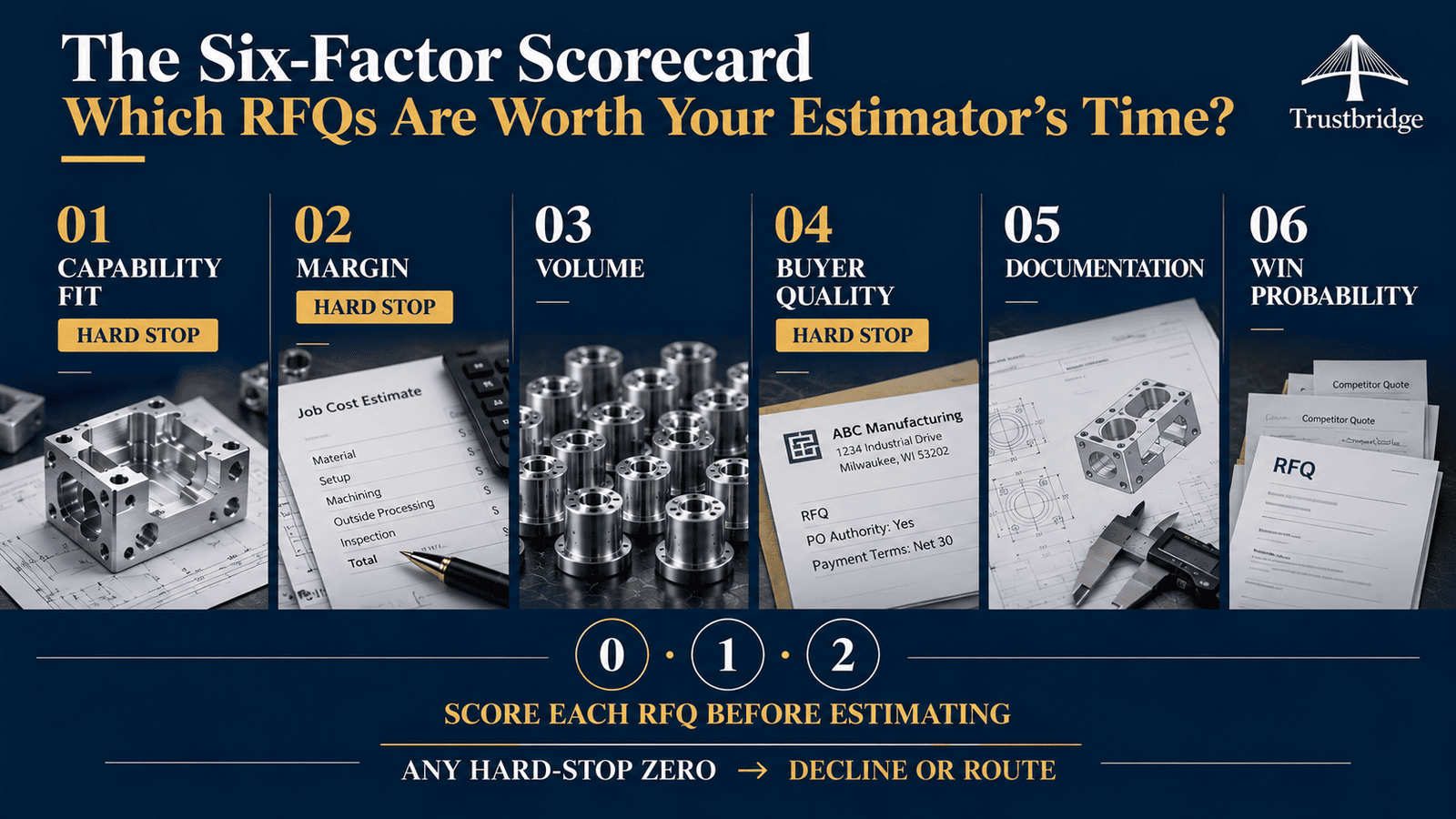
Score each RFQ 0, 1, or 2 on six factors. It takes about five minutes and needs no pricing. Three factors are hard stops: a zero on any of them ends the decision, whatever the total.
1. Capability Fit (Hard Stop)
Ask whether you can make it well, not just whether you can make it. Nominal fit means a machine can technically do the job. Real fit means the tolerances sit inside what your equipment and inspection can hold, you run the material regularly, you hold any certification the RFQ requires, you can hit the delivery date without bumping paying work, and the part won't need an outside process you've never managed. Score 2 if it's squarely in your wheelhouse, 1 if it's doable but a stretch you'll have to price, 0 if it's outside your capability. A zero gets routed, not quoted.
2. Margin (Hard Stop)
You don't need a finished price to score margin. You need to know whether a price this buyer would plausibly accept clears your minimum. Watch for outside processing that inflates the price without adding profit, and for setup that can't be spread across the quantity. The cost mechanics behind a job's profitability are worth revisiting here. Score 2 if it's comfortably above your floor, 1 if it's near it, 0 if no realistic price gets you there.
3. Volume
Score the quantity and whether it's real. A quantity that suits your equipment, backed by a release schedule or a credible repeat pattern, is worth more than the same number marked “volume TBD.” Ask for annual usage and release cadence before you invest. Score 2 for a stated quantity or schedule that fits your shop, 1 for plausible but unconfirmed, 0 for a one-off outside your economics or a volume claim you can't verify.
4. Buyer Quality (Hard Stop)
A quote only pays if the buyer can pay and will treat you fairly. Check that the company is real and reachable, whether it has a record of paying on terms, how quickly it answered your first question, and whether it knows what it's asking for. Verify before you spend more than an hour; funded demand and a verified buyer matter most. Score 2 for known or verified, 1 for unknown but plausible, 0 for unverifiable or a history of non-payment or scope creep.
5. Documentation
Count what's missing and what it would cost to get. A complete package has a model and drawing, tolerances, material grade, finish, quantity, and any inspection or certification requirements. Every gap becomes a clarifying email or an assumption you'll price as risk, which is what an incomplete RFQ costs in quote time. Score 2 for complete, 1 for gaps one email can close, 0 for anything that needs reverse engineering or repeated rounds. Set a time cap before you start. If closing the gaps would blow it, the buyer should do that work first.
6. Win Probability
This is the hardest factor to score and the most valuable. Odds rise with a direct invitation instead of a blast, an existing relationship or referral, a reason you'd beat the field besides price, and a buyer who cares more about lead time or quality than the lowest number. They fall with many shops invited, an incumbent supplier, or a deadline that leaves no time to respond well. Score 2 if you can name why you'd win, 1 for a fair shot, 0 if the best reason is “we might be cheap enough.” If you don't log hit rate by customer type and source, start now.
How to Turn the Score Into a Decision
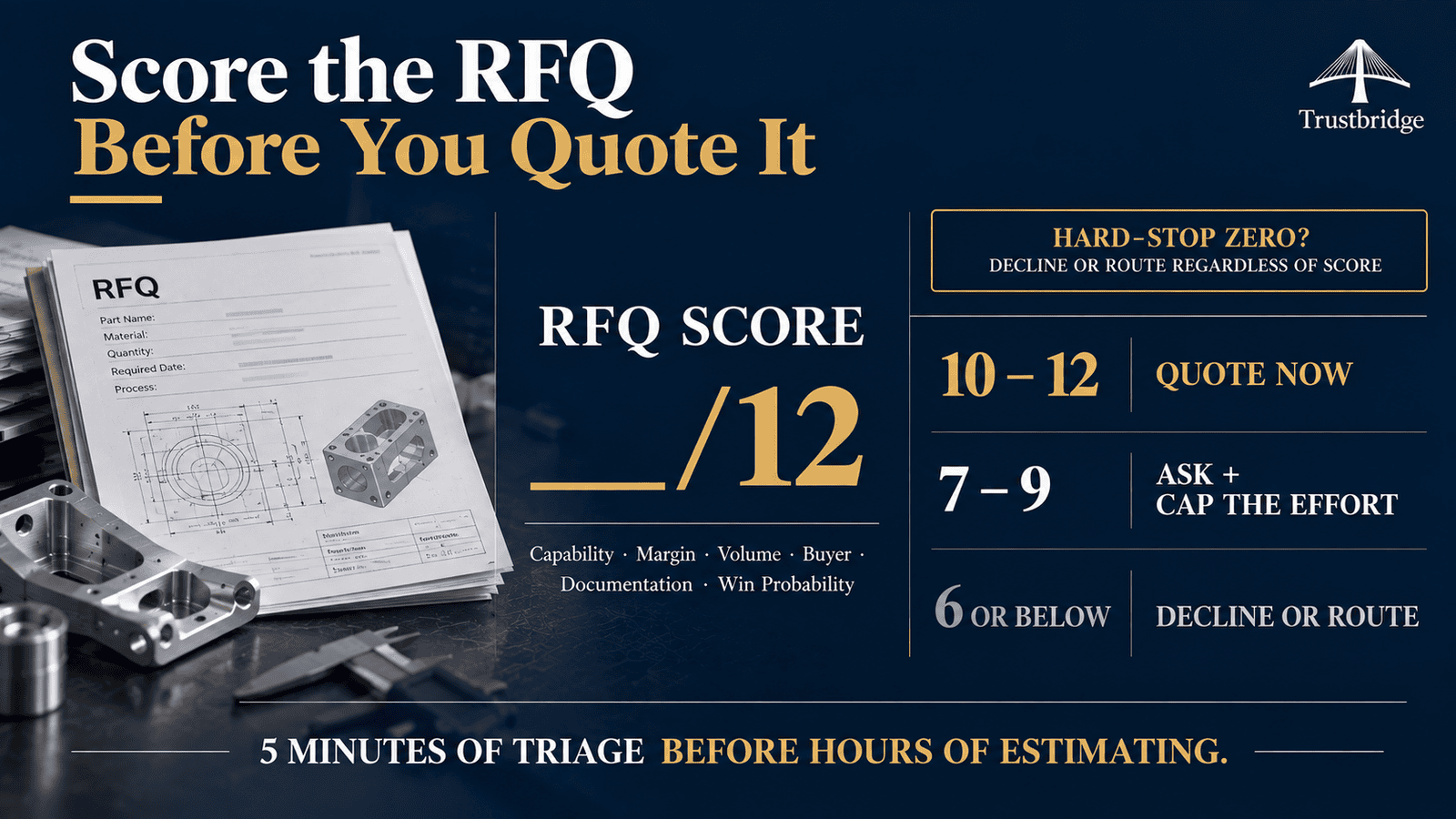
Add the six scores for a total out of twelve, then apply these rules:
Any hard-stop zero: decline or route, whatever the total.
10 to 12: quote now, ahead of anything scoring lower.
7 to 9: quote conditionally. Send clarifying questions first, set an estimating time cap, and hold the estimate until they're answered.
6 or below: decline politely or route.Treat the thresholds as a starting point. After a month or two, compare scores with outcomes and move the lines to fit your shop.
What the Buyer Sees When You Say No (or Say Nothing)
From the buyer's side, an RFQ sent to several shops produces a few responses and a lot of silence. Silence is the most expensive answer. The buyer can't tell whether you're busy, uninterested, or never saw it, so they chase you or stop sending you work.
A fast, specific no is easier to use: “We don't hold that tolerance on our equipment; a shop with a CMM and grinding capability will fit better.” It tells the buyer where to go and shows you know your own limits. Routing goes a step further. If you know a shop that fits, say so. Buyers tend to remember who sent them somewhere useful, and a no that saves them a week is often the start of the next RFQ that does fit.
Before the Next RFQ Gets Assigned
Put the scorecard at the front of the estimating queue, not the back. Whoever opens the RFQ, whether owner, salesperson, or estimator, scores it in five minutes, logs the score, and later logs the outcome. Within a couple of months you'll know your real hit rate by source, which scores actually win, and where your thresholds belong.
The goal isn't quoting fewer RFQs for its own sake. It's spending estimator hours where the odds and the margin justify them, and answering everything else fast enough that the buyer thinks better of you for it.
Apply to Receive Matched RFQs
Scoring gets easier when fewer poor fits arrive in the first place. A good matching network does part of that work before an RFQ reaches you, so what you see is closer to your capabilities, with files you can quote against and no pressure to quote everything. If your shop has capacity to fill, apply to receive matched RFQs through the Trustbridge supplier network.
Frequently Asked Questions
1. How do you decide which RFQs to quote in a machine shop?
Score each RFQ on capability fit, margin, volume, buyer quality, documentation, and win probability before estimating. Treat capability fit, margin, and buyer quality as hard stops. Quote the high scorers first, ask questions on the middle, and decline or route the rest.
2. What is a quote/no-quote decision?
A quote/no-quote decision is the choice to spend estimating time on an RFQ or to decline it. Contractors call the same process a bid/no-bid decision. The aim is to spend estimator hours where expected margin and win probability justify the effort.
3. How much does it cost a machine shop to prepare a quote?
The cost is mainly estimator time, including clarifying emails and follow-up. Multiply those hours by a loaded hourly rate, then compare the result with the margin you would earn multiplied by your odds of winning.
4. When should a machine shop route an RFQ instead of declining it?
Route it when the buyer is credible and the work is real but falls outside your capability, capacity, or specialty, and you know a shop that fits. A specific decline or referral saves the buyer time and tends to be remembered.