
The Quoting Bottleneck: Why the Front Office Is Where Deals Quietly Die
Most manufacturers assume lost work comes down to price, competition, or capacity. Often it doesn't. The RFQ simply sits for a few days while the person who could quote it accurately is needed somewhere else, and the buyer moves on before a number ever goes out. This piece names that mechanism specifically: not a sales failure, not a pricing failure, but a manufacturing quoting bottleneck built into how most shops are structured.
Introduction
An RFQ arrives Tuesday morning: a real buyer, a workable print, a volume worth having. By Friday, nobody has responded, because the one person who could price it accurately spent the week solving a tooling problem on the floor instead. The buyer, who sent the same print to three other shops, has already picked one — and it wasn't based on who would have done the best job, it was based on who answered.
That sequence is the whole piece in miniature. Manufacturers spend enormous energy tightening production — better scheduling, better machines, leaner floors — while the process that decides whether any of that capacity gets used at all runs on whatever time happens to be left over. Job shops and small to mid-sized manufacturers feel this hardest, because the same one or two people reviewing prints and building quotes are usually also running purchasing, quality, and the floor itself. The rest of this piece breaks down why that keeps happening, what it actually costs, and why it's a structural problem rather than a performance one.
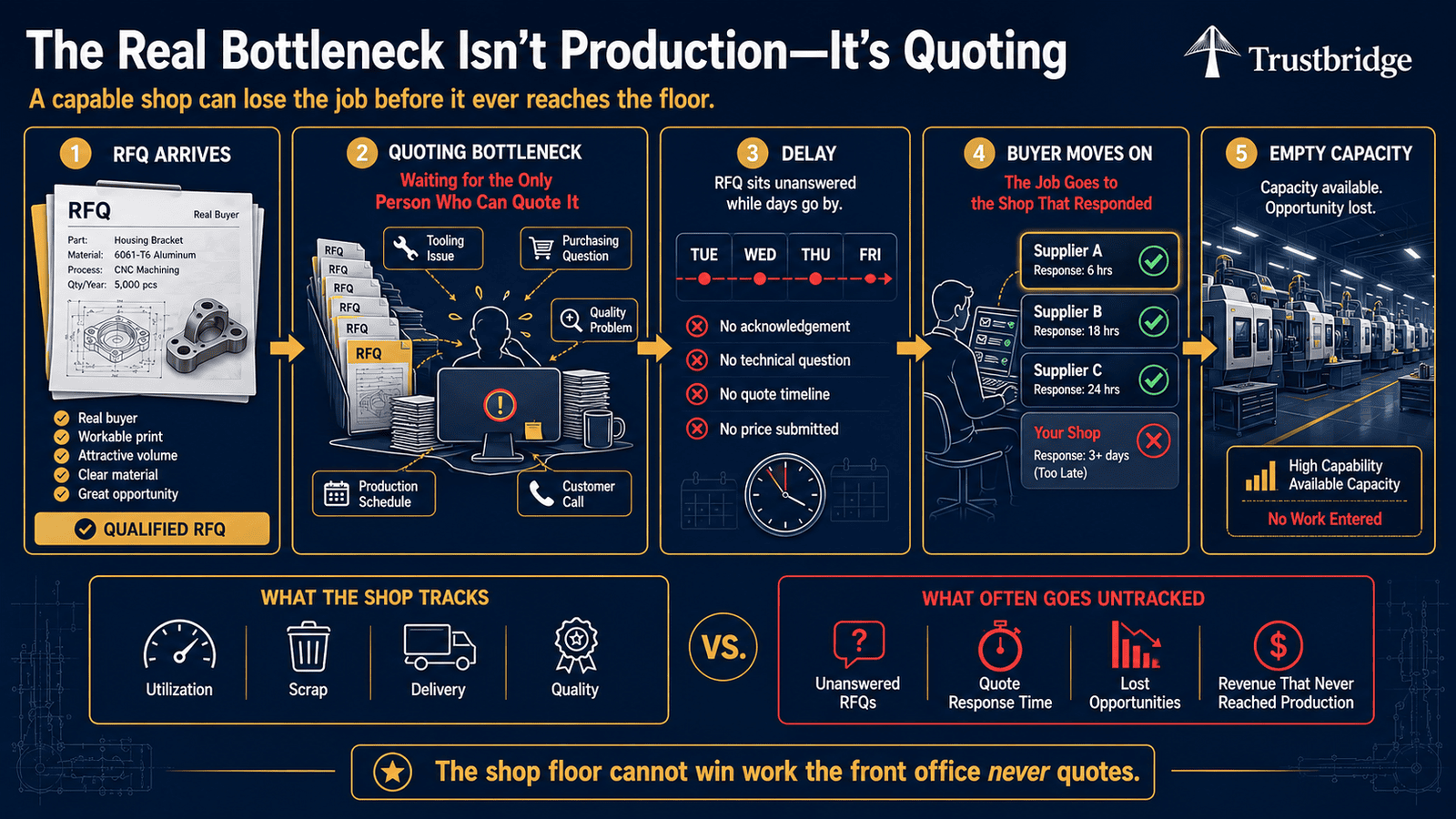
The Real Bottleneck Isn't Production It's Quoting
When manufacturers talk about bottlenecks, the conversation almost always lands on the shop floor machine utilization, labor availability, material lead times. Those constraints are visible, measurable, and by now well-instrumented; most shops can tell you their spindle utilization to the percentage point. Quoting rarely gets the same treatment, even though nothing reaches the floor without going through it first.
That asymmetry isn't an accident. Production has spent two decades absorbing automation, standardized scheduling, and lean methodology, all aimed at squeezing more consistent output from the same floor. Quoting has largely sat outside that investment, still depending on someone reading a print, judging manufacturability, and building a number from experience rather than a system. A shop can be running a genuinely efficient floor and still be losing work it never even got the chance to quote — which means the real constraint, for a lot of manufacturers, isn't how fast they can make a part. It's how fast they can decide what that part should cost.
Why RFQs Get Delayed in Real Operations
The mechanism behind the delay is almost always the same, regardless of what the shop makes. At most job shops, the person capable of reading a print and pricing it accurately isn't a dedicated estimator — it's the owner, a senior production lead, or whoever has the deepest floor experience, and that person already has a full day before an RFQ ever lands in their inbox.
Quoting and running the floor compete for the same hours, and quoting loses that competition almost every time, for a simple reason: a delayed quote has no immediate visible consequence, while a stalled machine, a missed shipment, or an unhappy customer on the phone does. Given the choice between something that will cause a problem in an hour and something that might cost a deal in three days, the urgent thing wins — correctly, every single time it comes up. The trouble is that it comes up every day, which means the RFQ doesn't wait a few hours. It waits until whatever's currently on fire gets put out, and then the next thing after that.
What Happens When You Don't Respond Fast Enough
None of this is visible to the buyer, and that's exactly the problem. Very few buyers requesting quotes from suppliers send one RFQ and wait patiently — most send the same print to several qualified shops at once and are evaluating responsiveness alongside price from the moment it goes out. A shop that acknowledges the request quickly, asks a sharp technical question, and gives a realistic timeline is building confidence before a single number has been discussed. A shop that goes quiet for three days is doing the opposite, whether or not the silence had anything to do with the actual work.
Buyers don't see the tooling problem, the staffing gap, or the quality issue that ate the estimator's week — they only see how long it took to hear back, and they read that delay as a signal about what production will be like once a purchase order is actually placed. A slow quote doesn't just arrive late. It arrives having already told the buyer something about the shop, and it's rarely something flattering.
The Hidden Cost: Opportunities That Disappear
Shops track production relentlessly — on-time delivery, scrap rate, machine utilization, quality escapes. Almost none of them track the RFQs that went quiet. There's no alarm for a lost opportunity the way there's an alarm for a stalled spindle, no line on a report labeled "quotes we were too slow to send." The buyer simply stops replying, or places the order somewhere else, and from inside the shop it looks identical to an RFQ that was never a good fit in the first place.
That invisibility is precisely why the problem persists at shops that are otherwise well run. A missed shipment gets a post-mortem. A quote that took five days instead of one gets nothing, because nobody can point to the specific order it cost. Multiply a handful of quietly lost jobs a month across a year, though, and the number stops being trivial — it's real, recurring revenue that never had the chance to reach a floor that, by every visible metric, was running just fine.
Why This Problem Hits Growing Job Shops Hardest
Large OEMs and established contract manufacturers typically have dedicated estimating staff, purpose-built quoting software, and workflows designed to move a high volume of RFQs without depending on any single person's calendar. Most job shops and growing manufacturers don't have any of that — estimating is a responsibility layered onto someone who already has a full-time job running production, purchasing, or engineering.
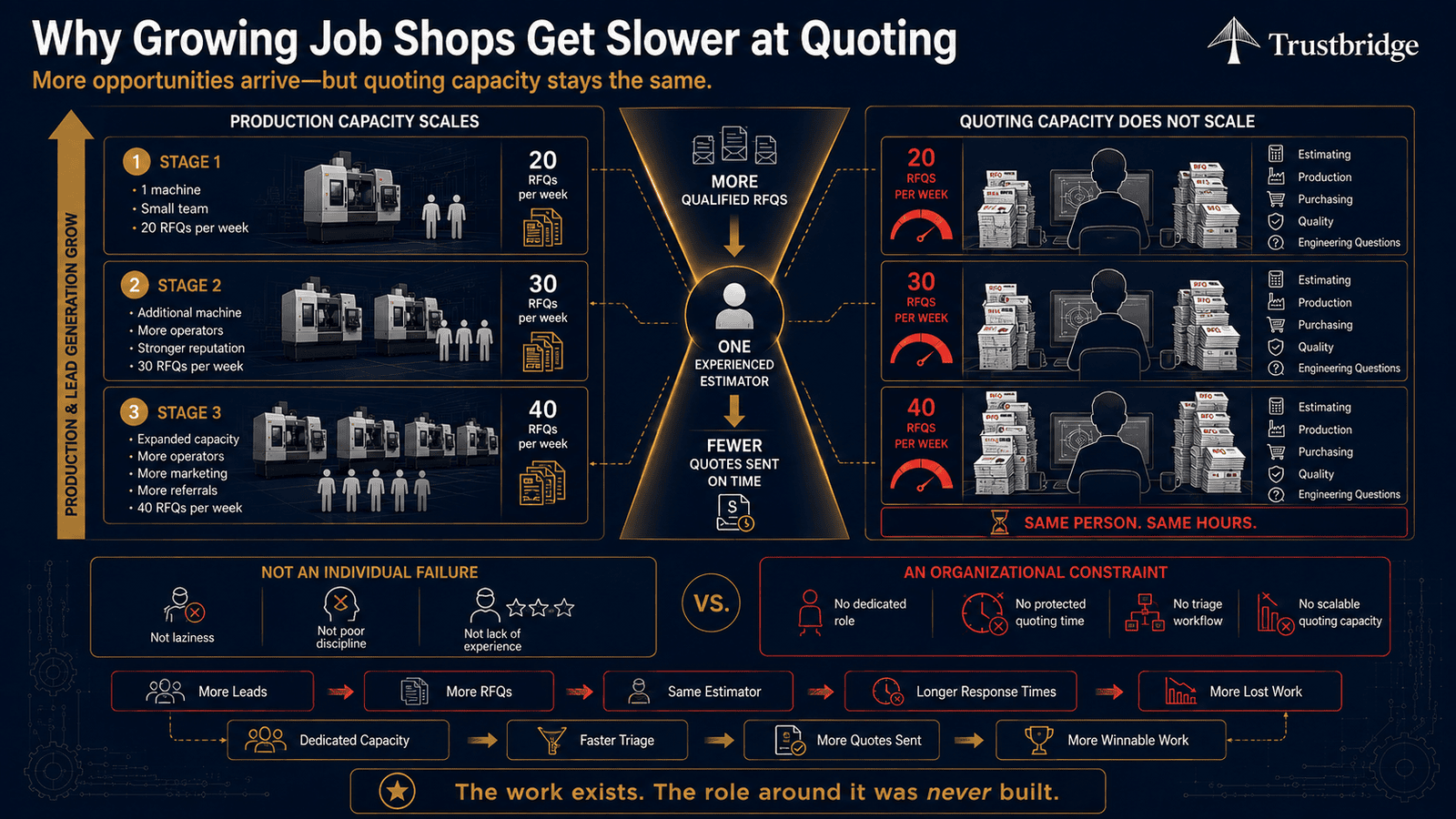
The problem gets worse, not better, with success. A stronger reputation, plus ordinary manufacturing lead generation work — referrals, trade shows, supplier directories — brings in more inbound RFQs, and production usually scales to meet that growth by adding a machine or another operator. The front office rarely scales at the same pace, because there's no obvious hire for "the person who reads prints and quotes them," so the added workload just gets absorbed by whoever was already doing it. An estimator handling twenty RFQs a week can suddenly be facing forty, with the same number of hours to do it in — which means the shops earning the most new business are often the ones where the quoting bottleneck is quietly getting worse.
The Bottleneck Is Organizational, Not Individual
It's tempting to read all of this as a performance problem — that the estimator is too slow, or isn't prioritizing the right things. That's rarely accurate, and treating it that way tends to make things worse rather than better: pushing an already-overloaded person to move faster raises the odds of a pricing mistake, and handing quotes to someone newer without the same floor experience just trades a slow number for an inaccurate one.
The actual issue is simpler and harder to fix with a pep talk. Most shops have someone capable of estimating accurately, but no position called "estimator" — no protected hours, no standing to say no to a floor request because a quote is due. The work exists; the role around it never got built. Recognizing that distinction matters, because it points at a different kind of fix entirely: not finding a faster or more disciplined person, but deciding that quoting deserves the same dedicated capacity production already gets.
Transition to Solution Thinking
None of this is unsolvable — it's just usually misdiagnosed. A shop that treats slow quoting as a sales problem tends to reach for sales fixes: more outreach, a better website, another trade show. A shop that recognizes it as a structural problem starts asking a different question entirely: what would it take to let quoting run on its own capacity, instead of on whatever's left over from production on a given day.
That question has more than one answer, and which one fits depends heavily on shop size, RFQ volume, and how specialized the estimating work actually is. Some of it is process — deciding which quotes genuinely need the most experienced person and which don't. Some of it is technology. And increasingly, some of it is about how a shop gets found by, and connects with, the buyers already looking for exactly what it does, rather than relying on the same RFQs finding their way to the same overloaded inbox.
Conclusion
The manufacturing quoting bottleneck rarely starts with pricing or a shortage of qualified buyers. It starts earlier, in the ordinary daily choice to handle whatever's urgent on the floor before whatever's merely important in the inbox — a choice that's individually reasonable every time it's made and expensive in aggregate over a year. Job shops, machining vendors, and contract manufacturers all feel this the same way, just at different scales.
Recognizing that the constraint is structural, not personal, changes what's worth fixing. The goal was never to make one estimator work faster. It's to stop asking quoting to run on whatever time production happens to leave behind, and start treating it as a function the business actually depends on — because for a lot of shops, it already is the difference between a quarter that grows and one that just stays busy.
Every RFQ is a potential customer, but only for the shop that reaches them first. Trustbridge helps manufacturers of every size — from a single-owner job shop to a full contract manufacturer — get in front of qualified buyers before an RFQ turns into a three-day wait, making it easier for the right supplier and the right buyer to find each other in the first place rather than leaving it to whichever shop happened to answer fastest. If quoting speed has been costing you winnable work, that's exactly the gap Trustbridge is built to close.
[See how Trustbridge connects suppliers with qualified buyers →]
Frequently Asked Questions
1. What is a manufacturing quoting bottleneck?
A manufacturing quoting bottleneck occurs when RFQs cannot be reviewed and priced quickly because the people responsible for estimating are also managing production, purchasing, quality, or engineering tasks. This delays quote responses, slows sales opportunities, and can result in lost business even when the shop has available manufacturing capacity.
2. Why do job shops struggle to respond to RFQs quickly?
Many job shops rely on experienced owners, production managers, or senior engineers to prepare quotes instead of dedicated estimators. Since these individuals are also responsible for day-to-day operations, urgent production issues often take priority over quoting, causing RFQs to sit unanswered for days.
3. How does slow quoting affect manufacturing lead generation and revenue?
Slow quoting reduces the effectiveness of manufacturing lead generation because buyers typically request quotes from multiple suppliers at the same time. Shops that respond quickly build confidence and are more likely to win the work, while delayed responses often cause buyers to move on before a quote is even submitted.
4. How can manufacturers eliminate the manufacturing quoting bottleneck?
Manufacturers can reduce the manufacturing quoting bottleneck by creating dedicated estimating capacity, standardizing quoting workflows, prioritizing RFQs more effectively, and using digital tools that streamline communication between engineering and sales. Faster, more consistent quoting helps job shops, machining vendors, and contract manufacturers improve responsiveness, win more RFQs, and protect long-term profitability.