
What Makes a Manufacturing Job Profitable for a Job Shop?
A job's quoted price says almost nothing about whether it's actually profitable. Five things decide that, and none of them show up on the purchase order.
Introduction
A job that pays well on paper can still lose a job shop money, and a job that looks modest can quietly be one of the best jobs on the floor. That gap exists because revenue and profitability are answering two different questions. Revenue asks how much the customer pays. Profitability asks how much of that payment survives contact with setup time, machine utilization, material cost, labor, and scrap five things that vary by job in ways a purchase order never shows.
None of those five are exotic. They're the ordinary mechanics of running a shop floor. What makes them worth walking through is that most buyers never see them, and most shops don't talk about them out loud, which leaves a lot of pricing behavior looking mysterious when it's actually just arithmetic.
Setup Time and Machine Utilization Decide How Fixed Costs Land
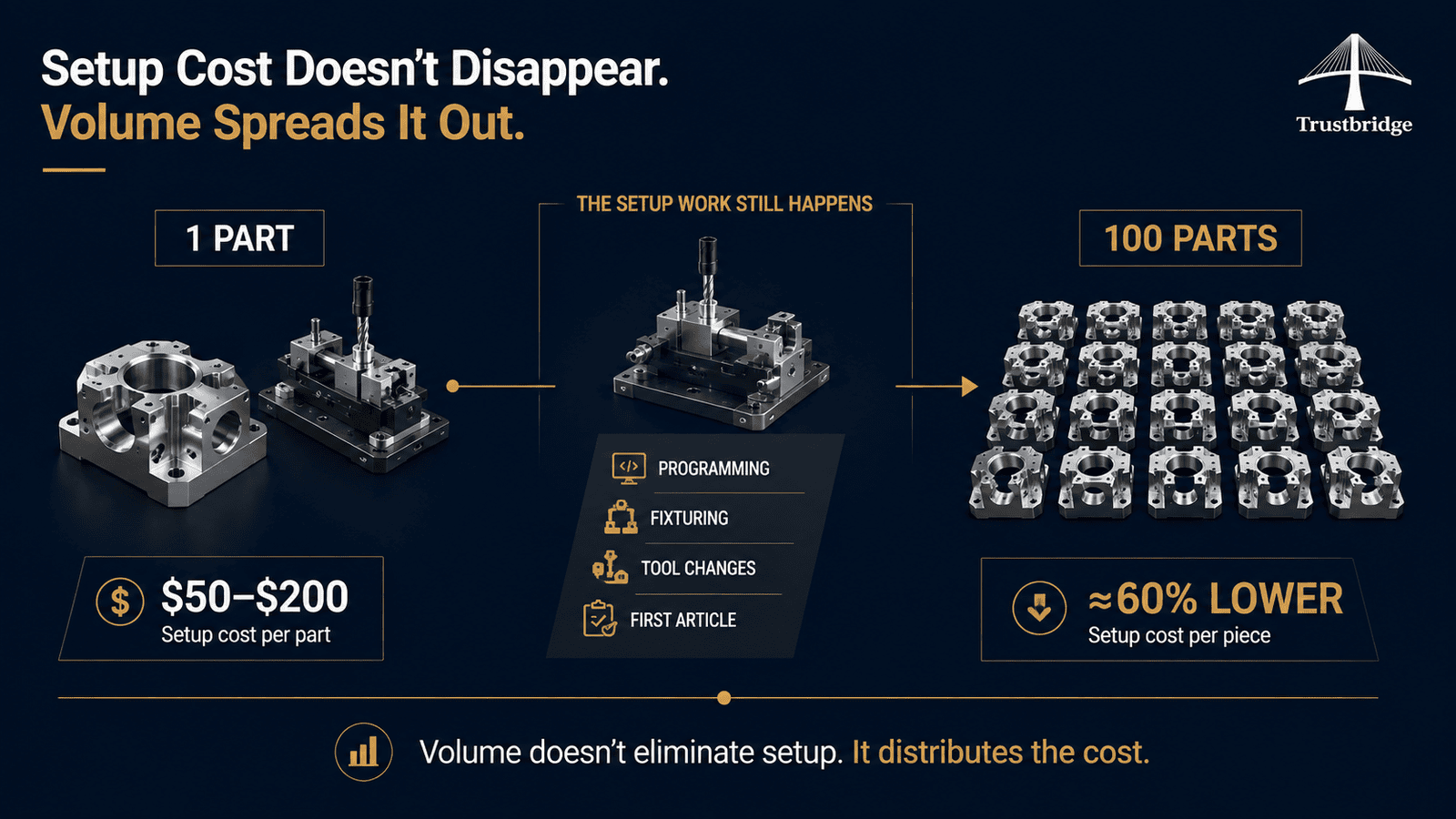
Every job carries a setup cost before a single good part comes off the machine programming, fixturing, tool changes, first-article inspection. That cost doesn't shrink because the order is small. It just gets divided across fewer parts, which is why a single prototype can run $50 to $200 per part in setup alone, while the same part machined 100 at a time can drop by roughly 60 percent per piece. Volume doesn't make a part cheaper to design or program. It just spreads a fixed cost over more units.
Utilization works alongside setup rather than separately from it. A machine sitting through a long changeover isn't earning anything. And a job that ties up an expensive 5-axis center for hours of setup, just to produce a handful of simple parts, is occupying capacity that could have run something more valuable in that same window. One documented job-costing example makes this concrete. A shop applying a single blended overhead rate across all its equipment priced a bracket job as comfortably profitable. Then the actual rate for the 5-axis machine that ran it nearly double the blended figure got applied instead. The job was still profitable. It just wasn't nearly as profitable as the first number suggested.
Material Costs and Scrap Determine How Much Actually Ships
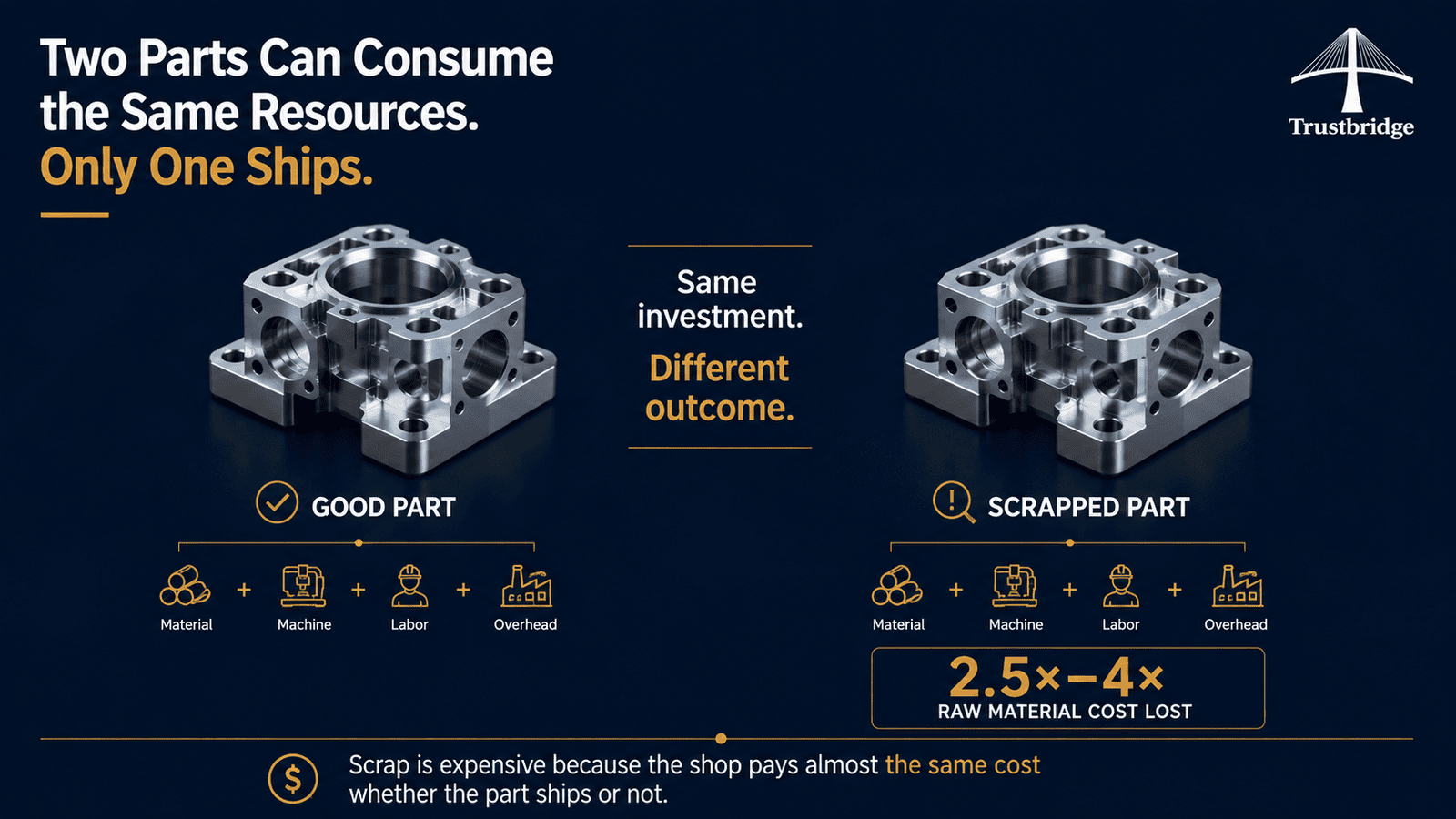
Material is usually billed at cost plus a modest markup, so it looks like the simplest line item in a quote. It isn't, mainly because of scrap. A scrapped part doesn't just waste the material in it it also wastes every hour of machine time, labor, and overhead already invested before the part failed inspection. The fully loaded cost of a scrapped part typically runs two and a half to four times its raw material cost, once machine time, labor, and overhead are counted alongside it. That gap means a material invoice badly understates what scrap actually costs a shop.
Most scrap doesn't come from bad luck. Setup and process errors together account for 60 to 70 percent of it in a typical shop, which ties scrap directly back to the same setup step discussed above rather than treating it as a separate, unrelated risk. A shop that groups similar jobs together to reduce changeovers isn't just saving setup time. It's also cutting into one of the biggest sources of scrap, for the same underlying reason.
Labor Is Where the Original Estimate Meets Reality
Labor cost isn't just an hourly wage multiplied by hours worked. A fully burdened labor rate includes benefits and payroll taxes on top of base pay, typically adding 30 to 50 percent above the number on a paycheck. That fully burdened rate, not the base wage, is what actually determines whether a job's labor estimate holds up. A quote built on the wrong assumption about how many hours a job needs doesn't just cost a little. It quietly resets the whole margin the job was supposed to deliver.
This is where operator experience matters most, and where it's hardest to see from outside the shop. An experienced machinist can often predict which features on a print will run long, well before the machine ever starts. A less experienced one or a shop stretched thin on a busy week is more likely to under-time a job that later runs over. The gap between estimated and actual labor hours is rarely visible to the buyer. It shows up entirely inside the shop's own numbers, after the job is already done.
Why a Big Order Isn't Automatically a Good Job
Put those three mechanisms together, and the reason a large order can still be a bad job becomes straightforward. Picture a big order that needs a long, fussy setup on a machine the shop needed for something else. Make it a material with real scrap risk. Have it estimated by whoever had time that week, rather than whoever actually knew the part best. That combination can produce a lower margin than a smaller order that avoids all three problems. Revenue measures none of this. It just measures what got billed.
This is exactly why two shops can look at the identical print and quote it completely differently, without either one being wrong. A shop already running the right material and the right machine configuration that week sees a straightforward job. A shop that would need to reconfigure a line, order an unfamiliar material, or pull its best estimator off something else sees a much harder one, and prices accordingly. The print didn't change. The shop's specific cost structure around that print did.
What This Tells a Buyer About Supplier Economics
None of this is only useful to shop owners. A buyer who understands these five mechanisms reads a quote differently, and often more usefully than one who doesn't. A quote that seems unexpectedly high isn't necessarily overpriced it may reflect a genuinely awkward setup, a scrap-prone material, or a machine that's a poor fit for the job at that shop specifically. A quote that seems unusually low is worth a second look too, for the opposite reason. A shop underestimating its own labor or scrap risk on a job is a shop more likely to renegotiate, delay, or cut corners once reality catches up with the number it already quoted.
The practical takeaway isn't to chase the lowest number. It's to ask a shop what's actually driving its price on a specific job the setup, the material, the labor, or something else. A shop that can answer that question specifically is a shop that actually understands its own costs. One that can't is guessing, and a guess baked into a quote eventually becomes someone else's problem.
Conclusion
Job shop profitability isn't a mystery, though it doesn't show up cleanly on an invoice either. It's a running total what setup ate, how the machine's time got used, what the material actually yielded, what labor really took, what got scrapped along the way measured against whatever the job paid. Every one of those varies by job in ways a purchase order never captures, whether the work is going through a machining vendor, a contract manufacturer, or a small batch cnc machining run for a custom manufacturing prototype.
A shop that prices well isn't lucky. It's a shop that has an honest, current answer to all five questions before it ever sends a number back.
Get Matched to Shops That Price With This in Mind
A request that lands with the right shop one whose equipment, material experience, and current schedule genuinely fit the job tends to get a quote built on real numbers instead of a guess. A request that lands with a mismatched shop tends to get exactly the kind of number this piece has been describing: technically a quote, but not really a reliable one. Trustbridge routes requests based on that kind of fit, not just who responds fastest, which matters just as much for a one-off prototype as it does for a recurring production order.
[See how Trustbridge matches requests to the right shop →]
Frequently Asked Questions
1. Can automated factories compete with legacy job shops for low-volume manufacturing?
Yes. Traditional automation has historically been difficult to justify for low-volume, high-mix work because frequent changeovers reduce efficiency. Flexible automation, including vision-guided robotics and adaptable production cells, is changing that equation by making it easier to automate jobs with greater variation.
2. What is flexible automation in manufacturing?
Flexible automation uses robotics, machine vision, software, and adaptable production systems to handle different parts or products with less manual reprogramming and setup time. Unlike traditional fixed automation, flexible systems are designed to accommodate frequent product changes, making them increasingly relevant to high-mix, low-volume manufacturing.
3. Why are legacy job shops vulnerable to flexible automation?
Legacy job shops have traditionally competed through their ability to handle complex, low-volume, and highly variable work. As flexible automation becomes better at managing variation, that advantage is no longer as difficult to automate. Shops that rely solely on flexibility without investing in processes, technology, and operational knowledge may face increasing competition.
4. How can legacy manufacturers compete with automated factories?
Legacy manufacturers can remain competitive by modernizing the flexibility that already makes them valuable. Investing selectively in automation, standardizing repeatable processes, documenting manufacturing knowledge, and addressing succession planning can help shops preserve their ability to handle specialized and high-mix work while improving efficiency and resilience.