
How to Get Better Manufacturing Leads, Not Just More
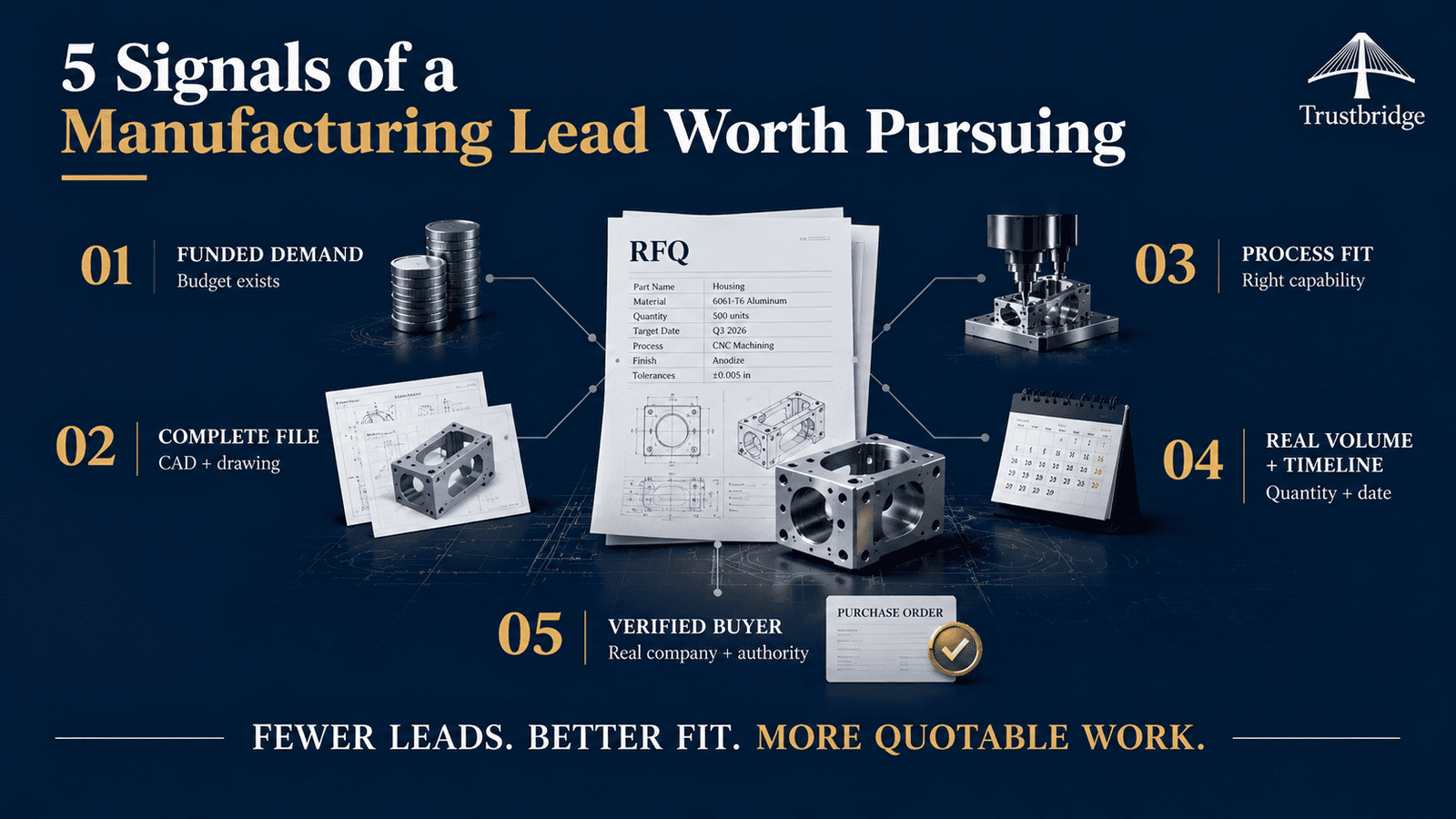
Better manufacturing leads don’t come from a larger contact list—they come from funded demand, complete technical files, tight process fit, clear unit economics, and verified buyers. A shop that filters incoming work on these five signals stops burning expensive estimating hours on dead ends, protects machine capacity, and wins a higher percentage of the RFQs it actually quotes.
Introduction
Your shop pays for a list of a few hundred “verified manufacturing buyers,” matched to your process and region. Someone spends two weeks working the phones and inboxes. Most calls go nowhere: wrong process, a hobbyist project with no budget, a broker fishing for a price to shop around. A handful turn into real conversations. One, maybe two, turn into an actual quote. The list cost real money and burned real hours, and it produced about the same number of usable opportunities you'd have found through a single good referral.
This is the gap most “get more manufacturing leads” advice skips. The problem was never the volume of contacts — five hundred names filtered on process and zip code is easy to buy. The problem is that most of those names were never leads in the economic sense. They were contacts who happened to clear a broad filter, with no funded project, no complete file, and often no real intention to buy anything soon.
A Full Contact List Isn't a Full Pipeline
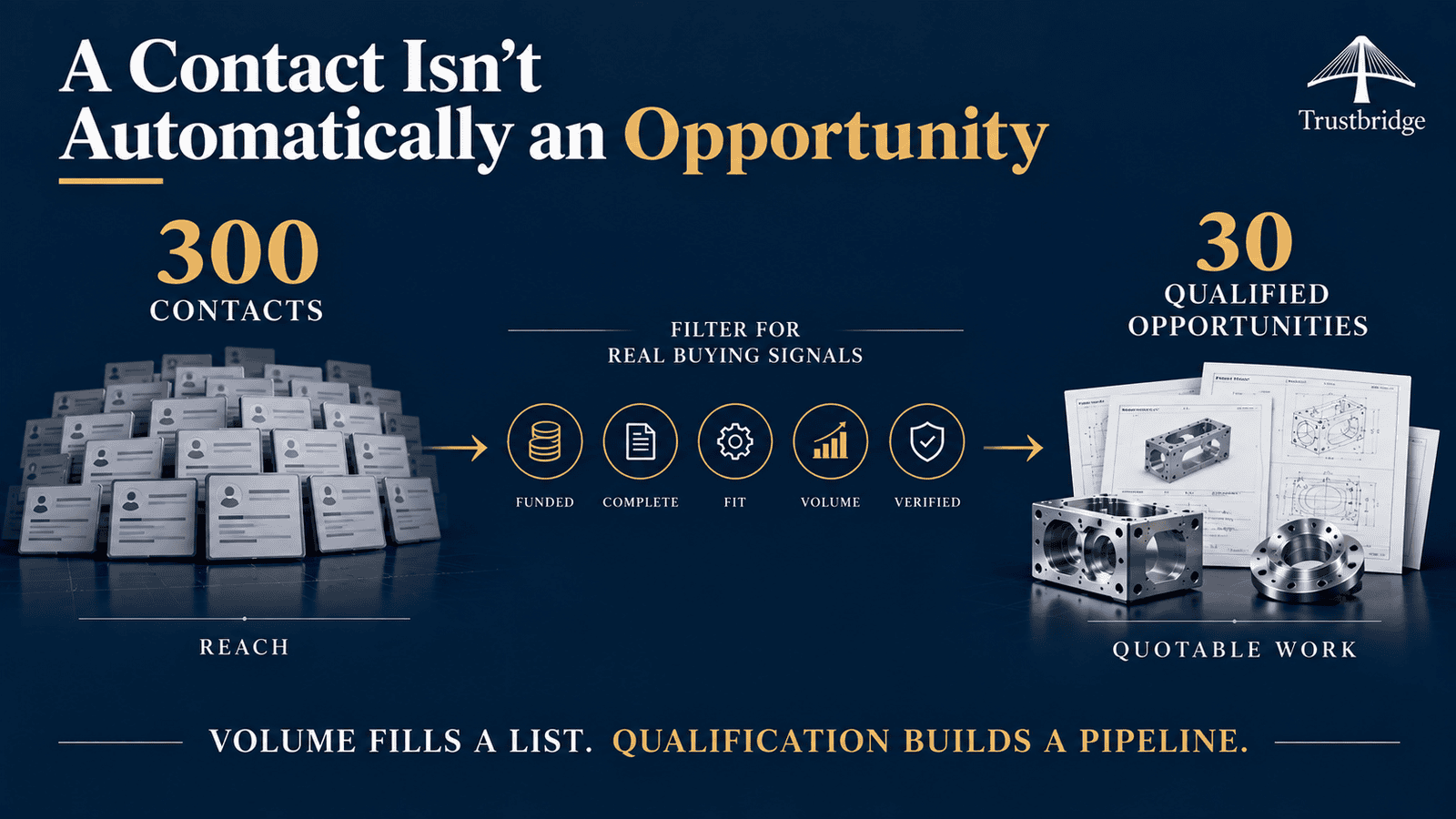
A contact list and a pipeline measure different things. A list counts names that match a filter: process type, location, company size. A pipeline counts opportunities that are actually going to become paid work, on a timeline you can plan capacity around. Generic lead-generation services are built to grow the first number — they're rewarded for reach: more contacts, more emails sent, more calls dialed. Whether any given contact has a funded project, a complete file, or the patience to work with a new shop isn't really their problem to solve. It's yours, after you've already paid for the list.
Generic lead-gen vendors get paid on top-of-funnel reach: names scraped, dials made, contacts exported. Your shop pays its bills on win rate and machine utilization. When your incentives don't match your lead provider's incentives, you end up paying for the privilege of disqualifying their bad data yourself. A shop that works thirty funded, complete opportunities a month will consistently out-earn a shop grinding through three hundred contacts filtered only on "makes CNC parts" and "is in the Midwest."
What Actually Makes a Manufacturing Lead Worth Pursuing
Five things separate an opportunity worth your quoting time from a name that happened to clear a filter.
Funded Demand, Not Just Interest
A project with a champion but no budget isn't a lead yet — it's a maybe. Funded demand means someone can actually issue a purchase order: a startup that's closed a round, an OEM with an approved program, a buyer who can point to where the money is coming from. Ask directly, early, whether budget is approved or still being sought. A shop that skips this question ends up quoting speculative projects at the same rate as funded ones, and speculative projects cancel or stall at a much higher rate.
A Complete File, Not a Vague Description
“We need some brackets machined” is a description, not a file. A lead worth chasing comes with something you can actually quote against: a drawing or model, target material, tolerance-critical features called out, and enough of a spec that two shops reading it would price it the same way. An incomplete file isn't disqualifying by itself, but it should reset your expectations — budget time to get the missing pieces before you invest real estimating hours, and price the uncertainty into your response time, not just your number.
Real Process Fit, Not a Keyword Match
“CNC machining” matches a filter. Your actual envelope, tolerances, tooling, and finish capability decide whether you should be quoting this specific part at all. A lead that's a keyword match but a capability mismatch wastes both sides' time: you quote high to cover the risk of stretching outside your comfort zone, or you quote a number you can't actually hold once the part is on the machine. Fit-based matching is supposed to solve exactly this problem; a contact list filtered on a single process label doesn't.
Volumes and Timelines That Match Your Economics
A prototype run of ten and a production order of ten thousand aren't the same lead wearing different clothes — they need different equipment, different pricing logic, and a different relationship with the buyer. Before you invest quoting time, confirm the real quantity and cadence: one-time buy, recurring release, or a ramp with production volumes later. A lead with no volume or timeline attached is a lead you're pricing blind.
A Verified Buyer, Not Just a Collected Contact
An email address that clears a validation check isn't the same as a company that's been confirmed to exist, have the authority to buy, and the ability to pay on the terms you'll offer. Anonymous or unverifiable buyers are where broker fishing and non-serious inquiries hide — someone collecting prices to shop around with no intention or ability to place an order. A verified buyer, at minimum, means you know who you're actually quoting, and that they can pay what they owe you.
What a Serious Buyer's Request Actually Looks Like
A buyer ready to issue a purchase order looks completely different from one shopping speculatively—often before you even open the file:
The Speculative Inquiry: Sends a vague description ("need some brackets machined") with no models or prints. Asks you to quote wide volume tiers ("quote 10 to 10,000") with no target date. Hesitates or goes silent when asked about funding, PO authority, or existing approved suppliers.
The Serious Buyer: Has a hard operational milestone (a product launch, a vendor drop-out, or an internal capacity crunch). Provides 2D prints and 3D CAD with critical tolerances called out upfront. Readily identifies who signs the PO and provides clear batch sizes and release cadences.
Speculative buyers aren't bad actors—they are simply too early. But quoting them at the expense of ready-to-run jobs turns your engineering team into an unpaid design and pricing consultancy.
Before You Pay for the Next List
The fix isn't finding a lead-gen vendor with a bigger database. It's changing what you measure. Before paying for another list, or before your team spends an afternoon on an inbound inquiry, run it through the same five questions: is there funded demand behind it, is the file complete enough to quote, does it actually fit your process and capability, are the volume and timeline real, and has the buyer been verified.
A lead source that produces fewer total contacts but a higher share of quotable, awarded work is worth more than one that produces a bigger list you have to filter yourself, one phone call at a time.
Frequently Asked Questions
1. How can manufacturers get better quality manufacturing leads?
Manufacturers can improve lead quality by qualifying opportunities based on funded demand, complete technical files, process fit, realistic volumes and timelines, and verified buyers. These factors help shops focus estimating and sales resources on opportunities that are more likely to become actual orders.
2. What makes a good manufacturing lead?
A good manufacturing lead has a real project, an available budget, enough technical information to quote, requirements that match the shop's capabilities, and a clear purchasing timeline. The buyer should also be identifiable and able to make or influence the purchasing decision.
3. How should manufacturing shops qualify RFQs before quoting?
Shops should evaluate whether the RFQ includes complete drawings or CAD files, required materials and tolerances, expected quantities, delivery requirements, and a realistic production timeline. They should also confirm that the project fits their equipment and process capabilities and that the buyer is legitimate and ready to purchase.
4. Why do manufacturing lead generation services produce so many unqualified leads?
Many lead-generation services optimize for contact volume rather than quoting or order quality. A contact may match a process, industry, or geographic filter without having a funded project, complete technical documentation, purchasing authority, or an immediate manufacturing need. Qualifying these factors before an opportunity reaches the shop can reduce wasted estimating time and improve lead-to-order efficiency.