
Why Manufacturing Quotes Take So Long to Get Right
A slow quote is rarely a sign of a complicated part or an overloaded shop. Usually, it means the request left something for the shop to guess at.
Introduction
A shop doesn't really quote a part. It quotes a drawing, a model, and whatever assumptions came attached to them. When that package is complete, the quote comes back fast, because there's nothing left to guess. When it isn't, the shop has two choices: ask a question or assume an answer. Asking adds a day. Assuming adds risk, and risk gets priced in.
That's most of what's behind a slow manufacturing quoting process. It isn't that shops are overloaded, or that quoting is inherently complicated, though both can be true. A request for a quote is really a request for a shop to reconstruct what the buyer actually needs from whatever got included. Gaps in that reconstruction are what show up as delay.
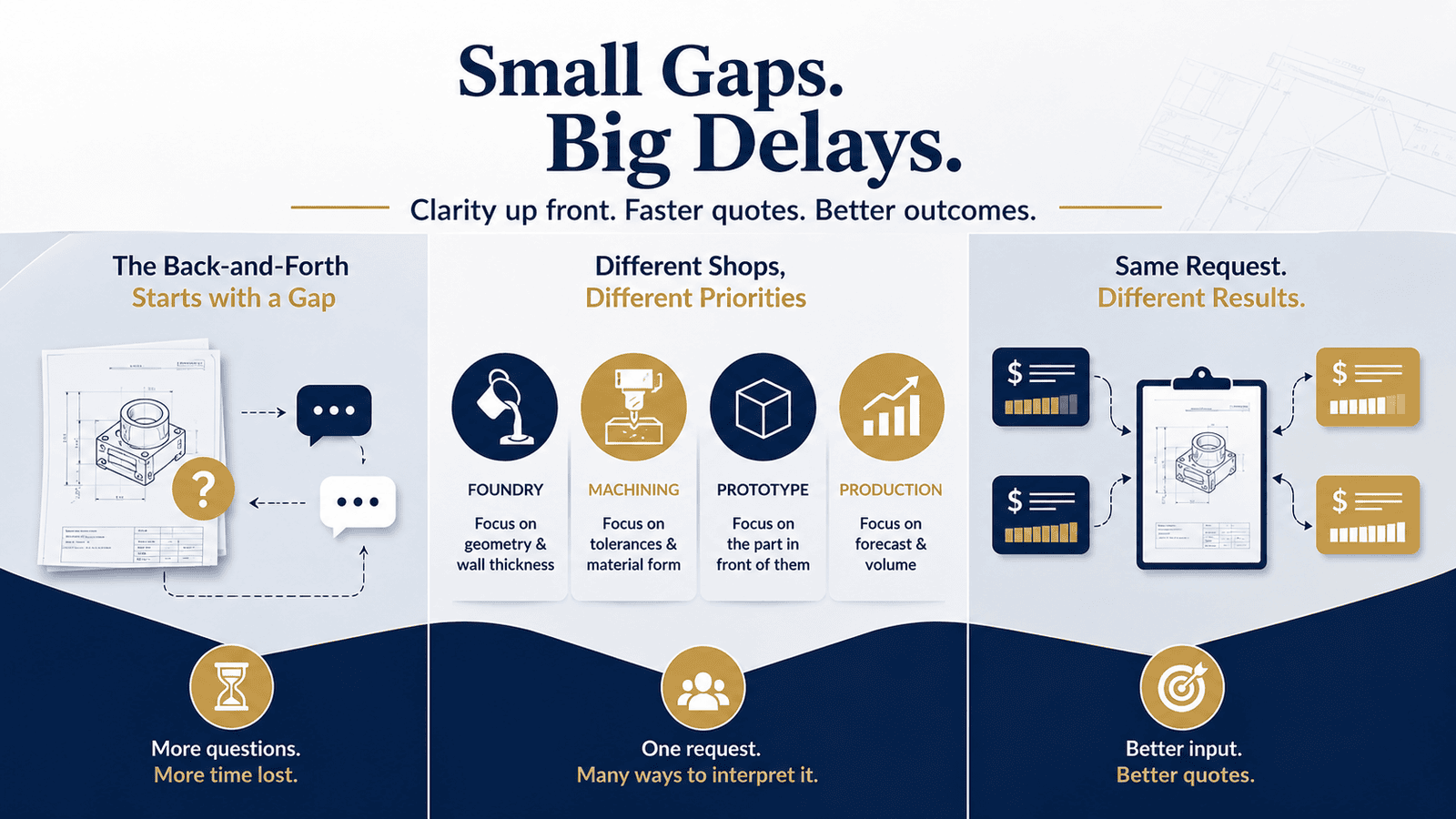
The Back-and-Forth Almost Always Starts with a Gap
A slow quote isn't always a sign of a complicated part or an overloaded shop. Often, it means the request left something for the shop to guess at. Write "Aluminum" instead of "6061-T6," and the shop must stop and ask which alloy, because both the price and the machining approach depend on the answer. That single question, sent and answered, can add one to three days before pricing even begins.
Tolerance works the same way. A drawing with no tolerance called out forces an assumption, and shops tend to assume the safer, tighter option rather than guess wrong. An unspecified tolerance often gets priced as if it were a tight one, whether or not the part needs it. Quantity does too: a shop pricing a single prototype and a shop pricing a recurring production order are answering two different questions, and a request that doesn't say which one it is usually gets a delay, a clarifying email, or both.
Not Every Shop Is Missing the Same Thing
The instinct, once this pattern is clear, is to just include everything every spec, every tolerance, every note that might conceivably matter. That doesn't fully solve the problem, because different types of shops are reading the same request for different things.
A foundry is thinking about mold design and metal flow, so geometry and wall thickness carry more weight there than elsewhere. A machining vendor is thinking about toolpaths and starting stock, so tolerance and material form bar, plate, forging matter more directly to them. A shop quoting a one-off prototype cares mainly about the part in front of them. A job shop or contract manufacturer quoting a production run cares just as much about the forecast behind it, since that's what determines whether tooling investment makes sense at all. A request that's complete for one type of shop can still leave another one asking questions. That's a real reason sending an identical package to every supplier on a list rarely produces quotes from suppliers that are actually comparable to each other.
The Inputs That Actually Move the Needle
Not every field in a drawing carries equal weight, which is useful, because it means a fast quote doesn't require anticipating every question a shop might ask. A handful of inputs do most of the work. The real material grade, not the general family. A tolerance that's been thought through, rather than defaulted too tight. An actual volume number, even a rough one, instead of silence on quantity. And a line on what the part does since a shop that understands the function can often flag where a spec is stricter than it needs to be.
That last point cuts both ways. One CNC shop's quoting guide put it plainly: a tolerance tighter than a feature needs can raise the cost of that feature by 40 to 80 percent, with no functional benefit at all.
Conclusion
A slower quote usually means a shop had to stop and reconstruct something the request should have said directly. Every reconstruction adds either a day of back-and-forth or a margin of safety built into the price sometimes both. A faster quote isn't the product of a simpler part or a less busy shop. It's usually just the product of a request that didn't leave anything important open to interpretation.
That's a fixable habit, not a fixed cost of doing business. The buyers who consistently get quotes back fast aren't sending simpler parts than everyone else. They've just learned which handful of details a shop actually needs to stop guessing, and they include those every time
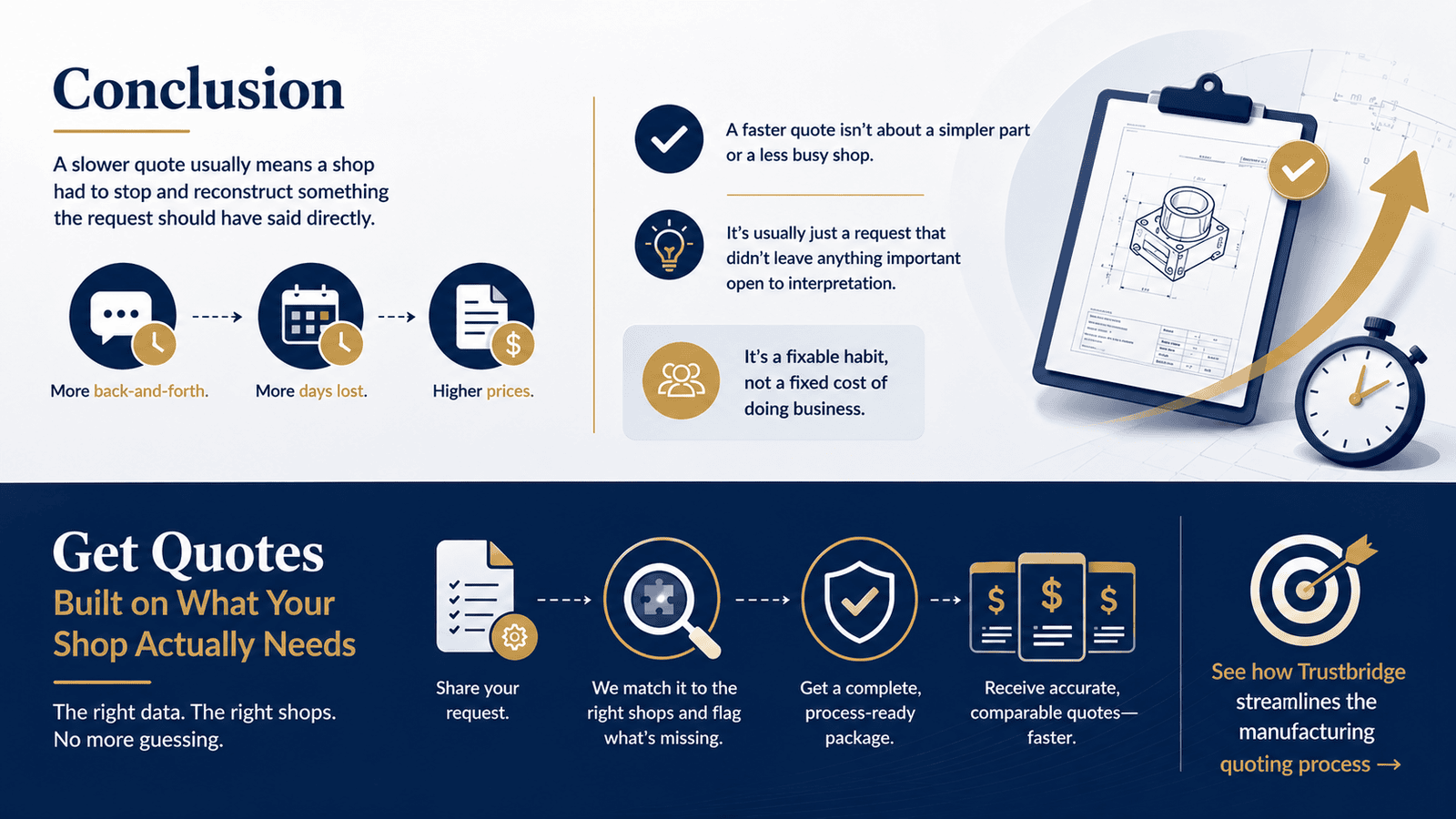
Get Quotes Built on What Your Shop Actually Needs
A package that's complete for a foundry can still be incomplete for a machining vendor. That's part of why the same RFQ sent to five suppliers doesn't always come back with five quotes worth comparing each shop filled a different gap with a different assumption. Trustbridge matches a request to the shops actually suited to make it, and flags what's missing for that specific process before the request goes out, so the back-and-forth happens once, up front, instead of after every supplier has already started guessing on their own.
[See how Trustbridge streamlines the manufacturing quoting process →]
Frequently Asked Questions
1. What information should be included in a manufacturing RFQ?
A complete manufacturing RFQ should include the latest drawing and 3D CAD model, material grade, required quantity or production volume, critical tolerances, surface finish requirements, and any important functional requirements. Providing these details upfront reduces clarification emails and helps suppliers return accurate quotes faster.
2. Why does an incomplete RFQ delay manufacturing quotes?
An incomplete RFQ forces suppliers to stop and ask questions or make assumptions about the part. Missing information such as material grade, quantity, tolerance requirements, or intended application can delay engineering review and pricing. The more uncertainty a supplier has to resolve, the longer the manufacturing quote turnaround time is likely to be.
3. How do tolerances affect manufacturing quote time and cost?
Tighter tolerances can require additional machining time, setup verification, inspection, and process control. If a tolerance is tighter than the part's function actually requires, it can increase manufacturing cost without adding meaningful product value. Clearly identifying critical and non-critical dimensions helps suppliers quote more efficiently and accurately.
4. Why can the same RFQ receive very different quotes from different suppliers?
Different suppliers may interpret the same incomplete RFQ differently based on their manufacturing process, equipment, production volume, and capabilities. One supplier may assume a tighter tolerance or different material, while another may include additional inspection or setup requirements. A complete, process-specific RFQ gives suppliers the same information to work from, making quotes faster and easier to compare.