
Design for Manufacturing Review Before Design Freeze
A finished-looking CAD model can still contain features that are costly or risky to manufacture. A design for manufacturing review brings process knowledge into the design while geometry, materials and tolerances can still be changed without reworking production tooling.
The review does not replace engineering judgment. It shows how each design choice affects tooling, setups, inspection, assembly and repeatability so the engineering team can protect function while removing avoidable cost.
How Much More Does a Change Cost After Tooling
There is no reliable universal multiplier. The cost depends on the part, process and how much work already depends on the released design: molds, fixtures, CAM programs, inspection plans, purchased material and finished inventory. A NASA study of large aerospace and defense projects found that fixing a requirements error cost 3 to 8 times as much during design and 7 to 16 times as much during manufacturing and build as during the requirements phase. Those figures describe complex systems, not a typical machined or molded component. They support the direction of the cost curve, not an estimate for a particular tool change. NASA’s Systems Engineering Handbook makes the same broader point: the cost of changing a design increases later in the lifecycle, while project-specific numbers vary.
What Changes After Tooling Release
Consider a molded housing whose wall lacks sufficient draft. Before tooling, the correction may require a model and drawing update followed by a fit check. After the mold is cut, the same correction may require tool-steel or insert modification, an engineering change order, revised drawings and inspection plans, new sample approval and, where required, requalification. Existing parts may also need rework or scrapping.
For a real decision, ask the supplier to separate one-time change cost, recurring unit-cost change and schedule impact. That quote is more useful than applying a generic 5× or 10× rule.
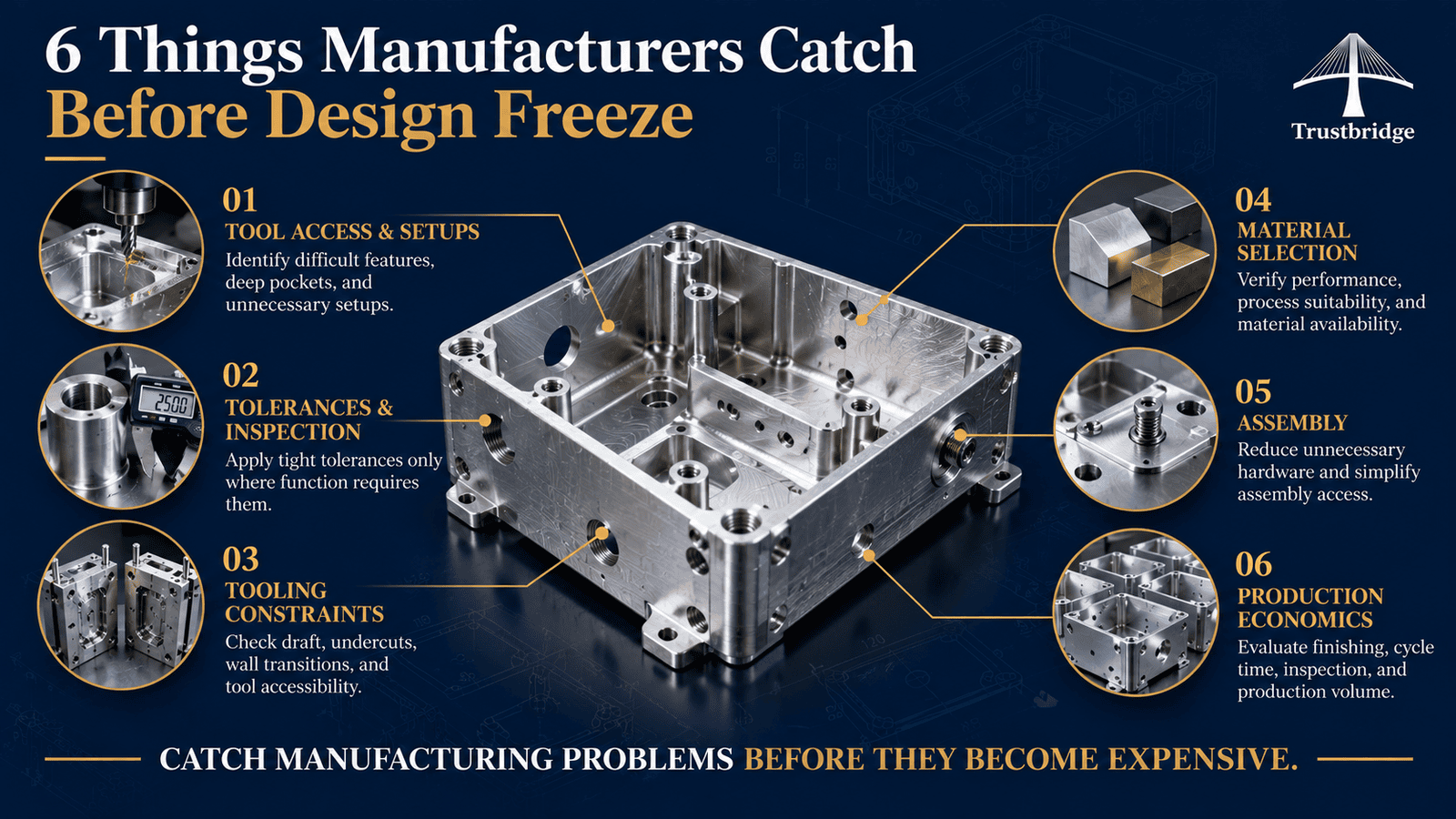
What Manufacturers Catch in a Design Review
A process-specific review usually covers six areas. For an applied example, see what a real DFM review can fix before manufacturing begins.
Tool Access and Setups
Sharp internal corners, deep pockets, thin walls and features reachable from only one awkward direction can force small or long-reach tools, additional orientations or custom fixturing. A larger radius or shallower pocket may preserve function while reducing cycle time and process risk.
Tolerance and Inspection
Tighter-than-needed tolerances can require more process control, inspection and rework. The effect depends on the feature, datum scheme, nominal size, measurement method and process capability. Keep precision where fit or function requires it and use appropriate general tolerances elsewhere. See how unnecessary tolerances affect machining and inspection.
Tooling Constraints
Molded, cast and formed parts must release from and work with their tooling. Draft, parting lines, undercuts, wall transitions, ribs, bosses and core geometry can change tooling complexity, cycle time and defect risk.
Material Selection
Material affects strength, stiffness, corrosion behavior, availability, machinability and process choice. A lower-cost grade is useful only when the engineering team verifies that it still meets the functional and compliance requirements.
Assembly
Fastener count, incorrect-part orientation, tolerance stacks and blocked tool access can add labor and error opportunities. Locating features, standardized hardware and a clear assembly sequence may simplify the product without changing its intended function.
Production Economics
Hidden cost may come from unnecessary finishing, cosmetic requirements on concealed surfaces, low-volume processes used at high volume or inspection requirements that do not protect a functional need.
Pre Tooling Checklist by Process
The exact limits depend on the supplier, material, equipment and volume. Use these prompts to start the review, then document the agreed process limits.
Process | Questions to resolve before release |
CNC machining | Can standard cutters reach the features? How many setups are needed? Are deep pockets, thin walls or tight tolerances justified by function? |
Injection molding | Is draft sufficient? Are walls reasonably uniform? Can undercuts or heavy ribs be simplified? Are gate, parting line, shrinkage and cosmetic surfaces understood? |
Sheet metal | Do bend radii suit the material and tooling? Are holes clear of bends? Are bend relief, flat pattern and tolerance accumulation understood? |
Casting | Are draft, parting line and section transitions practical? Can cores be reduced? Is enough machining allowance provided, with usable locating datums? |
A Hypothetical Cost Example
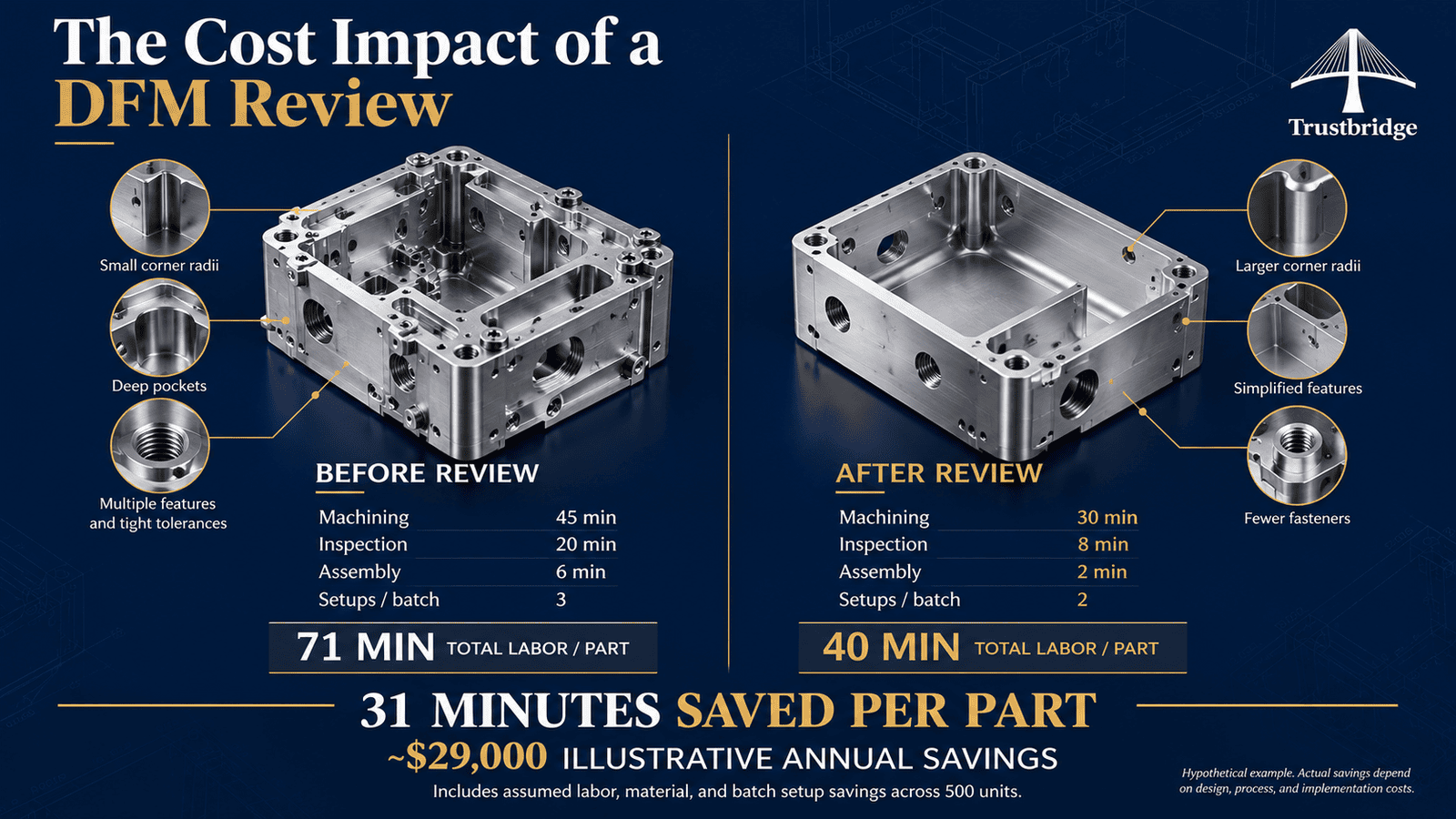
Assume a machined aluminum housing will be produced in four batches totaling 500 units per year. Machining time below excludes batch setup. A manufacturer proposes four changes:
Increase internal corner radii and reduce one pocket depth, allowing a larger tool and two setups instead of three.
Keep ±0.01 mm only on two locating bores if the fit analysis requires it; apply supplier-agreed general tolerances elsewhere. For this scenario, assume ±0.1 mm where appropriate.
Evaluate 6061 instead of 7075 because material cost is lower in this scenario. Adopt it only after verifying strength, stiffness, fatigue, corrosion, finish and compliance requirements.
Replace six screws with two screws and locating features after confirming joint loads and service needs.
Item | Before review | After review |
Machining time per part | 45 min | 30 min |
Inspection time per part | 20 min | 8 min |
Assembly time per part | 6 min | 2 min |
Total labor per part | 71 min | 40 min |
Material cost per part | $18 | $12 |
Setups per batch | 3 × 30 min | 2 × 30 min |
The labor reduction is 31 minutes per part, or about 258 hours across 500 units. At an assumed blended labor rate of $100 per hour, that is about $25,800. The assumed material saving is $3,000, and one fewer 30-minute setup across four batches saves $200. The recurring annual saving is therefore about $29,000 under these assumptions.
This is an illustration, not a benchmark or customer result. It excludes engineering time, qualification, drawing and program updates, inventory effects, freight and schedule impact. An actual business case should compare those one-time implementation costs with savings over the remaining production volume.
When to Ask for Manufacturing Feedback
Stage | Review focus | Likely change burden |
Concept | Process, material family, part split and target volume | Usually sketches and early CAD |
Before first prototype | Features, tolerances, material and assembly approach | CAD, drawings and possibly another prototype |
Before tooling release | Draft, parting lines, critical characteristics and inspection | Corrections may delay tool start or repeat earlier work |
After tooling release | The change and every dependent asset | Tool rework, new samples, change control, validation and inventory impact |
The best answer is not one review at the end. Ask at concept stage for process decisions, before the first prototype for feature-level feedback and again before tooling or production release to confirm that the agreed changes were applied.
When a Late Change Is Still Worth It
Early feedback does not mean refusing to change later. A late change may be necessary when the design misses a safety, functional or regulatory requirement, or when verified savings over the remaining volume exceed tool rework, qualification and disruption costs. Make that trade-off with a documented impact assessment rather than relying on sunk cost or a rule of thumb.
How to Get Useful Feedback
Share Context, Not Just Geometry
Provide the model and drawing together with the part’s function, critical features, expected volumes, mating components and cost or schedule constraints. A reviewer cannot protect requirements that were never explained.
Ask Cost Driver Questions
Instead of asking only whether the part can be made, ask which features drive price, which tolerances are hardest to control, how many setups are required and what would change at higher volume.
Record Decisions and Verification
For every suggestion, record the expected cost, lead-time and risk effect, the engineering owner and the evidence needed before approval. Check mating parts, tolerance stacks and assembly sequence before releasing the revision.
Better Designs Include Manufacturing Knowledge
A design for manufacturing review gives engineers a clearer view of how geometry, tolerances, materials and assembly choices behave in the selected process. The aim is to preserve verified functional requirements while reducing avoidable manufacturing cost, lead time and risk.
At Trustbridge, we bring production constraints into the design discussion while there is still room to adjust the manufacturing approach. We explain the trade-offs so product teams can make informed decisions before prototype or tooling commitments.
Working on a design that needs a manufacturing review? Discuss a design project or explore our Design for Manufacturability and Engineering Services.
Frequently Asked Questions
What Does Design Freeze Mean
Design freeze is an approved design baseline after which changes are formally reviewed, documented and authorized. It does not mean change is impossible, and the timing relative to purchasing, prototype tools or production tooling varies by program.
How Much Does an Engineering Change Cost After Tooling
There is no universal figure. Before tooling, the change may involve engineering analysis and CAD or drawing revisions. After release, it may also trigger tool or fixture work, updated programs and inspection plans, new samples, qualification, scrapped inventory and schedule delay. Use a supplier change quotation for the actual decision.
Who Should Join a Manufacturing Design Review
Include the responsible design engineer and people who understand the selected process: a machinist or process engineer, a toolmaker for molded or cast parts, quality or inspection staff and, for assemblies, someone familiar with the build sequence.
How Do I Protect a Design Shared with a Manufacturer
Use a confidentiality agreement, define the permitted purpose, mark sensitive files, limit access and agree how copies will be stored, returned or destroyed. An NDA is one protection measure, not a substitute for access control or legal advice. See the WIPO trade-secret guidance and the USPTO Trade Secret IP Toolkit.
Is Manufacturing Feedback Useful for Low Volume Parts
Yes. Prototypes and small batches can benefit from fewer setups, simpler inspection and more readily available materials. The best process or tooling decision may differ from high-volume production, so include both current and future volume in the review.