
DFM in Practice: A Real Design Saved by Early Manufacturing Input
Many products look complete in CAD but still contain design choices that increase manufacturing cost, complexity, and lead time. Early manufacturing design reviews help engineering teams identify these issues before production begins, reducing redesigns and improving manufacturability. This design for manufacturability case study shows how early collaboration between design engineers, manufacturing engineers, and suppliers transformed a production-ready design into one that was easier, faster, and more cost-effective to manufacture.
Introduction
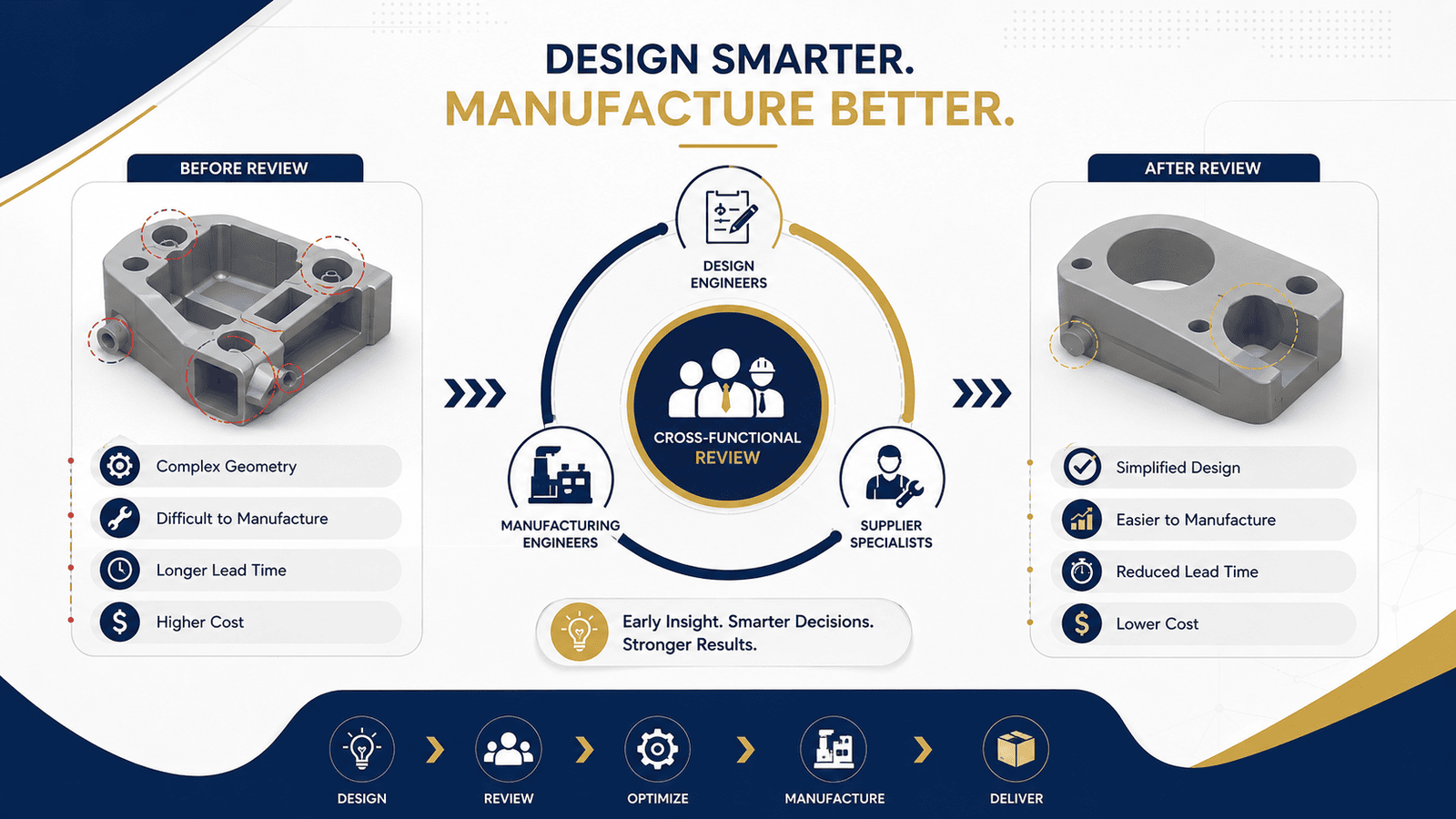
The Original Design Looked Production Ready
At first glance, the product appeared well engineered. It satisfied all functional requirements, met packaging constraints, complied with design specifications, and successfully passed initial engineering reviews. From a purely design perspective, there seemed to be little reason for concern.
However, once the design entered a structured manufacturing review, several hidden production challenges became apparent. None of these issues affected the product's functionality, but they significantly increased machining complexity, inspection effort, tooling requirements, and overall manufacturing cost.
The objective of the review was not to redesign the product from scratch. Instead, the goal was to preserve the original design intent while identifying practical opportunities to improve manufacturability before tooling investments and production planning had begun.
By conducting this review early, the engineering organization maintained flexibility to optimize the design without disrupting project timelines or increasing development costs.
Initial Design Challenges
Several features immediately raised concerns during the manufacturing review. Deep internal pockets required long-reach cutting tools that reduced machining rigidity and increased the likelihood of tool deflection. Multiple unnecessarily tight tolerances demanded additional machining passes and inspection time, while thin unsupported walls created vibration risks during CNC machining. Cosmetic surfaces also complicated fixture access, making repeatable setups more difficult.
Although none of these issues would have prevented production individually, together they created a compounding effect. Longer machining cycles, additional tool changes, increased inspection requirements, and more complex workholding strategies would have raised manufacturing costs while reducing overall production efficiency. This illustrates why seemingly minor design decisions often have significant downstream consequences.
Why Early Reviews Matter
At this stage of development, every modification required only updates to the CAD model and engineering documentation. Geometry could still be adjusted quickly without affecting suppliers, tooling investments, or production schedules. This made the cost of implementing improvements relatively small compared to changes introduced later in the product lifecycle.
Once fixtures, cutting tools, inspection programs, and manufacturing documentation have been finalized, even small design revisions can trigger weeks of engineering effort and substantial additional expense. Toolpaths may need to be regenerated, fixtures redesigned, validation repeated, and supplier documentation updated.
By conducting manufacturability reviews before production planning began, the cross-functional engineering and manufacturing team eliminated potential production problems while they were still simple and inexpensive to solve. This proactive approach reduced downstream engineering changes and helped ensure a smoother transition into manufacturing.
Manufacturing Engineers Identified Hidden Production Risks
One of the greatest advantages of early Design for Manufacturability (DFM) reviews is that they allow manufacturing engineers to evaluate the design from a production perspective rather than a purely functional one. While design engineers focus on product performance and user requirements, manufacturing engineers examine how efficiently a part can be machined, fixtured, inspected, assembled, and produced repeatedly at scale.
This different perspective often uncovers production risks that are not obvious during conventional design reviews. A feature that appears simple in CAD may require specialized tooling, additional machine setups, or complex inspection methods once it reaches the shop floor. Addressing these issues before production planning begins helps prevent unnecessary cost, delays, and engineering rework later in the project.
By involving manufacturing specialists early, the engineering organization gained valuable insight into machining strategies, fixture design, and production scalability without compromising the product's functional requirements.
Tool Accessibility
Several internal features required excessive cutter extension, forcing CNC machines to use long-reach cutting tools. While technically feasible, these tools are more susceptible to vibration, tool deflection, and premature wear, making it harder to maintain dimensional accuracy and surface finish during machining.
Instead of redesigning the component completely, the engineering and manufacturing teams adjusted internal corner radii and modified pocket geometry to accommodate shorter, more rigid cutting tools. These seemingly small design refinements improved machining stability, reduced chatter, increased tool life, and shortened machining cycle times without affecting the product's intended functionality.
This example demonstrates how early DFM feedback can eliminate manufacturing inefficiencies through relatively minor design adjustments that would have been far more expensive to implement after production release.
Fixture Accessibility
The review also identified several features that required multiple workholding setups to machine accurately. Every additional setup increased machining time while introducing opportunities for dimensional variation caused by repositioning the part between operations.
Manufacturing engineers recommended slight adjustments to datum locations and machining orientation so that more operations could be completed within a single fixture. Although these changes were almost invisible from a product design perspective, they significantly improved machining repeatability, reduced setup time, and simplified production planning.
Fewer setups also improved consistency across production batches, making it easier to maintain quality while supporting future production scaling.
How Small Design Changes Improved Manufacturing Efficiency
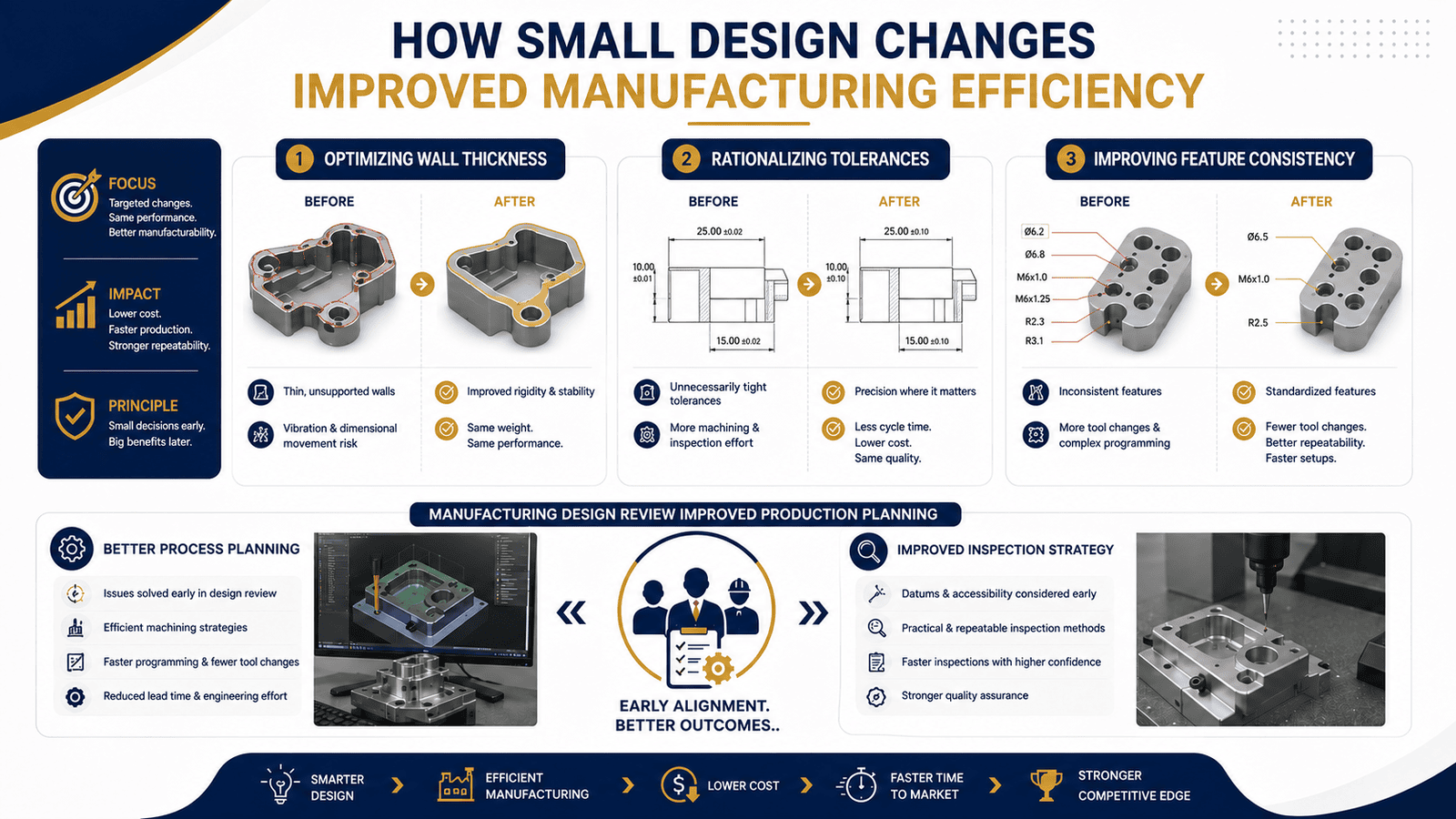
The objective of the redesign was never to simplify the product by sacrificing performance. Instead, the focus was on making targeted improvements that preserved every functional requirement while removing unnecessary manufacturing complexity. Each modification addressed multiple production challenges simultaneously, creating cumulative improvements throughout the manufacturing process.
Rather than introducing major design changes, the engineering team concentrated on optimizing geometry, tolerances, and standardized features. These adjustments reduced machining effort, simplified inspection, improved programming efficiency, and strengthened production repeatability without affecting product performance.
This demonstrates one of the core principles of DFM: small engineering decisions made early often generate disproportionately large manufacturing benefits later.
Optimizing Wall Thickness
Thin, unsupported wall sections were reinforced by redistributing material within the geometry rather than increasing the overall part mass. This improved machining rigidity, reduced vibration during cutting, and preserved the product's weight and functional performance.
The revised geometry also minimized the risk of dimensional movement during machining, helping operators achieve tighter process control without requiring additional finishing operations. Because the overall mass remained unchanged, the product continued to meet its original performance and packaging requirements.
This change illustrates how thoughtful geometry optimization can improve manufacturability without compromising the engineering intent behind the design.
Rationalizing Tolerances
During the review, manufacturing engineers found that several cosmetic and non-critical features had been assigned unnecessarily tight tolerances. Although these tolerances were achievable, they increased machining time, inspection effort, and manufacturing cost without delivering measurable functional benefits.
The engineering team therefore reserved precision tolerances only for critical interfaces responsible for assembly, performance, or product function. Less critical dimensions were assigned practical manufacturing tolerances that aligned with standard machining capabilities.
This change reduced CNC machining time, shortened inspection cycles, improved manufacturing efficiency, and lowered overall production costs while maintaining product quality and functionality.
Improving Feature Consistency
The review also highlighted opportunities to standardize several repeating design elements. Hole diameters, thread depths, internal corner radii, and other recurring features were revised to use consistent dimensions wherever possible.
This standardization reduced the number of cutting tool changes required during machining, simplified CNC programming, and improved process repeatability. Operators could use common tooling across multiple operations instead of repeatedly changing cutters to accommodate minor dimensional differences.
As production volumes increase, this level of feature consistency becomes increasingly valuable because it shortens setup times, reduces programming complexity, and minimizes opportunities for manufacturing variation.
Manufacturing Design Review Improved Production Planning
Manufacturing design reviews do much more than improve individual part geometry. They also strengthen production planning by allowing suppliers and manufacturing engineers to validate machining strategies, fixture concepts, inspection methods, and workflow requirements before production begins.
This proactive planning reduces uncertainty throughout the manufacturing process. Instead of reacting to problems during production, engineering and manufacturing teams can align their expectations early, ensuring that designs are practical to produce, inspect, and scale.
As a result, suppliers gain greater confidence in production planning while engineering teams reduce the likelihood of unexpected redesigns after release.
Better Process Planning
Because manufacturability issues had already been resolved during the design review, CNC programmers could develop efficient machining strategies without relying on complicated workarounds or excessive tool changes.
Validated geometry simplified toolpath generation, reduced programming time, and improved machining consistency. Instead of solving manufacturing problems through programming, CNC programmers could focus on optimizing cycle times and improving overall machining efficiency.
This streamlined planning process accelerated production readiness while reducing the engineering effort required before manufacturing could begin.
Improved Inspection Strategy
Inspection planning also benefited significantly from the early manufacturing review. Datum structures, measurement accessibility, and inspection sequences were evaluated alongside machining operations rather than as independent activities.
This allowed inspection engineers to develop practical verification methods that were both repeatable and efficient. Critical dimensions became easier to measure, reducing inspection time while improving confidence in product quality.
By integrating inspection planning into the DFM process, the organization strengthened quality assurance without introducing unnecessary manufacturing complexity.
Prototype-to-Production Became Significantly Smoother
Many products perform well during prototype development but encounter unexpected challenges when production begins. Prototype builds often validate functionality, but they do not always reveal issues related to machining efficiency, fixturing, inspection, or production scalability. This is why the transition from prototype to production is one of the most critical phases of product development.
In this case study, the early DFM review significantly reduced uncertainty before any production tooling or manufacturing documentation was finalized. By resolving manufacturability concerns during the design phase, the engineering and manufacturing teams entered production with greater confidence and far fewer unknowns.
The result was a smoother production launch, fewer engineering changes, and a more predictable path from prototype validation to full-scale manufacturing.
Fewer Prototype Iterations
One of the clearest benefits of early manufacturing involvement was the reduction in prototype iterations. In many product development programs, manufacturability issues discovered late can require four or five rounds of prototype revisions before a design is ready for production. In this case, early DFM reviews resolved the majority of manufacturing concerns digitally, allowing the project to move forward with approximately two focused prototype iterations dedicated primarily to functional validation rather than manufacturing corrections.
Because machining accessibility, fixture concepts, tolerance strategies, and tooling considerations had already been evaluated, physical prototypes could concentrate on verifying product performance instead of uncovering avoidable manufacturing issues.
This shortened the overall development timeline, reduced engineering effort, and minimized the cost associated with repeated prototype builds.
Higher Production Confidence
Production release occurred with much greater confidence because machining strategies, fixture accessibility, inspection methods, and manufacturing workflows had already been validated during the DFM review process.
Engineering teams entered production knowing that potential manufacturing risks had already been addressed, while suppliers had greater confidence in their ability to execute the design consistently. This reduced last-minute engineering questions and minimized unexpected production delays.
The transition from prototype to production became faster, more predictable, and considerably less disruptive because manufacturing readiness had been established well before the first production run.
The Measurable Benefits of Early Manufacturing Involvement
Although every product development project is unique, structured DFM reviews consistently generate measurable improvements across multiple manufacturing metrics. The value extends far beyond reducing machining complexity—it improves planning, supplier collaboration, production consistency, and long-term operational efficiency.
Rather than solving isolated production problems, early manufacturing involvement strengthens the entire product development process. Small design improvements often produce cumulative benefits that continue throughout the product's lifecycle.
This case study demonstrates how early collaboration between engineering and manufacturing teams creates advantages that reach well beyond the shop floor.
Lower Manufacturing Cost
Simplified machining strategies reduced cycle times, minimized cutting tool wear, lowered CNC programming complexity, and decreased the need for specialized machining operations.
Inspection requirements were also streamlined because practical tolerances and improved datum structures simplified measurement procedures. Together, these improvements reduced both direct manufacturing costs and indirect engineering effort.
Instead of achieving savings through cheaper materials or reduced quality, the organization lowered costs by eliminating unnecessary manufacturing complexity before production ever began.
Better Supplier Collaboration
Production suppliers received a design that closely aligned with real-world machining capability and production requirements. Because manufacturability concerns had already been addressed, suppliers spent less time requesting engineering clarifications or proposing redesigns after receiving the manufacturing package.
This improved communication between design engineers, manufacturing engineers, and suppliers while reducing uncertainty throughout the project.
Early collaboration transformed suppliers from reactive problem-solvers into proactive manufacturing partners, resulting in smoother project execution and greater confidence on both sides.
Improved Product Reliability
Stable manufacturing processes generally produce more consistent components. By reducing unnecessary process variation, the redesigned part achieved greater dimensional repeatability while lowering the likelihood of defects caused by tooling instability, complex setups, or inconsistent machining conditions.
Improved manufacturing consistency also simplified quality control and reduced the probability of production deviations across future manufacturing batches.
Ultimately, better manufacturability contributed directly to better product reliability because a stable manufacturing process consistently produces higher-quality components.
Lessons Every Engineering Team Can Apply
This DFM case study illustrates that successful manufacturing rarely depends on one major redesign. Instead, production success is typically achieved through dozens of small engineering decisions that collectively improve manufacturability without compromising product performance.
The earlier these discussions occur, the greater the opportunity to improve cost, quality, production schedules, supplier collaboration, and scalability simultaneously. Waiting until tooling has been ordered or production has begun significantly reduces flexibility and increases the cost of change.
Engineering teams should view manufacturing engineers as development partners rather than downstream reviewers. Their practical knowledge of machining, tooling, fixturing, assembly, inspection, and production planning often identifies valuable improvements that are difficult to recognize through CAD software alone.
Organizations that consistently involve manufacturing expertise early create products that transition into production faster, require fewer engineering changes, and achieve more predictable manufacturing outcomes.
Conclusion
This design for manufacturability case study demonstrates that production success begins long before the first prototype reaches the shop floor. Early manufacturing involvement allows engineering teams to identify hidden production risks while design changes remain inexpensive, practical, and easy to implement.
By combining structured manufacturing design reviews with thoughtful product optimization, organizations reduce machining complexity, improve supplier confidence, strengthen production consistency, and accelerate the journey from prototype to production. Rather than reacting to manufacturing problems after they appear, they eliminate many of those problems before production planning even begins.
The most successful products are rarely those that require the fewest design changes. They are the products where the right changes are made early—before manufacturing constraints become expensive engineering problems.
Ultimately, Design for Manufacturability is not simply about reducing cost. It is about creating products that can be manufactured consistently, scaled confidently, and delivered efficiently throughout their lifecycle.
Every product has opportunities for improvement before production begins—but only if those opportunities are identified early enough to act on them. Waiting until suppliers encounter machining issues, tooling limitations, or assembly challenges often leads to costly redesigns, delayed launches, and unnecessary engineering effort.
At Trustbridge, our engineering specialists work alongside product teams during the design phase to conduct comprehensive manufacturing design reviews, evaluate production risks, and optimize components for efficient, scalable manufacturing. Whether your project involves CNC machining, injection molding, sheet metal fabrication, or complex mechanical assemblies, our structured DFM approach helps identify issues before they impact cost, quality, lead time, or supplier performance.
By bringing manufacturing expertise into product development earlier, your team can reduce prototype iterations, improve supplier collaboration, simplify production planning, and accelerate the transition from concept to commercialization.
Ready to move from design confidence to manufacturing confidence? Connect with Trustbridge today and discover how expert Design for Manufacturability guidance can help you build products that are not only innovative—but also practical to manufacture, efficient to scale, and ready for long-term production success.
Frequently Asked Questions
1. What is Design for Manufacturability (DFM) and why is it important?
Design for Manufacturability (DFM) is the practice of designing products with manufacturing processes in mind from the earliest stages of development. By evaluating machining, tooling, assembly, inspection, and production constraints before release, engineering teams can reduce costs, shorten development cycles, minimize redesigns, and create products that transition smoothly from prototype to mass production.
2. When should a manufacturing design review be conducted?
A manufacturing design review should be conducted during the early design phase, before tooling, fixtures, or production documentation are finalized. Making design improvements at this stage is significantly less expensive than implementing changes after prototype testing or production planning has begun, helping teams avoid costly delays and engineering rework.
3. How does early manufacturing involvement improve product development?
Early collaboration between design engineers, manufacturing engineers, and suppliers helps identify hidden production risks such as difficult-to-machine features, unnecessary tight tolerances, poor fixture accessibility, and complex inspection requirements. Addressing these issues early improves manufacturability, reduces prototype iterations, lowers production costs, and accelerates the transition to manufacturing.
4. What are the biggest benefits of applying DFM before production?
Applying DFM early leads to shorter machining cycle times, simplified CNC programming, fewer tooling changes, improved inspection efficiency, lower manufacturing costs, and stronger supplier collaboration. Most importantly, it enables products to move from prototype to production with greater confidence, fewer engineering changes, and more predictable manufacturing outcomes.