
The Hidden Cost of Tight Tolerances: When ±0.005mm Hurts Your Margin
Preamble
Ultra-tight tolerances are often treated as a requirement for quality, but in many machining environments they introduce unnecessary cost, extended inspection time, and reduced profitability. For suppliers, overly restrictive drawings can increase setup complexity, slow CNC quote turnaround time, and negatively affect machine shop pricing competitiveness. By understanding when tight tolerances are truly necessary—and how to communicate manufacturability concerns effectively—shops can protect margins while maintaining strong customer relationships.
Introduction
Tighter tolerances are commonly associated with higher quality, but in practical manufacturing environments, unnecessary precision often creates avoidable production challenges.
For machining suppliers, holding ±0.005mm tolerances increases setup requirements, inspection time, tooling demands, and process variability. These factors directly impact machine shop pricing and production efficiency.
In many cases, engineers specify tolerances that exceed actual functional requirements, forcing suppliers to absorb unnecessary machining complexity or risk of losing the job entirely.
Understanding how to evaluate and communicate tolerance requirements has become increasingly important for every tight-tolerance machining supplier operating in competitive markets.
Ultra-tight tolerances are often treated as a requirement for quality, but in many machining environments they introduce unnecessary cost, extended inspection time, and reduced profitability. For suppliers, overly restrictive drawings can increase setup complexity, slow CNC quote turnaround time, and negatively affect machine shop pricing competitiveness. By understanding when tight tolerances are truly necessary—and how to communicate manufacturability concerns effectively—shops can protect margins while maintaining strong customer relationships.
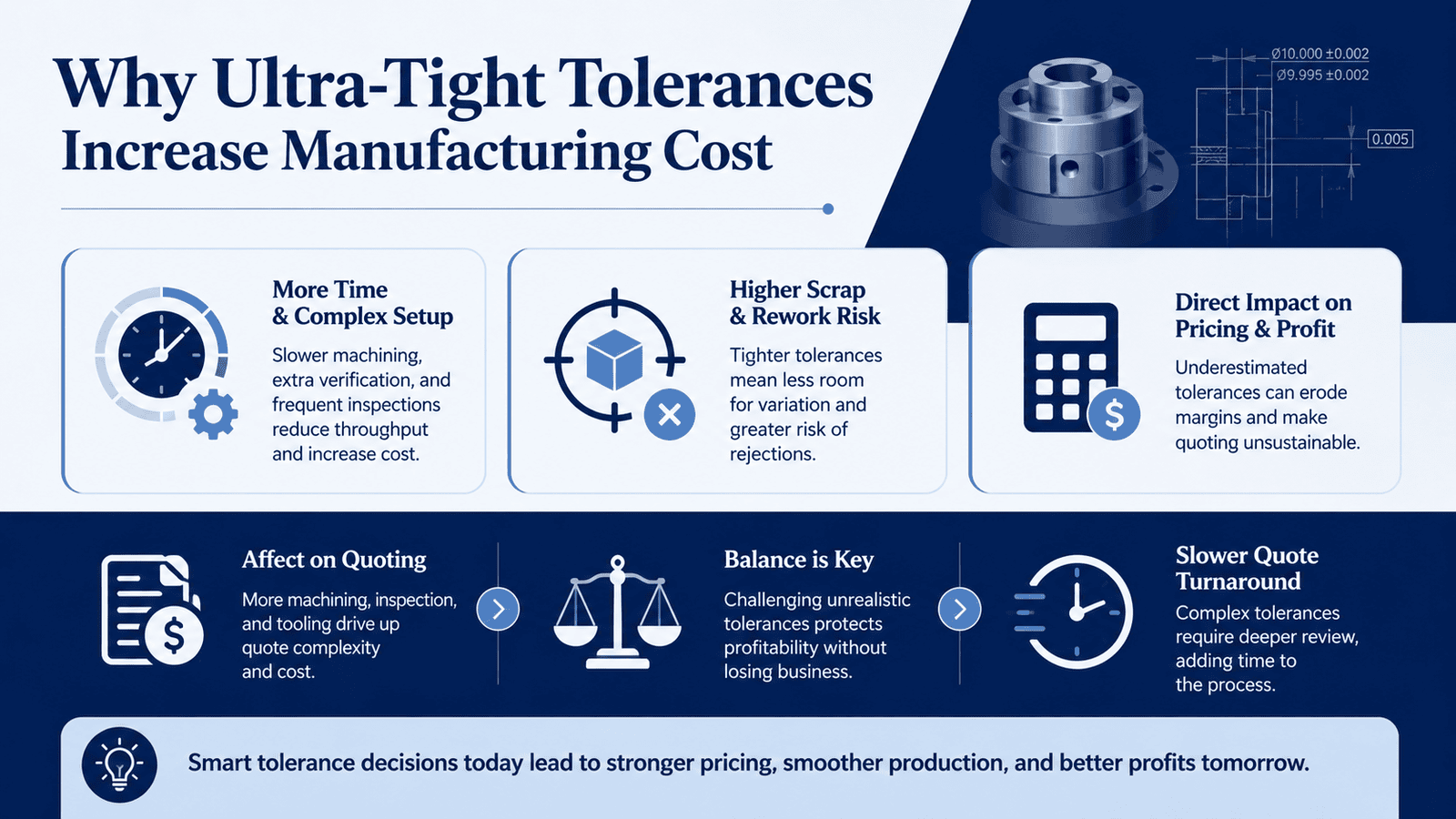
Why Ultra-Tight Tolerances Increase Manufacturing Cost
Achieving extremely tight tolerances requires additional machining control, inspection processes, and production time.
These hidden costs directly affect quoting competitiveness and profitability.
Increased Machining Time and Setup Complexity
Holding micron-level tolerances often requires slower cutting parameters, additional setup verification, and more frequent in-process inspection.
These adjustments reduce throughput and increase production costs.
Higher Scrap and Rework Risk
As tolerances tighten, acceptable process variation becomes smaller.
This increases the likelihood of rejected parts and additional rework during production.
The Impact on Machine Shop Pricing
Tolerance requirements significantly influence production cost calculations.
For suppliers, unrealistic tolerances can quickly erode profit margins if quoting assumptions are inaccurate.
How Tight Tolerances Affect Quoting
Ultra-precision requirements increase machining time, inspection effort, and tooling consumption.
These factors directly impact machine shop pricing models.
Balancing Competitiveness and Profitability
Suppliers often hesitate to challenge customer drawings for fear of losing business.
However, failing to address unrealistic tolerances can create long-term financial pressure.
CNC Quote Turnaround Time and Engineering Review Delays
Complex tolerance requirements frequently slow quoting workflows.
Additional engineering evaluation is often needed before suppliers can confidently estimate production cost.
Increased Technical Review Requirements
Drawings with excessive tolerances require deeper process analysis and manufacturability review.
This slows CNC quote turnaround time and delays customer response.
Engineering teams may need to evaluate fixture rigidity, thermal behavior, tooling wear patterns, and inspection repeatability before confirming production feasibility.
Additional communication between manufacturing, quality, and programming departments is also common for ultra-tight tolerance projects.
Complex quoting reviews increase overhead even before production begins.
Communicating Risk During Quoting
Clear communication helps customers understand the production impact of unnecessary precision requirements.
This strengthens alignment between engineering intent and manufacturing feasibility.
When suppliers explain how tolerances affect inspection time, process stability, and production cost, customers are often more willing to review non-critical dimensions.
Collaborative manufacturability discussions improve project transparency and reduce future production conflict.
Strong engineering communication frequently improves customer trust more effectively than aggressive pricing alone.
Coordinate Measuring Machine Requirements and Inspection Costs
Inspection complexity increases significantly as tolerances tighten.
Many ultra-precision parts require advanced metrology equipment and extended quality verification.
As tolerance windows become smaller, standard handheld measurement tools often become insufficient for reliable inspection verification.
This forces suppliers to invest in advanced quality-control systems, climate-controlled inspection environments, and more detailed measurement procedures.
Inspection cost increases can become substantial even when machining processes remain relatively stable.
The Role of Coordinate Measuring Machine Systems
A coordinate measuring machine provides high-accuracy dimensional inspection for complex components.
While essential for critical applications, extensive CMM inspection increases both production time and operating cost.
Many ultra-tight tolerance environments require advanced inspection systems such as bridge CMMs, optical measurement systems, laser scanners, surface profilometers, bore gauges, air gauges, and digital height measurement systems.
Temperature-controlled inspection rooms are also frequently required because even minor thermal variation can affect measurement accuracy at micron-level tolerances.
Operators must often perform multi-point measurement routines and repeat verification cycles to confirm dimensional consistency.
For many suppliers, inspection infrastructure becomes one of the largest hidden costs associated with ultra-precision manufacturing.
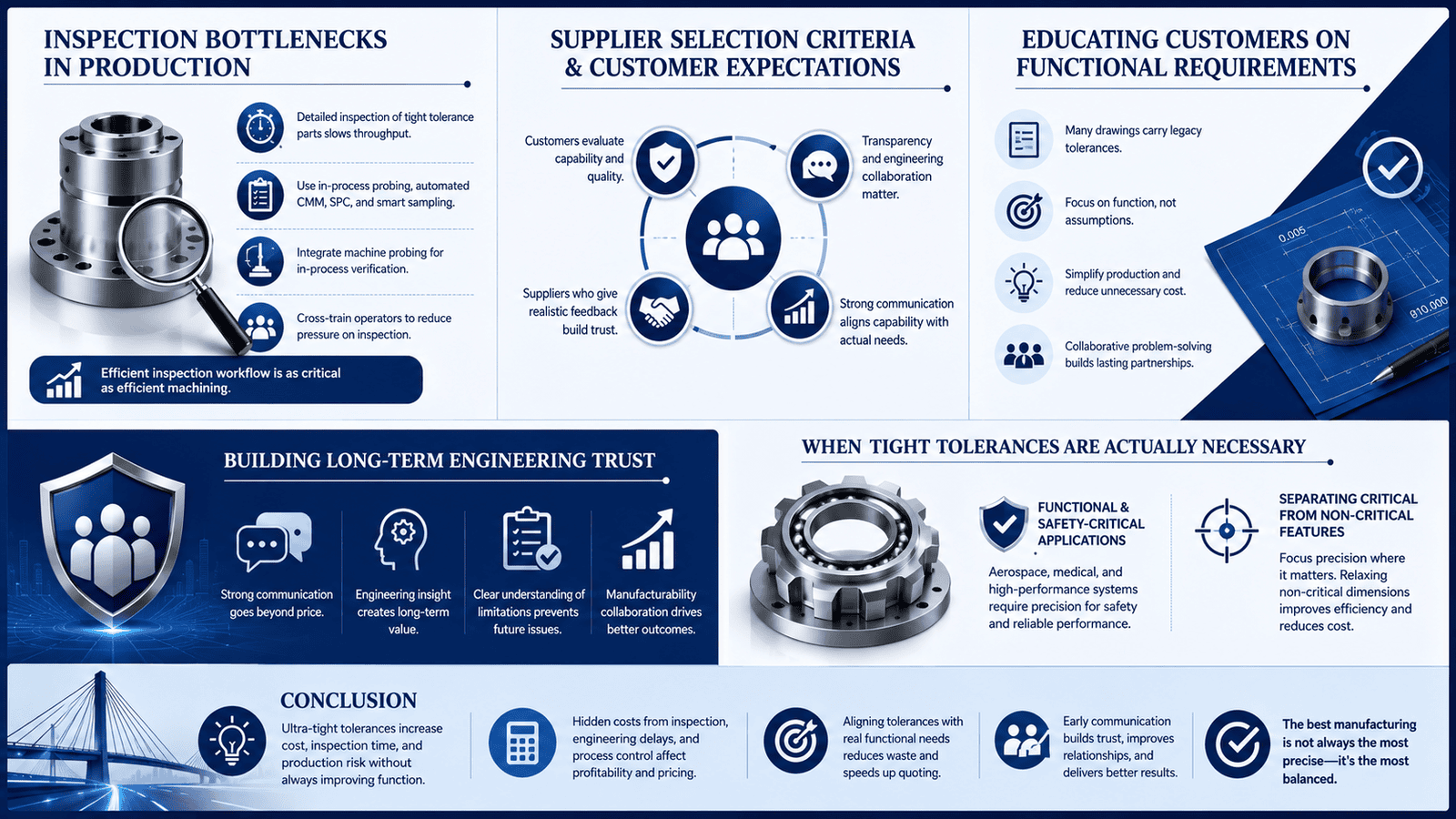
Inspection Bottlenecks in Production
Inspection departments can become production bottlenecks when large volumes of tight tolerance parts require detailed measurement verification.
This slows throughput and impacts delivery timelines.
Many suppliers counter this problem by implementing in-process probing, automated CMM programming, statistical process control (SPC), and sampling-based inspection strategies where appropriate.
Some shops also reduce bottlenecks by integrating machine-mounted probing systems directly into cnc machine and programming workflows, allowing dimensional verification during machining instead of waiting for final inspection.
Cross-training operators to perform basic dimensional validation can also reduce pressure on centralized quality departments.
Improving inspection workflow efficiency is often just as important as improving machining efficiency when managing tight tolerance production.
Supplier Selection Criteria and Customer Expectations
Customers often evaluate suppliers based on machining capability and quality performance.
However, successful supplier relationships also depend on transparency and manufacturability collaboration.
Many customers value suppliers that provide realistic engineering feedback instead of simply accepting difficult drawings without discussion.
Strong communication helps align production capability with actual functional requirements.
Educating Customers on Functional Requirements
Many drawings contain legacy tolerances that no longer reflect actual functional needs.
Suppliers who provide constructive feedback help customers optimize manufacturability and cost.
Engineering discussions focused on functionality rather than assumption-based tolerancing often reveal opportunities to simplify production significantly.
Customers frequently appreciate suppliers that help reduce unnecessary manufacturing cost while maintaining product performance.
Collaborative problem-solving strengthens long-term supplier relationships.
Building Long-Term Engineering Trust
Strong communication improves supplier selection criteria beyond price alone.
Customers value suppliers that contribute engineering insight and production expertise.
Suppliers that explain machining limitations clearly often build stronger long-term partnerships than suppliers competing only on aggressive pricing.
Manufacturability collaboration also reduces future production disputes and unexpected quality issues.
Engineering trust becomes especially important in complex machining environments where tolerance strategy directly affects profitability.
When Tight Tolerances Are Actually Necessary
Not every tolerance should be relaxed.
Critical assemblies, sealing surfaces, and precision alignment features may require extremely tight control.
The key challenge is distinguishing between dimensions that genuinely affect functionality and dimensions that have been over-specified unnecessarily.
Functional tolerancing helps suppliers focus machining precision where it truly matters.
Functional and Safety-Critical Applications
Aerospace, medical, and high-performance mechanical systems often depend on precise dimensional control.
In these cases, tight tolerances directly affect safety and functionality.
Critical bearing fits, sealing interfaces, alignment features, and motion-control systems may require extremely stable dimensional accuracy during operation.
For these applications, precision is not optional because performance reliability depends directly on dimensional consistency.
Proper tolerance allocation becomes essential for both safety and manufacturing efficiency.
Separating Critical from Non-Critical Features
Identifying which dimensions truly require precision allows suppliers to optimize production efficiency while maintaining performance requirements.
Non-critical cosmetic or clearance dimensions often allow wider tolerances without affecting functionality.
Relaxing unnecessary tolerance restrictions can reduce machining cost, inspection time, and production variability significantly.
Many successful manufacturability reviews focus on simplifying non-functional dimensions first before adjusting critical features.
This balanced approach improves both production efficiency and product reliability.
Conclusion
Ultra-tight tolerances are not always a sign of better engineering. In many cases, unnecessary precision increases machining complexity, inspection cost, and production risk without improving functionality.
For machining suppliers, understanding the hidden impact of tight tolerances is essential for protecting profitability and improving machine shop pricing competitiveness.
Inspection requirements, engineering review delays, and process-control complexity often create larger operational costs than many customers initially realize.
By aligning tolerance requirements with real functional needs and communicating manufacturability concerns early, suppliers can reduce waste, improve CNC quote turnaround time, and build stronger customer relationships.
The most successful manufacturing environments are not always the most precise—they are the most balanced between functionality, manufacturability, and long-term production stability.
If your machining team is struggling with shrinking margins, extended inspection time, or difficult quoting discussions, your tolerance strategy may need closer evaluation.
Reviewing drawings through both engineering and manufacturing perspectives can reveal opportunities to improve cost efficiency without compromising product performance.
Companies like Vulcury support suppliers with production-focused manufacturability insights, helping teams balance precision requirements with machining efficiency and long-term profitability.
By improving communication around tolerance requirements early, suppliers can strengthen customer trust, reduce production risk, and create more sustainable manufacturing operations.
Frequently Asked Questions
1. Why do ultra-tight tolerances increase CNC manufacturing cost?
Ultra-tight tolerances require slower machining speeds, additional setup validation, more frequent in-process inspection, and tighter process control. These added requirements increase machining time, inspection workload, tooling wear, and scrap risk—significantly impacting manufacturing cost and profitability.
2. How do tight tolerances affect machine shop pricing and quoting?
Tighter tolerances increase production complexity, engineering review time, and inspection requirements. As a result, suppliers must account for additional machining risk, quality-control effort, and process stability when calculating machine shop pricing and CNC quote turnaround time.
3. Why do tight tolerance parts require advanced inspection equipment?
Micron-level tolerances often exceed the capability of standard handheld measuring tools. Suppliers may need advanced metrology systems such as coordinate measuring machine (CMM) equipment, optical inspection systems, and temperature-controlled inspection environments to reliably verify dimensional accuracy.
4. When are ultra-tight tolerances actually necessary in manufacturing?
Ultra-tight tolerances are essential for critical applications such as aerospace assemblies, medical components, sealing surfaces, bearing fits, and precision alignment features where dimensional accuracy directly affects safety or performance. For non-critical features, unnecessarily restrictive tolerances often increase cost without adding functional value.