
The 5 Things That Consumer Electronics OEMs Expect from Their Manufacturing Partners
Introduction
Consumer electronics OEMs operate in one of the most competitive and fast-moving industries in manufacturing. Product cycles are short, consumer expectations are high, and companies must constantly innovate to remain competitive. Many devices move from concept to market within a year, and successful launches often require manufacturing partners who can scale production from prototype builds to thousands or even millions of units without compromising quality.
For suppliers and manufacturers working in this space, success depends not only on production capability but also on the ability to align closely with the needs of OEM partners. Manufacturing partners are expected to deliver consistent quality, support rapid product development cycles, and maintain reliable supply chains. Suppliers who understand these expectations are better positioned to build long-term relationships with consumer electronics OEMs and become trusted partners rather than transactional vendors.
The 5 things that consumer electronics OEMs expect from their manufacturing partners are: consistent process and quality control, design for manufacturability support, flexibility during product development and ramp-up, supply chain reliability and component sourcing, and transparent communication and operational visibility. Please read on for the details.
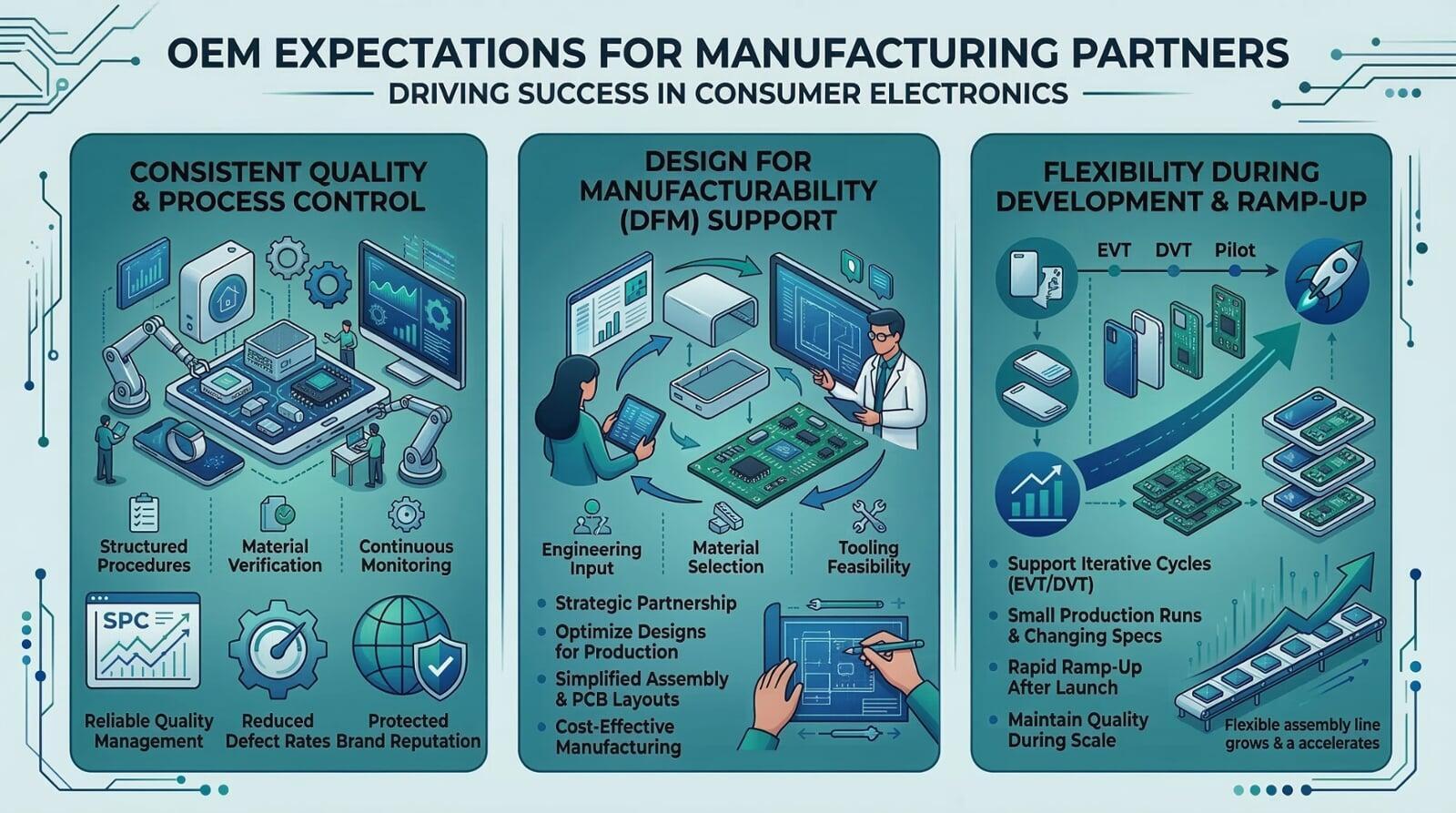
Consistent Quality and Process Control
Quality is one of the most important expectations OEMs have when working with manufacturing partners. Consumer electronics products often include complex assemblies, precision components, and integrated electronics that must function reliably across thousands or even millions of units.
OEMs expect suppliers to maintain strong quality control systems that ensure production consistency. This often includes structured inspection procedures, incoming material verification, and continuous process monitoring throughout the manufacturing workflow. Many OEMs also look for manufacturers that implement established quality frameworks such as statistical process control (SPC), traceability systems, and internationally recognized quality standards like ISO 9001.
Manufacturers that demonstrate repeatable production processes and reliable quality management systems help OEMs reduce defect rates, protect brand reputation, and maintain product reliability in the market.
Another major expectation OEMs have for manufacturing partners is the ability to contribute to design for manufacturability (DFM). While product development typically begins within the OEM’s engineering team, manufacturing partners often play an important role in refining designs before full-scale production begins.
Suppliers that provide early feedback on material selection, tooling feasibility, assembly workflows, and process limitations can help OEMs avoid costly redesigns later in development. For example, manufacturers may suggest simplifying enclosure geometries for injection molding, reducing part counts to streamline assembly, or optimizing PCB layouts for automated pick-and-place processes.
Manufacturers that actively participate in DFM discussions position themselves as strategic partners who contribute value beyond basic fabrication services and help ensure products can be manufactured efficiently at scale.
Flexibility During Product Development and Ramp-Up
Consumer electronics products often go through several iterations before reaching final production. During development phases such as engineering validation builds (EVT), design validation builds (DVT), and pilot production runs, OEMs may require small batches of products while designs are still evolving.
Manufacturing partners are expected to support this iterative process. Suppliers who can accommodate short production runs, rapid tooling adjustments, and changing product specifications provide significant value during the product development cycle.
Flexibility during ramp-up is also important when demand shifts quickly after a product launch. OEMs prefer manufacturing partners that can scale production volumes efficiently while maintaining quality and delivery reliability.
Supply Chain Reliability and Component Sourcing
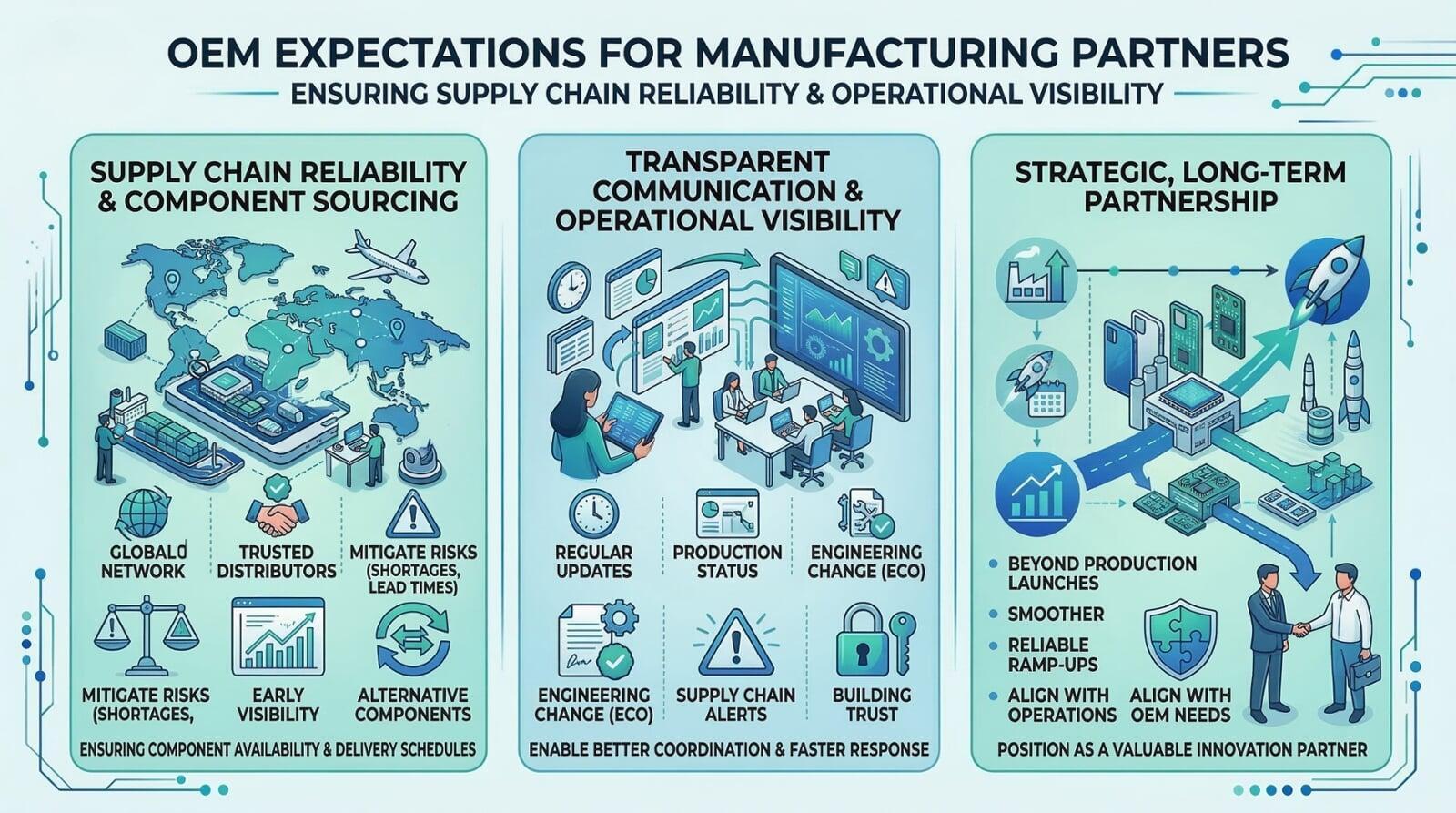
Consumer electronics manufacturing depends on complex global supply chains for electronic components, materials, and specialized parts. OEMs expect their manufacturing partners to have strong supply chain management capabilities that ensure components are sourced reliably and delivered on schedule.
Manufacturers that maintain relationships with trusted component distributors and understand global sourcing dynamics can help OEMs mitigate risks such as component shortages, extended lead times, or component obsolescence. Recent industry disruptions—including semiconductor shortages—have demonstrated how quickly supply challenges can affect production timelines.
Suppliers that provide early visibility into potential supply risks and recommend alternative components when necessary help OEMs maintain stable production schedules and meet product launch deadlines.
Transparent Communication and Operational Visibility
Clear and consistent communication is another key factor in successful OEM–manufacturer relationships. Consumer electronics OEMs expect regular updates on production progress, potential risks, and any issues that may affect delivery schedules or product quality.
Many manufacturers support this expectation through structured communication systems such as production status reports, engineering change notifications, and supply chain alerts. These updates allow OEM engineering and procurement teams to stay informed about manufacturing progress and respond quickly to any emerging challenges.
Manufacturers that prioritize transparent reporting and operational visibility build stronger trust with OEM partners and enable better coordination between design, procurement, and production teams.
Conclusion
For suppliers and manufacturers in the consumer electronics industry, meeting OEM expectations requires more than production capacity. Successful partnerships depend on consistent quality systems, active collaboration during product development, flexible production capabilities, and reliable supply chain management.
Manufacturers who understand these priorities can position themselves as valuable long-term partners for consumer electronics OEMs. By aligning closely with the needs of OEM engineering and product teams, suppliers can help enable faster product launches, smoother production ramp-ups, and more reliable electronics manufacturing operations.
As consumer electronics products become more sophisticated and development cycles continue to accelerate, manufacturers that combine technical expertise with strong collaboration will play an increasingly important role in successful product launches.
For manufacturers and suppliers in the consumer electronics industry, building strong relationships with OEMs requires more than production capability. OEMs increasingly look for partners who can contribute to design for manufacturability, support rapid product development cycles, and maintain reliable supply chains as products scale to mass production.
Platforms like Trustbridge help connect capable manufacturers with consumer electronics OEMs seeking reliable production partners. By participating in collaborative manufacturing ecosystems, suppliers can showcase their capabilities, engage earlier in product development discussions, and build long-term partnerships with innovative consumer electronics brands.
Manufacturers that align their operations with the evolving expectations of OEMs position themselves to win more projects, strengthen strategic partnerships, and play a key role in bringing the next generation of consumer electronics products to market.
Frequently Asked Questions (FAQs)
1. What do consumer electronics OEMs look for in manufacturing partners?
OEMs typically prioritize consistent quality systems, strong design for manufacturability support, reliable supply chain management, and the ability to scale production efficiently. Manufacturers that can collaborate closely with engineering teams and maintain operational transparency are more likely to become long-term partners.
2. Why is design for manufacturability important in OEM–manufacturer collaboration?
Design for Manufacturability (DFM) helps ensure that product designs can be produced efficiently at scale. When manufacturers provide early feedback on materials, tooling, and assembly processes, OEMs can avoid costly redesigns and improve production efficiency.
3. How does supply chain reliability impact consumer electronics production?
Consumer electronics products depend on globally sourced components such as semiconductors and electronic assemblies. Manufacturing partners that maintain strong supplier networks and proactively manage component availability help OEMs avoid production delays and meet product launch timelines.
4. How can manufacturers become long-term partners for consumer electronics OEMs?
Manufacturers that consistently deliver high quality, provide technical feedback during product development, communicate transparently, and support flexible production ramp-ups are more likely to build long-term partnerships with OEM companies.