
The Buyer’s Guide to the Supplier Scorecard: Metrics That Truly Matter
Procurement teams often face a familiar struggle: suppliers promise excellence, but performance tells a different story. Deliveries arrive late, product quality wavers, and service consistency becomes guesswork. The bigger the supplier network grows, the harder it becomes for buyers to separate dependable partners from those quietly draining value.
Real pain lies in invisibility. Without measurable performance data, buying decisions turns into educated guesses. Budgets leak through inefficiencies, and buyer credibility takes the hit when supplier lapses affect operations. Each missed deadline or quality defect ripples through production schedules, customer trust, and cost efficiency.
The solution? A Supplier Scorecard, a structured, data-driven way for buyers to measure, compare, and improve supplier performance. It brings visibility where there’s ambiguity, turning performance conversations into evidence-based decisions. For buyers, it’s not just a management tool; it’s leverage. The supplier scorecard transforms supplier relationships from reactive firefighting to proactive control.
What Is a Supplier Scorecard?
A supplier scorecard is a performance management tool used by buyers to evaluate how well their suppliers are meeting expectations across specific criteria. Think of it as a performance dashboard for procurement, capturing how each supplier performs on key factors such as quality, delivery, pricing, and compliance. It converts scattered supplier data into a clear, comparable view that buyers can act upon. In simple terms, a supplier scorecard helps buyers answer critical questions like: Are we getting consistent value? Is this supplier reliable? Do their actions align with our business priorities? It also reveals performance trends over time, showing whether a supplier is improving, stagnating, or declining. More importantly, it ensures that decisions about renewals, negotiations, and sourcing are rooted in real performance, not assumptions.
For buyers, the supplier scorecard becomes the foundation of supplier management, ensuring every partnership is measured, accountable, and strategically aligned with the organization’s goals.
Why Is a Supplier Scorecard Used in Procurement?
Procurement teams use a supplier scorecard to bring structure and transparency to supplier performance management. It enables buyers to move from intuition to intelligence, using measurable performance data to guide every sourcing decision. In procurement, this matters because every supplier relationship impacts cost, quality, delivery, and ultimately customer satisfaction. By implementing a supplier scorecard, buyers can track how suppliers perform against agreed-upon expectations and identify gaps that need immediate attention. It becomes a shared language between procurement and suppliers, one that replaces subjective judgments with objective insights. Beyond tracking, the scorecard helps identify top-performing suppliers for strategic collaboration while flagging underperformers before they cause costly disruptions.
For procurement teams, it’s also a risk-control mechanism. It highlights patterns of inconsistency or non-compliance early, helping buyers take corrective steps before issues escalate. Over time, this structured monitoring drives continuous improvement, better supplier relationships, and measurable business value. In short, the supplier scorecard gives buyers the clarity and confidence needed to make decisions that strengthen their supply base and protect profitability.
Why Implement a Supplier Scorecard from the Buyer’s Viewpoint
For buyers, managing suppliers isn’t just about contracts or pricing; it’s about accountability and partnership. A supplier scorecard allows buyers to see the complete picture of supplier performance and take action before small issues become large problems. It converts scattered supplier interactions into measurable outcomes that directly link to procurement goals. To understand how a supplier’s scorecard transforms the buyer’s decision-making process, it helps to look at how it aligns with a buyer’s day-to-day priorities and supports smarter procurement strategies.
Setting the Scene: Buyer Priorities
Every buyer aims to build a supplier network that performs consistently, delivers value, and supports business growth. But that balance is hard to achieve when suppliers vary in performance, responsiveness, and reliability. A supplier scorecard gives buyers the structure to evaluate each supplier through a consistent lens, measuring real performance instead of relying on assumptions or occasional feedback.
From a buyer’s point of view, the priorities are simple yet demanding consistent delivery, reliable quality, competitive cost, and low risk. A supplier scorecard aligns all of these priorities into one system. For example, it helps buyers track whether suppliers are meeting delivery commitments, maintaining product quality, or complying with agreed standards. Over time, this insight reveals which suppliers deserve more business and which require review or intervention. Buyers often find that what cannot be measured cannot be improved and that’s where the supplier scorecard becomes their most valuable performance compass.
How a Supplier Scorecard Supports Buying Decisions
When buyers base their decisions on clear data rather than assumptions, outcomes improve across every stage of procurement. A supplier scorecard equips buyers with facts not feelings, about supplier performance. It becomes the foundation for every sourcing, negotiation, and partnership decision. For instance, if a supplier consistently achieves high delivery accuracy, the buyer gains confidence to allocate more business to that supplier. Conversely, if performance indicators like response time or defect rate begin to decline, the buyer has evidence to address it early or reconsider the relationship. This objective assessment saves both time and cost while preventing disruptions.
Moreover, the scorecard makes supplier conversations more transparent and productive. Instead of vague feedback, buyers can point to clear metrics and trends that support constructive discussions. This builds credibility for procurement teams and strengthens relationships with suppliers who see the buyer as performance-driven and fair. A supplier scorecard doesn’t just track performance; it shapes better decisions, reinforces accountability, and builds stronger supply ecosystems where both sides understand what “good” looks like.
Core Metrics to Include in a Supplier Scorecard
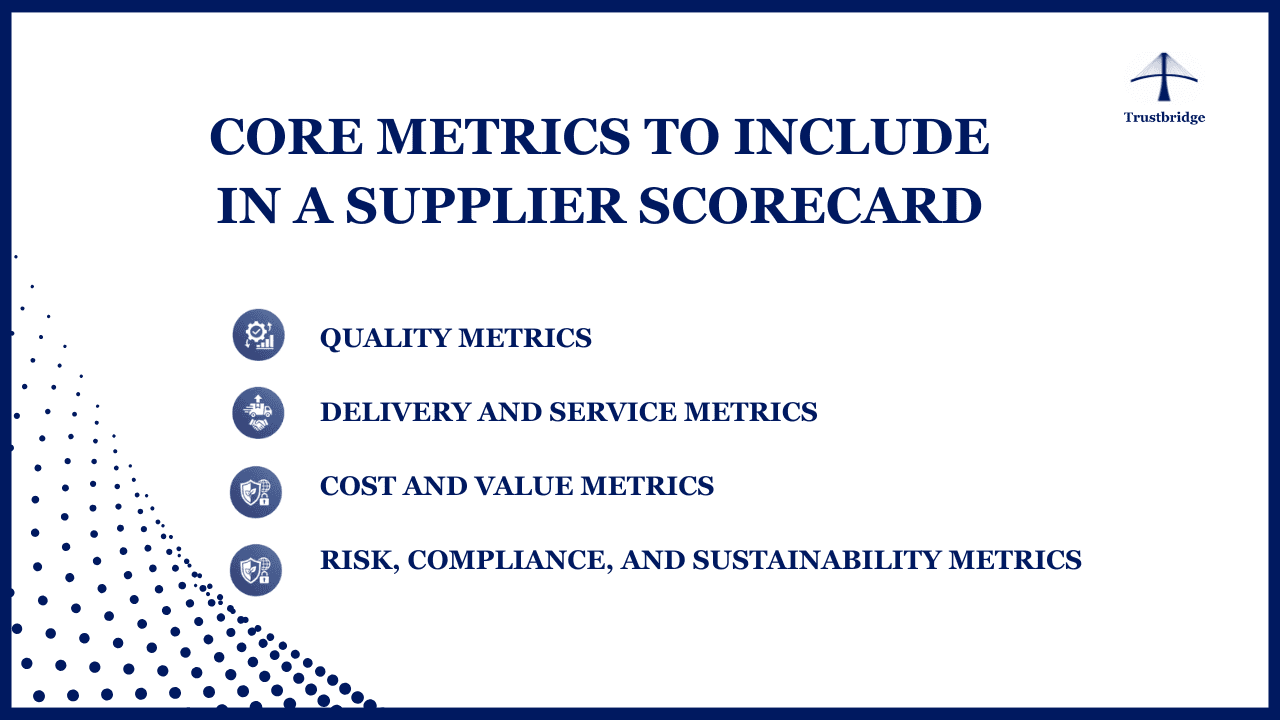
A supplier scorecard is only as effective as the metrics it measures. For buyers, this means focusing on what truly drives operational performance, cost efficiency, and reliability. The right metrics help buyers separate high-performing suppliers from those that need improvement. Before diving into specific metrics, it’s important to note that buyers should prioritize clarity over complexity. A good supplier scorecard isn’t about adding endless KPIs, it’s about selecting the ones that matter most to procurement goals.
1. Quality Metrics
Quality remains one of the most critical factors for buyers because poor quality affects far more than the product itself; it impacts cost, delivery schedules, and customer trust. A supplier scorecard helps buyers track metrics like defect rate, return rate, and conformance to specifications to evaluate whether a supplier is meeting expectations consistently.
From a buyer’s view, quality metrics reveal not just what is delivered, but how reliably it’s done over time. For example, a supplier who maintains high quality under tight deadlines is often more valuable than one who delivers cheaply but inconsistently. Monitoring trends also allow buyers to detect gradual quality drops early and work with suppliers on corrective actions before they become costly. Ultimately, these quality insights give buyers confidence in choosing partners who align with their organization’s standards and reputation goals.
2. Delivery and Service Metrics
Even the best product loses value if it doesn’t arrive on time. Buyers depend heavily on reliable delivery and responsive service to keep operations running smoothly. Delivery and service metrics in a supplier scorecard typically measure factors such as on-time delivery rate, lead-time consistency, order accuracy, and issue resolution speed.
From a buyer’s perspective, these metrics directly influence productivity and cost control. When a supplier consistently meets delivery timelines, it allows procurement teams to plan inventory better, avoid production delays, and reduce emergency expenses. On the other hand, recurring late deliveries or inaccurate shipments highlight where the supply chain needs tightening. Tracking these performance patterns helps buyers identify dependable partners and gives them a factual base during negotiations or contract renewals. Reliable delivery metrics also foster trust, something every buyer values when managing long-term supplier relationships.
3. Cost and Value Metrics
For buyers, price is only one part of the equation; total value matters more. A supplier scorecard helps buyers evaluate cost metrics beyond just the quoted price, looking instead at the total cost of ownership. This includes not only the purchase cost but also hidden costs such as logistics issues, delays, quality failures, and administrative effort.
By tracking cost-related indicators like price stability, cost reduction initiatives, and invoice accuracy, buyers can understand which suppliers genuinely contribute to financial efficiency. Over time, this helps identify opportunities for negotiation and highlights suppliers who deliver consistent value at sustainable costs. For procurement teams, this shift from price-driven buying to value-based buying creates a more balanced, strategic approach, where cost efficiency is achieved without compromising reliability or quality.
4. Risk, Compliance, and Sustainability Metrics
A buyer’s responsibility doesn’t end at securing low-cost, high-quality suppliers. It also involves ensuring that suppliers operate responsibly, ethically, and within compliance frameworks. This is where risk and sustainability metrics become vital parts of a supplier's scorecard. Buyers can assess suppliers based on risk exposure, financial stability, adherence to compliance requirements, and alignment with sustainability goals. For example, suppliers who meet environmental standards, follow ethical sourcing practices, and maintain regulatory compliance reduce risk for the buyer and enhance corporate reputation. For modern procurement teams, these metrics go beyond paperwork, they reflect the buyer’s long-term strategy and brand values. By integrating sustainability and compliance tracking into the supplier scorecard, buyers create a supply chain that is not only efficient but also responsible and future ready.
Designing a Supplier Scorecard That Works for Buyers
Creating a supplier scorecard that actually drives results requires more than just picking metrics and filling in numbers. For buyers, the real value lies in how well the scorecard aligns with business goals, guides decisions, and encourages supplier improvement. It should feel less like a report and more like a strategic dashboard, one that tells procurement exactly where each supplier stands and what needs to change. Let’s explore how buyers can design a supplier scorecard that truly works in their favor.
1. Aligning Metrics with Business Goals
A supplier scorecard is only as strong as its alignment with what the buying organization truly values. If the procurement team’s top priority is reliability, then delivery metrics should carry more weight. If cost efficiency or sustainability is the key focus, those dimensions should take center stage. The alignment ensures that every metric on the scorecard connects directly to real business outcomes. For buyers, this alignment helps avoid the trap of measuring what’s easy instead of what’s important. It encourages procurement teams to ask: Does this metric reflect our business priorities? Will tracking it improve supplier performance or decision-making? When the answer is yes, the scorecard becomes a reflection of strategic intent rather than a collection of random data points.
In practice, this means involving key stakeholders, finance, operations, and quality teams when designing the scorecard. Their input ensures that the metrics serve the broader business rather than just the procurement department. Ultimately, a well-aligned supplier scorecard helps buyers evaluate suppliers in the same way the business measures its own success.
2. Weighting, Scoring, and Benchmarking
Once the right metrics are in place, buyers need a clear system to interpret them. This is where weighting, scoring, and benchmarking come into play. These elements turn raw performance data into actionable insight, helping buyers compare suppliers fairly and make confident decisions. Weighting means assigning importance to each metric. For example, a buyer might give 40% weight to delivery reliability, 30% to quality, 20% to cost, and 10% to sustainability, depending on business priorities. This ensures that the scorecard reflects what truly matters, not just what is easy to measure.
Scoring gives structure to evaluation. By defining what “excellent,” “acceptable,” and “poor” performance looks like, buyers can quickly interpret supplier standings. A consistent scoring system removes bias and keeps evaluation objectives. Benchmarking helps buyers see how suppliers perform against industry standards or internal targets. For instance, comparing suppliers’ defect rates or delivery accuracy reveals who leads and who lags. This comparative insight allows procurement teams to reward top performers, support mid-level suppliers to improve, and take firm action where performance is falling behind. Together, these elements ensure that supplier evaluations are fair, data-driven, and meaningful, helping buyers transform metrics into management intelligence.
3. Review Cadence and Continuous Improvement
A supplier’s scorecard shouldn’t be a one-time assessment; it’s a continuous improvement tool. Buyers benefit most when scorecards are reviewed regularly, discussed openly with suppliers, and updated as business needs to evolve. Setting a consistent review cadence ensures the scorecard stays relevant and actionable. For example, strategic or high-risk suppliers can be reviewed quarterly, while standard suppliers might be reviewed twice a year. This structured approach allows buyers to stay proactive, identifying potential risks early and addressing them before they disrupt operations.
Beyond review frequency, what matters most is what happens after the review. The scorecard should drive conversations that encourage improvement, not blame. When buyers share performance insights transparently, suppliers are more willing to collaborate on corrective actions and innovation. Over time, this process builds trust. It positions procurement as a strategic partner invested in supplier success, not just an evaluator. The end goal is a supply network where performance consistently rises, benefiting both buyer and supplier through shared accountability and growth.
How to Use Supplier Scorecard Insights for Buying Strategy
Once the supplier's scorecard is in place, its value extends far beyond reporting. For buyers, the insights it generates can reshape sourcing strategies, negotiation approaches, and supplier relationships. The key lies in translating the data into clear, strategic actions that strengthen the supply base and reduce risk. Let’s look at how buyers can use these insights to make smarter, more confident decisions.
1. Supplier Segmentation and Prioritization
Not all suppliers are equal, and that’s precisely why segmentation matters. A supplier scorecard gives buyers the data to categorize suppliers based on their performance, reliability, and strategic value. This segmentation helps procurement teams focus on their time and resources where they matter most. For example, top-performing suppliers with strong delivery, quality, and compliance scores can be labeled as strategic partners. These are the suppliers' buyers may collaborate with on innovation, joint development, or long-term contracts. Mid-level performers may require targeted improvement plans, while consistently underperforming suppliers might be considered replacement or reduced allocation.
This segmentation creates clarity. Buyers no longer need to treat all suppliers the same they can tailor their engagement, investment, and expectations based on real data. It also strengthens risk management, ensuring that critical supply categories are backed by high-performing partners. In essence, segmentation driven by the supplier scorecard helps buyers run procurement with precision rather than guesswork.
2. Negotiation, Contract Decisions, and Supplier Development
The supplier scorecard isn’t just an evaluation document — it’s leverage in action. Buyers can use scorecard insights as a foundation for negotiation and contract management. Concrete data on performance gives procurement teams a factual base during discussions, replacing opinion with evidence.
For example, a supplier with consistent on-time delivery and quality excellence might justify a preferred status or longer-term contract. On the other hand, if data shows declining performance or repeated issues, buyers have the grounds to renegotiate terms or request corrective action.
Beyond negotiation, supplier scorecards also help in supplier development, guiding suppliers toward improvement through measurable goals. When buyers share scorecard findings openly, it sets clear expectations and fosters collaboration. Suppliers understand what needs attention, and buyers gain confidence that improvement is being tracked. This two-way approach transforms the buyer-supplier relationship from transactional to developmental. The supplier scorecard becomes the shared language that drives progress, accountability, and mutual success.
Trustbridge Tip: Choosing suppliers solely on the lowest bid often leads to quality drops, hidden costs, and performance issues all of which a supplier's scorecard can help uncover. To understand how low-cost decisions damage profitability can silently, read our detailed insight: Your Lowest Bidder Is a Hidden Cost Disaster.
Common Pitfalls Buyers Should Avoid with Supplier Scorecards
Even the most thoughtfully designed supplier scorecards can fail if they’re not implemented correctly. For buyers, it’s important to remember that the goal isn’t to collect data for the sake of reporting; it’s to create a living tool that drives better supplier relationships and stronger outcomes. Unfortunately, many organizations fall into avoidable traps that make their scorecards less effective. Let’s explore the most common pitfalls buyers should be aware of and how to avoid them.
1. Measuring Too Many Metrics
It’s tempting to track everything about delivery, cost, compliance, ESG, innovation, responsiveness, and more. But when a scorecard becomes overloaded with metrics, it loses focus. Buyers end up spending more time collecting data than actually using it. The best scorecards follow a simple rule: measure what matters most. For example, a manufacturing buyer might focus on quality, delivery, and cost, while a service buyer may prioritize responsiveness and accuracy. Limiting the number of metrics ensures that each one drives meaningful decisions.
Think of it as the 80/20 rule: 20% of the right metrics often provide 80% of the actionable insights. A concise scorecard keeps procurement teams agile and suppliers clear on what truly defines success.
2. Ignoring Supplier Input
A supplier scorecard works best when it’s a two-way street. Too often, buyers create the scorecard in isolation, share it after the evaluation, and expect suppliers to align without discussion. This approach can make suppliers defensive or disengaged, limiting the potential for collaboration. Instead, involve suppliers early. Ask their feedback on which metrics are fair, what data they can realistically provide, and how results will be interpreted. When suppliers feel included in the process, they’re more likely to take ownership of their performance.
This open dialogue also helps buyers refine their scorecard to be more accurate and practical. It transforms the exercise from one-sided grading into a shared effort to improve outcomes, which is the real goal of supplier management.
3. Failing to Act on the Results
Collecting data and reviewing it regularly is only half the job. The other half, the part that creates real impact, is acting on what the scorecard reveals. Many buyers make the mistake of stopping at the report stage. They present scores, file them away, and move on until the next review cycle. But a scorecard’s true power lies in follow-through. If a supplier’s quality has dropped, buyers should schedule a review meeting, discuss root causes, and set an improvement plan. If another supplier consistently outperforms, that success should be rewarded, through increased business, recognition, or preferred status. Action builds credibility. It shows suppliers that performance data isn’t just being collected for compliance, but to genuinely improve collaboration and outcomes.
4. Using the Scorecard as a Punishment Tool
One of the quickest ways to lose supplier trust is to use the scorecard as a “gotcha” tool. When evaluations are framed around blame instead of improvement, suppliers become defensive, communication shuts down, and opportunities for growth are lost. The most effective buyers take a coaching approach. They use the scorecard to start conversations and not end them. For example, instead of saying, “Your delivery rate dropped 10%,” a buyer might ask, “What caused the drop, and how can we help stabilize it?” This shift from criticism to collaboration builds long-term value. Suppliers that feel respected and supported are more likely to invest in performance improvements, which ultimately benefits the buyer too.
5. Not Updating the Scorecard Over Time
Business priorities evolve, and so should the scorecard. What mattered last year, such as cost reduction, might give way to new priorities like sustainability, digital integration, or resilience. If the scorecard stays static, it quickly loses relevance. For buyers, revisiting the scorecard annually (or when major business changes occur) ensures that the metrics reflect current goals. This periodic refresh keeps the evaluation framework modern, meaningful, and connected to strategy. In short, a supplier scorecard should grow with the business. It’s not a static tool, but a dynamic system for ongoing improvement.
Conclusion: Turning Supplier Scorecards into Strategic Advantage
For buyers, supplier scorecards are far more than performance tracking tools, they’re strategic levers that shape stronger partnerships, drive efficiency, and reduce risk. When designed thoughtfully and used consistently, they help procurement teams move from reactive problem-solving to proactive supplier development. By focusing on the right metrics, aligning with business goals, and maintaining open communication, buyers can transform supplier scorecards into instruments of growth rather than just compliance. The process also encourages transparency and shared accountability, ensuring suppliers understand exactly how their performance impacts business outcomes.
In the long run, this approach turns procurement from a transactional function into a strategic force, one that’s capable of building reliable, resilient, and high-performing supply networks. For buyers, that’s not just operational excellence, it’s a competitive advantage.
Trustbridge strives to support buyers by executing the sorts of activities outlined in this blog at scale for our customers. Ready to turn supplier performance into strategic growth? Start building trust and measurable value with Trustbridge. Visit Trustbridge.pro to explore buyer resources, case studies, and solutions designed to help procurement professionals lead with confidence.
Frequently Asked Questions
1. What is a Supplier Scorecard?
A supplier scorecard is a structured tool buyers use to measure and evaluate supplier performance based on key metrics such as quality, delivery, pricing, and reliability.
2. How Do You Create a Supplier Scorecard?
Buyers can create a supplier scorecard by identifying core performance metrics, setting measurable benchmarks, assigning weights to each metric, and tracking results regularly to ensure supplier accountability.
3. How Do You Calculate a Supplier Scorecard?
A supplier scorecard is usually calculated by assigning scores to each metric (for example, on a scale of 1–10), multiplying them by their assigned weight, and then summing the total to get an overall supplier performance rating.
4. Why Should Buyers Use a Supplier Scorecard?
For buyers, a supplier scorecard brings clarity and control. It helps identify high-performing suppliers, spot risks early, and drive data-based decisions that improve procurement efficiency and supplier relationships.
5. What Metrics Matter Most to Buyers in a Supplier Scorecard?
Buyers typically prioritize metrics like quality consistency, on-time delivery, cost adherence, communication responsiveness, and compliance — factors that directly affect operational reliability and customer satisfaction.