Why Finding the Right Manufacturing Partner Is Still So Difficult
Finding a manufacturer has never been easier, but finding the right manufacturing partner remains a major challenge. Online sourcing platforms and supplier directories can quickly generate a list of potential manufacturers, yet they reveal very little about engineering expertise, communication, production readiness, or long-term reliability.
For product designers and hardware engineers, selecting the right design partner manufacturing network is about more than comparing quotes. It means finding a partner who understands your design intent, provides valuable DFM feedback, and can support your product from development through production. This article explores why that process is still so difficult and what engineering teams should look for before choosing a manufacturing partner.
Introduction
You've probably already felt this moment if you're reading this: the CAD file is locked, the tolerances are called out, the BOM is finalized, and for one satisfying second it feels like the hard part is over. Then you start looking for someone to actually build the thing, and you realize the CAD file was the easy part.
This shouldn't still be true. We have instant online quoting, global supplier directories, sourcing marketplaces, and manufacturing networks that promise to connect you with thousands of vetted factories in a few clicks. And yet ask almost any product designer or hardware engineer how they found their current manufacturing partner, and the honest answer usually involves a failed relationship or two, a shipment that didn't match the sample, or months of back-and-forth before anything clicked.
And the frustration shows up in the data, too: 52% of manufacturing and supply-chain leaders name supplier quality, reliability, and compliance as significant ongoing challenges, according to aState of Manufacturing & Supply Chain Report, a 254-leader survey conducted in an era with more sourcing platforms than ever before. The tools for finding manufacturers have gotten better. The problem of finding the right one hasn't gone away. Here's why.
Your product is a parts list, not a single part
Almost nothing you design gets built by one shop using one process. A simple connected device might need an injection-molded enclosure, a stamped or die-cast metal bracket, a machined heat sink, and a populated circuit board — four distinct manufacturing disciplines, each with its own tooling, tolerances, and failure modes.
Most manufacturers are genuinely strong at one or two of these and only adequate at the rest, but you won't learn that from their homepage. So you're left choosing between stitching together several specialized vendors — more relationships to manage, more seams where responsibility can get lost — or picking one partner who's competent everywhere and excellent nowhere. Neither option is obviously right, and the choice has to be made part by part, product by product.
The equipment list on the website isn't the equipment in the room
Every supplier profile lists the same reassuring specs: five-axis CNC, injection molding up to some tonnage, tolerances down to a couple hundredths of a millimeter. What that listing can't tell you is whether that machine is well-maintained or overdue for calibration, whether it's dedicated to jobs like yours or squeezed between three other customers' priority runs, or whether the operator running it has actually held that tolerance on geometry like yours before.
This gap between claimed and actual capability is one of the most stubborn problems in sourcing, and it resists remote diagnosis. Certifications like ISO 9001 confirm that a process and a quality system exist on paper; they don't confirm that this shop, this week, can hit your spec on your part. Short of visiting the floor yourself or paying for an independent audit, you're often taking that gap on faith until your first real order tells you the truth.
DFM feedback is where partners quietly sort themselves
Send the same drawing to ten shops for a quote, and you'll get two very different kinds of responses. Some will quote exactly what you drew, no questions asked. A smaller group will come back with design-for-manufacturability notes: this rib will sink, this wall is too thin for that draft angle, this tolerance will push your reject rate up and your yield down.
That distinction carries more weight than it might seem: roughly 80% of a product's total manufacturing cost is already locked in by design decisions — material, geometry, tolerances, process — before a single supplier ever quotes it, according to DFMA / Boothroyd Dewhurst.
That second group is worth more than almost anything else on their quote sheet, but there's no line item for it, and no easy way to tell which kind of shop you're dealing with until after you've sent the design and waited for the reply. Plenty of designers, especially on a first build, read a quiet quote as a good sign — no pushback, no delays — only to discover during a production run that "as quoted" meant "we'll build precisely what you drew, warts included."
Prototyping skill and production skill don't travel together
A shop that turns around a gorgeous one-off prototype in three days may have never held a tolerance across ten thousand consecutive parts. A factory built around long production runs may treat your fifty-unit pilot batch as an inconvenience, something to fit in between real jobs rather than something to get right.
What most designers actually need — a partner who can nail the first article and then scale with the product — sits in a narrower band of the market than any directory search suggests. It's worth explicitly asking, and verifying, where on that spectrum a candidate partner actually sits, rather than assuming excellence at one end implies competence at the other.
The quote is never the whole cost
Unit price is the easiest number to put in a spreadsheet, so it tends to dominate the decision even though it rarely determines the real cost of the relationship. Tooling costs and who owns that tooling once it's paid for, minimum order quantities, the price and lead time of an engineering change after the mold is already cut, rush fees, and the hours you'll personally spend chasing status updates all add up to far more than the gap between two competing per-unit quotes.
A partner charging a bit more who owns their mistakes and answers your emails is, almost every time, cheaper across the life of the product than the lowest bidder who doesn't. This is easy to say and genuinely hard to price out in advance, which is exactly why so many designers learn it the expensive way, once.
Compliance and certification aren't universal skills
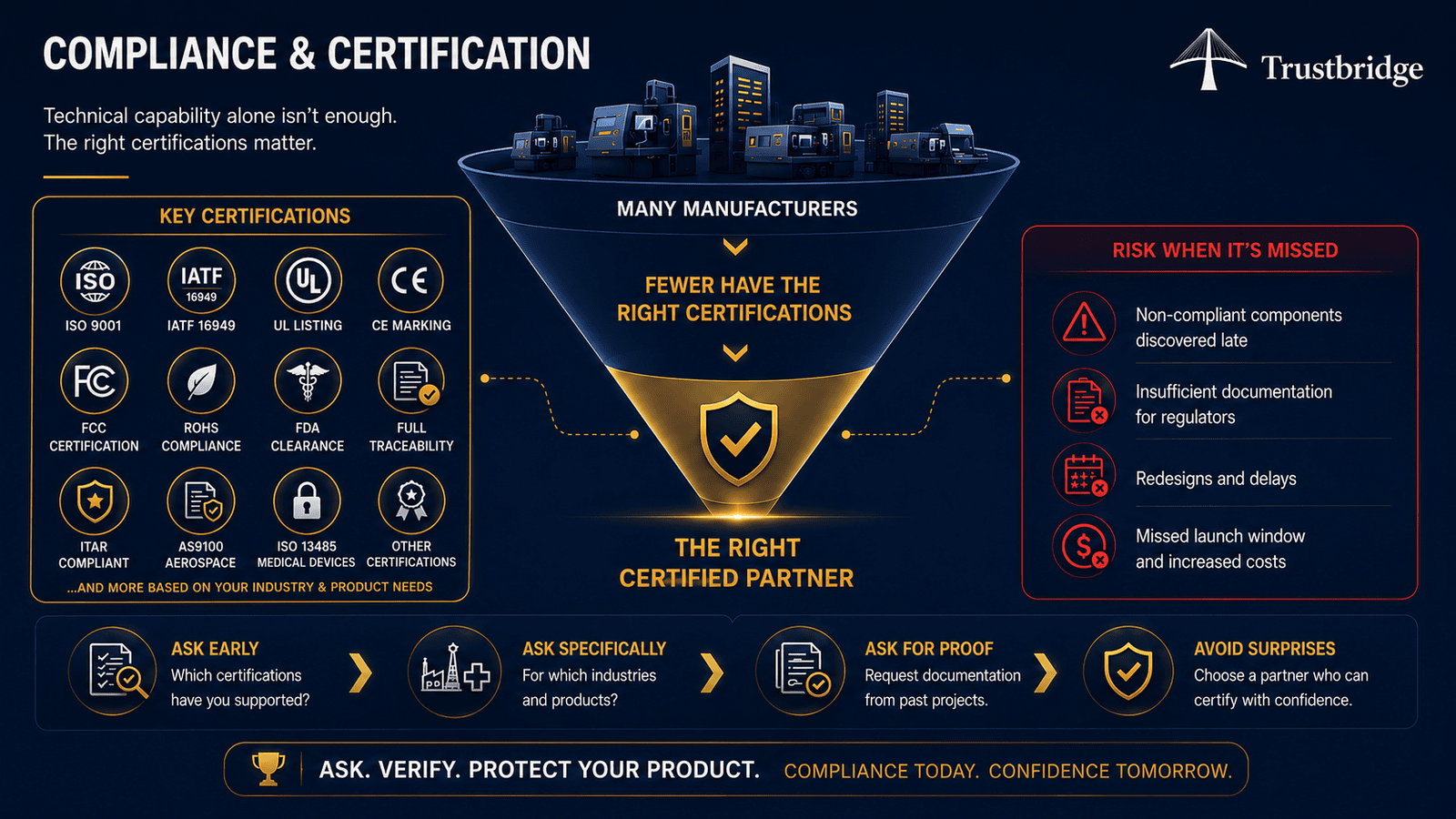
If your product needs UL listing, CE marking, FCC certification, RoHS compliance, or FDA clearance, the list of manufacturers who can actually support that shrinks fast — and it's not always the same list as the one full of shops with the right CNC or molding capability. A factory can be excellent at hitting your tolerances and still have never built a single unit through a UL-recognized component program, never worked with a notified body, or never handled a device that needed FDA-cleared materials and full traceability records.
This mismatch tends to surface late, usually right when you're trying to get a pre-production unit into a test lab and discover the factory hasn't been using UL-recognized components in the exact configuration your listing requires or can't produce the documentation a regulator wants to see. Asking a candidate partner directly which certifications they've supported, for which industries, and asking to see paperwork from a past project, is one of the few ways to catch this before it costs you a redesign or a missed launch window.
Handing over your design is a trust exercise before it's a technical one
Sending a CAD file to a manufacturing partner you haven't worked with, particularly overseas, means putting your design into the hands of a business you have limited ability to verify or, if things go wrong, to hold accountable. NDAs and NNN agreements (non-disclosure, non-use, non-circumvention) help on paper, but enforceability varies enormously by jurisdiction, and few independent designers or small teams have the legal budget to chase a violation across borders even when the agreement is airtight.
This isn't a problem you fully solve; it's a risk you manage in stages. Share less sensitive components first, watch how a partner behaves on a small order, and let the relationship earn increasing trust rather than extending it all up front.
The communication overhead nobody budgets for
Even with a technically excellent partner, day-to-day communication across time zones, languages, and sometimes a chain of sales agents between you and the actual production floor adds friction that's hard to appreciate until you're living inside it. A question that should take five minutes to answer can take five days if it has to pass through several people who are each incentivized to say yes rather than admit uncertainty.
The designers who describe the smoothest partnerships are almost always the ones with a direct line to an engineer on the shop floor, not a sales contact relaying messages in both directions. That access is rarely advertised and almost never shows up in a supplier directory listing, but it may matter more than any spec on the page.
More listings haven't made the choice easier
Instant-quote platforms and supplier marketplaces have made it dramatically faster to find factories that claim to do what you need. What they haven't done is verify fit — whether a given shop's real capability, capacity, and way of communicating actually match your part, your volume, and your timeline. More options can mean more noise rather than less, if the underlying diligence still has to happen by hand, one relationship at a time.
Conclusion
None of this means the search is hopeless, just that it can't be shortcut. A few things consistently separate designers who end up with a partner worth keeping from those who don't:
Treat the first small paid order, not a free sample, as the real audit. It will tell you more about DFM feedback, communication, and quality consistency than any spec sheet or certification ever will. Ask for references tied specifically to your process and your volume, not just the client logos on their homepage. Get tooling ownership and the cost of future design changes in writing before you're committed, not after. And weight your actual access to an engineer as heavily as you weight price — it's usually the better predictor of how the next two years will go.
Finding the right manufacturing partner is still difficult because it was never really a search problem. It's a trust problem, built in stages, verified by evidence rather than by a listing. The designers who go in expecting that, rather than expecting a directory to end the search for them, are the ones who come out the other side with a partner worth calling a partner.
Finding the right manufacturing partner isn't about collecting the longest list of supplier quotes—it's about building relationships with manufacturers who understand your product, contribute engineering expertise, and can support your design from prototype through production.
Trustbridge helps product teams connect with experienced manufacturing partners across CNC machining, injection molding, sheet metal fabrication, and other production processes. By combining engineering collaboration with a trusted global manufacturing network, teams can validate suppliers earlier, improve Design for Manufacturability (DFM), reduce sourcing risk, and make more informed manufacturing decisions before production begins.
If you're evaluating suppliers for your next product, start by finding partners that offer more than manufacturing capacity. The strongest products are built through collaboration with manufacturers who become an extension of your engineering team—not just another name in a supplier directory.
Frequently Asked Questions
1. Why is finding the right manufacturing partner still so difficult today?
While online sourcing platforms make it easy to find manufacturers, they provide limited insight into engineering expertise, production quality, communication, and long-term reliability. Choosing the right manufacturing partner requires evaluating technical capabilities, Design for Manufacturability (DFM) support, and the ability to scale from prototype to production—not just comparing prices.
2. What should designers look for when choosing a manufacturing partner?
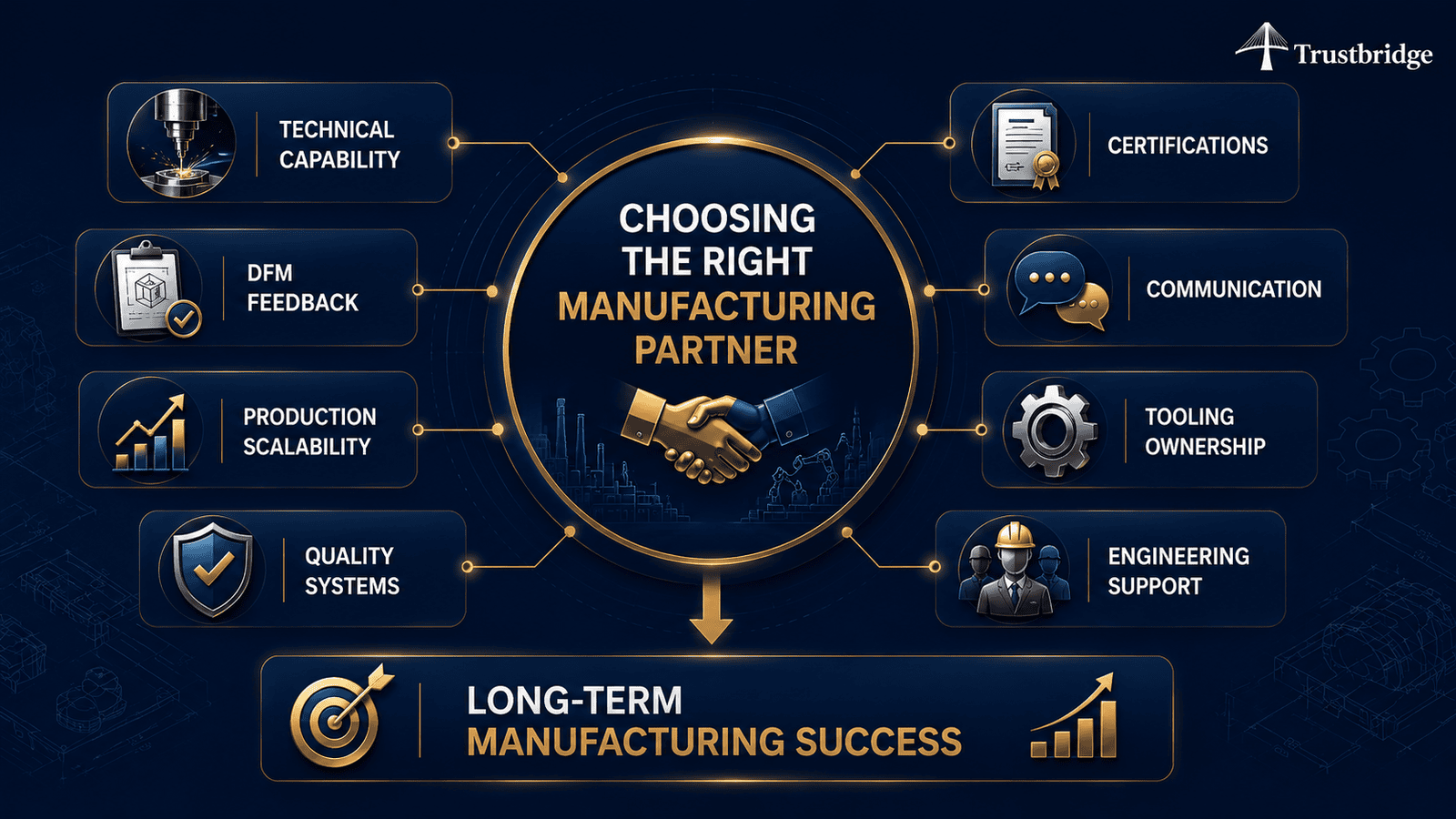
Beyond manufacturing capability, designers should evaluate a supplier's DFM expertise, quality systems, communication process, production capacity, certifications, and experience with similar products. The best manufacturing partners actively identify design improvements and collaborate throughout the product development process.
3. Why is Design for Manufacturability (DFM) feedback important when selecting a manufacturer?
DFM feedback helps identify potential manufacturing issues before production begins, such as unnecessary tight tolerances, difficult geometries, or material choices that increase cost or reduce yield. A manufacturing partner that provides proactive DFM recommendations can improve product quality, reduce production costs, and shorten time to market.
4. How can you verify whether a manufacturing partner is the right fit before full-scale production?
The most effective approach is to start with a small production order rather than relying solely on certifications or prototype samples. This allows you to evaluate manufacturing quality, communication, engineering responsiveness, on-time delivery, and problem-solving capabilities before committing to larger production volumes.