
Supply Generates Demand: The Counterintuitive Logic of a Manufacturing Network
The obvious way to think about a manufacturing network is that buyers create the demand, and suppliers are just capacity waiting to be matched to it. The companies that actually built successful two-sided marketplaces found that the opposite works better.
Introduction
The instinctive way to picture a manufacturing marketplace is buyer-first: demand exists somewhere out there, and the platform's job is finding enough supply to satisfy it. That picture treats suppliers as a resource to be allocated once demand shows up, not as something that does any work of its own beforehand.
The companies that actually built successful two-sided marketplaces learned the opposite lesson the hard way. A marketplace with no suppliers has nothing for a buyer to look at, and a buyer who shows up to an empty shelf once rarely comes back to check again. Supply isn't capacity waiting for demand to justify it. In a real network, supply is very often what creates the demand in the first place.
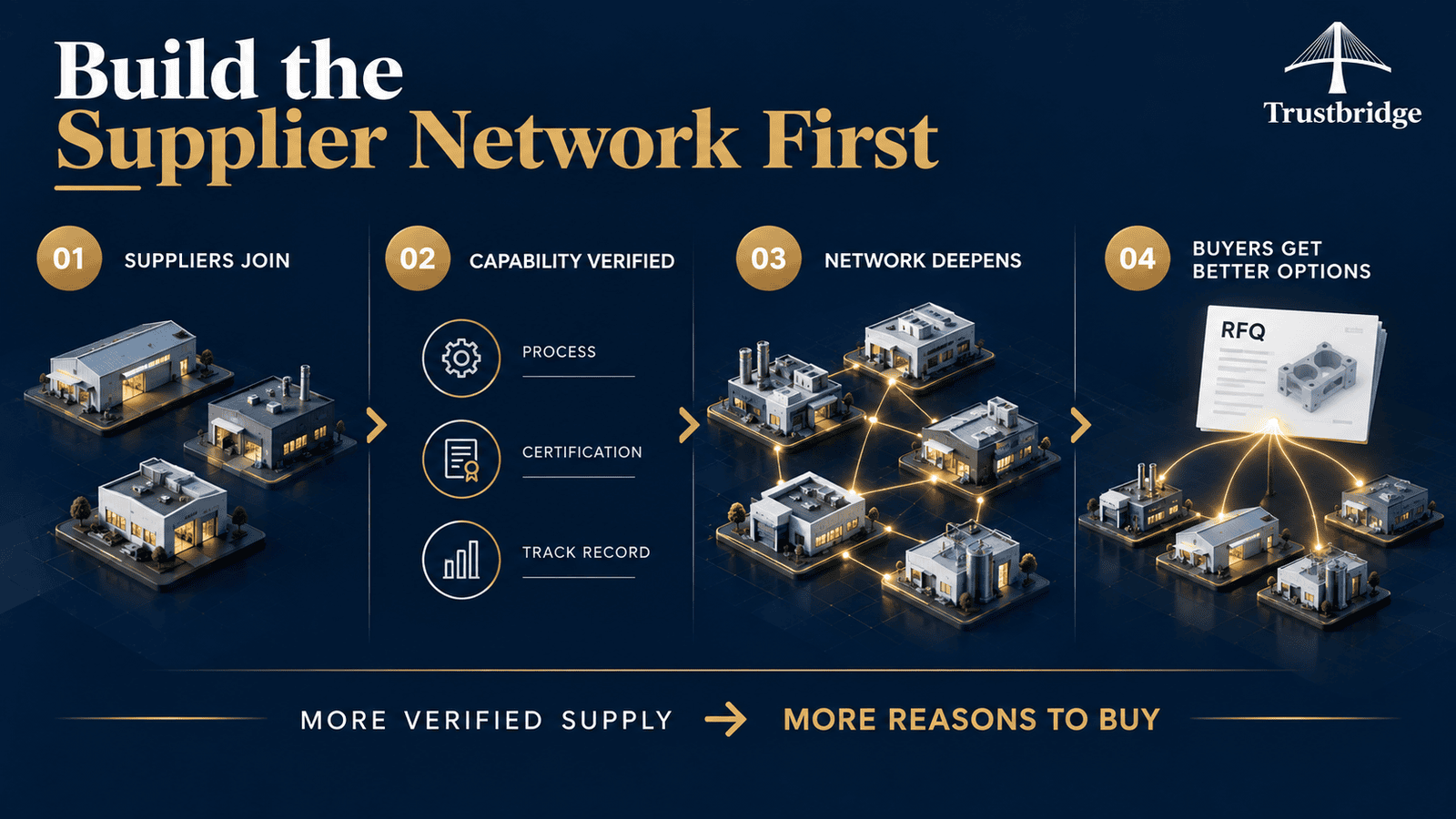
Every Two-Sided Market Hits the Same Wall First
Any marketplace connecting two different groups drivers and riders, hosts and guests, suppliers and buyers runs into the same problem before either side is established. Buyers won't join a marketplace with nothing to buy. Suppliers won't join one with no buyers to sell to. Both sides are waiting on the other, and neither has a reason to move first.
A study examining eight two-sided marketplace ventures across different industries found something consistent. The founders who broke through this problem did it in the same order every time: they built supply first, then worked on demand, then expanded geographically once both sides were working together in one place. That sequence wasn't a coincidence across eight unrelated companies. It reflects something structural about how these markets actually start moving, not a specific playbook any one company happened to stumble onto.
Why Supply Comes First, Not Demand
Uber's early expansion into new cities didn't wait for organic driver interest to build on its own. It paid drivers a guaranteed hourly rate whether or not a ride request ever came in, which removed the real risk of joining a marketplace that might have zero customers on a given day. Once enough drivers were already active and visible, riders had an actual product to use cars nearby, real wait times, a service that worked the first time they opened the app.
OpenTable took a related but different path: it sold restaurants a standalone reservation management system that had genuine value on its own, whether or not a single diner ever booked through the platform. Restaurants adopted the software to manage bookings they already had, not to reach new customers, and by the time OpenTable turned on the consumer-facing side, it had over 20,000 restaurant partners already using the system daily. Priceline acquired the company in 2014 for $2.6 billion a business built on the strength of its supply side well before its demand side existed at any real scale. Both companies solved the same underlying problem the same way: make supply worth joining on its own terms first, and demand follows the supply that's already there.
What This Means for a Manufacturing Network Specifically
A manufacturing network runs into the identical structural problem, even though the "supply" is machining vendors and job shops rather than drivers or restaurants. A buyer with real sourcing needs won't spend time on a platform with a thin, unverified supplier base, no matter how good the technology behind the matching is. A rich, deep bench of verified capability real certifications, real track record, real process variety is what gives a buyer an actual reason to look twice, not a feature added on top of the buyers who eventually arrive.
That reframes what building a strong supplier network is actually for. It isn't backend infrastructure sitting quietly behind the buyer-facing product, waiting to be tapped once demand shows up. It's the demand-generation strategy itself, in the same way OpenTable's restaurant software and Uber's guaranteed driver pay were. A machining vendor's certifications, a foundry's specialization, a job shop's track record none of it is capacity waiting around. It's the reason a buyer chooses to show up at all, and the reason they come back once they have.
Conclusion
Supply generating demand isn't a slogan borrowed from somewhere else and applied to manufacturing for effect. It's the same structural logic that built Uber, Airbnb, and OpenTable, applied to a market where the two sides happen to be manufacturing buyers and manufacturing suppliers instead of riders and drivers. Treating suppliers as the asset a network is built around, rather than capacity a network eventually gets around to using, isn't a values statement. It's the actual mechanism that makes a network worth joining for anyone on either side of it.
The practical version of this is simple enough to act on directly. A network that spends its early effort making supply genuinely worth joining visible, verified, worth a shop's time even before the buyer volume shows up is doing the same work that made every one of these earlier marketplaces succeed. A network that waits for demand to arrive before investing in supply is solving the two-sided problem backward.
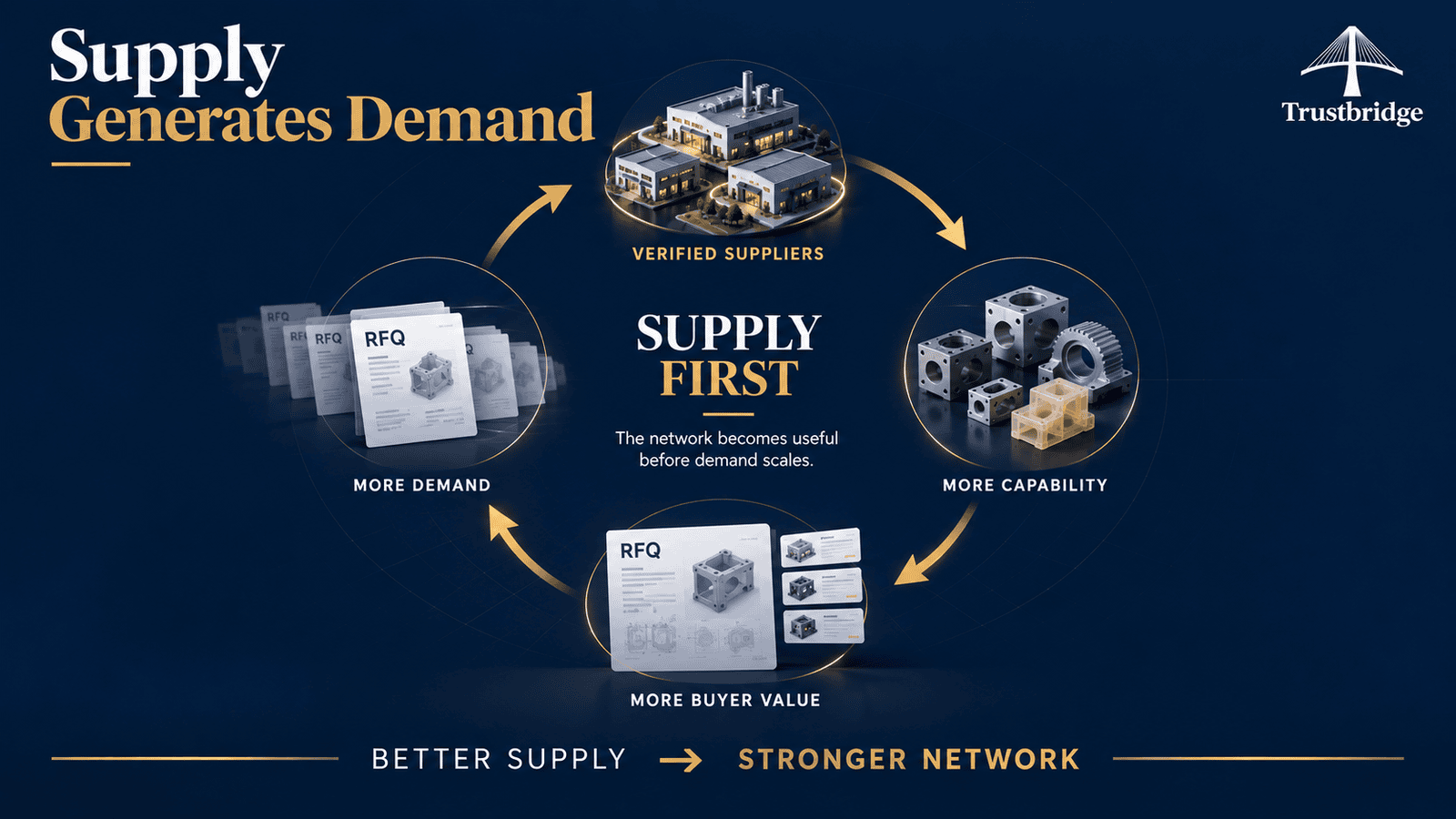
Built on Supply, Not Waiting for Demand
Trustbridge treats its supplier network as the product, not as inventory sitting quietly behind it. Every machining vendor, job shop, and contract manufacturer that joins with verified capability and a real track record makes the network more worth a buyer's time. That's the same reasoning that built a driver base before Uber had real ride volume, and a restaurant list before OpenTable had a working consumer app. It's not a metaphor borrowed for marketing. It's the actual growth strategy, applied to manufacturing instead of rides or restaurant tables.
Frequently Asked Questions
1. Why should a manufacturing marketplace build its supplier network before focusing on buyer demand?
A strong supplier network gives buyers a reason to join and return to the marketplace. Verified manufacturers, specialized capabilities, certifications, and proven track records create useful supply before significant buyer demand exists. This helps solve the two-sided marketplace problem by making the platform valuable from the supply side first.
2. How does a supplier network generate demand for a manufacturing marketplace?
A deep supplier network can generate demand by giving buyers access to capabilities they cannot easily find elsewhere. When a marketplace offers verified suppliers across processes, materials, certifications, and production requirements, its supply becomes part of the product rather than simply infrastructure supporting buyer transactions.
3. What makes a manufacturing supplier network valuable to buyers?
A valuable manufacturing supplier network combines verified capabilities, relevant certifications, manufacturing experience, process variety, and supplier track records. Buyers are more likely to engage when they can find credible suppliers that match the technical and production requirements of their projects.
4. Why is supply important to the growth of a two-sided manufacturing marketplace?
Two-sided marketplaces need both buyers and suppliers, but buyers have little reason to participate if there is not enough relevant supply available. Building a strong supplier network first can create the depth and credibility needed to attract buyers, improve marketplace usefulness, and support growth within a manufacturing network.