What to Look for in a Design Partner - The Criteria That Actually Predict a Successful Outcome
Choosing a design partner is rarely just a creative decision. For companies developing physical products, the right partner influences everything from engineering feasibility and manufacturability to production timelines and long-term scalability. While many businesses still evaluate design firms based on their portfolios, successful product development depends on much more than attractive concepts.
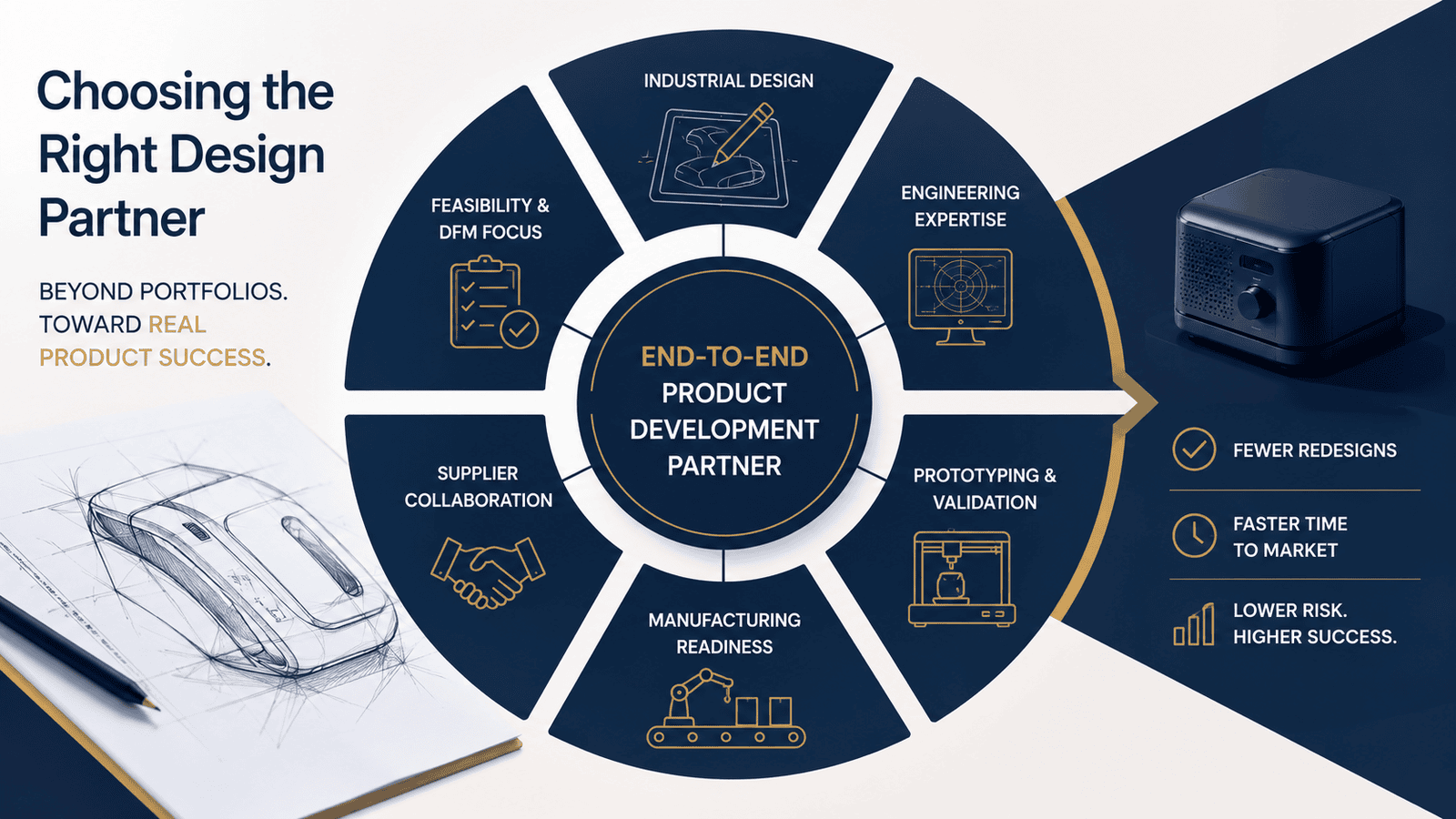
The strongest product design consultancies integrate industrial design, engineering design services, prototyping, validation, and manufacturing expertise into one connected workflow. Understanding how to choose a product design firm means evaluating whether a partner can transform ideas into production-ready products while minimizing redesigns, technical risks, and manufacturing challenges.
Introduction
The role of a product design consultancy has evolved significantly over the past decade. Modern product development is no longer divided into isolated creative and engineering phases. Instead, successful companies rely on partners who can connect industrial design, engineering, prototyping, supplier collaboration, and manufacturing into one continuous development process.
Many organizations still evaluate an industrial design partner primarily through visual portfolios or award-winning concepts. While creativity remains important, attractive designs alone cannot guarantee a successful product launch. Engineering feasibility, manufacturability, production cost, and supplier capabilities all influence whether a concept can become a commercially viable product.
This becomes especially evident during product validation stages. Products typically progress through Engineering Validation Test (EVT), where engineering functionality is verified, Design Validation Test (DVT), where the design is tested for performance and usability, and Production Validation Test (PVT), where manufacturing processes are validated before mass production. Weak decisions made during early design frequently surface during these stages, resulting in costly redesigns and delayed product launches.
Understanding how to choose a product design firm therefore requires looking beyond aesthetics and evaluating how effectively a company manages the complete product design process, from concept generation through engineering and production.
Why the Right Design Partner Determines Product Success
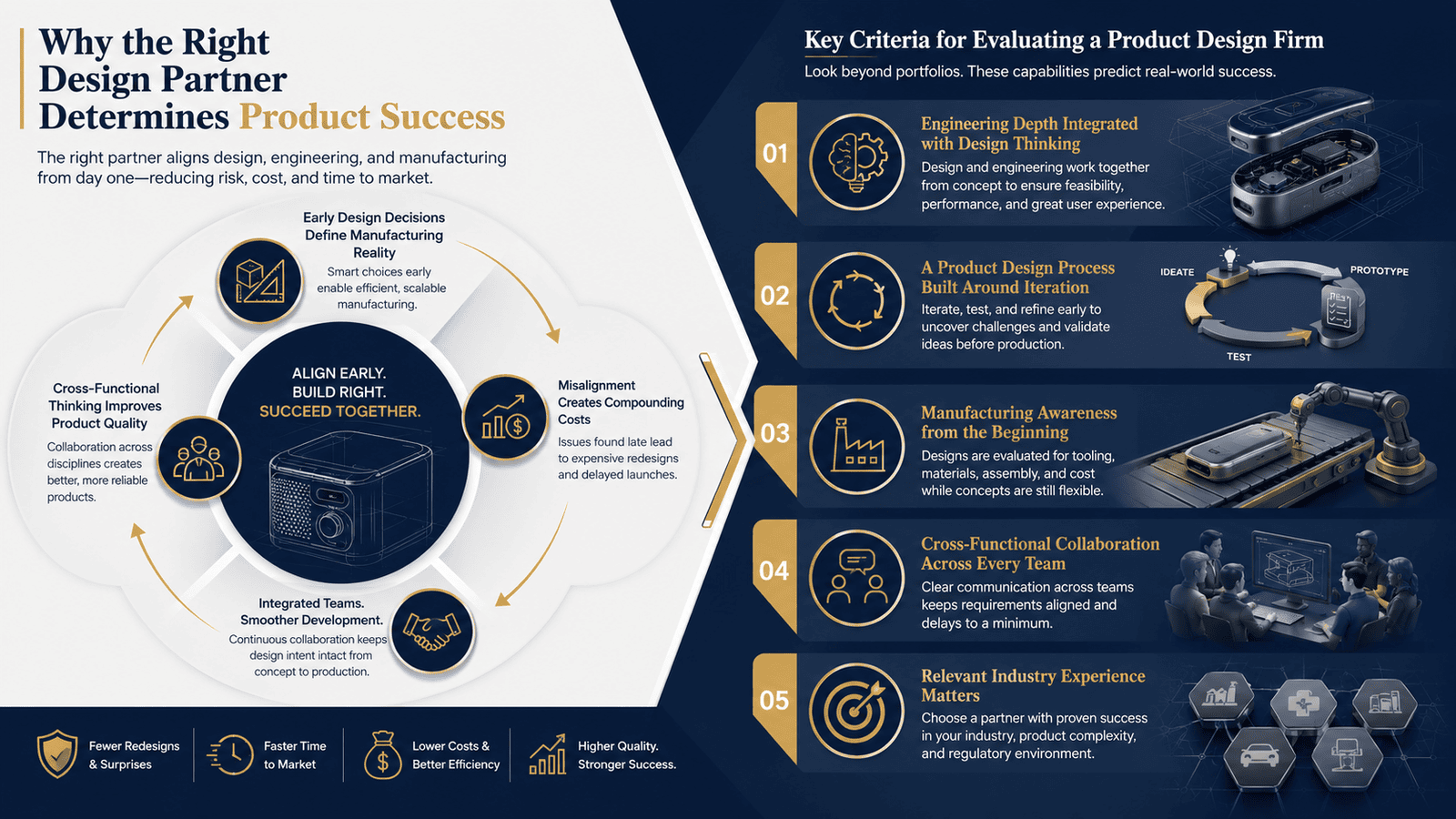
Choosing the right design partner affects much more than the appearance of a product. Every decision made during the early development phase influences engineering complexity, manufacturing efficiency, production costs, and product reliability. Organizations that integrate design and engineering from the beginning typically experience fewer development delays and smoother transitions into manufacturing.
A capable product development agency acts as a strategic partner throughout the development journey rather than simply delivering design files. Their role is to balance creativity with engineering practicality while ensuring every design decision supports long-term manufacturing success.
Early Design Decisions Define Manufacturing Reality
The majority of manufacturing challenges originate long before production begins. Decisions involving geometry, material selection, tolerance stack-ups, fastening methods, and component architecture all influence tooling complexity, production costs, assembly efficiency, and product reliability.
An experienced industrial design partner evaluates these manufacturing constraints while concepts are still evolving. Rather than treating engineering as a separate downstream activity, they integrate engineering knowledge into the creative process. This reduces the likelihood of discovering expensive design issues once prototypes have already been built.
By considering manufacturing capabilities early, companies avoid unnecessary redesign cycles and create products that are both innovative and practical to manufacture at scale.
- Misalignment Creates Compounding Costs During Development
When design, engineering, and manufacturing teams operate independently, small design decisions often become significant production problems. Features that appear visually appealing may prove difficult to manufacture, impossible to assemble efficiently, or excessively expensive to tool.
These issues frequently emerge during Engineering Validation Testing (EVT), Design Validation Testing (DVT), or Production Validation Testing (PVT). At these stages, redesigning tooling, modifying components, or changing manufacturing processes becomes significantly more expensive than making adjustments during concept development.
A strong product development agency minimizes these risks by maintaining alignment between designers, engineers, manufacturing teams, and suppliers throughout the entire product development lifecycle.
- Cross-Functional Thinking Improves Product Quality
Modern product development requires continuous collaboration across multiple disciplines. Designers, mechanical engineers, electronics specialists, manufacturing engineers, quality teams, and suppliers all contribute valuable expertise that influences the final product.
Effective design partners encourage collaboration rather than sequential handoffs. This integrated approach improves communication, reduces engineering conflicts, and ensures design intent remains intact throughout manufacturing.
As products become increasingly complex, companies benefit from partners capable of coordinating every stage instead of optimizing only one discipline in isolation.
Key Criteria for Evaluating a Product Design Firm
Not every product design consultancy offers the same capabilities. While portfolios provide insight into creative work, they reveal very little about engineering quality, manufacturing expertise, or development methodology. Companies should evaluate potential partners using criteria that predict successful execution rather than visual appeal alone.
The following characteristics consistently distinguish high-performing design firms from agencies that focus primarily on aesthetics.
- Engineering Depth Integrated with Design Thinking
Strong product development teams do not separate industrial design from engineering. Instead, both disciplines work together throughout concept development, ensuring every design decision can be supported by mechanical feasibility, material behavior, structural performance, and manufacturing constraints.
This integrated workflow reduces conflicts between designers and engineers while improving product functionality without sacrificing user experience.
Companies seeking engineering design services should prioritize firms capable of combining technical expertise with creative problem-solving rather than outsourcing engineering later in the project.
- A Product Design Process Built Around Iteration
Successful product development rarely follows a perfectly linear sequence. Instead, the best firms continuously refine ideas through research, CAD modeling, simulation, prototyping, testing, user feedback, and engineering improvements.
An effective product design process embraces iteration rather than treating each stage as a one-time milestone. Early prototypes expose technical challenges before significant investments are made in tooling and manufacturing.
This iterative methodology allows teams to improve performance, reduce risk, and validate assumptions before committing to production.
- Manufacturing Awareness from the Beginning
Designs that look impressive on screen may not always translate into efficient manufacturing. Experienced design firms evaluate tooling requirements, assembly methods, production tolerances, material availability, and manufacturing costs while concepts are still evolving.
Embedding manufacturability into the design process reduces engineering changes later and shortens the path toward production readiness.
This proactive approach enables companies to avoid unnecessary tooling modifications, improve production yield, and accelerate commercialization.
- Cross-Functional Collaboration Across Every Team
Product development involves continuous communication between designers, engineers, suppliers, quality specialists, and manufacturing partners. Without strong collaboration, valuable information is often lost during project handoffs.
The best industrial design partners establish structured communication throughout the project, ensuring engineering requirements, manufacturing constraints, and business objectives remain aligned from concept through production.
This collaborative environment improves decision-making while significantly reducing development delays caused by disconnected teams.
- Relevant Industry Experience Matters More Than Portfolio Variety
A visually impressive portfolio does not necessarily indicate technical capability. Companies should evaluate whether a design firm has successfully developed products with similar engineering complexity, manufacturing requirements, regulatory standards, and production volumes.
Experience with comparable products often provides more value than broad creative diversity because the team already understands the technical challenges likely to arise.
Ultimately, design firm evaluation should prioritize execution capability, engineering knowledge, and manufacturing success over aesthetics alone.
Leading Product Design Partners and Product Development Ecosystems
Selecting the right design partner also means understanding where different organizations fit within the broader product development ecosystem. Some firms specialize in user-centered innovation and industrial design, while others focus on engineering execution, manufacturing readiness, or supply chain integration. No single company excels equally across every stage of development, so businesses should evaluate partners based on their specific product goals, technical complexity, and production requirements.
The following organizations represent different strengths across the product development lifecycle, from concept generation to manufacturing and procurement.
- IDEO
IDEO is one of the world's most recognized product design consultancies, known for pioneering human-centered design methodologies. The company specializes in identifying user needs, conducting deep design research, and transforming customer insights into innovative product concepts.
Its greatest strength lies in helping organizations define the right product before engineering begins. IDEO is particularly valuable during early-stage innovation projects where user experience, market differentiation, and design thinking drive product strategy.
Companies looking for breakthrough innovation often engage IDEO during concept development before transitioning into detailed engineering and manufacturing.
- Frog
Frog combines industrial design, digital product development, and business strategy to create connected customer experiences. The consultancy is especially well known for designing products where hardware, software, and digital ecosystems must work seamlessly together.
Its multidisciplinary teams help organizations develop products that balance aesthetics, usability, and technological innovation. Frog is particularly suited for consumer electronics, connected devices, healthcare technology, and smart products that require both physical and digital integration.
Rather than focusing solely on industrial design, Frog emphasizes the complete customer experience throughout the product lifecycle.
- Designit
Designit approaches product development from a systems perspective. Instead of viewing products as isolated devices, the company focuses on how products interact with services, digital platforms, and larger business ecosystems.
Its work often spans industrial design, service design, engineering collaboration, and organizational transformation. This makes Designit particularly valuable for companies managing multiple interconnected products or large-scale innovation programs.
Organizations seeking long-term product strategy alongside design execution frequently choose Designit for its cross-functional capabilities.
- Trustbridge
Trustbridge brings together two critical capabilities that are often separated within traditional product development organizations: an experienced product design studio and an extensive manufacturing supplier network. This combination allows design decisions to be evaluated against real manufacturing capabilities from the earliest stages of development.
Unlike conventional design consultancies that primarily focus on aesthetics and engineering before involving manufacturers, Trustbridge's design teams work with insights gathered from a broad ecosystem of manufacturing suppliers across multiple industries and production processes. This practical manufacturing exposure enables designers and engineers to consider tooling requirements, production tolerances, material availability, process limitations, and assembly methods while concepts are still evolving.
Because manufacturing knowledge is embedded into the design process, products are developed with greater confidence that they can move efficiently from concept to production. This integrated approach reduces engineering revisions, minimizes manufacturability issues during validation, and helps companies avoid costly redesigns later in the development cycle.
For businesses looking to shorten development timelines while improving manufacturing readiness, Trustbridge offers the advantage of combining creative design expertise with real-world production knowledge throughout the entire product development process.
- Zetwerk
Zetwerk specializes in large-scale manufacturing execution by connecting OEMs with an extensive network of manufacturing partners. Once product designs have been validated and finalized, the platform helps organizations transition into production across multiple facilities and geographic regions.
Its strength lies in coordinating distributed manufacturing while maintaining quality standards and production schedules. Companies requiring scalable manufacturing capacity often leverage Zetwerk after engineering and product validation have been completed.
Rather than replacing design consultancies, Zetwerk complements them by focusing on production execution.
- Moglix
Moglix focuses primarily on industrial procurement, supply chain management, and manufacturing operations. As organizations move toward full-scale production, procurement efficiency becomes increasingly important for maintaining delivery schedules and controlling manufacturing costs.
The platform simplifies sourcing, inventory visibility, supplier management, and procurement workflows, enabling manufacturers to operate more efficiently as production volumes increase.
While Moglix does not function as a product design consultancy, it plays an important supporting role in sustaining manufacturing operations after products enter production.
Building the Right Product Development Ecosystem
Successful product development rarely depends on a single organization. Instead, the strongest products emerge when design consultancies, engineering teams, manufacturing suppliers, production partners, and procurement organizations work together as one connected ecosystem. Each participant contributes specialized expertise that supports different stages of the product lifecycle.
Companies that establish these collaborative relationships early experience fewer communication gaps, smoother engineering transitions, and more predictable manufacturing outcomes. Rather than solving problems after they occur, they identify risks during concept development, where changes are significantly less expensive.
The most effective product development strategies therefore combine creative design, engineering excellence, supplier knowledge, manufacturing expertise, and procurement planning into a unified workflow. This integrated approach improves product quality while reducing both development time and production risk.
Conclusion
Understanding how to choose a product design firm involves evaluating far more than creative capabilities. The best partners combine industrial design, engineering design services, manufacturability expertise, structured iteration, and cross-functional collaboration into one continuous development process. Their ability to balance innovation with technical execution directly influences product quality, manufacturing readiness, and long-term commercial success.
Organizations should also recognize that successful product development depends on a broader ecosystem rather than a single service provider. Design consultancies establish product direction, engineering teams validate technical feasibility, manufacturing partners enable production scalability, and procurement platforms ensure operational efficiency. When these functions remain connected throughout development, products move from concept to market with fewer delays, lower costs, and significantly reduced risk.
Choosing the right partner ultimately means selecting a team that understands both creativity and manufacturing equally well. This balanced perspective produces products that are not only innovative but also practical to build, scale, and sustain.
Whether you're developing a new hardware product or refining an existing design for manufacturing, selecting the right partner can dramatically influence your project's success. Look for a team that combines creative thinking with engineering expertise, manufacturing knowledge, and a structured product development process.
Trustbridge brings together experienced product designers, engineering specialists, and an extensive manufacturing supplier ecosystem to help companies transform ideas into production-ready products. By integrating manufacturability into every stage of development, Trustbridge helps reduce engineering risk, shorten development timelines, and improve production outcomes.
If you're looking for a product development partner that bridges design and manufacturing from day one, connect with Trustbridge to explore how our integrated design and manufacturing ecosystem can accelerate your next product.
Frequently Asked Questions
1. How do I choose the right product design firm for a new hardware product?
The right product design firm should offer more than creative design capabilities. Look for a partner that combines industrial design, engineering design services, prototyping, manufacturability expertise, and supplier collaboration into one integrated product development process. This helps reduce redesigns, shorten development timelines, and improve production readiness.
2. Why is manufacturing expertise important when selecting a product design consultancy?
Manufacturing expertise ensures that design decisions are practical to produce at scale. A product design consultancy that understands tooling, materials, assembly methods, and production constraints can identify manufacturability issues early, reducing engineering changes, production delays, and overall development costs.
3. What should businesses evaluate beyond a product design firm's portfolio?
While a portfolio showcases creativity, it does not always reflect engineering capability or execution quality. Businesses should evaluate a firm's product design process, cross-functional collaboration, industry experience, prototyping approach, engineering depth, and ability to support products through EVT, DVT, PVT, and manufacturing.
4. Why is an integrated product development ecosystem important for successful product launches?
Successful product development depends on collaboration between design teams, engineers, manufacturers, suppliers, and procurement partners. An integrated ecosystem improves communication, reduces technical risks, streamlines the transition from concept to production, and helps companies launch products faster with fewer redesigns and lower manufacturing costs.