How to Become a Preferred Manufacturing Supplier: What Buyers Look for Beyond Price
Price gets you a chance to quote. Reliability, quality and responsiveness are what keep you on a buyer's preferred list. Here's what buyers actually measure when they rate suppliers, and the practical steps shops can take to become the first call instead of one of many quotes.
Price gets you in the door. It doesn't keep you there.
Every machine shop has felt this frustration. You lose a job to a competitor with a lower quote, so you sharpen your pencil on the next one. You win it, but the margin is thin, and the following order goes to someone else anyway.
That's because most buyers don't choose suppliers on price alone, at least not for long. Price matters when they first try a new shop. But once the parts start arriving, buyers judge suppliers on a different set of questions. Did the parts show up on time? Were they right the first time? Did the shop answer questions quickly and flag problems early?
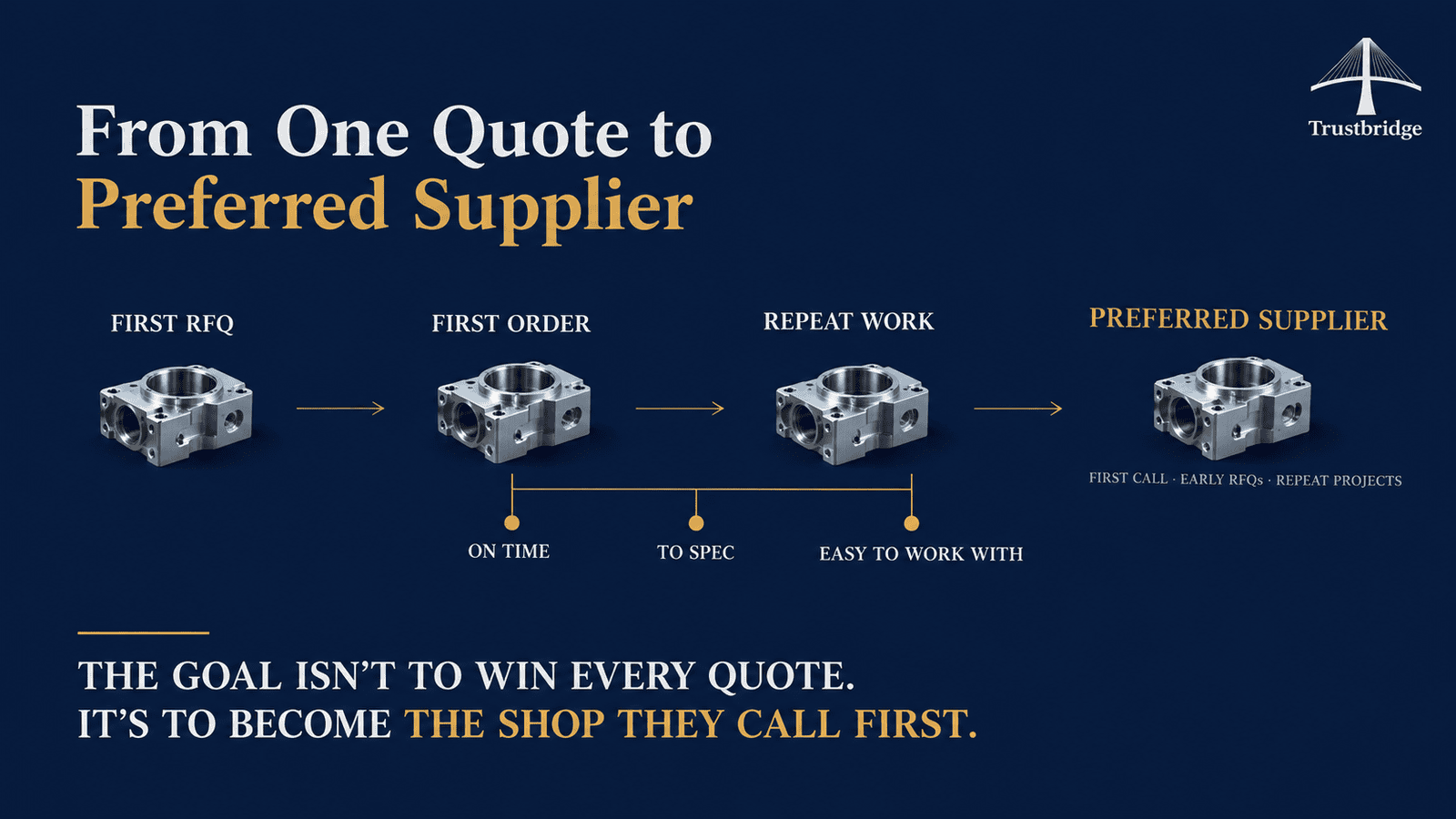
The shops that answer yes become preferred suppliers. They get RFQs before competitors do, win more repeat work and are often trusted with new projects without a long bidding process. In many companies, being on that list is the difference between steady work and constant hunting.
The good news is that preferred status isn't a mystery. Many buyers measure it with simple, consistent criteria. This guide explains what they look at, and what your shop can do to earn a place at the top of the list.
How buyers actually evaluate suppliers
Many manufacturers formalize supplier evaluation with a scorecard. A supplier scorecard rates vendors on consistent measures, typically on-time delivery, quality or defect rates, cost, lead-time reliability and responsiveness. The results feed into decisions about which suppliers get approved, which get more work and which get dropped.
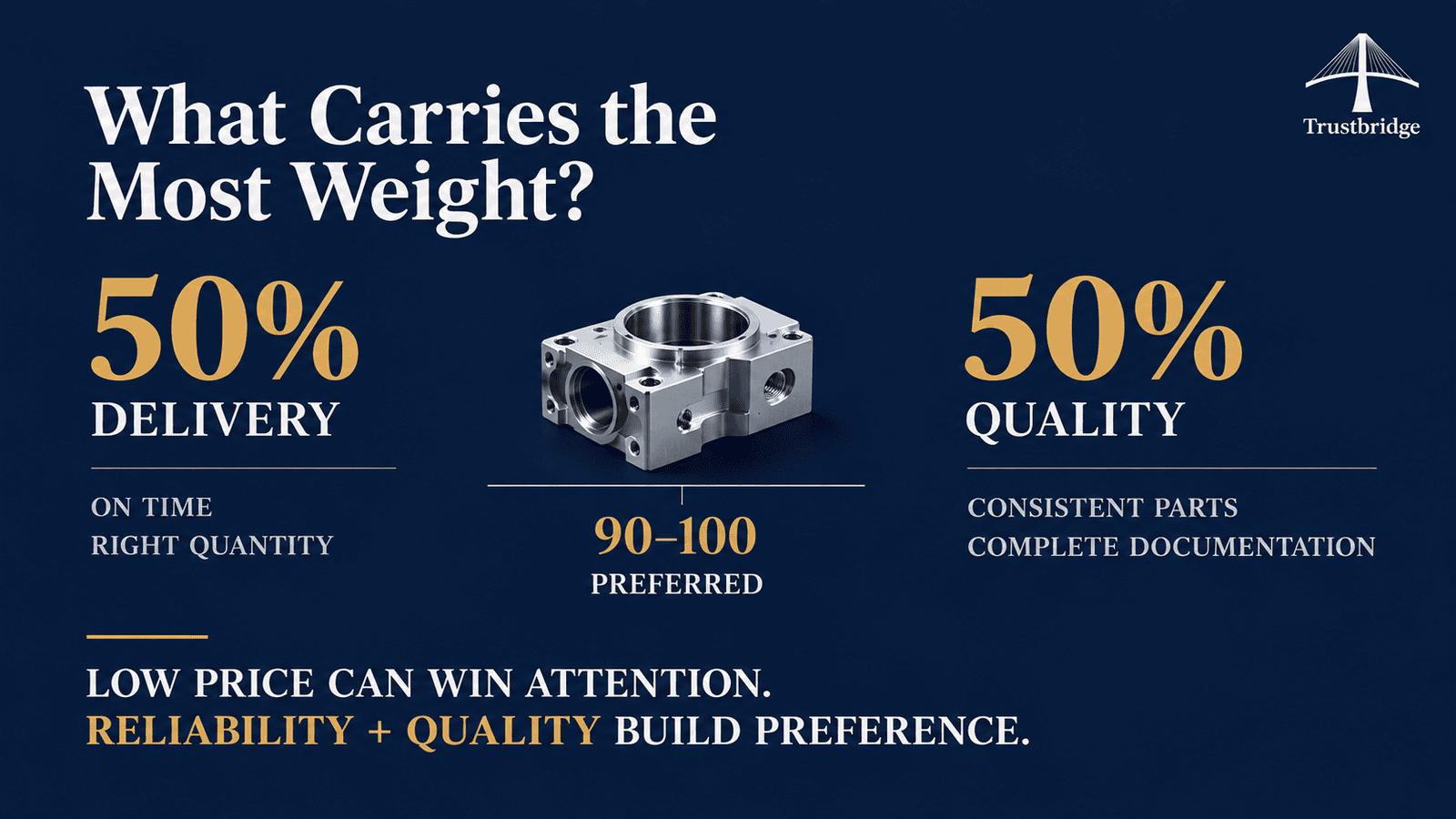
Real scorecards show how much weight delivery and quality carry. Automotive parts company DRiV, for example, rates suppliers 50 percent on delivery and 50 percent on quality, and only suppliers scoring 90 to 100 earn its "Preferred" rating. Lincoln Electric's scorecard gives up to 35 points each for quality and delivery, alongside corrective action response and flexibility.
Notice what's missing from the top of those lists: price. Cost still matters, and some scorecards include it, but the heaviest weight usually goes to whether parts arrive on time and to spec. A cheap part that arrives late or fails inspection costs the buyer far more than it saved.
Smaller buyers may not use a formal scorecard, but they think the same way. They remember which shops made their lives easier and which created problems. Whether it's written down or not, every buyer is keeping score.
1. On-time delivery and reliability
For most buyers, on-time delivery is the first thing they track. A late part can stop an assembly line, delay a product launch or force the buyer to explain a slip to their own customer. That's why delivery often carries as much weight as quality on a scorecard.
The definition of "on time" is often stricter than shops assume. DRiV counts a delivery as on time only if it arrives no more than one day early and zero days late, within 5 percent of the ordered quantity. Lincoln Electric's typical window is three days early to zero days late. Early can count against you, and partial shipments often do.
Reliability starts with the promise, not the shipment. Quote lead times you can actually hit, even if a competitor promises faster. Buyers would rather plan around a realistic date than get surprised by a missed one.
When something does slip, tell the buyer early. A heads-up a week before the due date, with a new date and a reason, gives them time to adjust. Silence until the part is late damages trust far more than the delay itself.
2. Consistent quality and documentation
Quality is the other half of most scorecards. Buyers often measure it in parts per million (PPM) rejected: the number of parts that fail inspection divided by the number received, multiplied by a million. If a buyer rejects 10 parts out of 10,000, that's 1,000 PPM.
What buyers want most is consistency. A shop that makes a perfect first article and then drifts on the production run is a bigger risk than one that's steady every time. Strong process control, regular in-process inspection and clear work instructions all help make the hundredth part as good as the first.
Documentation matters almost as much as the parts. Inspection reports, material certifications, first article reports and traceability records let buyers confirm quality without re-inspecting everything themselves. Sending complete, accurate paperwork with every shipment saves them time and builds confidence.
When a quality problem does happen, how you respond counts too. Many scorecards measure corrective action response time. Acknowledge the issue quickly, find the root cause, explain what you're changing and follow through. Buyers forgive a problem handled well far more readily than one that's ignored or repeated.
3. Responsiveness and communication
Buyers are busy, and the suppliers they prefer are the ones that make their jobs easier. In one survey of custom part buyers, 47 percent said a shop's speed of response directly affects their decision to work with it.
Responsiveness starts with quotes, but it doesn't end there. Answer emails and calls the same day where you can, confirm purchase orders promptly and acknowledge delivery dates in writing. Some scorecards explicitly check whether a supplier acknowledges delivery dates.
Good communication also means being proactive. Tell buyers about potential delays, material shortages or drawing questions before they become problems. A short status update on a long job can prevent a dozen follow-up emails.
Finally, make it easy to reach the right person. Buyers value having a named contact who knows their parts and can answer technical questions directly. When every question gets routed through a general inbox, even a great shop can feel hard to work with.
4. Clear capabilities and specialization
Before a buyer can prefer you, they need to know exactly what you're good at. In the same buyer survey, 69 percent of respondents said they look at a shop's capabilities, and 54 percent at its quality certifications, to judge whether it can complete their project.
Vague claims don't help. "We can make anything" makes a buyer wonder what you actually do well. A clear description of your sweet spot, including part sizes, materials, tolerances, volumes and industries, helps the buyer send you the right work from the start.
Specialization also builds preference. Buyers tend to keep a short list of go-to shops for specific kinds of work: one for tight-tolerance medical parts, another for fast-turn prototypes, another for larger production runs. Being the obvious choice for one category is often more valuable than being a backup option for everything.
Be honest about what doesn't fit. Turning down work outside your strengths, and pointing the buyer somewhere better, shows you understand your own capabilities. Buyers remember that, and they trust you more with the work that does fit.
5. Problem-solving and engineering support
The suppliers buyers value most do more than follow the drawing. They help improve it. Some scorecards reward this directly: DRiV includes supplier cost-saving suggestions as a scored category alongside delivery and quality.
In practice, that means spotting a tolerance tighter than the part needs, a feature that adds a setup, or a material change that would cut lead time, and raising it with the buyer before quoting or production. Small suggestions like these can save a customer real money, and they show you understand their product, not just their purchase order.
Engineering support also helps when plans change. Buyers face design revisions, urgent orders and unexpected volume spikes. A supplier that can adapt quickly, reschedule sensibly and suggest workable options becomes far more valuable than one that only quotes what it's sent.
This kind of partnership takes time to build, but it's one of the strongest reasons buyers keep a supplier. Once you've helped a customer solve a few real problems, you're no longer just a vendor competing on price. You're part of how they get their product made.
How to get on a buyer's preferred list
Knowing what buyers value is one thing. Turning it into preferred status takes deliberate steps. Here's a practical place to start.
Step | What to do |
|---|---|
Track your own numbers | Measure your on-time delivery and rejection rate for each customer, using their definitions where you know them. Don't wait for the buyer's scorecard to tell you how you're doing. |
Ask for the scorecard | Many buyers will share how they rate suppliers if you ask. Knowing the criteria and weights tells you exactly where to focus. |
Quote realistic lead times | Promise what you can deliver, then hit it. A reliable date beats a fast one you miss. |
Standardize your paperwork | Send complete inspection reports, certifications and traceability documents with every order. |
Respond within a day | Set a simple rule for answering RFQs, questions and order confirmations, and stick to it. |
Offer one improvement | On your next few jobs, look for one design or process suggestion that would save the customer time or money. |
Start with your best two or three customers, the ones whose repeat work matters most. Earning preferred status with them often leads to more work across their organization, and referrals to their peers.
Preferred status isn't permanent, either. Buyers keep measuring, and in one survey 85 percent said they turn to new vendors when their current ones fail to deliver. Staying on the list takes the same consistency that got you there.
Frequently asked questions
What is the difference between an approved supplier and a preferred supplier?
An approved supplier has passed a buyer's basic qualification and is allowed to receive orders. A preferred supplier is one the buyer actively chooses first, usually because of a strong track record. Many companies have far more approved suppliers than preferred ones.
How long does it take to become a preferred supplier?
It depends on the buyer, but it usually takes months of consistent performance rather than weeks. Buyers want to see reliable delivery and quality across several orders before they move a supplier to the top of their list.
Can a small machine shop become a preferred supplier for a large company?
Yes. Large companies often rely on small specialists for specific parts or processes. A small shop that is excellent in one area, and reliable every time, can earn preferred status even with much bigger customers.
Do I need ISO 9001 to become a preferred supplier?
Not always, but it helps, and some buyers require it. Regulated industries may require more specific certifications, such as AS9100 for aerospace or ISO 13485 for medical devices. Check each customer's supplier requirements before investing.
Should I lower my prices to win preferred status?
Usually not. Cutting prices may win a first order, but preferred status is earned through delivery, quality and responsiveness. Competitive pricing matters, but a fair price backed by reliable performance tends to build a longer relationship than a low price alone.