
What Information Should You Include When Requesting a Manufacturing Quote?
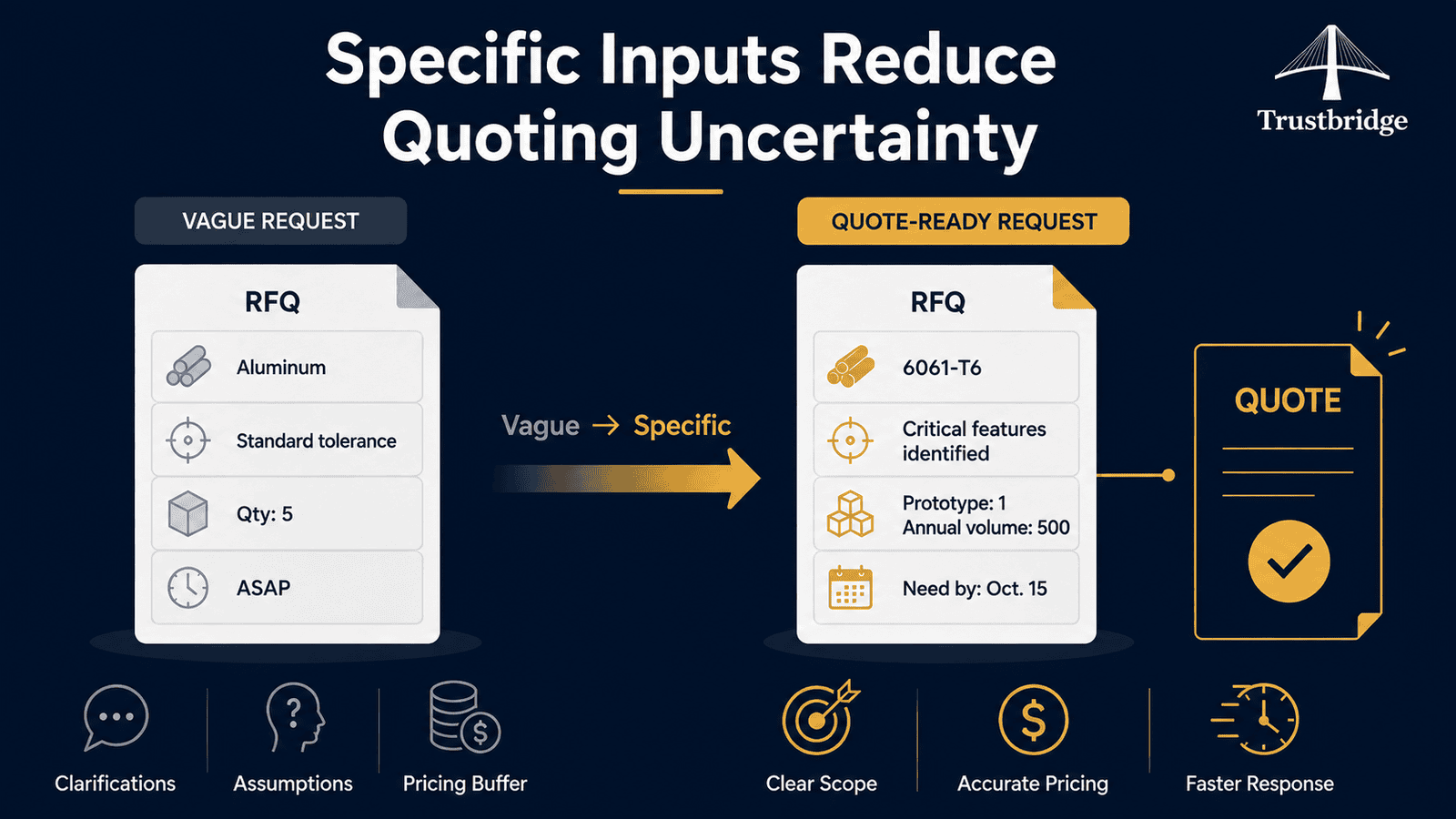
A complete request typically gets a quote back within a day. An incomplete one usually adds three to five days of clarification before pricing even starts. The difference is almost never the part. It's what's on the page.
Introduction
A complete request for a manufacturing quote can come back in about a day. An incomplete one typically adds three to five business days, spent entirely on clarifying questions before a shop ever starts pricing. That gap has almost nothing to do with how complicated the part is. It comes down to what was actually included in the request.
This isn't a long list. Files, material and tolerance specifics, quantity, and a sense of what the part actually does, that's most of it. Missing any one of them doesn't make a request unusable. It just means a shop must ask, guess, or price around the gap, and all three of those cost time.
Start With Files That Actually Agree With Each Other
Most manufacturing quotes start from two files: a 3D model, usually a STEP file, and a 2D drawing that carries the tolerances, GD&T, and material callouts the model alone can't show. A shop can sometimes work from a 3D model by itself, but only for simple geometry at standard tolerances. Anything with a tight callout or a critical feature needs the drawing. Cad design for 3d printing follows a looser version of the same rule; an STL or 3MF file usually replaces the STEP file, but wall thickness and orientation notes still do the job a 2D drawing would do for a machined part.
The two files need to match. A model and a drawing built to different revisions will quote two different parts without anyone noticing until the mismatch shows up later, sometimes after production has already started. It's worth stating outright which document controls if the two ever disagree a small note that costs nothing to include and prevents a real problem down the line. Naming the file clearly, with a part number and revision in the file name itself, does the same job in a smaller way.
Material and Tolerance Specificity Changes the Price
"Steel" or "aluminum" isn't a specification. It's a starting point for a guess, and shops price guesses conservatively. A grade and temper 6061-T6 aluminum, 304 stainless, 1018 cold-rolled steel removes the guess entirely, and it usually removes a day or two of back-and-forth along with it. The same discipline applies when sourcing materials for prototyping, even though the part is only meant to prove a concept rather than ship.
Tolerance works differently, because the risk runs the other way. A part quoted at standard tolerance can come back 50 to 100 percent higher once a shop discovers, often in a note rather than a callout, that one feature actually needs to hold much tighter than the drawing implied. The fix isn't loosening every tolerance across the board. It's marking the handful of features usually three to five on most parts that are genuinely critical, and saying why: this bore needs to seal, this face needs to align with another part, this dimension controls fit. A shop that knows which features matter can hold those tightly and leave everything else at a standard, cheaper tolerance, instead of guessing that everything might matter and pricing the whole part accordingly.
Quantity Means More Than One Number
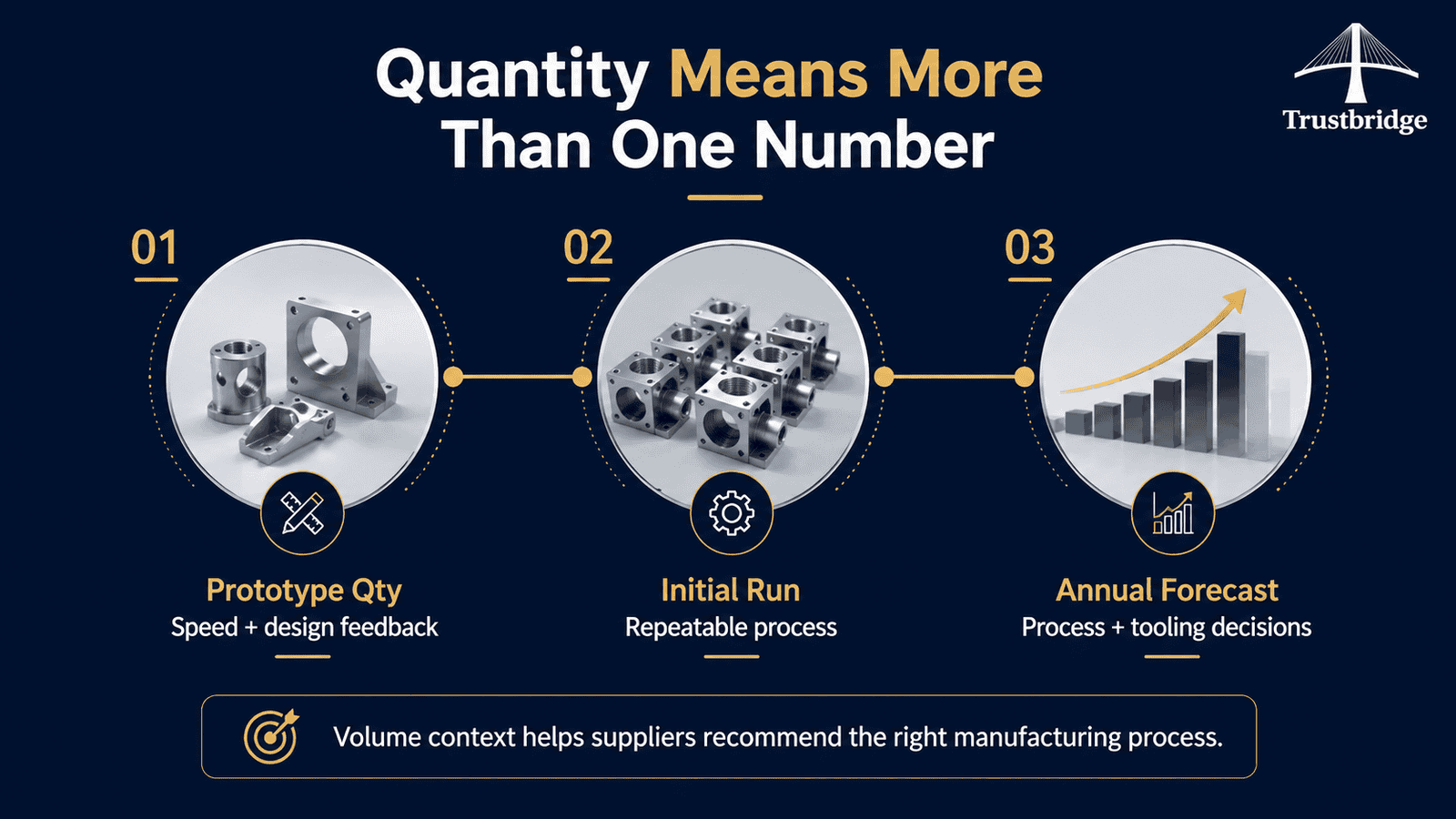
A single quantity field usually isn't enough information on its own. Most programs actually have three separate numbers worth stating: a prototype quantity, an initial production run, and an annual volume forecast. Give a shop only the prototype number, and it has no way to know whether tooling investment for a later production run makes sense, which affects both the process it recommends and the price it quotes.
This matters most at the fork between prototyping and production. A prototype request is really asking for speed and design feedback. A production request is asking for a repeatable process at a specific cost, over a specific volume. Sending both under one quantity number, with no forecast attached, tends to produce a quote that fits neither situation especially well.
Function Tells a Shop What Actually Matters
Dimensions describe a shape. They don't describe what the shape is for, and that gap matters more than it looks like it should. A shop that knows a housing carries a load, or a surface has to mate flush against another part, can make judgment calls a shop working from geometry alone can't, including calls that lower cost rather than raise it.
That's the upside of context that speed alone doesn't capture. A shop reviewing a complete package might notice that a small change in a slightly shallower pocket; a relaxed radius on a non-functional edge removes a tool to change and lowers the price. But it can only make that call if it understands enough about the part to recognize the feature isn't load-bearing in the first place. Complete manufacturing quote requirements aren't only about getting a faster answer. They're about getting a shop's actual judgment applied to the part, instead of its default assumptions.
Lead Time Is Part of the Spec, Not an Afterthought
A request that leaves lead time blank, or just says "ASAP," gives a shop nothing to plan against. Different jobs pull from different parts of a shop's schedule; a prototype needing five expedited days competes for capacity differently than a production run staged across two shipments a month apart. A shop that doesn't know which situation it's looking at can't tell a buyer whether a timeline is realistic. It can only guess and hope the guess holds.
Stating an actual need-by date does more than set expectations. It tells a shop which machine and which slot in the schedule actually fits the job, and it's often the detail that reveals whether a lower quote from one shop is genuinely comparable to a higher one from another. A faster turnaround can be worth more than a lower unit price, once the cost of carrying extra inventory to cover a slower one gets factored in.
Certifications, Post-Processing, and Inspection Define What "Done" Means
A material certificate, an ISO 13485 quality system, an ITAR registration these decide which shops are even eligible to quote the job, not paperwork to sort out after a shop's already been picked. A request that leaves them out gets routed to shops that may not hold the right one at all.
Those requirements connect directly to two details; buyers often leave unstated: what happens to the part after its basic shape is cut, and when inspection happens. Two shops can quote the identical drawing and mean different things by "done" — one checking only the raw cut blank, another including a weld fixture, a coating step, and a final fit check after every process is complete. Medical and aerospace parts often need every critical dimension checked rather than sampled, and a request that doesn't say so gets priced against a shop's default sampling plan instead. Naming which features must survive each step, and stating what "complete" includes, closes all three gaps in one move.
The Manufacturing Quote Request Checklist
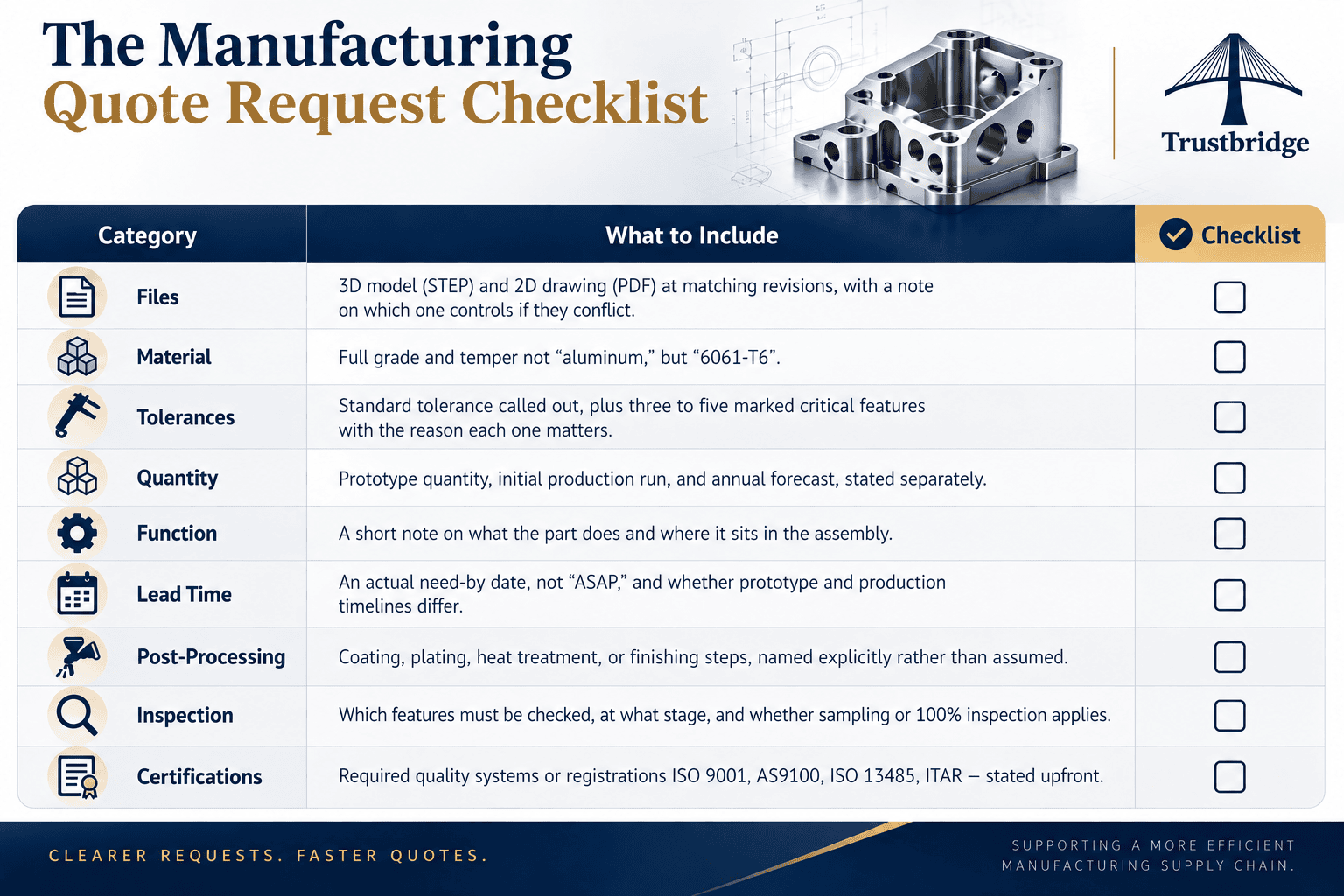
Everything above compresses into a short list. Include all of it, and most requests come back priced within a day.
Conclusion
None of this requires a redesign of how a team sources parts. It requires filling in fields most requests already have space for and being specific instead of general in each one. A shop that receives all of it can price a part in a day, flag a real issue early, and sometimes suggest a cheaper way to make the same part. A shop that receives half of it has to choose between asking, guessing, or padding the price to cover the guess, and none of those three options works in the buyer's favor.
The five categories above aren't a burden to assemble. Most of the information already exists somewhere in a design file or a project spec. The only real work is pulling it into one request instead of leaving a shop to track it down field by field.
Send Requests Your Shop Can Actually Quote Fast
A request built around these five categories is ready for almost any machining vendor, job shop, or contract manufacturer to quote without a clarification round. Trustbridge checks incoming requests against this same list before they reach a supplier, flagging what's missing so the back-and-forth happens once, before the request goes out, instead of after a shop has already started guessing. That check takes minutes, not days, and it applies whether the part is going to one shop or five, regardless of which process or material the job actually calls for.
[See how Trustbridge speeds up the manufacturing quoting process →]
Frequently Asked Questions
1. What information should you include when requesting a manufacturing quote?
A complete manufacturing quote request should include a matching 3D model and 2D drawing, specific material grade and temper, required tolerances, quantity, and a brief description of the part's function. Providing this information upfront helps manufacturers understand the job without additional clarification and produce a more accurate quote.
2. What files are needed to get an accurate manufacturing quote?
Most machining quote requests should include a 3D CAD model, such as a STEP file, and a 2D engineering drawing with tolerances, GD&T, material specifications, and other critical requirements. The files should use the same revision and clearly identify which document controls if they contain conflicting information.
3. How do tolerances affect manufacturing quote pricing?
Tighter tolerances can increase machining time, inspection requirements, setup complexity, and scrap risk. Instead of applying unnecessarily tight tolerances across an entire part, buyers should identify critical features and specify where tighter control is functionally required. This allows manufacturers to price the part more accurately while avoiding unnecessary production costs.
4. Why does an incomplete manufacturing quote request take longer to price?
An incomplete request forces the manufacturer to stop and clarify missing information such as material, tolerances, quantity, drawings, or part requirements before pricing can begin. These clarification cycles can add several business days to the quoting process and may also result in conservative pricing when important manufacturing requirements remain unclear.