Are You Selling Manufacturing Capacity or Manufacturing Expertise?
Two shops can own the same machines and still run very different businesses. One sells spindle hours to whoever pays. The other sells judgment, experience and problem-solving. Here's how to tell which one you are, and why the answer shapes your margins, your customers and your future.
Same machines, different businesses
Picture two machine shops down the road from each other. Both have five-axis mills, a couple of lathes and a good inspection room. Both employ skilled machinists. On paper, they look almost identical. But talk to their customers and you'll hear two different stories. The first shop's customers say, "They had capacity, so we sent them the job." The second shop's customers say, "They're the ones who figured out how to make our part work."
The first shop is selling manufacturing capacity: available machine time. The second is selling manufacturing expertise: the knowledge of how to make difficult parts well. Both can be profitable. But they attract different customers, earn different margins and face very different risks.
Most shops never decide which one they want to be. They drift into selling capacity because it's what the RFQ asks for. This article explains the difference, the signs of which side you're on and how to move toward the side that builds a stronger business.
What selling capacity looks like
A shop selling capacity is essentially renting out machine time. The buyer sends a complete drawing, the shop quotes what's on the page, makes it as drawn and ships it. The main questions are price and lead time. This model has real strengths. It's simple, predictable, and easy to scale: more machines and more shifts mean more output. When demand is high and capacity is scarce, a capacity seller can stay very busy.
The weakness is that capacity is easy to replace. Any shop with similar machines and open hours can offer the same thing. So, buyers compare capacity sellers mainly on price, and they switch whenever a cheaper or faster option appears.
Capacity sellers also feel every downturn first. When demand drops, buyers bring work in-house or move it to whoever bids lowest. A shop whose only offer is open machine time has little to defend itself with except for a lower price.
What selling expertise looks like
A shop selling expertise is selling knowledge, not just hours. Its customers come to it because it knows how to make a certain kind of part better, faster or more reliably than most. The machines matter, but the judgment of the people running them matters more.
You can see expertise in how the shop engages before the first chip is cut. It asks questions about the part's function. It suggests a looser tolerance where the design allows it, a different material that machines faster, or a fixture approach that makes the part repeatable at volume. It flags risks in the drawing before they become scrap.
Expertise is often concentrated in a niche: a material like titanium or Inconel, a part type like thin-walled housings, an industry like medical or aerospace, or a stage like rapid prototyping. The narrower and deeper the knowledge, the harder it is for another shop to replace.
Buyers treat expertise sellers differently. They call them earlier, involve them in design decisions and are more willing to pay for the value they add. The relationship looks less like buying a service and more like working with a partner.
Why the difference matters
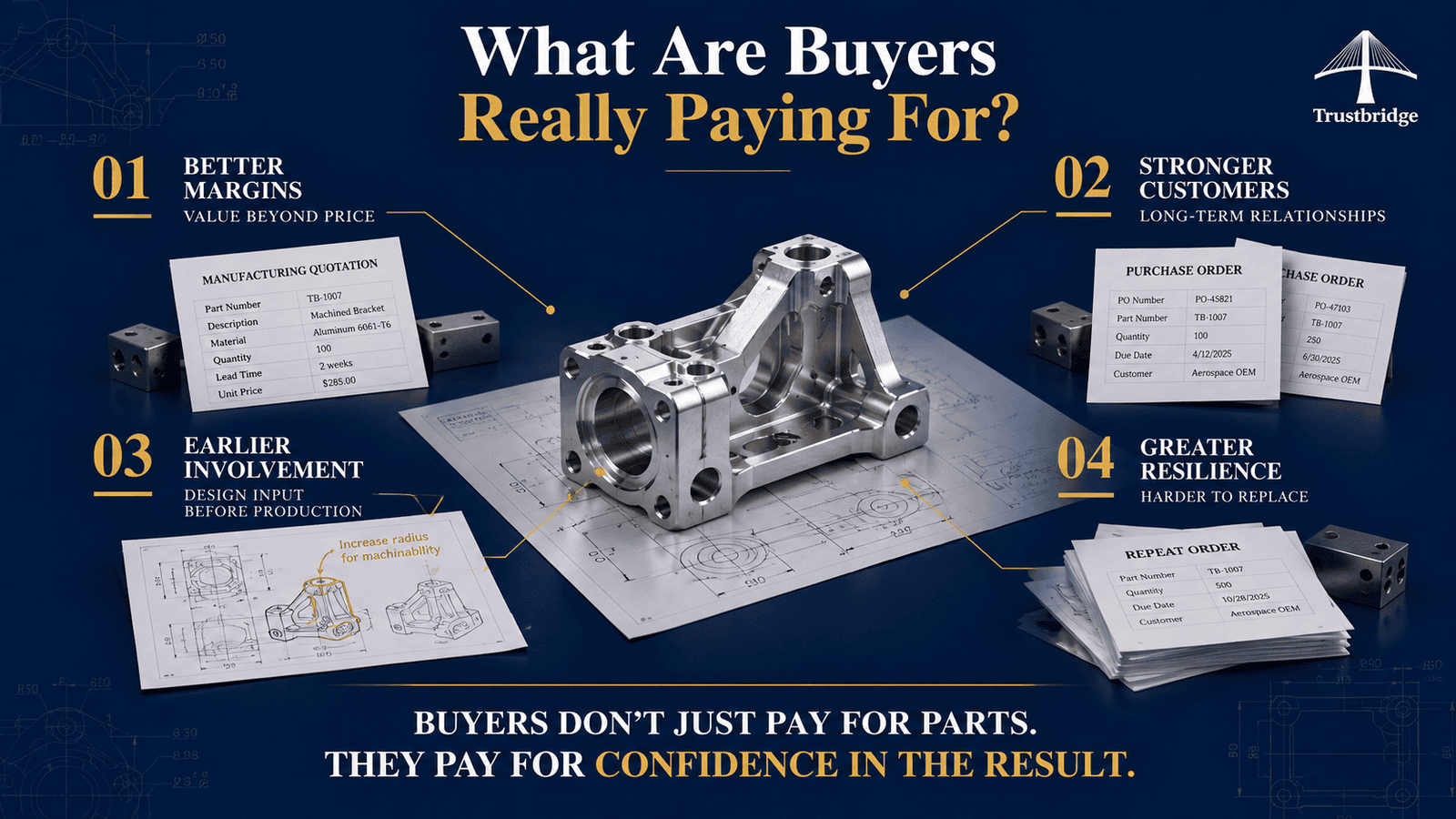
The first difference is margin. When buyers see you as one source of machine time among many, they compare you on price. When they see you as the shop that knows how to make their part work, price becomes one factor among several. Expertise gives you room to charge for the value you add.
The second is the kind of customers you attract. Buyers already look for expertise when choosing suppliers. 69 percent said they look at a shop's capabilities, and 54 percent at its certifications, to judge whether it can complete their project. Shops that make their expertise visible tend to attract buyers with harder, higher-value work.
The third is influence. Much of a part's cost is set by design decisions made before a shop ever sees the drawing. A shop that's involved early, through design-for-manufacturability (DFM) feedback, can help shape those decisions, while a capacity seller can only quote what it's given.
The last is resilience. Capacity is the first thing buyers cut or move when demand slows. Expertise is much harder to walk away from, because switching means losing knowledge, time and confidence. Shops known for something specific tend to keep their best customers through downturns.
Signs your shop is selling capacity
Most shops are a mix of both, but the balance matters. Compare your shop with the table below to see which way you lean.
Selling capacity | Selling expertise |
Your website lists machines and equipment first | Your website leads with the parts, materials and industries you're best at |
Most RFQs arrive as finished drawings to quote as-is | Customers call before the design is final to ask for input |
You win or lose mainly on price | Buyers accept a higher price because of what you bring |
Customers describe you as "a shop with availability" | Customers describe you as "the shop that's good at X" |
Work volume swings sharply with the economy | Your best customers stay with you through slow periods |
Anyone with similar machines could replace you | Replacing you would cost a customer time, risk and know-how |
If most of your answers fall in the left column, you're mainly selling capacity. That isn't a failure, and plenty of shops make good money that way. But it means your business depends heavily on price and on how busy the market is. If you'd like more of your work in the right column, the good news is that most shops already have more expertise than they show. The next step is learning to package it and sell it.
How to shift toward selling expertise
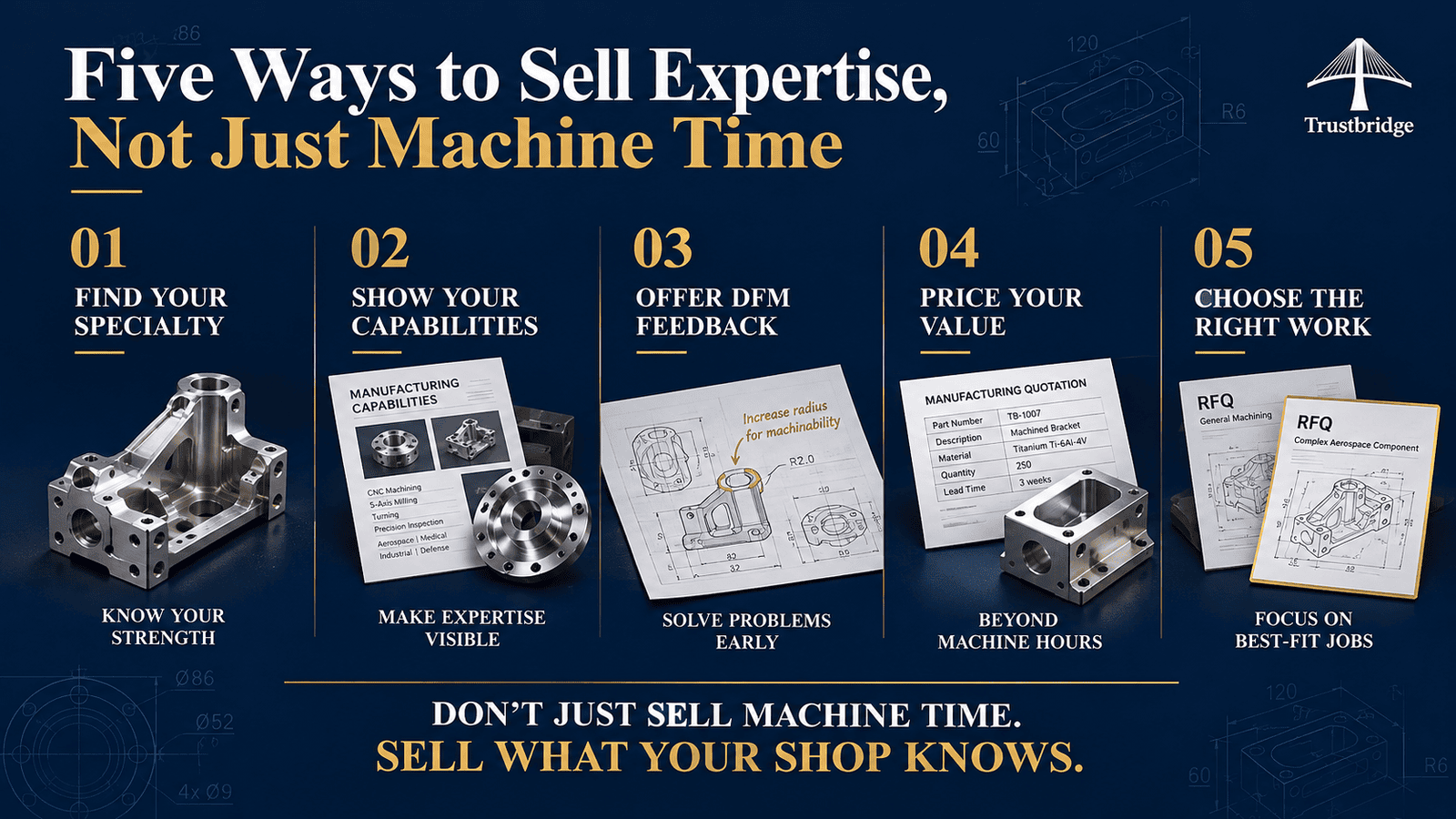
Find what you're already best at. Look back at your last year of jobs. Which parts ran smoothest, earned the best margins and came back as repeat orders? Which customers came to you specifically because other shops couldn't do the work? The answer usually points to a material, part type or industry where you already have real expertise.
Lead with it everywhere. Rewrite your website, capability sheet and introductions around that strength. Instead of "we have 12 CNC machines," say "we make tight-tolerance titanium components for medical device companies." Show real parts, short case studies and the problems you've solved.
Get involved before the drawing is final. Offer DFM feedback when you quote, and invite customers to call you during design. Each useful suggestion, like a relaxed tolerance or a better material, shows the buyer your judgment and makes you harder to replace.
Price the value, not just the hours. When your input saves a customer a redesign, reduces scrap or speeds up a launch, that value deserves to be reflected in your price. Explain what the buyer gets for it, and be comfortable letting price-only buyers go elsewhere.
Be selective about the work you take. Every job that sits squarely in your specialty strengthens your reputation. Every job far outside it pulls you back toward selling hours. Saying no to poor-fit work, and referring it to a better-suited shop, protects the expertise you're building.
Decide what you're selling
Every shop has machines. Not every shop has the knowledge, experience and judgment to make difficult parts well, and that's what the best customers are really looking for. Selling capacity can keep the lights on. Selling expertise builds a business that's harder to replace, easier to price and more resilient when the market turns. The shift doesn't require new equipment. It starts with recognizing what you already do best and making sure buyers can see it.
So ask yourself honestly: when a customer sends you work, are they buying your open machine time, or your expertise? The answer will tell you a lot about where your shop is headed.
Trustbridge is building a network of great manufacturers, and we help them solve problems like the ones described here. If you run a shop and this sounds familiar, and we'll be in touch.
Frequently asked questions
What is value-added manufacturing?
Value-added manufacturing means doing more for a customer than producing a part exactly as drawn. It can include design feedback, process engineering, finishing, assembly, inspection documentation or managing other suppliers, anything that saves the customer time, cost or risk.
How do machine shops charge for engineering support?
Shops use a few approaches. Some list engineering or setup work as a separate one-time charge, often called NRE (non-recurring engineering). Others build it into the part price, especially for repeat production. For prototypes, some shops charge a design-review or development fee that can be credited against a production order.
Is it risky for a job shop to specialize?
It can be if a shop depends too heavily on one customer or one industry. The safest approach is to specialize in a capability, such as a material or part type, that serves several industries, so a slowdown in one market doesn't empty the schedule.
Can a shop sell both capacity and expertise?
Yes, and most do. Many shops use expertise to win and keep key accounts, and fill remaining machine time with simpler capacity work. The important thing is knowing which work is which, and pricing each one accordingly.
Do I need certifications to sell expertise?
Not always, but they help. Certifications such as ISO 9001, AS9100 or ISO 13485 give buyers outside proof of your quality systems, and some industries require them. They work best alongside real examples of the parts and problems you've handled.