
Why Manufacturing Capacity and Demand Rarely Find Each Other Efficiently
Introduction
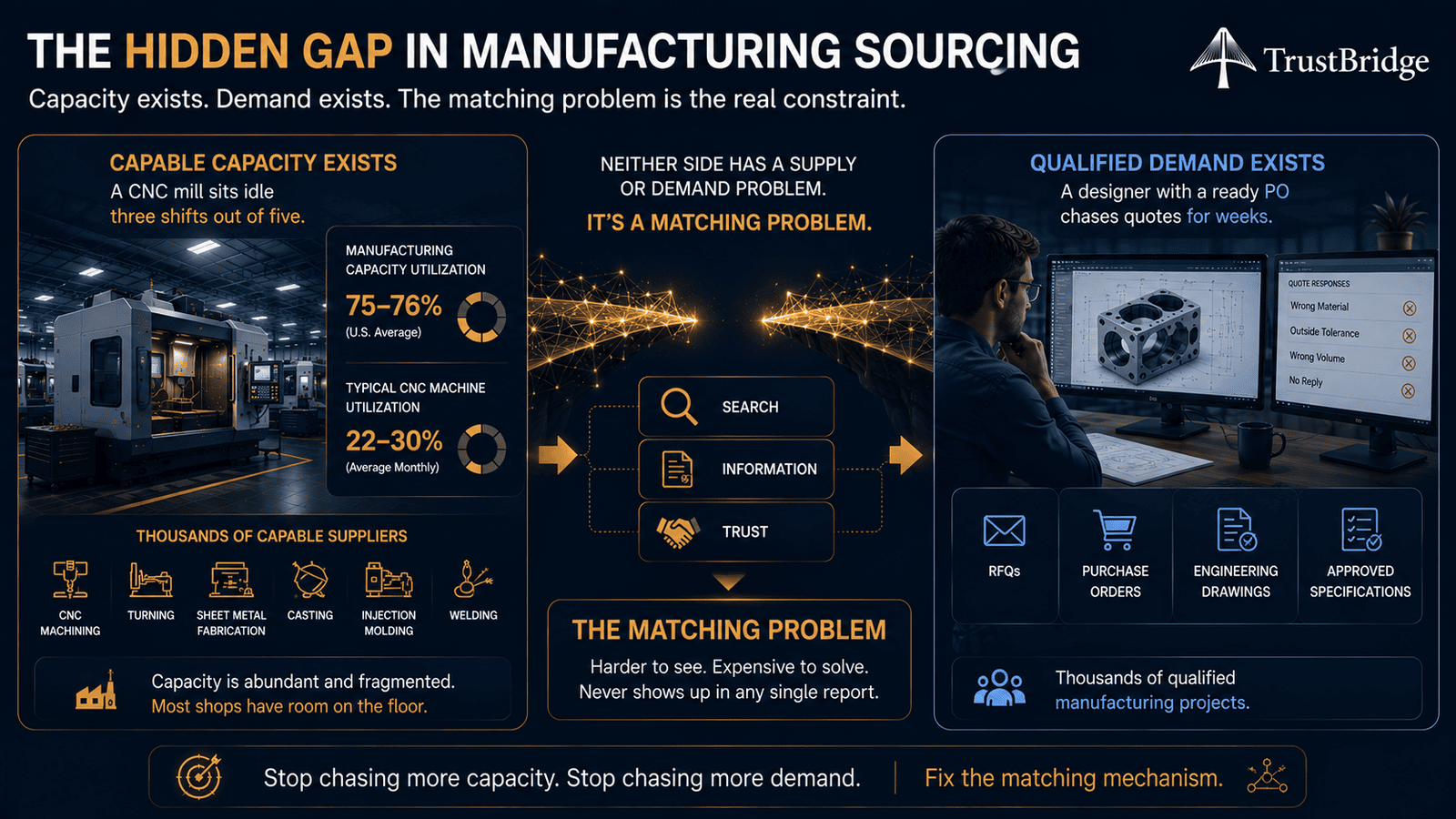
Somewhere in the Midwest, a CNC mill sits idle three shifts out of five. Somewhere else, a designer with a fully toleranced drawing and a purchase order ready is four weeks into chasing quotes that still don’t fit — wrong volume, wrong material, outside tolerance band, or no reply at all. Neither side has a supply or demand problem. What they have is a matching problem, and it's a harder one to see, because it never shows up cleanly in any single company's numbers.
That's worth sitting with, because "we need more capacity" and "we need more design work in the pipeline" are the two most common explanations offered for why sourcing feels slow and the data doesn't support either one particularly well. This isn't unique to any one region or process, either: the same gap shows up whether the job is a small batch running through a niche machining vendor or a larger program headed to a well-known contract manufacturer, which is a strong signal that the problem sits in the matching mechanism itself rather than in any single corner of the industry. Below is what the capacity and demand data actually show, why the real failure sits in matching rather than either one, and the specific frictions — search costs, information asymmetry, and trust — that keep a qualified job from reaching the right shop.
Capable Capacity and Qualified Demand Both Exist in Abundance
Two separate data sets back this up: how much manufacturing capacity is sitting unused at any given time, and how much genuinely qualified design work is out there looking for a home. Pulled independently, both turn out to be larger than the day-to-day sourcing experience would suggest.
The capacity side
The Federal Reserve's G.17 release — the standard read on how hard American factories are working — put manufacturing capacity utilization at roughly 75–76% through the first half of 2026, a few points below the long-run (1972–2025) average of around 78%. Zoom in from that macro number to an individual machine and the contrast becomes more dramatic: MachineMetrics, which pulls usage data directly off connected CNC equipment, has reported average monthly machine utilization in the 22–30% range — meaning a typical spindle is cutting metal for well under a third of the time it's physically available to. Multiply that spare capacity across the roughly 600,000 manufacturing establishments the SBA and Census Bureau count in the U.S., and the result is fragmentation, not scarcity: thousands of capable machining vendors, foundries, and fabrication shops, the large majority of them small, with room on the floor most of the time. A shop three towns over might be the best fit for a given job and be functionally invisible to the designer who needs it — not because it lacks capacity, but because nothing connects the two.
The demand side
The number of teams designing physical products — not just software — has grown steadily, helped along by cheaper prototyping tools, more accessible CAD software, and a wider pool of independent and freelance designers taking on hardware work. Custom manufacturing demand, in other words, is not scarce; if anything, there's more of it competing for shop floor attention than there was five years ago. And it isn't unqualified demand either: a properly toleranced drawing, a sensible material call-out, and a realistic volume meet any reasonable definition of "qualified" — yet that demand still routinely fails to reach the shop that's actually the best fit for it. Hardware-focused founders and design teams consistently report the same experience regardless of what they're building: sourcing takes longer and pulls more attention than they budgeted for, often more than the design work itself, and the mismatch has nothing to do with the quality of the design brief they're bringing to the table.
The Failure Is Matching, Not Supply or Demand
That's the part that should be surprising. Capable capacity and qualified demand both exist in real volume, on both sides of the transaction, and they still don't reliably meet. If the constraint were really supply, idle CNC time wouldn't sit in the 70–78% range industry-wide, year after year. If it were really demand, hardware teams wouldn't be reporting that sourcing eats more time than the design work itself. What's actually happening is that the mechanism connecting the two — the process of finding, evaluating, and trusting a manufacturing partner — is expensive enough that a lot of genuinely good matches simply never happen. That mechanism, not the underlying supply or demand, is the part worth examining closely.
Search Costs, Trust, and Information Asymmetry Keep the Right Job From the Right Shop
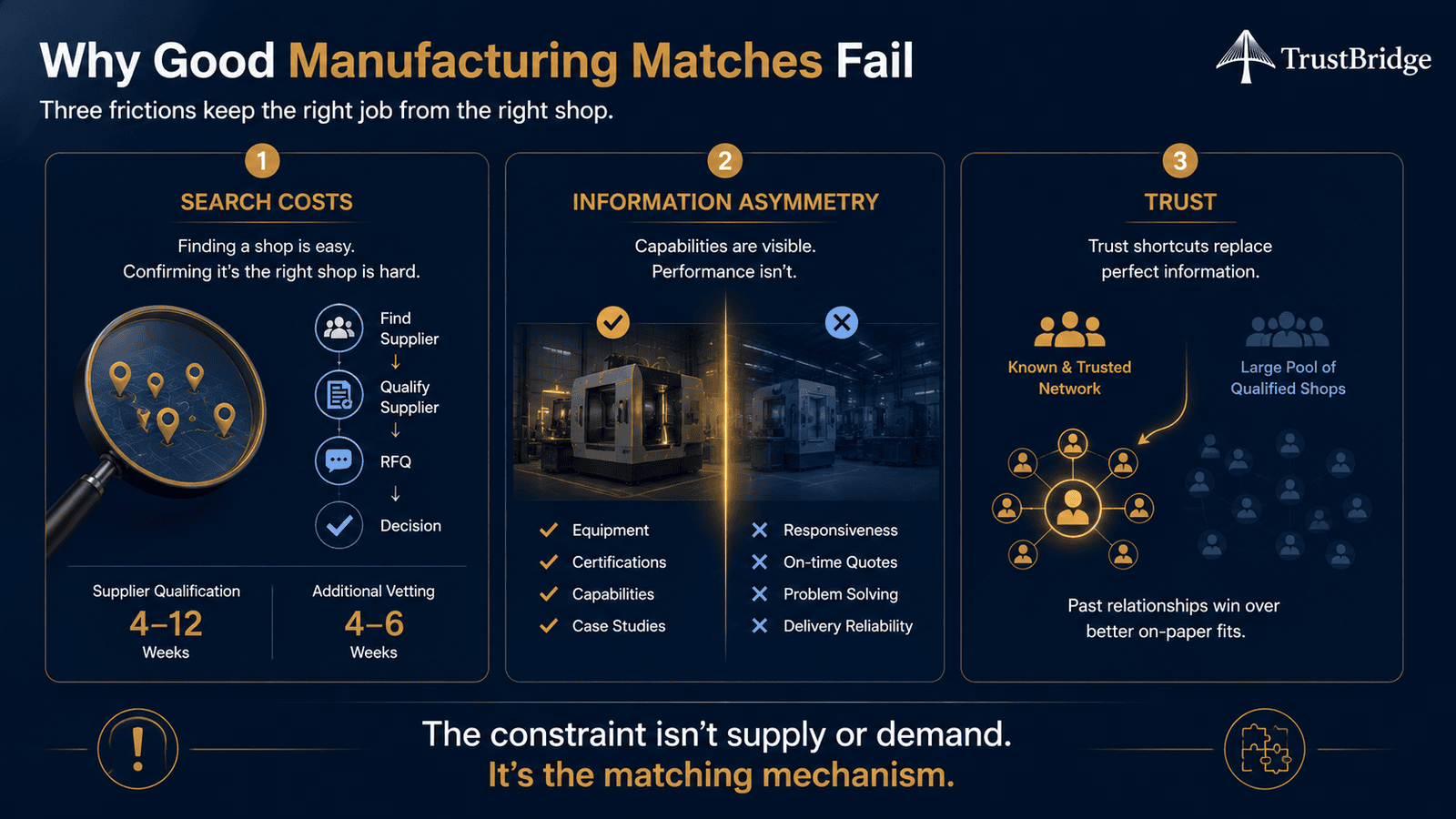
If capacity and demand are both abundant, the friction has to live somewhere else — and it turns out to live in three specific, well-documented places: how expensive it is to search, how little either side can actually verify about the other before committing, and how much both sides end up leaning on trust as a shortcut once verification gets too costly.
Search costs
Finding a shop is the easy part; confirming it's the right shop is not. Formal supplier qualification processes typically run 4–12 weeks depending on complexity and industry, and vetting an unfamiliar manufacturer — checking registration, capability, and samples — commonly adds another 4–6 weeks on top of that. For a one-off part or a small early production run, that timeline can cost more than the part itself, and every week spent qualifying a new machining vendor is a week not spent iterating on the design or preparing for launch. Online directories and instant-quoting platforms have cut into some of this time by making it faster to surface a list of candidate shops — but surfacing a list was never the hard part. Confirming fit still takes just as long as it always did, because a listing can tell you what a shop owns, not how it performs.
Information asymmetry
Every shop's website lists its best equipment, its broadest capability range, and its most flattering case studies. None of that tells a designer how a shop behaves under a real deadline. A certification confirms a shop has documented procedures; it says nothing about whether a quote will arrive on time, whether the shop will flag a design issue before cutting metal, or how they'll handle a change order mid-run. As certifications have proliferated across the industry, they've raised the documented floor — a genuine improvement — but they haven't helped a designer distinguish between two similarly certified manufacturing suppliers competing for the same job. The information gap just reappears one level up, hidden behind a badge instead of an absence of one. Shops face the mirror version of the same problem, unable to tell a serious buyer from someone collecting quotes they'll never place.
Trust
Because verified information is expensive to get, both sides default to what they already know. Designers lean on referrals and prior relationships rather than the theoretically best-fit stranger — trusted manufacturing relationships, built up over past projects, beat an unknown shop with a better on-paper fit almost every time. Shops, for their part, prioritize known customers over new inquiries of uncertain size and seriousness. Rational as each choice is individually, together they mean most sourcing decisions get made from a small, familiar shortlist rather than the full population of manufacturing suppliers that technically exists and could plausibly do the job. And because there's no shared, portable record of how a shop actually performed, that vetting cost gets paid again on the next project instead of compounding into something reusable — trust built on one program rarely transfers cleanly to the next sourcing decision, even inside the same company.
Conclusion
None of this is an argument that manufacturing capacity is unlimited, that every design is instantly manufacturable, or that good shops are hard to find in any absolute sense. It's narrower than that: the capacity is broadly there, the qualified demand is broadly there, and the layer connecting them — search, information, trust — is where the real inefficiency lives. Recognizing that distinction matters, because it points sourcing improvement efforts at the right target; pouring more attention into building capacity or generating more design briefs won't fix a problem that was never really about either one. Whoever meaningfully moves this forward won't do it by manufacturing more parts. They'll do it by shortening the distance between a capable shop and the designer who's actually looking for it — which, in the end, is just a more precise way of describing where the next manufacturing partnership either forms quickly or doesn't form at all.
This piece stays with the diagnosis on purpose — understanding where the friction actually sits matters before jumping to a fix. The next piece in this series looks at what's being tried to close that gap, and what actually works in practice. If you'd rather not miss it, subscribe or follow along for the follow-up.
Frequently Asked Questions
1. Why is it so difficult to find the right manufacturing supplier even when capacity exists?
The challenge is rarely a lack of manufacturing capacity. Many qualified shops have available machine time, but buyers struggle to identify which supplier is the best fit for their specific part, material, tolerances, production volume, and timeline. Search costs, limited visibility into supplier performance, and trust barriers make matching capable manufacturers with qualified demand far more difficult than it appears.
2. What causes the gap between manufacturing capacity and customer demand?
The gap is primarily a matching problem rather than a supply or demand problem. Manufacturers often have unused production capacity while engineering teams spend weeks searching for suitable suppliers. Information asymmetry, lengthy qualification processes, and reliance on existing supplier relationships prevent many qualified projects from reaching capable manufacturing partners.
3. Why do manufacturers and buyers rely so heavily on existing supplier relationships?
Building trust with a new supplier takes time and resources. Buyers need confidence in a supplier's quality, delivery performance, and communication, while manufacturers want assurance that an opportunity is genuine. Because this information is difficult to verify upfront, both sides often prefer established relationships instead of exploring potentially better-fit manufacturing partners.
4. How can manufacturers improve supplier matching and reduce sourcing delays?
Improving supplier matching requires better visibility into manufacturing capabilities, performance history, and production fit—not simply larger supplier directories. Faster qualification processes, standardized capability information, and transparent performance data help buyers identify the right manufacturing partner more quickly while enabling capable shops to connect with qualified opportunities more efficiently.