Prototype to Production: The Supplier Relationship You Should Build Before You Need Volume
The shop that nails your first fifty units and the shop that can profitably deliver your next fifty thousand are not automatically the same shop. Waiting until you need volume to find out is the expensive way to learn it.
Introduction
Most teams pick a prototype supplier for speed and a production supplier for capability, as if those are two separate decisions made at two separate times. That gap is where a lot of cost, delay, and rushed compromise gets created. The relationship that actually protects a launch isn't found in a panic once volume is confirmed. It's built early, while the stakes are still low enough to ask hard questions and walk away if the answers are wrong. This piece covers why that timing matters, what to check before you scale, and why the relationship itself deserves the same attention as a design decision.
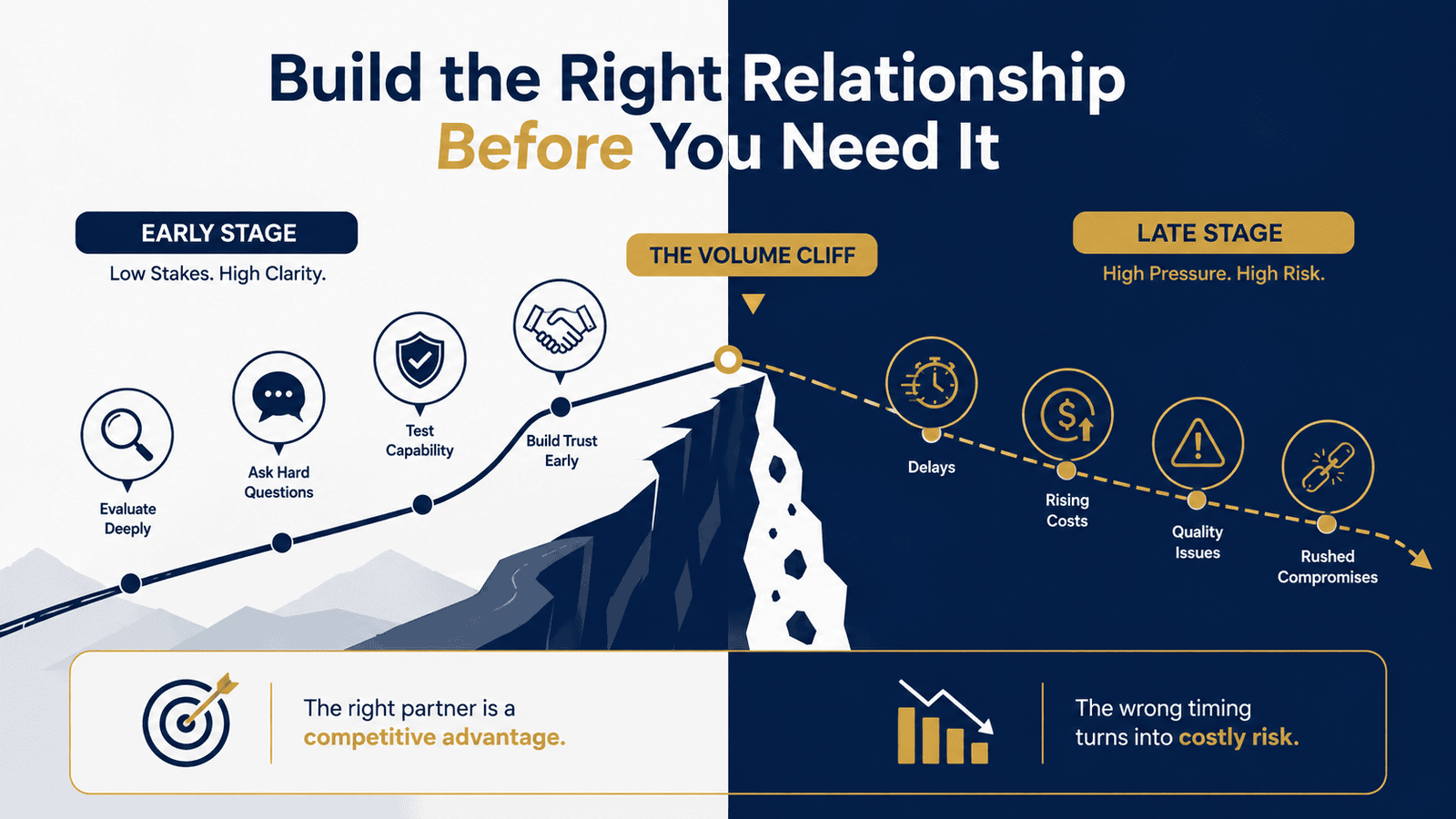
Why the right partner is chosen early, not at the volume cliff
A shop that's excellent at 100 units a month isn't automatically excellent, or even solvent, at 10,000. Prototyping and production reward different things. Prototyping rewards speed and iteration. Production rewards repeatability. A shop hand-fitting the occasional out-of-spec part at low volume isn't hiding anything that's just how a small operation solves an occasional problem. That same fix, needed on one part in twenty instead of one in a thousand, is a different business entirely, and most prototype shops never advertise that they can't run it.
This gap rarely shows up on a quote. It shows up three months after the purchase order, at the exact moment a supplier who was never built for repeatable production gets asked to become that overnight. Call it the volume cliff: the point where confirmed demand meets a relationship that was never actually tested against it.
What to look for before you scale
The evaluation that matters happens before tooling gets cut, not after. Start with a question most teams never ask directly how much room does this supplier actually have left?
Capacity utilization is the clearest signal. A shop running at moderate utilization generally has more room to absorb new volume than one operating close to its practical capacity. The important question isn't the headline utilization number; it's whether the specific machines and processes your parts require have enough available capacity when your volume ramps.
Equipment claims deserve the same scrutiny. A factory's design capacity and its effective capacity are two different numbers. The gap between them aging equipment, unplanned downtime, single-shift limits is exactly where volume commitments quietly break. Ask to see the equipment list alongside maintenance records, not just a capabilities page.
Two more signals worth checking directly: quality system maturity, since a supplier who can describe real process controls, not just pass a first article inspection, is signaling they can hold a tolerance across thousands of parts rather than only the first one, and how long the supplier's other relationships have actually lasted. A shop with multi-year partnerships elsewhere is demonstrating something a capabilities page can't: that other teams trusted them with a volume ramp, and it worked out well enough to keep going.
The relationship as the real strategic advantage
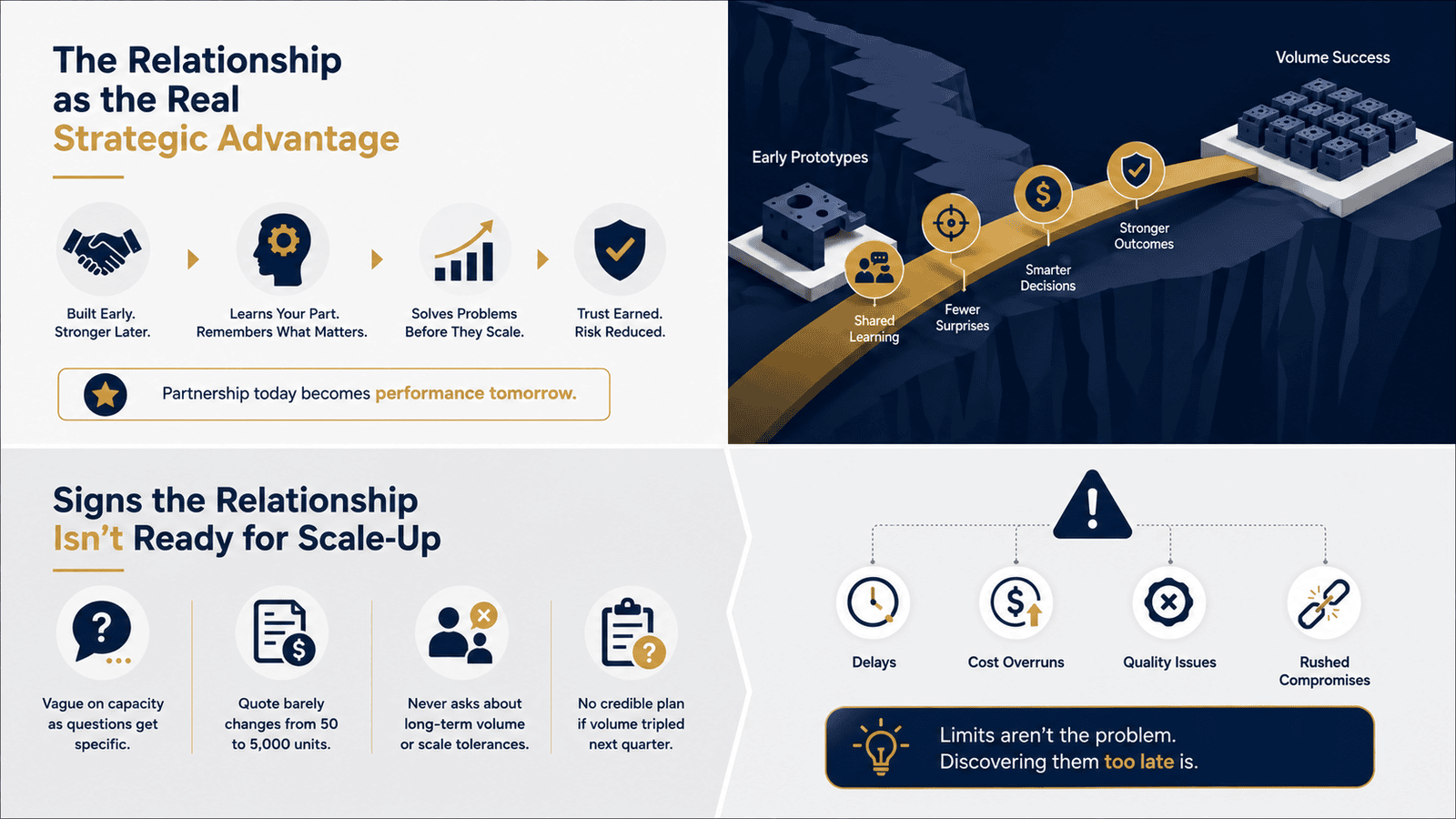
Starting this relationship early isn't only about de-risking the eventual production order. It's about what gets thrown away every time a team switches suppliers mid-program instead of building on one relationship over time. A manufacturing partner who's been present since early prototypes has already learned the part which tolerances actually matter, which datum choices caused headaches last time, which process substitution quietly saved money without changing function. None of that transfers with a purchase order. Switch suppliers right before a volume ramp, and all of it resets to zero at exactly the moment a team can least afford a learning curve.
This is a different kind of whitespace than the kind that shows up in a drawing or a development timeline. It's whitespace built into the relationship itself unused capacity and earned trust that only exist because the partnership started before it was urgently needed.
Signs the relationship isn't ready for the scale-up
A few patterns tend to show up before a supplier relationship breaks under volume. A shop that gets vaguer about capacity numbers as questions get more specific is usually protecting an answer it doesn't want to give. A quote that barely moves whether the order is fifty units or five thousand often means pricing was never modeled at scale, just extrapolated from a smaller job. A supplier who has never asked about long-term volume plans or tolerances at scale has been treating the relationship as a one-off, regardless of how the sales conversation was framed.
One more worth asking outright: if volume tripled next quarter, does the shop have a credible plan for it, or would that be the first time anyone discussed the scenario out loud? None of these signs are disqualifying on their own. Plenty of excellent prototype shops are honest about not being production shops, which is a genuinely useful answer if it comes early enough to plan around. The problem isn't a shop having limits. It's discovering those limits for the first time after a purchase order is already signed.
Conclusion
The right production partner is a relationship, not a purchase made under pressure. The earlier that relationship starts, the more you actually learn about a supplier's capacity, quality systems, and honesty about limits while walking away still only costs a quote. None of this requires a formal audit program. It requires asking a handful of direct questions early enough that "we're not set up for that yet" is useful information instead of a crisis.
Not sure if your current supplier can handle where this product is headed?
Share where the part is today and where the volume is realistically headed, and get a straight read on whether the relationship has the capacity, quality systems, and track record to make that jump. Get a production-readiness check before the volume cliff turns a good prototype partner into an expensive surprise.
Frequently Asked Questions
1. How do I know if a supplier is ready for mass production?
A supplier is ready for mass production when it has sufficient capacity, reliable quality systems, repeatable processes, and experience handling production volumes similar to your expected demand. Buyers should evaluate the specific equipment, processes, maintenance practices, and available capacity needed for their parts rather than relying only on a supplier's capabilities list.
2. Is a prototype manufacturer the same as a production manufacturer?
Not necessarily. Prototype suppliers typically prioritize speed, flexibility, and rapid iteration, while production suppliers must demonstrate repeatability, capacity, process control, and cost efficiency at higher volumes. A supplier that performs well for 50 units may not be equipped to produce 5,000 or 50,000 units consistently.
3. What should I ask a manufacturing supplier before scaling production?
Ask about available capacity, machine utilization, quality systems, maintenance, production lead times, and experience supporting similar volume increases. It is also important to ask how the supplier would handle a significant increase in demand and whether the specific processes required for your parts can support that ramp.
4. When should you choose a production supplier for a new product?
You should evaluate potential production suppliers before high-volume manufacturing is needed, ideally while the product is still in the prototype or development stage. Starting the relationship early gives both teams time to validate manufacturing capability, identify capacity constraints, improve the production process, and avoid switching suppliers when a volume ramp is already underway.