
How to Evaluate a Machining Vendor: A Buyer's Checklist
Most buyers evaluate a machining vendor on price and lead time. The real risks usually show up later after the first bad batch. This checklist is for catching them first.
Introduction
A machining vendor can look identical to three competitors right up until something goes wrong a late delivery, an out-of-spec batch, an expired certification. That's true whether the shop is a ten-person job shop or a multi-facility contract manufacturer. By then the buyer has usually already committed. Tooling is paid for. A schedule is built around the vendor's promised capacity. The information that would have caught the problem almost always existed before the order was placed. It just wasn't checked.
That's because most buyers default to comparing quotes and lead times, and treat everything else as a formality. This checklist covers the four categories that actually predict whether a machining vendor relationship holds up: certifications, capacity, quality systems, and references. None of them require an outside audit firm. They just require asking a sharper question than the one most sourcing conversations settle for.
Certifications Set the Floor, Not the Ranking
ISO 9001 is the baseline most machining vendors are expected to hold. It confirms a documented quality system exists necessary, but not sufficient on its own. Depending on the industry, more sits on top of that baseline: AS9100 for aerospace, IATF 16949 for automotive, ISO 13485 for medical devices. Each adds requirements around risk management and traceability that ISO 9001 alone doesn't cover. A shop marketing itself as a precision CNC machining service for a regulated industry, without the matching certification, hasn't been independently audited against the standard that industry actually requires.
What a certificate doesn't tell you is how a shop behaves day to day. Audits typically happen once a year. A shop can hold a valid certificate and still run an inconsistent floor between audits compliant on the day of inspection, less disciplined on a rush job six months later. Treat certifications as a pass/fail filter for eligibility, not a ranking system. The real differentiation happens in the next three categories.
Capacity Is About Fit, Not Size
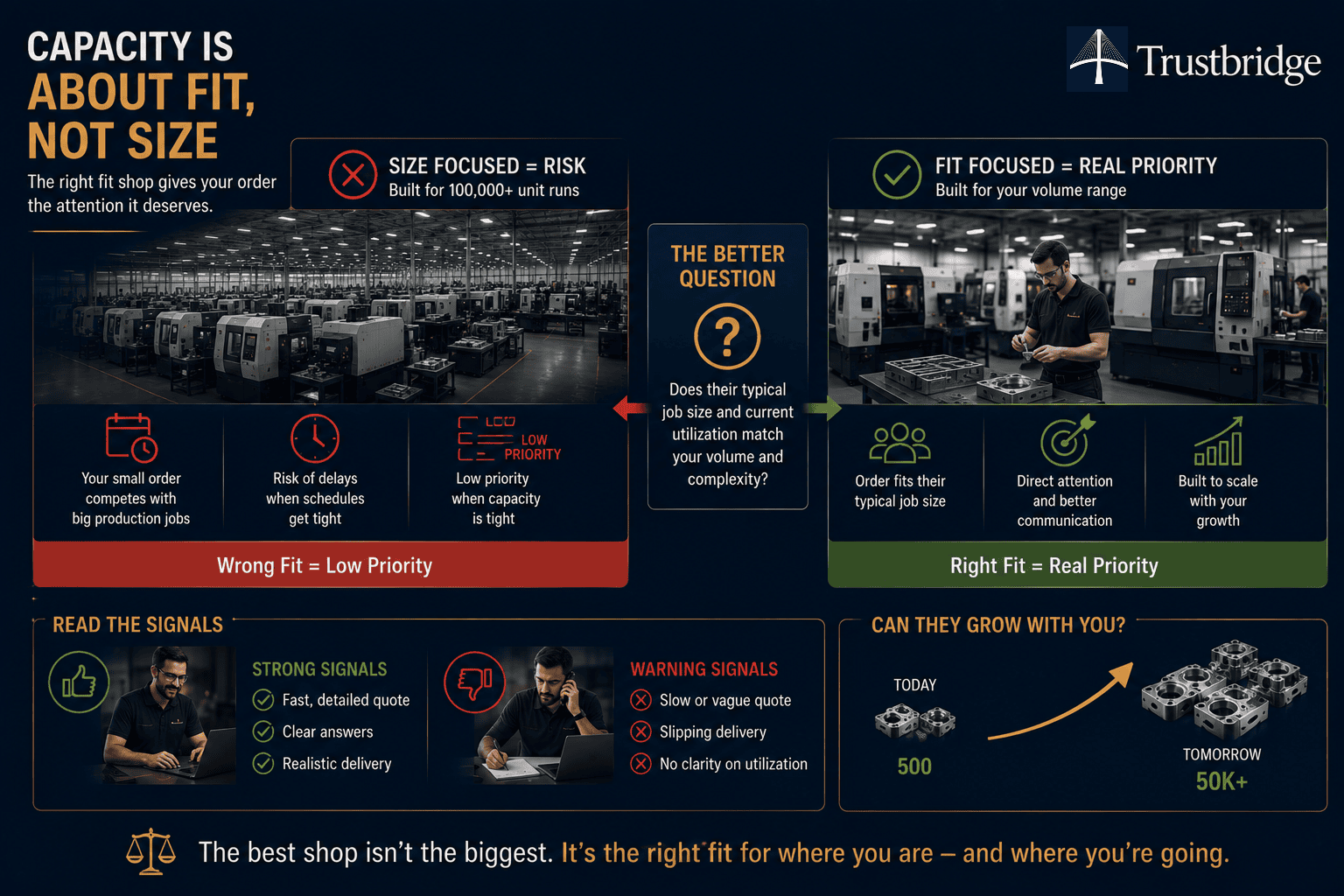
The instinct to favor the biggest, best-equipped shop is usually the wrong one. Capacity evaluation isn't about maximum output it's about whether a shop's typical job size actually matches your order. A shop built around 100,000-unit automotive runs might accept a 500-piece prototype order, but that order will compete against production jobs that pay the shop's bills. It can lose that competition when scheduling gets tight. A shop sized appropriately for the order has a direct incentive to treat it as real business instead.
The better question isn't "can you handle this" almost every vendor says yes. It's whether their typical job size and current utilization actually match your volume and complexity. A shop's own quoting behavior is often the clearest evidence: enthusiasm and a fast turnaround on a smaller order is one signal, a slow and vague quote with a slipping delivery date is another. It's also worth asking about scaling can this vendor grow with you, or does growth mean starting a new vendor search from scratch next year.
Quality Systems Reveal How They Handle a Mistake
Every machining vendor eventually produces a bad part. That's not the real question. The real question is what happens next. The most direct way to find out is asking a shop to walk through a recent corrective action: what the nonconformance was, what root cause they found, and how they confirmed the fix actually worked.
Two answers are warning signs. The first is a root cause that stops at "operator error" that's rarely the true cause, and a shop that stops investigating there hasn't fixed anything. The second is a fix that amounts to "we added more inspection." That catches defects after the fact. It doesn't change the process that produced them. A shop worth trusting can name a specific process change and describe, with data, how they confirmed it held.
References Are the Hardest Category to Fake
No machining vendor hands out a bad reference. Every name on the list has already been screened to say something positive, which means the standard questions — were you satisfied, would you recommend them — are close to worthless. The value in a reference check comes from asking something specific enough that a generic positive answer can't cover for a real problem.
The single best question is what the reference wishes the vendor did differently. An answer that touches quality or delivery, even gently, is worth following up on. A second useful move: ask the vendor to connect you with a former customer, not a current one, and ask why they left. Vendors rarely offer this on their own, but a shop confident in its track record won't hesitate when asked. A vendor with no references at all, or one that stalls when asked, is itself a signal worth taking seriously.
The Machining Vendor Evaluation Checklist
Everything above compresses into a short set of checks. Run each candidate through this table before committing.
Category | What to Check | Red Flag |
Certifications | Current ISO 9001 plus any industry-specific standard your part requires (AS9100, IATF 16949, ISO 13485) | Certificate is expired, unverifiable, or doesn't match your industry |
Capacity | Typical job size and current utilization match your volume and complexity | Vague answers on volume, or eagerness to accept any order size |
Quality Systems | Review one recent corrective action and ask how the fix was verified | Root cause is "operator error," or the fix was just more inspection |
References | Ask what the customer would change and, where appropriate, speak with a completed-program customer | No references offered, or every answer is generically positive |
Conclusion
The buyers who get burned by a machining vendor rarely got burned by a shop that failed an obvious check. They got burned by one that passed every surface-level question and never got asked a harder one. The four checks above take the same amount of time as the questions most buyers already ask. They just produce an answer that's actually worth something.
The cheapest time to run this evaluation is before the first purchase order, not after the first bad batch shows up on the receiving dock.
Find a Pre-Vetted Machining Vendor, Not Just a Cheaper One
Running this evaluation properly takes time most buyers don't have for every vendor on a shortlist. Trustbridge pre-screens its network of machining vendors, CNC machining suppliers, and contract manufacturers against these same four categories. The certifications, capacity, and quality history are already verified before a shop reaches your shortlist.