
Reshoring Is a Demand Story, Not a Policy Story
Quality problems, long delivery times, and supply chain risk are becoming stronger drivers of reshoring decisions than tariffs alone. Companies are bringing manufacturing closer to home because unreliable quality, delayed deliveries, and disruption can cost more than the apparent savings of offshore production. Understanding these demand-driven factors helps manufacturers and suppliers see why reshoring is happening, where demand is forming, and what is likely to sustain it beyond changes in trade policy.
Introduction
Most coverage of reshoring focuses on policy: a new tariff, an incentive program, a plant relocating because of a trade rule. The data tells a different story. When contract manufacturers are asked directly why their customers actually reshored, tariffs rank near the bottom of the list. Quality problems, slow delivery, and supply chain risk rank far higher.
Policy still plays a role. It changes the cost math and adds urgency to decisions that were often already on the table. But it doesn't determine the outcome by itself. 2025 makes that clear: tariff policy was unusually aggressive that year, yet reshoring activity slowed rather than accelerated. The reason wasn't weaker policy. It was that companies don't commit real capital based on a policy that might change again within the year they commit, based on whether the underlying business case holds up regardless of who's in office.
The Reasons Companies Actually Give
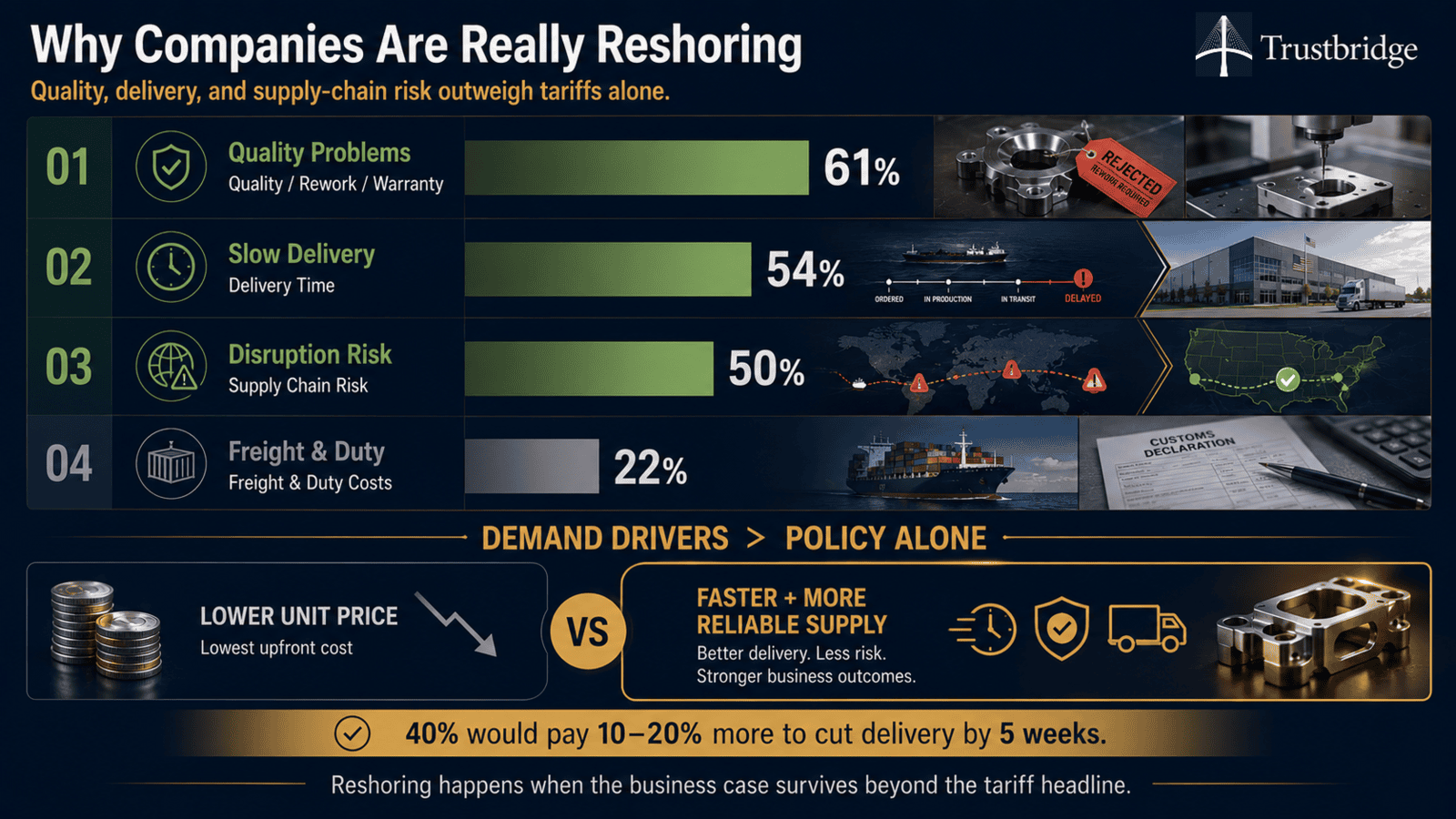
The clearest evidence comes from a 2025 survey by the Reshoring Initiative, which asked contract manufacturers why their OEM customers had reshored work. The top answers were quality, rework, and warranty problems (61%), delivery time (54%), and supply chain disruption risk (50%). Freight and duty costs, the category closest to tariffs, came in at just 22%, tied with brand positioning.
The same survey found real money behind these preferences. Forty percent of OEMs said they'd pay 10 to 20 percent more to cut delivery times by five weeks. That's not a response to a tariff schedule. It's a company deciding that speed and reliability are worth paying for directly. Using total cost of ownership instead of unit price alone, that same demand is estimated to be large enough to reshore roughly $200 billion in manufacturing with no government subsidy involved at all.
Where This Demand Shows Up
Reshoring isn't spread evenly. Roughly 90% of 2025's reshoring jobs landed in high-tech sectors: computer and electronics manufacturing, EV batteries and solar, and transportation equipment. Texas, South Carolina, and Mississippi led the state rankings, reflecting existing infrastructure and workforce availability more than any single state's policy advantage.
That concentration is itself informative. If reshoring were mainly a policy response, it would likely spread more evenly, following wherever incentives happened to be offered. Instead, it keeps clustering in the same sectors and states year after year, which looks much more like a durable, demand-driven shift than a reaction to any one administration's trade policy.
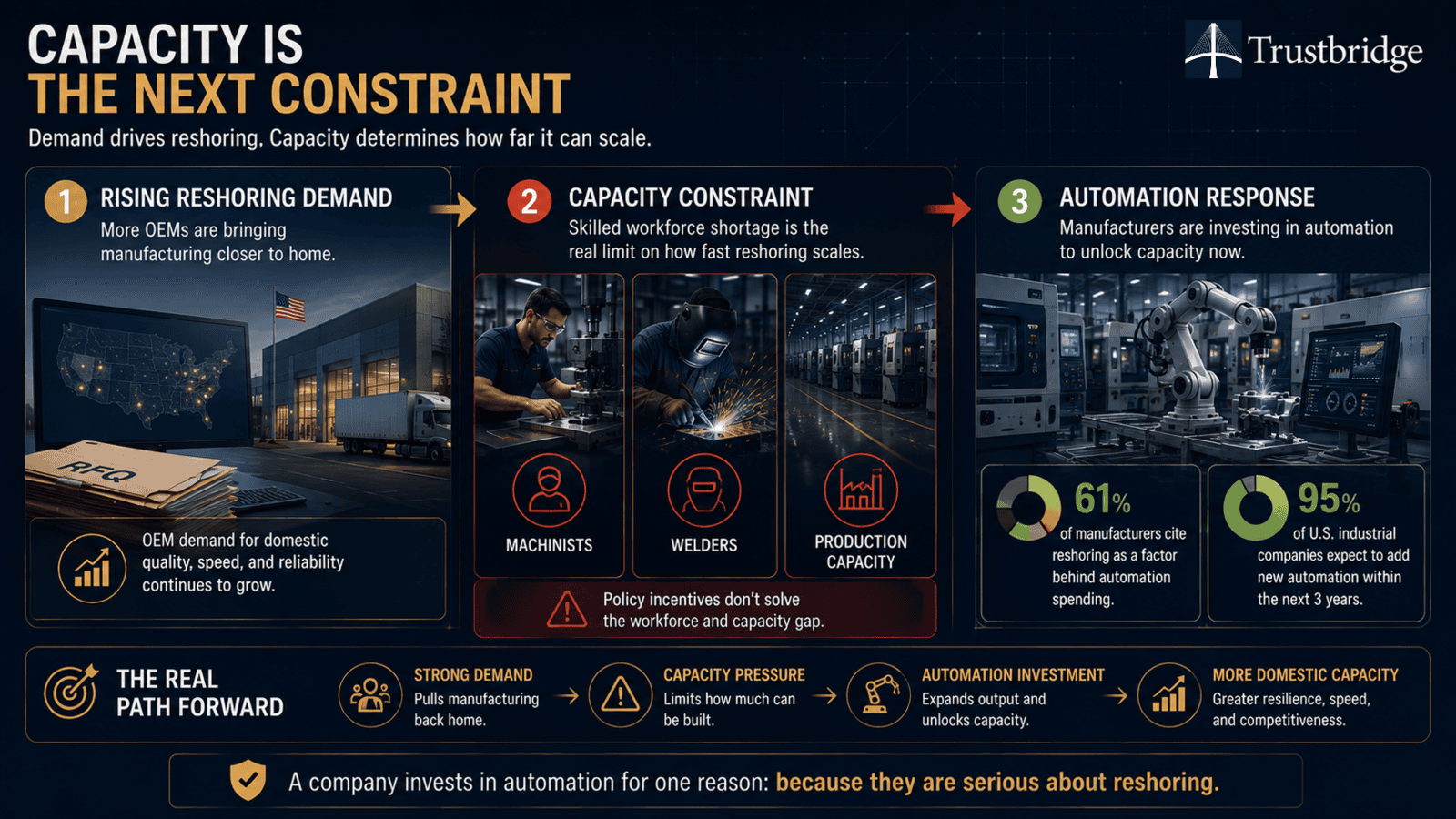
Capacity Is the Next Constraint
Conclusion
Reach the Buyers Whose Demand Is Already Moving
If reshoring demand is concentrating in specific industries and regions rather than following policy headlines, the practical question for a job shop or contract manufacturer is how to get discovered by the OEMs whose demand is actually moving. Trustbridge connects domestic manufacturing capacity with buyers actively sourcing it, matching on the same factors driving real reshoring decisions — quality, delivery, and reliability, not just price.
See how Trustbridge connects domestic capacity with reshoring demand →
Frequently Asked Questions
1. Why are companies reshoring manufacturing to the U.S.?
Companies are increasingly reshoring manufacturing to improve quality, shorten delivery times, reduce supply chain disruption, and gain greater control over production. While tariffs and government incentives can influence the decision, operational factors such as quality problems, long lead times, and supply chain risk are often stronger reasons for bringing production closer to customers.
2. Are tariffs the main reason companies are reshoring manufacturing?
No. Tariffs can change the cost of offshore manufacturing, but they are not the only or necessarily the primary driver of reshoring. Companies also consider quality, delivery reliability, supply chain risk, and total cost of ownership when deciding whether to move production to the U.S. or closer to their customers.
3. What industries are driving the growth of reshoring in the U.S.?
Reshoring activity is concentrated heavily in technology-intensive manufacturing sectors, including computer and electronics manufacturing, electrical equipment, EV batteries, solar, and transportation equipment. These industries often have strong reasons to prioritize shorter supply chains, production reliability, and closer coordination between engineering and manufacturing teams.
4. How can U.S. manufacturers benefit from the reshoring trend?
U.S. manufacturers can benefit by positioning their capabilities around the factors driving reshoring demand, including quality, delivery speed, production reliability, and supply chain resilience. Shops that can demonstrate dependable capacity and respond quickly to OEM sourcing needs are better positioned to capture manufacturing work moving back to the U.S.