
Manufacturing Constraints Every Consumer Electronics Engineer Should Understand
Why Manufacturing Constraints Matter in Product Development
Consumer electronics engineers are often driven by performance goals and innovative feature sets. However, even the most sophisticated designs must ultimately be produced within the limitations of manufacturing processes. When engineers overlook these realities during early development, they frequently encounter costly redesigns, production delays, and unexpected engineering challenges.
In real-world product development cycles, these oversights can lead to serious consequences. For example, a consumer electronics device may require a last-minute tooling redesign because enclosure walls were not optimized for injection molding. Situations like this can delay product launches by several months while also increasing tooling and manufacturing costs.
Understanding manufacturing limitations early allows engineers to create designs that can be produced reliably and economically while avoiding preventable engineering setbacks later in the development cycle.
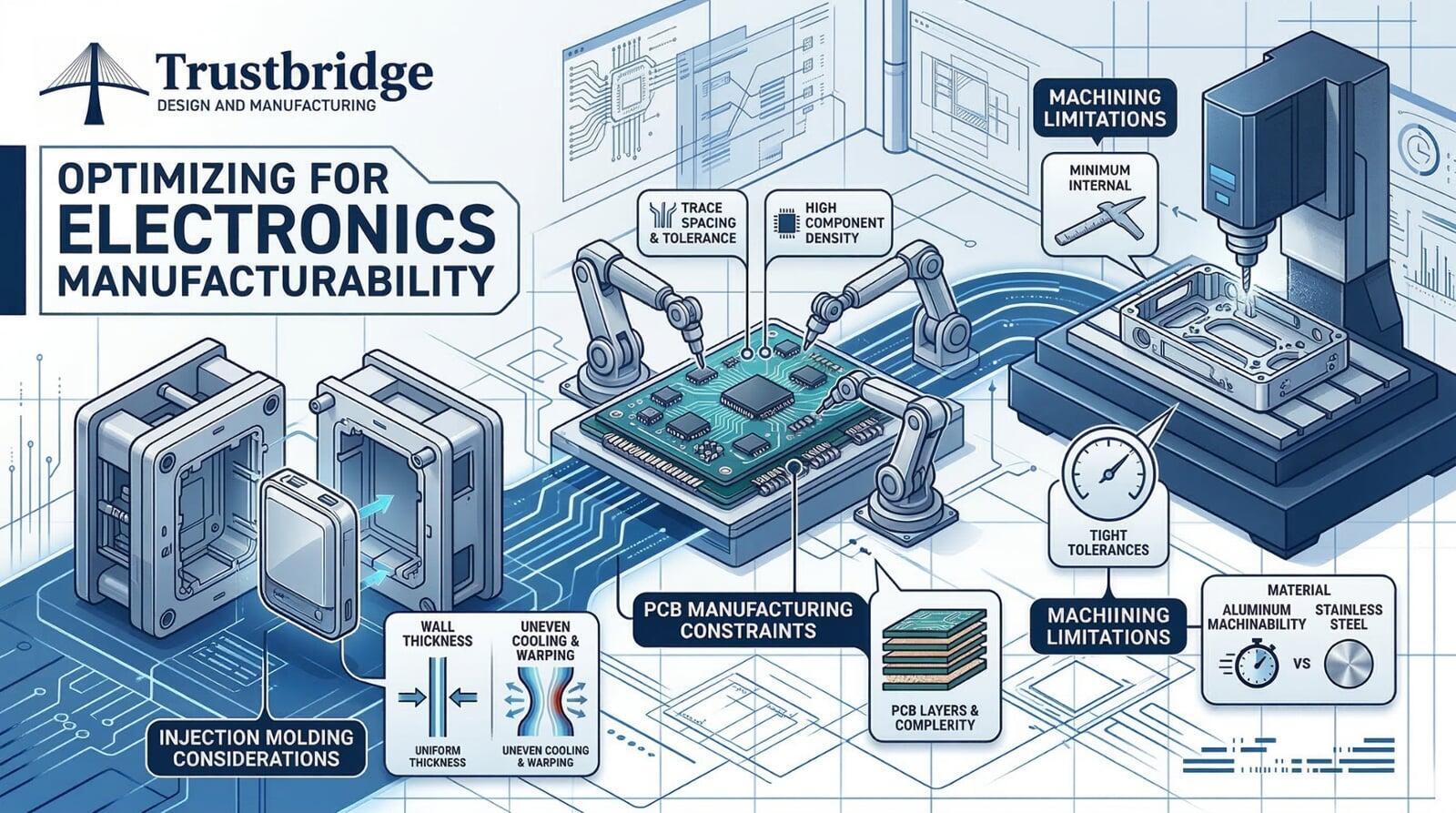
Injection Molding Considerations for Electronic Enclosures
Plastic enclosures are widely used in consumer electronics products due to their durability, flexibility, and cost efficiency. However, injection molding introduces several design considerations that engineers must address during development. Factors such as wall thickness consistency, mold flow behavior, and tooling geometry influence the quality of molded components.
Inconsistent wall thickness can cause uneven cooling during the molding process, often leading to defects such as warping or sink marks. Similarly, complex enclosure geometries can interfere with plastic flow inside the mold, increasing the likelihood of incomplete filling or cosmetic defects.
Engineers who design enclosures with these manufacturing realities in mind can significantly reduce production risks and ensure that molded parts maintain both structural integrity and aesthetic quality.
Printed Circuit Board Manufacturing Constraints
Printed circuit boards form the foundation of most consumer electronics devices. Engineers must consider multiple manufacturing realities when designing PCB layouts, including trace spacing, component density, thermal management, and fabrication tolerances. These factors affect not only the electrical performance of the device but also whether the board can be produced efficiently at scale.
- Fabrication Limits That Affect PCB Design
PCB manufacturers typically impose minimum trace widths and spacing requirements, often around 4–6 mils depending on fabrication capabilities. Designs that exceed these limits may require specialized fabrication processes, which can significantly increase manufacturing costs.
Via size limitations and PCB layer count also influence production complexity. As the number of layers increases, fabrication costs rise due to additional lamination, drilling, and inspection steps required during manufacturing.
- Design for Assembly in PCB Development
Engineers must also consider Design for Assembly (DFA) principles when creating PCB layouts. Component orientation, spacing, and compatibility with automated pick-and-place equipment are essential for efficient assembly.
Poorly oriented components or insufficient spacing can slow automated assembly processes, increasing the risk of misplacement errors and reducing manufacturing throughput.
By aligning PCB designs with both fabrication and assembly requirements, engineers can improve manufacturability and minimize downstream production challenges.
Machining Limitations for Precision Components
Certain consumer electronics products incorporate metal components that require precision machining. Engineers must understand how machining processes interact with material properties and tooling limitations in order to design manufacturable parts.
- Tooling and Geometry Constraints
Machining tools cannot produce perfectly sharp internal corners, which means engineers must account for minimum internal corner radii when designing pockets or cavities. Similarly, deep or narrow features can create tool access challenges, increasing machining time and manufacturing complexity.
Tight tolerances can also affect production costs. While tolerances such as ±0.01 mm may be achievable, maintaining them often requires slower machining speeds, specialized tooling, and additional inspection processes.
- Material Machinability Differences
Material selection also influences machining efficiency. Aluminum is widely used in consumer electronics components because it is lightweight and relatively easy to machine, enabling faster production cycles.
In contrast, stainless steel is significantly harder and more abrasive, which increases tool wear and machining time. Engineers who consider these material differences during the design stage can better balance performance requirements with manufacturing efficiency.
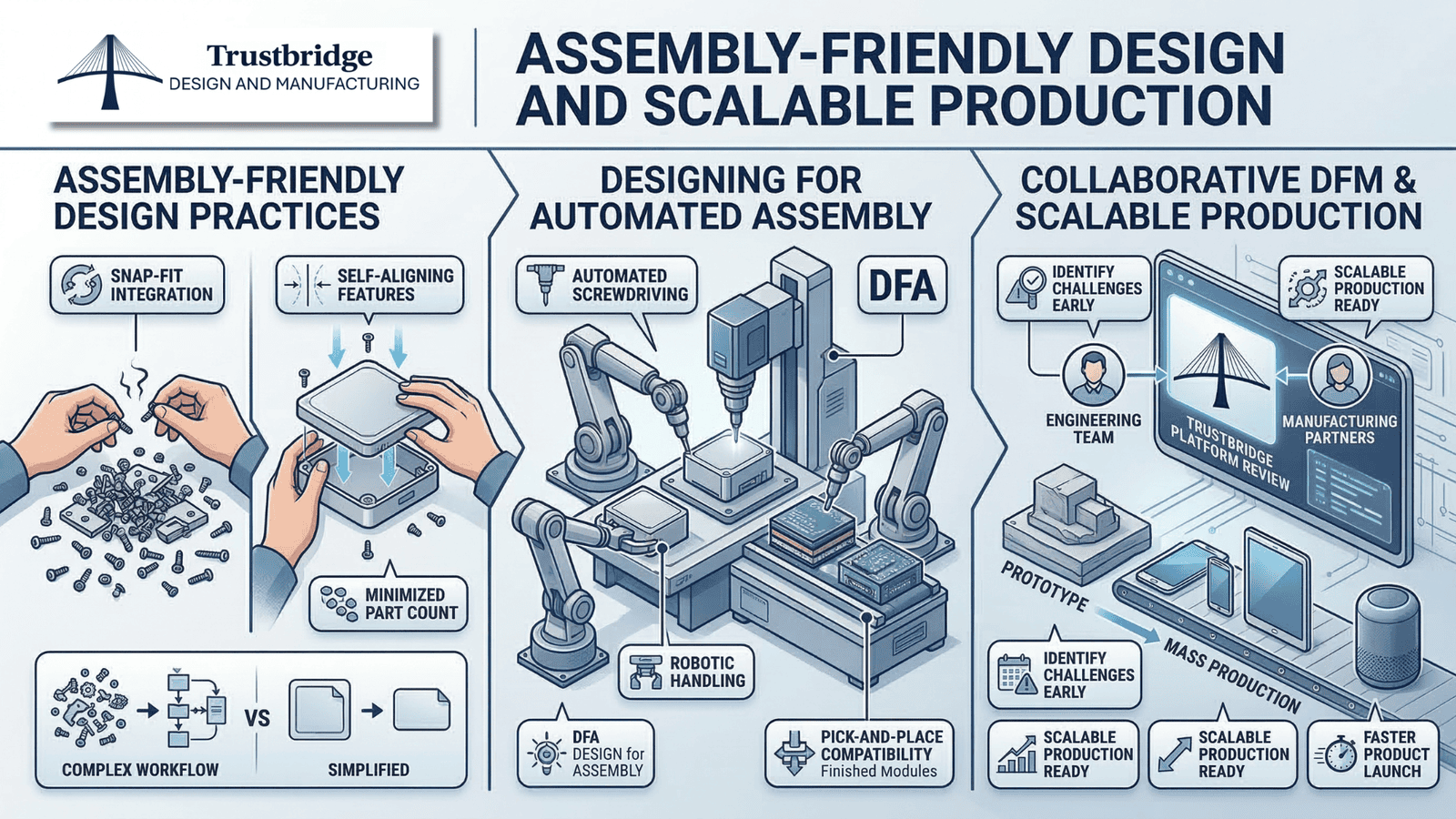
Assembly Constraints in Consumer Electronics Production
Assembly processes represent another critical stage in electronics manufacturing. Products that require complicated assembly steps or difficult component alignment can slow production lines and increase defect rates.
Engineers who consider assembly workflows during product design can significantly improve manufacturing efficiency.
- Assembly-Friendly Design Practices
Several design strategies help simplify assembly and improve production reliability. These include incorporating snap-fit features that reduce or eliminate the need for fasteners, designing self-aligning parts that guide components into position during assembly, and minimizing the total number of screws or fasteners required.
Reducing part complexity and improving component alignment can significantly streamline production processes.
- Designing for Automated Assembly
Automation compatibility is also a key factor in modern consumer electronics manufacturing. Many products are assembled using automated or semi-automated systems, and designs must accommodate robotic handling, automated screwdriving, and pick-and-place equipment.
These approaches align with Design for Assembly (DFA) methodologies, which focus on simplifying product structures so they can be assembled quickly, consistently, and at lower cost.
When engineers design products with assembly efficiency in mind, they enable faster production cycles and improved product reliability.
Conclusion
Manufacturing realities shape every stage of consumer electronics production, from enclosure fabrication to PCB development and final product assembly. Engineers who account for these factors early in the design process can avoid costly development setbacks and ensure smoother transitions from prototype to mass production.
Successful product development often depends on strong collaboration between engineering teams and manufacturing partners. By working together throughout the design process, teams can identify potential production challenges before they escalate into delays or costly redesigns.
This collaborative approach aligns closely with Design for Manufacturability (DFM), a strategic framework that helps engineering teams optimize designs so they can be produced efficiently, reliably, and at scale.
As consumer electronics markets continue to accelerate and competition intensifies, engineers who integrate manufacturing considerations early in the design process will be better positioned to launch products faster, control production costs, and deliver high-quality devices to market.
Engineering teams increasingly rely on platforms like Trustbridge to connect with experienced manufacturing partners who can review product designs, provide prototyping support, and help prepare products for scalable production.
Frequently Asked Questions (FAQs)
1. Why should consumer electronics engineers consider manufacturing constraints during the design stage?
Manufacturing constraints influence whether a product can move smoothly from prototype to mass production. If engineers ignore factors like material behavior, tooling limitations, or assembly requirements, they may face costly redesigns, production delays, or quality issues once manufacturing begins.
2. What are the most common manufacturing constraints in consumer electronics production?
Some of the most common constraints include injection molding design limits for plastic enclosures, PCB fabrication requirements such as minimum trace width and spacing, machining limitations for metal components, and assembly constraints related to automation and part alignment.
3. How do PCB manufacturing limits affect electronics product design?
PCB fabrication capabilities determine factors such as minimum trace width, via sizes, layer counts, and spacing between components. Designs that exceed these limits may require specialized fabrication processes, increasing both production complexity and manufacturing cost.
4. How do Design for Manufacturability (DFM) and Design for Assembly (DFA) improve production efficiency?
Design for Manufacturability focuses on ensuring that parts can be produced efficiently using available manufacturing processes, while Design for Assembly simplifies how those parts are assembled into the final product. Together, these approaches help reduce production costs, improve product reliability, and enable faster scaling to mass production.