
The Hidden Coordination Cost in Every Custom Manufacturing Transaction
Every custom manufacturing quote has two numbers attached to it. One is the price on the page. The other is the cost of everything it took to get a trustworthy price in the first place, and that second number has a name economists gave it almost ninety years ago.
Introduction
A quoted price captures the costs the supplier chooses or is able to price into the job. It does not capture every cost the buyer and supplier incur in finding each other, defining the work, coordinating it, and verifying the outcome. Everything that happened before the quote landed, and everything that has to happen after the part ships to confirm it's actually right, carries its own cost too. That second cost rarely shows up on an invoice, which is exactly why it's easy to underestimate and expensive to ignore.
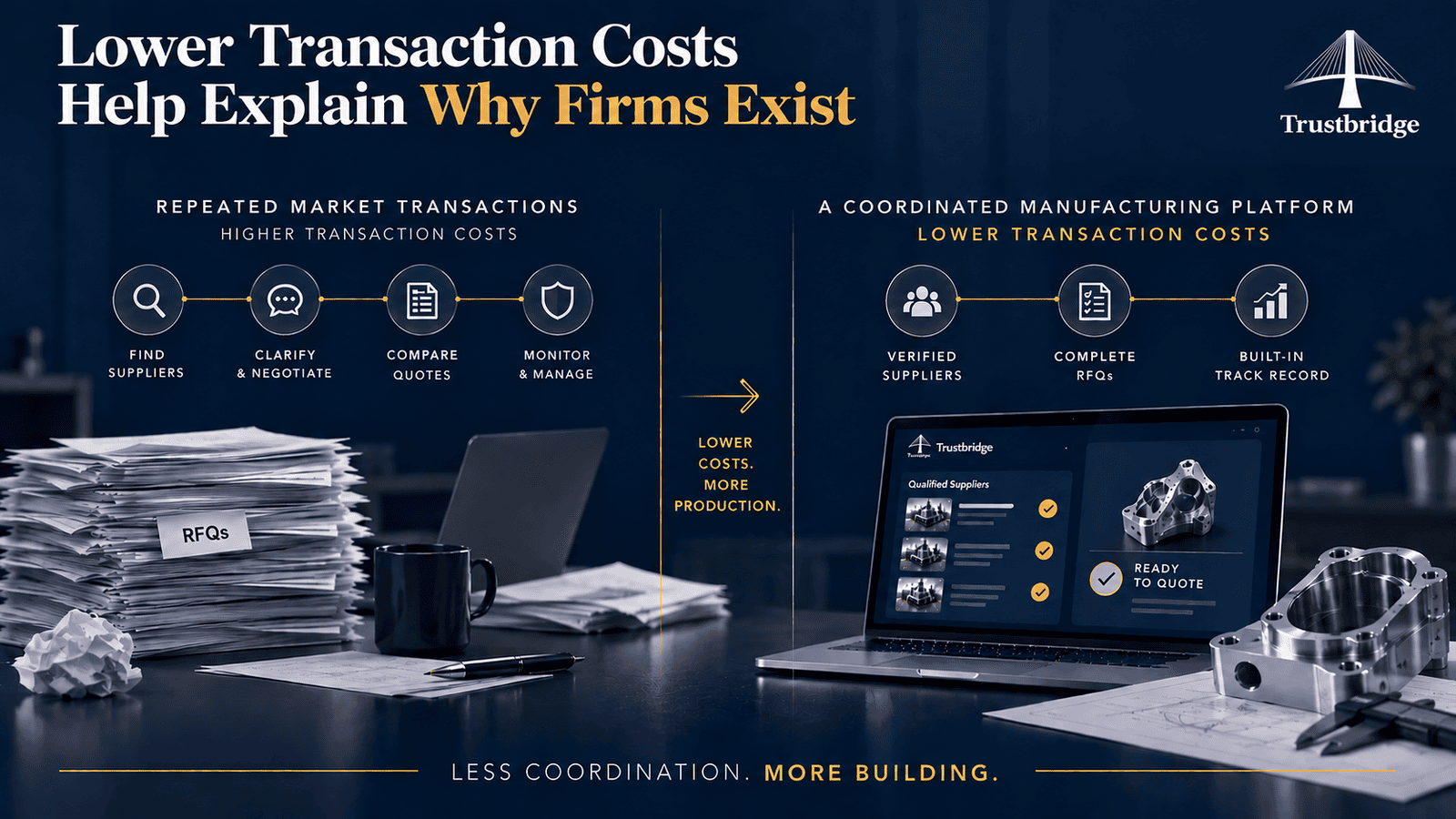
Economists have a name for this, and it isn't new. In 1937, Ronald Coase asked a question that sounds almost too simple. If markets are efficient at setting prices, why do firms exist at all? Why doesn't everyone just contract out every task to whoever offers the best price that day? His answer, later awarded a Nobel Prize, was that using a market carries real costs of its own costs of finding a counterparty, negotiating terms, and making sure the deal actually gets honored. He called them transaction costs. Custom manufacturing transaction costs run on exactly this logic, every single time a part changes hands.
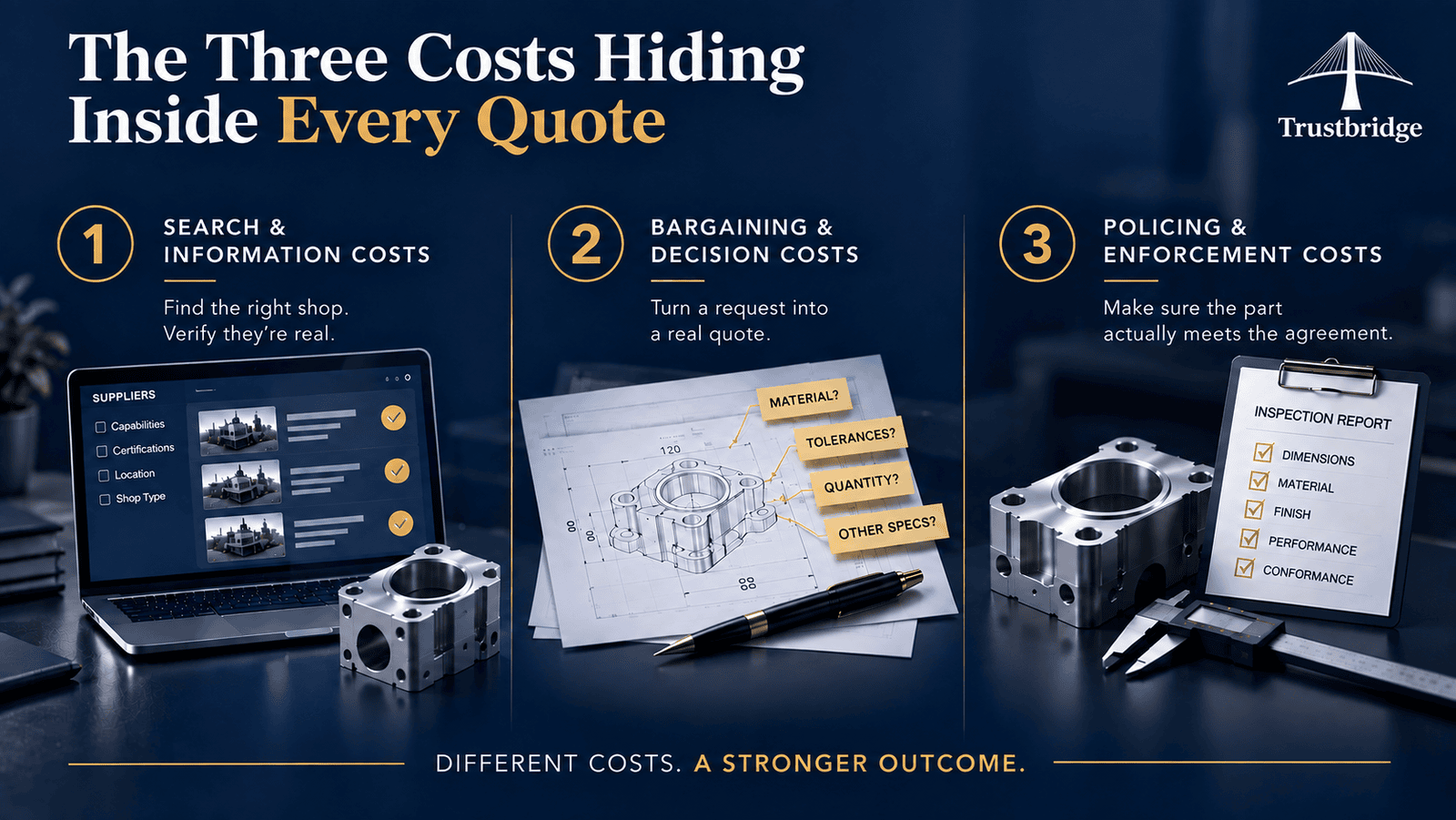
The Three Costs Hiding Inside Every Quote
Economists building on Coase's work later organized transaction costs into useful categories. A widely cited framework from Carl Dahlman groups them into search and information costs, bargaining and decision costs, and policing and enforcement costs. The first is search and information cost: the work of finding a job shop capable of the work, and figuring out whether it's actually trustworthy before committing anything real to it. That's the cost this series has already traced through certifications, references, and how a shop behaves on a small trial order. None of it shows up in a unit price. All of it takes real time to check properly.
The second is bargaining cost, and in manufacturing it shows up as everything involved in getting a request and a quote to actually describe the same part. A drawing missing a material grade, an unstated tolerance, a quantity that's really three different numbers — every one of those gaps is a small negotiation that has to happen before pricing can even start. This series has already spent real space on exactly how much time that negotiation eats. The third is policing cost: verifying, once a part exists, that it actually meets the spec it was supposed to meet. Inspection, corrective action, the gap between a good sample and a good production run these are the direct manufacturing version of what Coase called the cost of making sure an agreement gets honored.
Custom Work Carries a Heavier Version of All Three
None of these three costs disappear when a part is standardized and bought off a shelf. They just shrink dramatically, because the same search, the same negotiation, and the same verification only have to happen once, and then get reused across every future purchase. Buying a standard fastener means none of that groundwork gets repeated. The trust, the spec, and the quality bar were all settled the first time, for every purchase after it.
Custom manufacturing doesn't get that discount. A new part, from a machining vendor that hasn't made it before, resets all three costs close to zero every time it happens. That's not a flaw in how custom manufacturing works. It's the direct, structural reason custom work is more expensive to coordinate than commodity purchasing, independent of how good any individual shop's price or quality actually is. The coordination cost is baked into the category of transaction, not into any one party's performance.
Reducing This Cost Was the Whole Point of Coase's Answer
Coase's original insight wasn't just that transaction costs exist. It was that institutions form specifically to reduce them. A contract manufacturer that internalizes coordination across many jobs can economize on exactly the search, negotiation, and verification costs that a pure open market forces every participant to pay repeatedly and separately. That's the same logic behind why a platform built around manufacturing coordination makes sense as more than a convenience.
A structure that verifies capability once and makes it visible to many buyers is doing real work, not offering something decorative. The same goes for one that flags a spec gap before a quote goes out instead of after. It applies just as much to one that carries a track record forward from one transaction into the next, building toward a real manufacturing partnership rather than resetting cold with every job. It's addressing the actual cost this piece has been describing, using the same logic Coase used to explain why firms exist in the first place. Coordination has a cost. Something that reliably lowers it is worth real value, regardless of what it's built on top of.
Conclusion
The price on a custom manufacturing quote was never the whole cost of the transaction, and treating it as though it were is how a technically fair quote still ends up feeling expensive. Search, negotiation, and verification are real costs, carried by someone whether or not they appear on an invoice. Naming them doesn't make them go away. It just makes clear that reducing them is a legitimate goal in its own right, not a nice-to-have layered on top of getting a good price.
Custom manufacturing transaction cost, in other words, isn't a niche accounting concept. It's the actual explanation for why two shops quoting the identical print can feel completely different to work with, even when their prices land within a few dollars of each other.
Coordinate Less, Build More
Search, negotiation, and verification are the three costs this piece has walked through, and reducing all three is exactly what Trustbridge is built to do. A verified profile carries search cost forward instead of resetting it with every new buyer. A request gets checked for completeness before it goes out, cutting the negotiation cost that a vague drawing usually creates. Growing that kind of relationship stops requiring either side to re-earn trust from zero on every single transaction, whether the work is a one-off prototype or the start of a recurring order.
See how Trustbridge lowers the coordination cost in custom manufacturing →
Frequently Asked Questions
1. What are transaction costs in custom manufacturing?
Transaction costs in custom manufacturing are the time and resources required to find a capable manufacturer, define and negotiate the job, and verify that the finished parts meet the agreed requirements. These costs can include supplier research, drawing clarification, quoting discussions, quality inspections, and corrective actions, even though they rarely appear as separate line items on a manufacturing invoice.
2. Why is custom manufacturing more expensive to coordinate than buying standard parts?
Custom manufacturing requires buyers and suppliers to repeat much of the search, negotiation, and verification process for each new part or supplier relationship. Standard products typically have established specifications, suppliers, and quality expectations, while custom work requires new technical and commercial coordination before production can begin.
3. What are the three main types of transaction costs in manufacturing?
The three major transaction costs are search and information costs, bargaining and decision costs, and policing and enforcement costs. In custom manufacturing, these correspond to finding and evaluating suppliers, clarifying specifications and agreeing on the job, and verifying that manufactured parts meet the required specifications.
4. How can companies reduce transaction costs in custom manufacturing?
Companies can reduce transaction costs by making supplier capabilities easier to evaluate, improving the completeness of manufacturing specifications before quoting, and carrying verified supplier and quality information from one transaction into the next. These practices reduce repeated supplier research, clarification cycles, and verification work while making custom manufacturing relationships easier to manage.