Job Shop vs. Contract Manufacturer vs. OEM: What the Terms Actually Mean
The difference between a job shop, contract manufacturer, and OEM comes down to the role each plays in the manufacturing process. A job shop focuses on flexible, custom production, a contract manufacturer builds products under ongoing production agreements, and an OEM owns the product design and brand. Understanding these terms helps suppliers position their capabilities accurately, attract the right customers, and avoid confusion during sourcing, RFQs, and production planning.
Introduction
For suppliers, getting this right matters even more than it does for buyers. The way you describe your own operation shapes who reaches out to you and whether the inquiries you receive actually match what you're set up to do. This article breaks down what each term really means, where the lines blur, and how to think about where your shop fits in the job shop vs. contract manufacturer conversation — plus how OEM and ODM fit into the same picture.
What Is a Job Shop?
A job shop is a manufacturing operation built around flexibility rather than volume. Instead of a dedicated line producing the same part thousands of times, a job shop organizes its equipment by function — all the lathes in one area, all the mills in another, all the welding stations in a third. Each incoming order, or "job," gets routed through whichever combination of machines and processes it needs.
That structure makes job shops well suited to:
One-off or small-batch custom parts
Prototypes and first-articles
Quick-turn or urgent work
Jobs that vary significantly from one order to the next
Because every job is different, a job shop typically quotes and negotiates each order individually — there's rarely a standing agreement covering future volume. A customer might place one order this month and nothing for the next six, and that's completely normal in this model. It's also why job shops tend to be smaller, generalist operations: the value they offer is the ability to say yes to almost anything that comes through the door, rather than the ability to run one specific part efficiently at massive scale.
What Is a Contract Manufacturer?
Contract manufacturing starts from a similar place — a supplier building parts to a customer's design and specifications — but the relationship is structured differently. A contract manufacturer (CM) typically works from an ongoing agreement rather than a single negotiated order. The customer commits to a forecast or production schedule, and the CM builds the systems to support it: repeatable quality processes, documented routings, material planning, and capacity reserved against future demand.
This is the core distinction people are usually reaching for when they ask about job shop vs. contract manufacturer: a job shop is built for one-off, negotiated-per-order work, while contract manufacturing is built around a recurring, forecasted relationship. A contract manufacturer isn't just filling an order — it's acting as an extension of the customer's own production line, expected to scale from an initial small batch up to full production volume without the customer needing to requalify a new supplier at every stage.
Because of that, contract manufacturers often provide more than machining or fabrication alone. Many also offer assembly, testing, packaging, and even limited engineering support, so a customer can hand off an entire piece of their supply chain rather than a single process step.
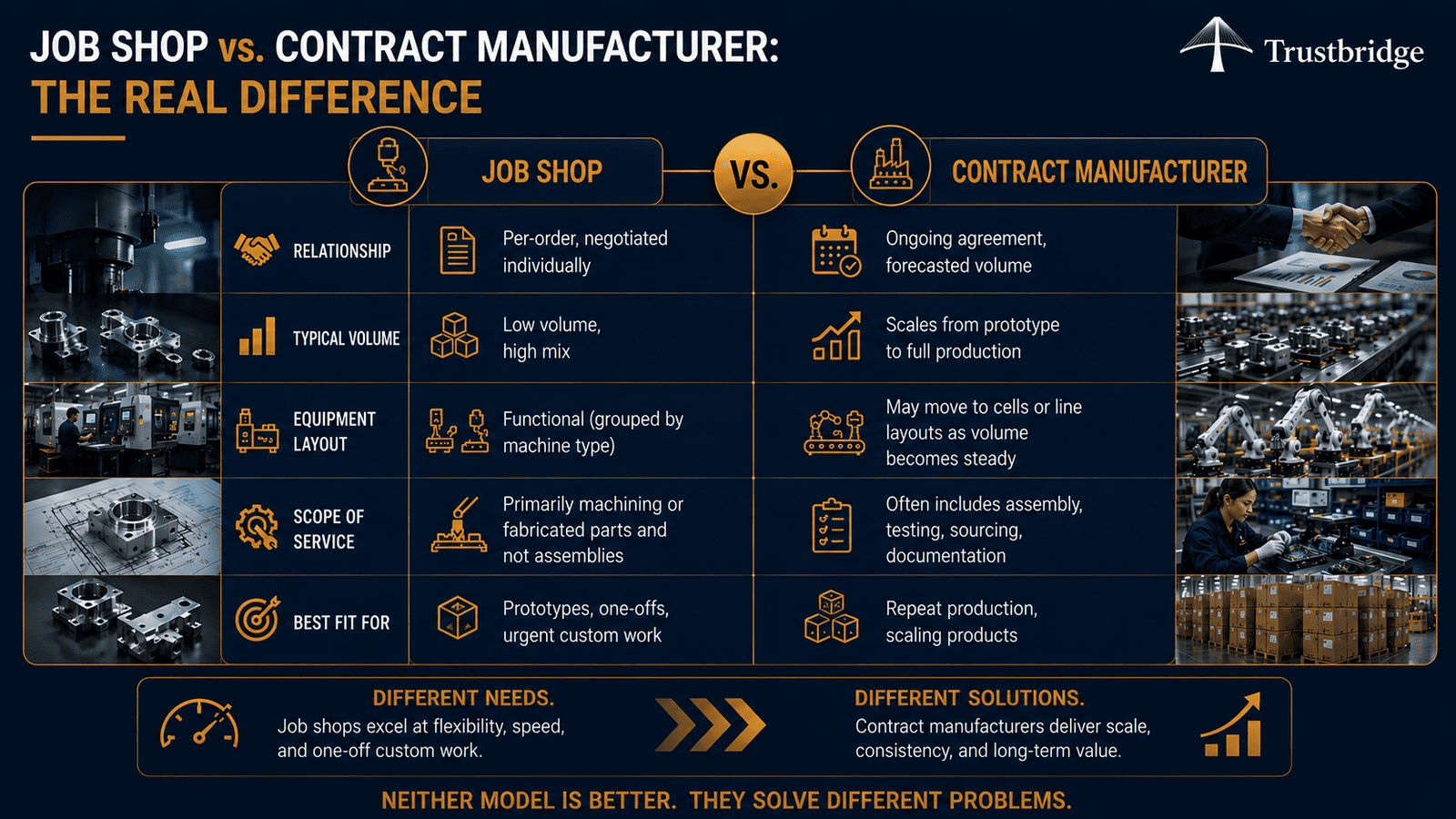
Job Shop vs. Contract Manufacturer: The Real Difference
| Job Shop | Contract Manufacturer |
Relationship | Per-order, negotiated individually | Ongoing agreement, forecasted volume |
Typical volume | Low volume, high mix | Scales from prototype to full production |
Equipment layout | Functional (grouped by machine type) | May move to cells or line layouts as volume becomes steady |
Scope of service | Primarily Machining or fabricated parts and not assemblies | Often includes assembly, testing, sourcing, documentation |
Best fit for | Prototypes, one-offs, urgent custom work | Repeat production, scaling products |
Neither model is "better" they solve different problems. A startup validating a new design needs a job shop's flexibility and speed. That same company, once the design is locked and it needs 10,000 units a quarter with consistent quality documentation, needs a contract manufacturer instead. Plenty of suppliers operate as both, depending on the customer and the project in front of them.
What Does OEM Actually Mean (And Why It Trips People Up)
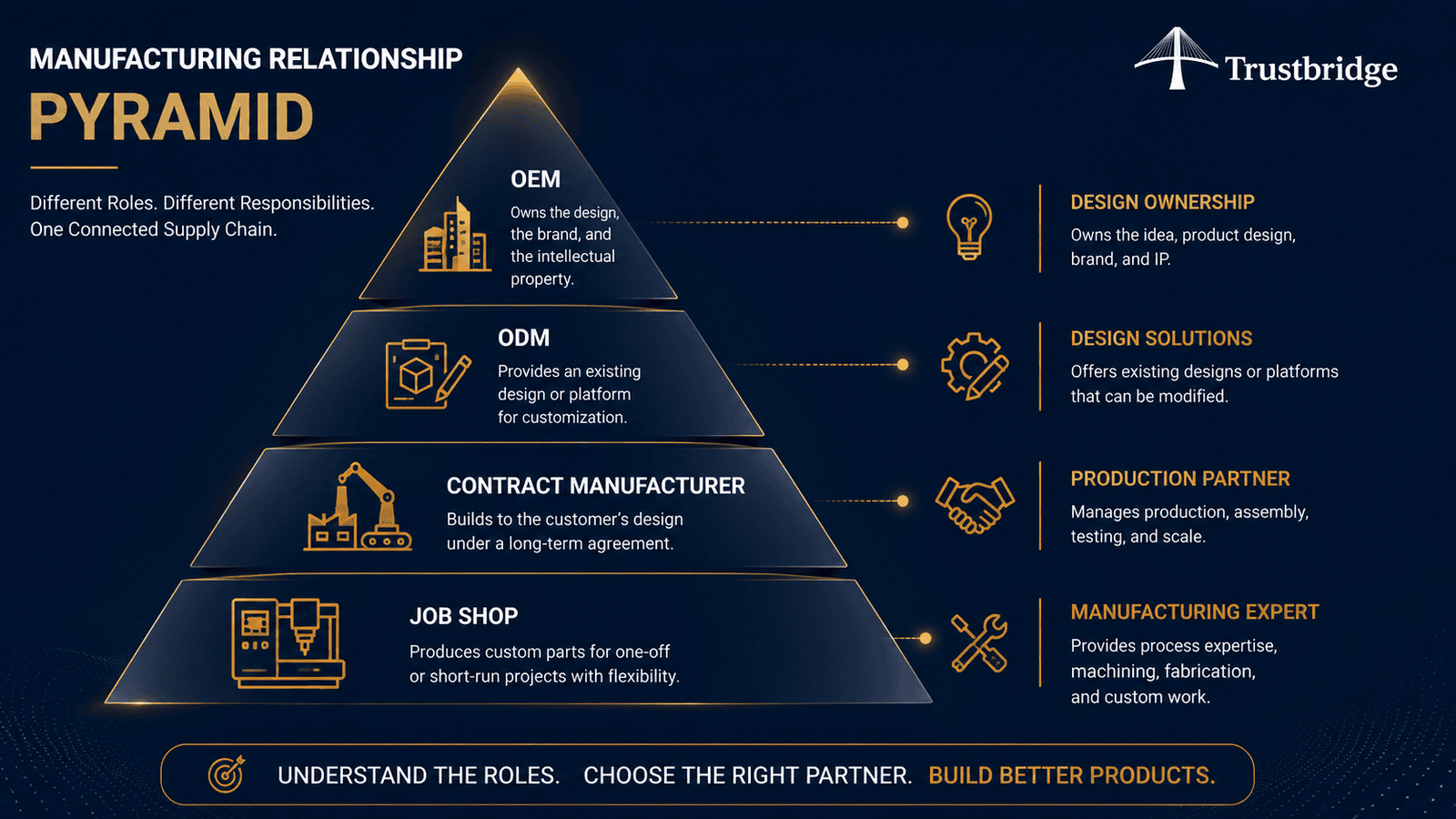
OEM stands for Original Equipment Manufacturer, and in most modern sourcing usage, it refers to the company that owns the product design, the intellectual property, and the brand it's sold under. Under this definition, the OEM is the customer — the company that designed the part and is looking for someone to build it. An automaker, a medical device company, or a consumer electronics brand acting as an OEM owns the product; it may or may not build that product in-house.
Here's where it gets genuinely confusing: in everyday sourcing conversations — especially around replacement parts and components — "OEM" often gets used the other way around, to describe the manufacturer that builds the part to spec, rather than the brand that owns it. You'll see this in phrases like "OEM parts supplier" or "OEM manufacturer," where the term is really describing a build-to-spec production role instead of design ownership. Both usages are common enough that you have to read context carefully to know which one a buyer means.
For suppliers, the practical takeaway is this: most of the companies you'll work with through a supplier network are acting as the OEM in that first sense — they own the design and are looking for a partner (a job shop or contract manufacturer) to produce it. You are rarely the OEM yourself unless you're designing and branding your own product line in addition to manufacturing.
OEM vs. Contract Manufacturer: Who Owns What
Because "OEM" and "contract manufacturer" describe different roles in the same relationship, comparing them isn't really an apples-to-apples exercise — it's closer to comparing a customer to a vendor. In a typical OEM vs. contract manufacturer relationship:
The OEM owns the design, the intellectual property, and the brand the finished product sells under. It defines specifications, quality standards, and the product roadmap.
The contract manufacturer builds the product, or a major component of it, to the OEM's specifications, without owning the underlying design.
Where this gets genuinely comparative is when a company is deciding how to get something built: should it manufacture in-house, acting fully as a vertically integrated OEM, or outsource to a contract manufacturer? That decision usually comes down to capital investment, speed to market, and how much manufacturing expertise the company wants to build internally versus buy from a specialist partner.
OEM vs. ODM: Adding a Third Acronym
Once OEM and contract manufacturer are sorted out, the next term that inevitably shows up is ODM — Original Design Manufacturer. The distinction in the OEM vs. ODM comparison comes down to one question: who created the design?
OEM model: the customer brings a proprietary design; the manufacturer builds it exactly to spec.
ODM model: the manufacturer already has a design — sometimes a whole catalog of them — and the customer selects one, then adds branding, minor customization, or packaging.
An ODM arrangement gets to market faster and cheaper because the engineering work is already done, but the customer doesn't own the underlying design, and competitors can often source a nearly identical product from the same ODM. A contract manufacturer, by contrast, builds only what the customer designs, which protects the customer's IP but requires the customer to have done that design work in the first place.
For most job shops and contract manufacturers building custom parts to a customer's drawings, the ODM model doesn't apply directly — it's more relevant to product-level manufacturing like electronics and consumer goods than to piece-part machining and fabrication. Still, it's worth knowing, because a buyer who brings up ODM is usually telling you they're weighing "build my design" against "sell me your existing design," which is useful context for how you quote and position your own capabilities.
Why This Terminology Matters If You're a Supplier
None of this is just vocabulary trivia. The words a buyer uses in an RFQ are a signal for what they actually need, and the words you use to describe your own shop determine whether the right buyers find you in the first place.
If you quote jobs individually, carry no standing production agreements, and thrive on variety, describing your operation as a job shop — or precision machine shop, custom fabricator, and so on — sets accurate expectations from the first conversation. If you run recurring production for customers under longer-term agreements, with the documentation and quality systems to match, "contract manufacturer" is the more accurate description, and it signals to larger buyers that you can handle an ongoing relationship rather than a single order.
Plenty of shops genuinely do both, and that's fine — but being explicit about which one applies to a given inquiry, rather than defaulting to whichever term sounds more impressive, saves everyone time. A buyer looking for a prototype partner and a buyer looking to qualify a production-scale supplier are searching for different things, even when the underlying capability overlaps.
Final Thoughts
Job shop, contract manufacturer, and OEM aren't interchangeable labels — they describe genuinely different relationships, order structures, and expectations. A job shop wins on flexibility and speed for custom, negotiated-per-order work. A contract manufacturer wins on scalable, forecasted production. OEM describes whoever owns the design, whether or not they're also the one holding the tools — and ODM flips that ownership question around entirely.
Understanding where your shop fits, and describing it accurately, is one of the simplest ways to attract the right inquiries instead of the wrong ones. If you're ready to get in front of buyers who already know what they're looking for, Trustbridge connects vetted suppliers with qualified, project-ready manufacturing opportunities — no bidding wars, no guesswork.