
What Should a Professional DFM Review Include Before Tooling?
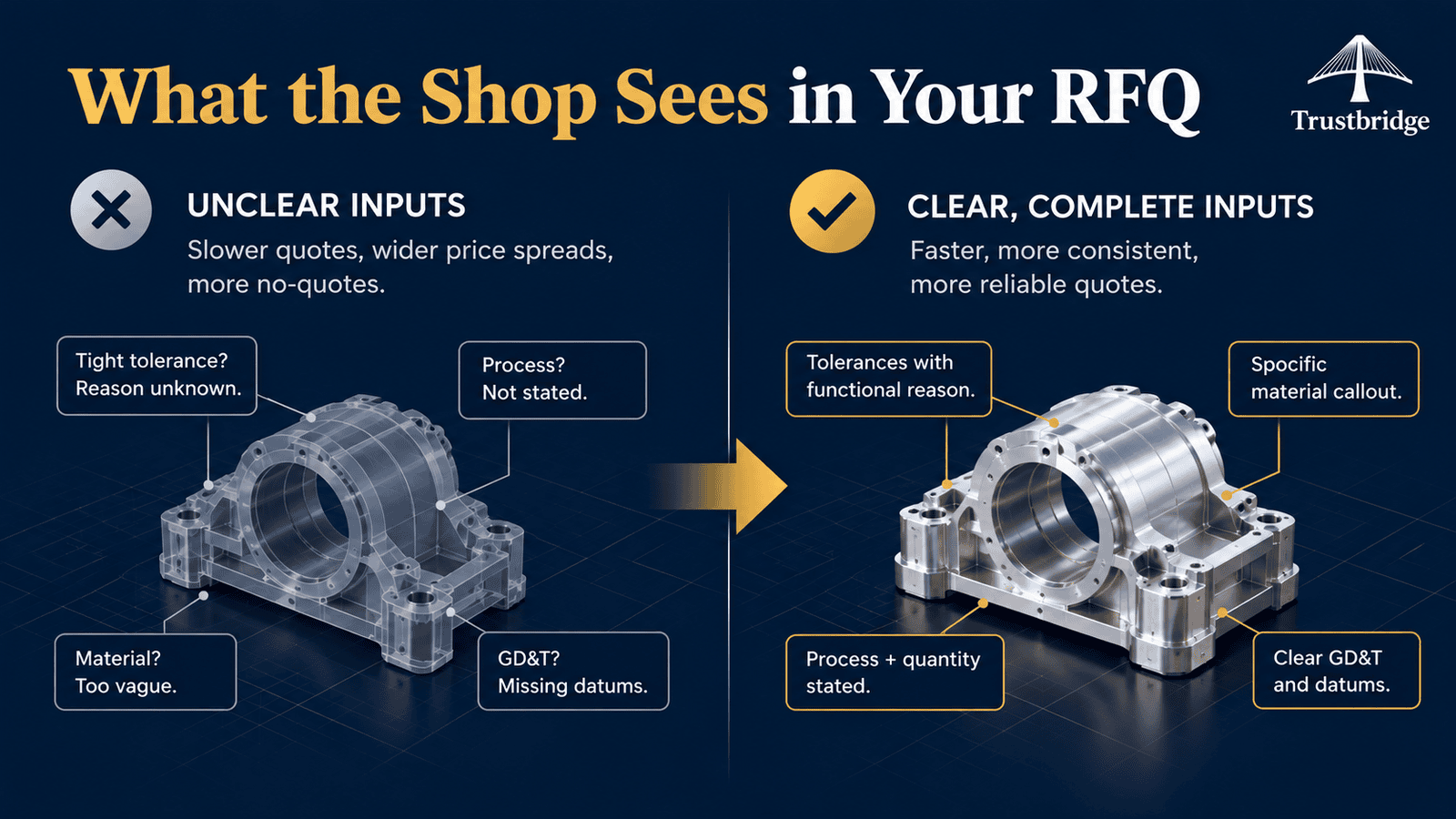
A DFM review conducted before tooling should confirm four things: every tight tolerance has a stated functional reason, the intended process and quantity are written down rather than assumed, material callouts are specific enough for a shop to act on, and GD&T or datum structure reflects a real inspection need rather than a copied habit. A review that only asks whether a part can be made without checking whether a shop can quote it quickly, confidently, and consistently produces slow quotes, wide price spreads across shops, and RFQs that get rejected outright.
Introduction
You finish the model, clean up the tree, and send the same STEP file to five shops for a quote. A week later, the answers don't match: two shops pass without much explanation, one comes back three times over budget, one wants a call to “confirm a few tolerances” before committing to a number, and one quote looks great until you notice the lead time is nine weeks longer than your last vendor. Nothing about the part changed between shop one and shop five. What changed was how each shop read the same file and that reading is deciding your budget and your schedule before you've spoken to any of them.
This is what a lot of DFM content skips. It's easy to find checklists for whether a part can be made. It's harder to find anything about what design choices do to machine shop quoting itself not just whether a shop can cut, mold, or form the geometry, but how confidently, how fast, and how consistently across the shops you send it to.
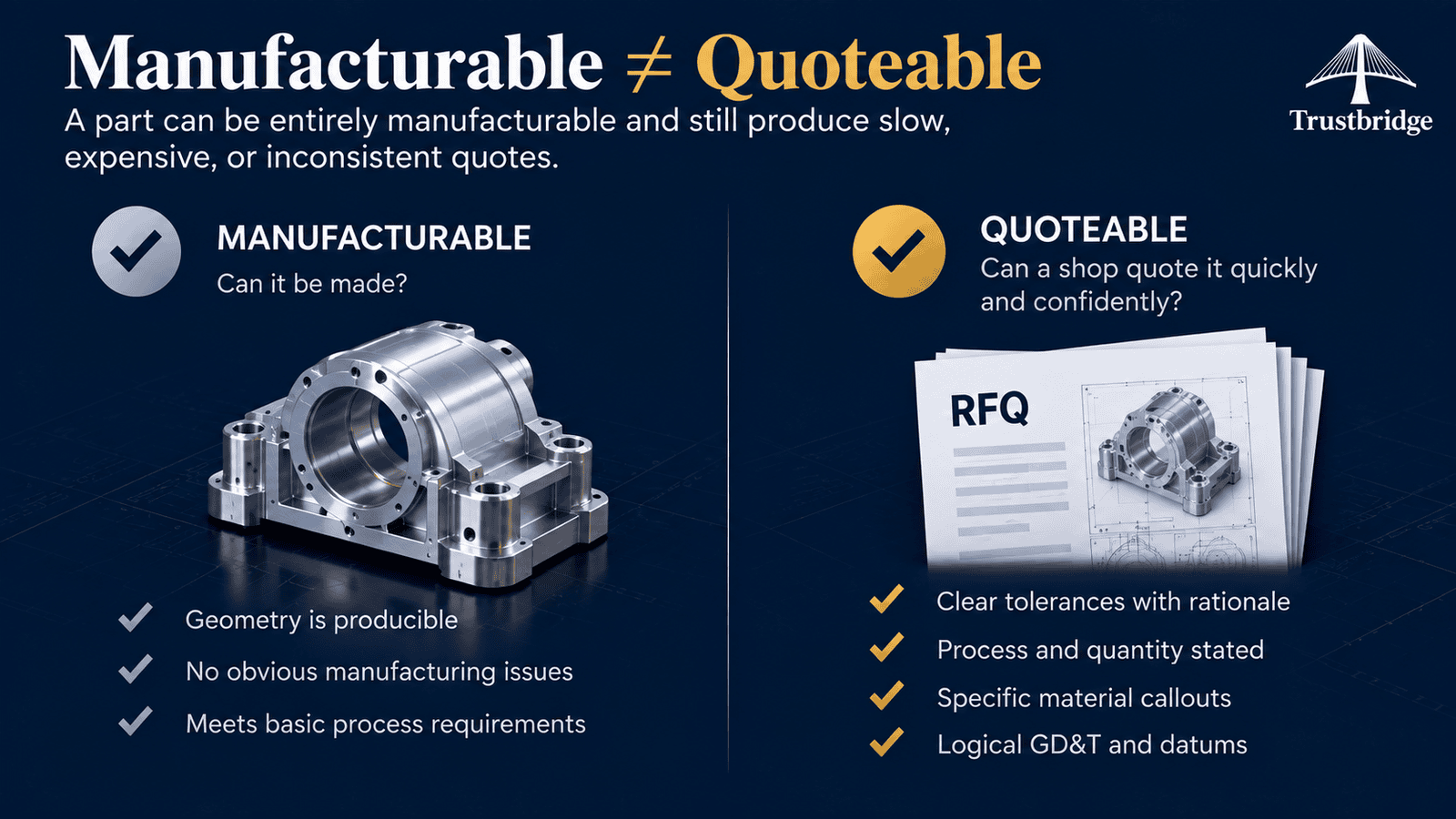
Manufacturability Isn't the Same as Quotability
A DFM review is supposed to catch problems before tooling, when a fix is still a CAD change instead of a schedule change. Most reviews are built around one question: can this be made? That's necessary, but it's not the whole test. A feature can be entirely manufacturable and still produce a slow, expensive, or inconsistent manufacturing RFQ, because manufacturability and quotability are different things.
Manufacturability asks whether the geometry is physically producible. Quotability asks whether an estimator can look at the file for a few minutes and commit to a price and a date with confidence. A review that only checks the first question leaves the second to chance and that chance shows up later as a rejected RFQ, a widespread difference between quotes, or a lead time nobody budgeted for.
What a DFM Review Should Actually Check Before Tooling
A review aimed at quotability, not just feasibility, looks at a smaller and more specific set of things. Four are worth treating as non-negotiable before a design becomes a machine shop RFQ.
Tight Tolerances Need a Stated Reason
Audit every tolerance tighter than standard commercial precision (e.g., tighter than 0.005'' / 0.12mm for milling). If the rationale is "to be safe" or a carryover from a legacy drawing, open it up. Unexplained tight limits trigger costly CMM programming and scrap allowances. Worse, two shops will read them differently: one prices in high-precision risk, while the other assumes an oversight, quotes cheap, and files change orders later.
State the Process and Quantity, Don't Imply Them
A part modeled with uniform walls and generous radii can look like “maybe machined, maybe molded, maybe cast” to five different shops, each guessing differently and a prototype quantity of five and a production run of five thousand are different projects wearing the same CAD file. State the intended process and quantity on the drawing or the RFQ, even as a placeholder. Leaving it open doesn't keep your options open. It gets you a mix of no-quotes from shops who guessed wrong, quotes for the wrong process from shops who didn't ask, and for tooling-dependent processes a number that protects the shop's margin against the volume they assumed, not the one you actually need.
Give Material Callouts a Shop Can Act On
“Aluminum” is a starting point, not a specification. Grade, temper, and any required certification mill cert, RoHS, material traceability change machinability, cost, and, in regulated industries, which shops can even bid. A vague material line reads as a project the buyer hasn't fully scoped, and shops serving regulated markets will often no-quote rather than ask, because a buyer who never answers the clarifying email is more common than one who actually knows.
Let GD&T and Datums Tell an Inspection Story
A drawing with tolerances but no clear datum structure asks the shop to invent an inspection plan and price the one they imagine. If a stack-up is real, show it. If a feature is cosmetic, don't dress it up with callouts that imply otherwise. Datums that match how the part is actually fixtured and measured take the guesswork out of inspection, and inspection guesswork is one of the more common reasons two quotes for the same part land a few thousand dollars apart.
What the Shop Sees
An estimator isn't reading your file the way you built it feature by feature, with the reasoning fresh. They're scanning it for a handful of signals in the few minutes they can spend per RFQ, because they're triaging a stack of requests, not reviewing one.
Clean, consistent tolerances and a stated process read as “this buyer has done this before” and tend to get quoted quickly, often at a tighter number, because the shop trusts the file. Unexplained tight tolerances, an ambiguous process, or a material line that raises a compliance question read as risk. Risk gets handled one of three ways: priced in as a cushion, punted back as a clarifying question that costs you a few days, or quietly passed over, because a shop with a full queue spends its attention on the RFQs that look like they'll close.
None of that is a judgment on your design. It's what happens to any manufacturing quote request that leaves questions for the reader to answer, multiplied by however many shops you sent it to. The RFQ that comes back with five fast, tight, comparable quotes and the one that comes back with two no-quotes and a scattered spread are often the same part, described with a different amount of certainty.
Before Your Next Design Goes Out for Quotes
The fix isn't a longer checklist. It's a habit: before a design goes out, read it once as the estimator will cold, without the context that's only in your head. Can you explain every tight tolerance in one sentence? Is the process and quantity written down, or only understood by you? Would someone who's never seen the assembly know exactly what to order?
If you didn't build the file yourself you're a founder reviewing a contractor's or an in-house engineer's work this is the list to walk through with them before you sign off on sending it out. It costs five minutes, which is cheap compared to a quote that comes back wrong, and a lot cheaper than a tooling order that does.
A design that passes that read tends to come back from five shops looking like five quotes for the same part. One that doesn't tends to come back looking like five shops each quoted a slightly different project because, on paper, they did. That gap is easier to see from outside the file than from inside it, which is why a second reviewer looking for what the original review wasn't built to catch usually finds it before a shop does.
How Trustbridge Helps With DFM Reviews
That kind of outside read is easy to skip when you're the one who built the file, which is exactly why it works. It's the same read we do at Trustbridge before a design gets matched to a shop: what the file is actually asking a supplier to price, and what to tighten so the quotes that come back are fast, fair, and easy to compare. Talk to us about a DFM review before your next set of quotes goes out.
.Frequently Asked Questions
1. What should a professional DFM review include before tooling?
A professional DFM review should evaluate whether tight tolerances have a functional reason, the intended manufacturing process and quantity are clearly defined, material specifications are complete, and GD&T and datum structures support a practical inspection plan. The review should also consider whether the design can be quoted quickly and consistently by multiple machine shops.
2. How does a DFM review improve machine shop quoting?
A DFM review reduces ambiguity in the CAD model and drawing before an RFQ is sent to suppliers. Clear tolerances, materials, processes, quantities, and inspection requirements give estimators the information they need to price the same manufacturing scope, reducing quote delays, no-quotes, and large differences between supplier estimates.
3. Why do tight tolerances affect CNC machining quotes?
Tight tolerances can require additional setup verification, slower machining, tighter process control, and more detailed inspection. If a tolerance is not functionally necessary, it can add cost and make quotes less comparable because different shops may interpret the associated manufacturing and inspection risk differently.
4. How should GD&T and datums be reviewed before sending an RFQ?
GD&T and datums should reflect how the part will actually be fixtured, manufactured, and inspected. A DFM review should identify whether each critical tolerance serves a functional purpose and whether the datum structure provides a clear inspection strategy. This reduces ambiguity and helps suppliers estimate inspection requirements more accurately.