
The Design Partner That Raises the Questions You Didn't Know to Ask
A radiologist study from 2013 found that most expert radiologists, searching CT scans for lung nodules, missed an image of a gorilla forty-eight times larger than the tumor they were looking for. It was inserted directly into the scan. Eye-tracking showed many of them looked right at it. That result explains more about manufacturing surprises than most checklists do.
Introduction
Most expensive manufacturing mistakes don't come from a question nobody could answer. They come from a question nobody thought to ask, discovered well after the point where it was still cheap to fix. That's not a story about carelessness, and it's not really a story about experience either, at least not in the way people usually mean it. It's a story about attention: what a skilled team is looking at so closely that everything just outside that frame quietly stops being visible at all. This piece covers why that happens even to good engineers, and what closes the gap in practice. It also covers why a second set of eyes matters more than a longer checklist.
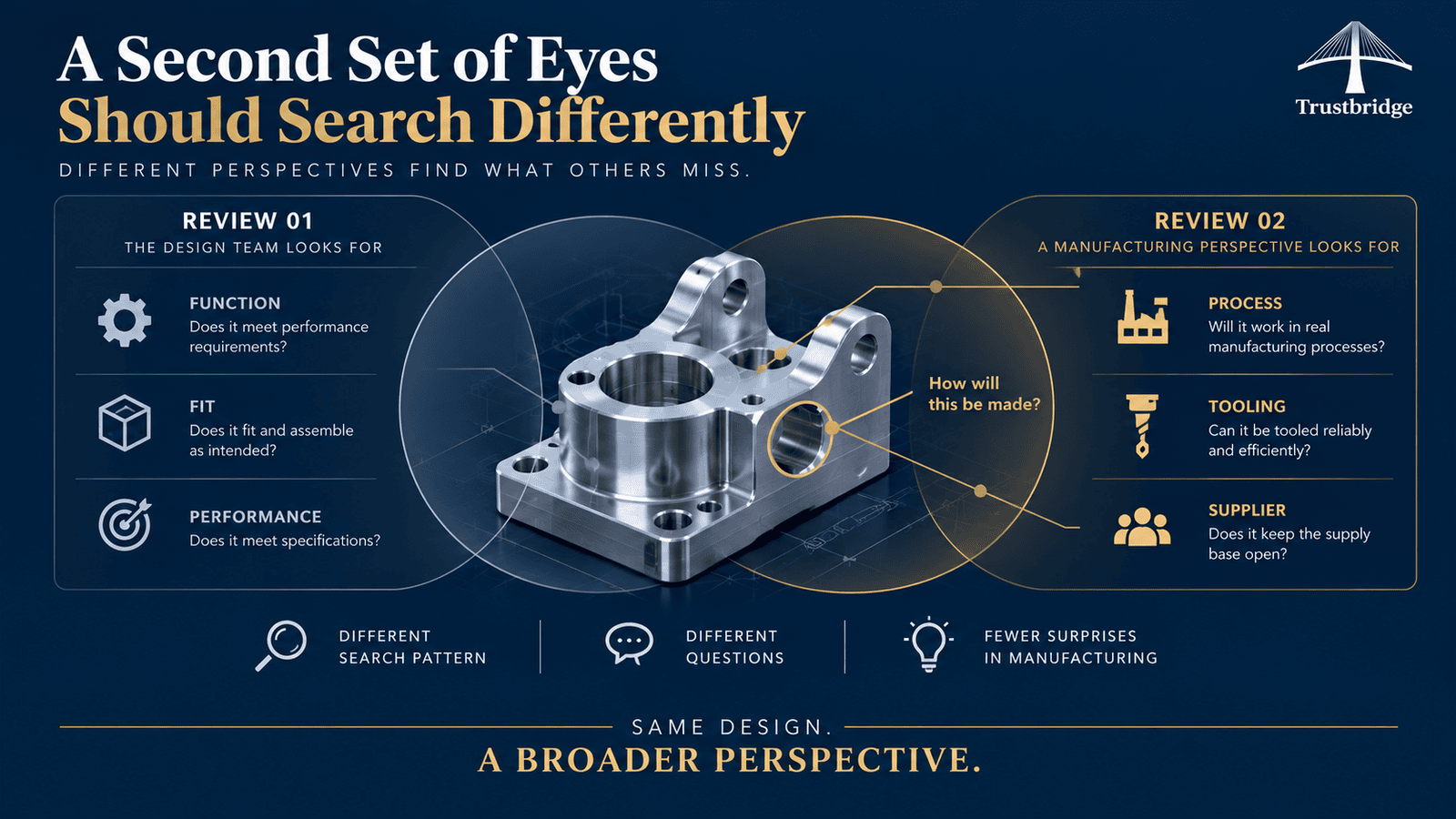
Why skilled teams miss things that seem obvious in hindsight
In 2013, cognitive psychologist Trafton Drew ran an experiment with 24 expert radiologists. Their task was ordinary: scan a set of CT images for lung nodules, something each of them had done thousands of times. Hidden in one of the scans, Drew inserted the image of a gorilla, roughly 48 times larger than the nodules they were searching for. More than eight in ten radiologists missed it entirely. Eye-tracking equipment showed that many of them looked directly at the gorilla's location. Their eyes saw it. Their attention, tuned with enormous precision to a much smaller and more specific target, did not register it as something worth noticing.
That result isn't really about radiology. It's about what expertise does to attention generally. Getting very good at spotting one category of problem comes with a cost. It narrows the visual and mental search to exactly that category. Something genuinely different in kind, not just in severity, can then sit in plain sight without ever being flagged. A design team that's excellent at verifying function, fit, and performance is running the equivalent search. They're tuned for those categories. A manufacturing consideration that falls outside that frame entirely isn't a hard question they got wrong. It might be a certification a material choice will trigger, or a fixturing problem a geometry will cause. It's a gorilla they were never looking for.
The gap CAD and simulation can't close on their own
This gap shows up constantly in a specific, well-documented pattern. A design passes every internal review, looks complete in CAD, and still runs into trouble once it reaches a shop floor. The difference isn't engineering competence. It's the distance between an idealized design environment and the reality of how manufacturing actually happens. CAD tools and simulations don't close that gap by themselves. They're built to answer the questions someone already thought to model. An undercut that looks like a minor detail on screen can force complex side-actions into an injection mold. A radius applied globally across a part can make one specific corner nearly impossible to machine. None of this shows up as an error in the software. It shows up as a surprise once the part actually needs to be built.
What actually counteracts this, and what doesn't
The honest answer isn't "more experience" in the vague sense most people mean it. It's a specific, deliberate practice: looking for the thing the current review isn't organized to find, on purpose, rather than doing the same search more thoroughly. A checklist makes this harder, not easier, if it isn't updated, because a checklist only ever catches the categories someone already thought to put on it. The Drew study's most useful implication isn't "hire more careful radiologists." It's that a second reviewer, searching with a different frame of reference, catches things the first reviewer's expertise was specifically tuned to miss. That's a structural fix, not a diligence fix, and it's why the practice matters more than any individual's track record.
What that different frame actually produces is usually a short, specific question, not a general warning. Does this tolerance need to be this tight, or did it get copied from an unrelated part nobody re-checked? Will this geometry survive the process it's about to move to, or does it only work because the current process happens to forgive something the next one won't? Does this material choice just remove three of the five shops that could otherwise bid on it? None of these are hard to answer once someone asks them. The difficulty was never in the answer. It was in a review organized around function and performance ever landing on the question at all.
Why this is what Trustbridge Design is actually built to do
This is the specific gap Trustbridge Design exists to close. A review built by people who've spent their attention on manufacturing outcomes across many different projects brings a different search pattern to a design than the team that built it. Not a better one. A different one. That difference is exactly where a fixturing problem, a certification trigger, or a tooling complication tends to surface. It was never going to show up in a review searching for the categories the original team was already tuned to check. It's a harder thing to package into a single checklist. That's exactly why the practice is worth having as an ongoing discipline rather than a one-time pass.
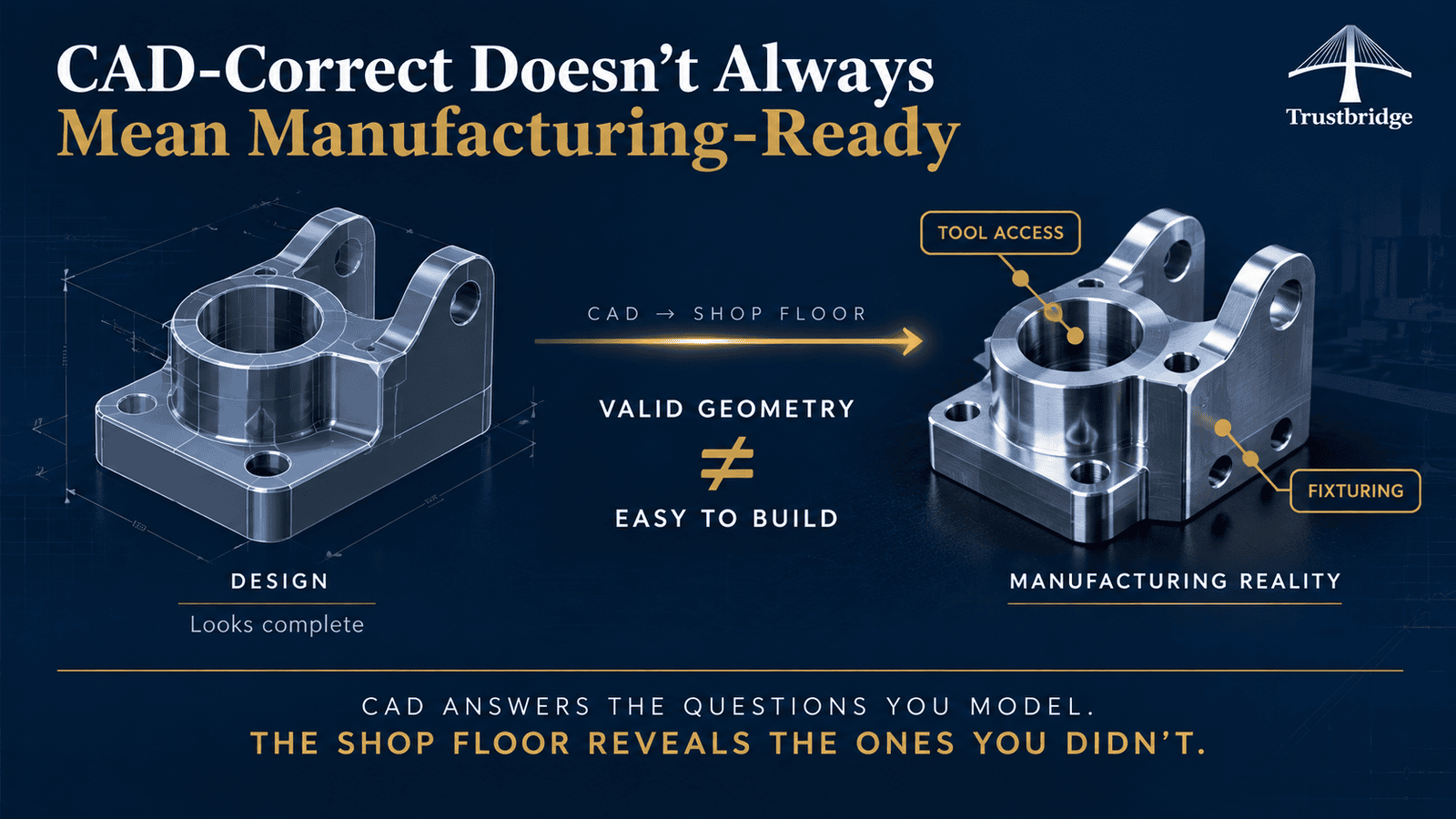
Conclusion
The gorilla in that CT scan wasn't hidden. It was in plain view, looked at directly, and missed anyway, because expertise had narrowed exactly where attention landed. Manufacturing works the same way. The mistake that ends up costing real time and money is rarely the one nobody could have caught. It's the one that sat in plain sight, just outside the frame the original team was searching in.
Want a second set of eyes searching a different frame than the one that built it?
Share your design, wherever it currently stands, and get a straight look at what a different search pattern actually turns up. Talk to Trustbridge Design about a review built to catch what your own team's expertise is tuned to miss.
Frequently Asked Questions
1. Why do experienced engineering teams miss manufacturing problems before production?
Experienced teams can miss manufacturing problems because design reviews are often focused on known requirements such as function, fit, performance, and aesthetics. Manufacturing risks involving tolerances, tooling, fixturing, material selection, or assembly may fall outside that review framework. A separate manufacturing-focused review can identify issues that the original design team was not specifically looking for.
2. Can CAD and simulation detect all manufacturing problems?
No. CAD and simulation can identify many geometric, functional, and performance issues, but they cannot automatically catch every real-world manufacturing constraint. Problems such as difficult fixturing, excessive tolerances, tooling limitations, material availability, or process-specific complications may only become apparent when the design is evaluated against actual manufacturing conditions.
3. What is a manufacturing design review and why is it important before production?
A manufacturing design review evaluates a product specifically for manufacturability before it reaches production. It examines factors such as tolerances, geometry, materials, tooling, fixturing, assembly, and production processes. Conducting this review early can uncover costly manufacturing problems while design changes are still relatively easy and inexpensive to make.
4. Why does a second set of eyes help identify manufacturing problems?
A second reviewer with a different manufacturing perspective may examine the design for risks that the original engineering team was not focused on. Instead of simply repeating the same design checks, a different review framework can raise questions about manufacturability, production constraints, sourcing, tooling, and process capability that might otherwise remain unnoticed.