The Battle for American Manufacturing: Can Legacy Manufacturers Compete with the New Generation of Automated Factories?
Automation and legacy job shops were never really competing for the same work. That's changing in one specific way, and it's not the way most coverage of this topic assumes.
Introduction
According to the International Federation of Robotics, the United States now runs about 307 industrial robots for every 10,000 manufacturing workers, and that number has been climbing steadily for years. None of that growth has come from automated factories replacing the custom, low-volume work legacy job shops have always done. Automation earns its keep on repetition the same part, over and over, at a scale that justifies the equipment. Job shops earn theirs on variation, building a different part every week, sized for orders too small or too specific for a production line to bother with.
That split is old news, and it's mostly still true. What's actually changing is narrower and more specific: a newer kind of automation is starting to handle the variation legacy shops used to own almost by default. This piece is about that shift, not a general debate over whether robots are coming for manufacturing jobs.
The Territories Were Never the Same
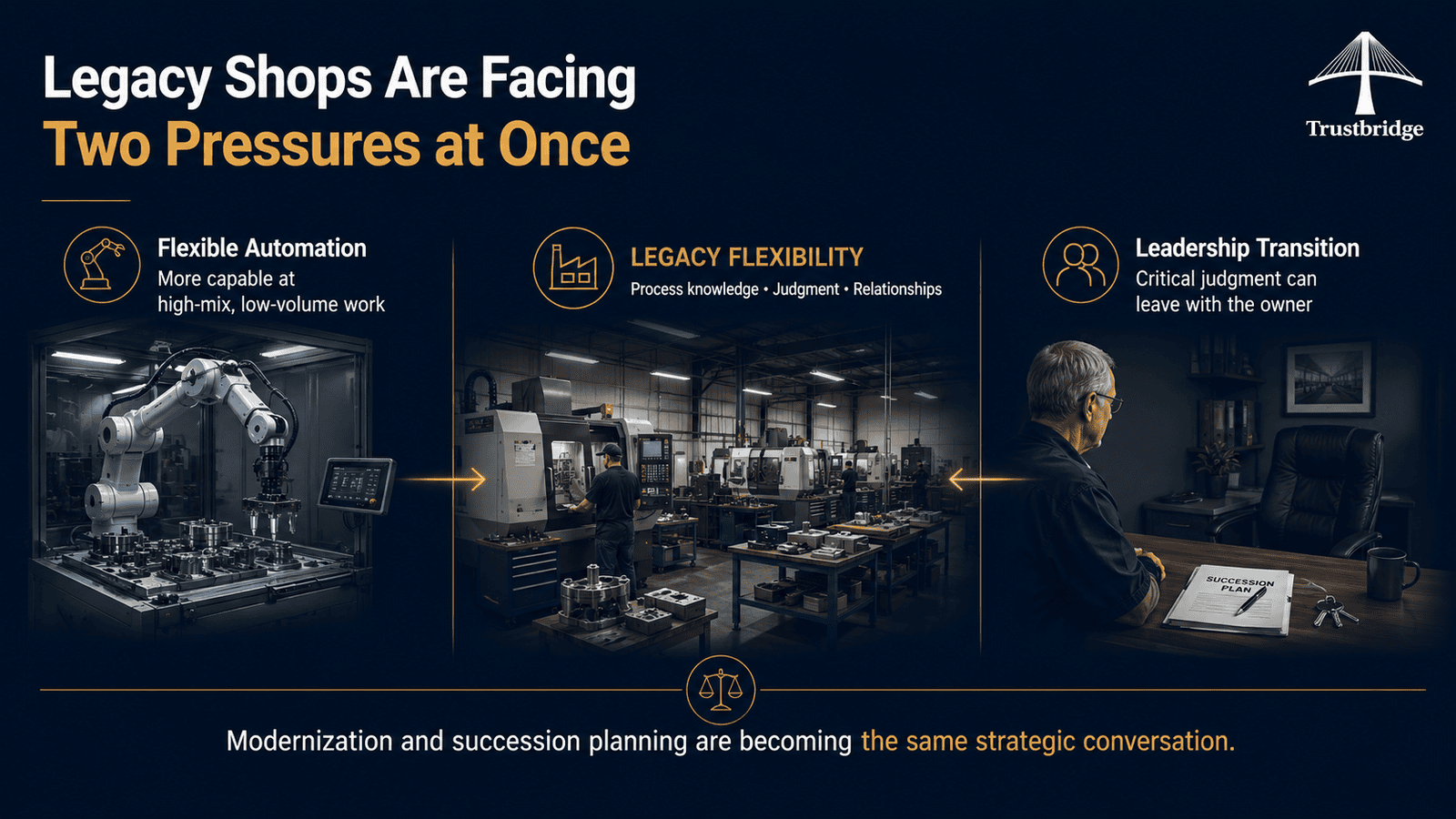
Traditional automation is rigid on purpose. A dedicated production line gets built once and runs at volume, and every changeover to a different part costs real time and money to reprogram. That math works fine for an automotive stamping line running the same bracket a hundred thousand times a year. It works terribly for a shop making twelve different parts a week in batches of twenty, because the line would spend more time being reconfigured than actually cutting metal.
A job shop exists precisely because that second kind of work is common and genuinely hard to automate the old way. A skilled machinist reading an unfamiliar print, adjusting a setup on the fly, catching a problem before it becomes scrap that's judgment, not repetition, and rigid automation has never been good at judgment. For most of the last several decades, this has meant automated factories, and legacy job shops simply weren't fighting over the same customers. One did a high volume. The other did everything the volume didn't justify.
Flexible Automation Is Learning to Do What Legacy Shops Used to Own
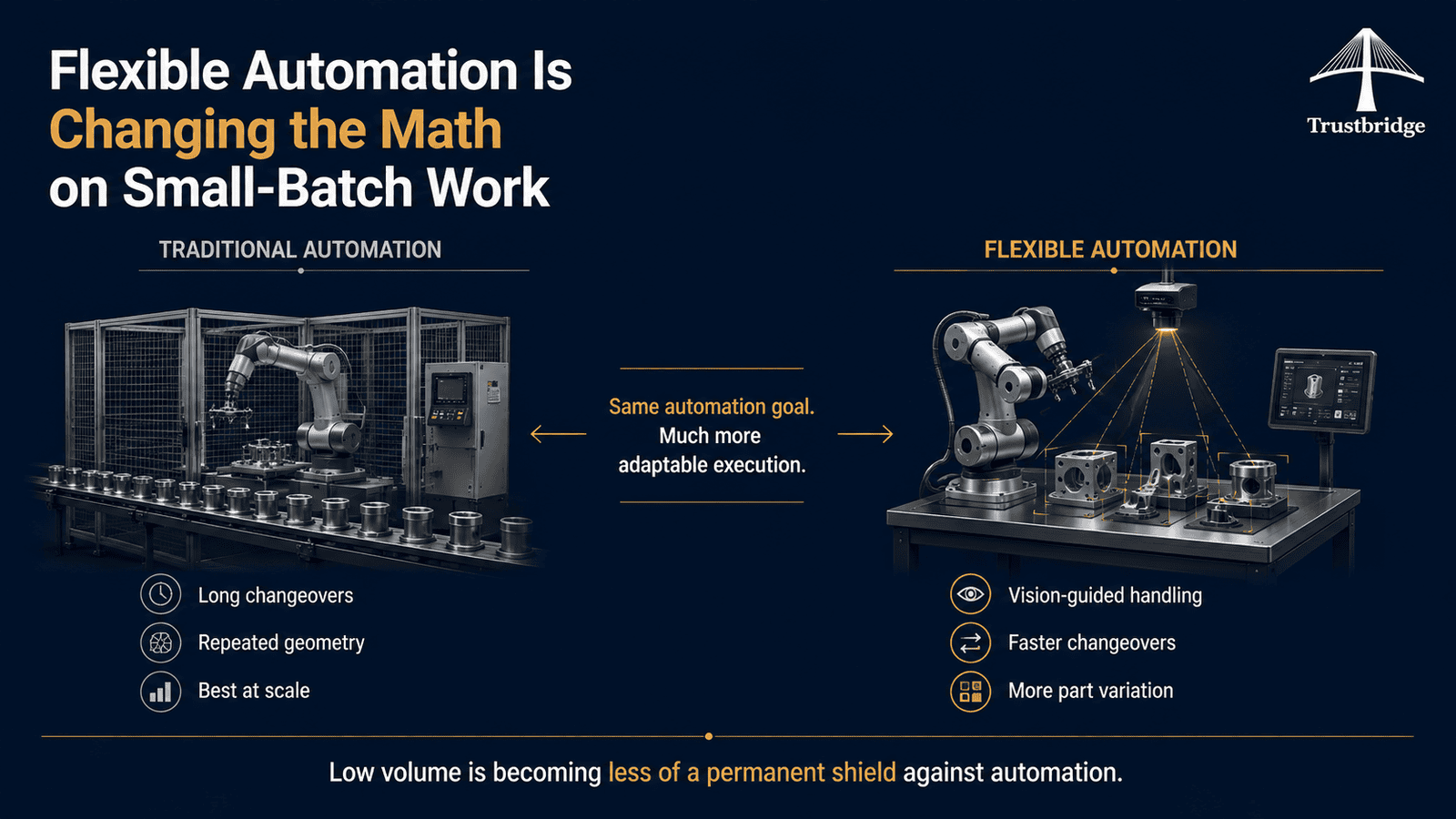
That's the part actually moving. Vision-guided robotics, in particular, changes the math on small-batch work, because a system that can recognize a part and adjust its own handling doesn't need the lengthy reprogramming a traditional line does between changeovers. Aerospace suppliers are already using vision-guided robots to handle different turbine geometries on the same cell. Contract manufacturers are using the same approach to manage frequent product changeovers in consumer electronics assembly, adjusting parameters automatically as the variant on the line changes.
The common industry assumption used to be that a shop's volumes were simply too small to justify automating at all. That assumption is getting weaker every year's flexible automation improves, and shops that have treated low volume as a permanent shield against automation are the ones most exposed to finding out it wasn't.
Two Kinds of Pressure Are Hitting Legacy Shops at Once
Even where flexible automation genuinely applies, bolting it onto an existing shop rarely performs like building a shop around it from the start. High-mix, low-volume production doesn't reward incremental upgrades bolted onto decades-old workflows. It rewards being designed for that variability from day one to the changeover process, the quality tracking, the scheduling logic, all built around handling constant variation rather than adapted after the fact from a system that assumed long, stable runs. A new automated factory built around this from its first day on the floor starts with a real structural advantage over a 40-year-old shop trying to retrofit the same capability onto machines and habits that predate it.
That technology pressure is landing at an unusually bad moment for a separate reason. Gallup research puts nearly half of U.S. small manufacturing business owners at 55 or older, and industry analysis of that same population finds more than half have no documented succession plan in place. At many small shops, the owner is simultaneously the estimator, the process engineer, the quality lead, and the only person who remembers why a certain job has always been quoted a certain way. When that person retires without a successor, the shop doesn't just lose an owner. It loses the judgment that made the shop worth choosing over a more rigid, higher-volume alternative in the first place — right as that same judgment is the exact thing new automation is starting to compete with directly.
What This Actually Means for the Competition
None of this means legacy manufacturers are obsolete, and it doesn't mean every automated startup will out-execute a shop with decades of relationships and hard-won process knowledge. It means the actual fight is narrower than "old versus new." It's happening specifically in high-mix, low-volume work, where flexible automation is a real and improving threat to an advantage legacy shop used to take for granted. And it's happening at the same time a large share of those shops is approaching a leadership transition with no plan for who takes over.
A legacy shop that treats its flexibility as permanent and untouchable is the shop most likely to be surprised. One that reinvests its own flexibility deliberately and solves its succession question before the choice gets made for it, is genuinely well positioned against the newer generation of automated factories. That's not because the old model wins by default. It was never actually losing on the work it does best if it's losing at all, it's losing on the assumption that the work it does best would stay hard to automate forever.
Conclusion
The interesting question was never whether automated factories will replace legacy manufacturers wholesale. It's whether legacy shops modernize their own flexibility and solve their succession problem before flexible automation and an unplanned retirement arrive at the same shop in the same year. Some will. Plenty won't, and the difference between the two groups will look a lot more like a management decision than an inevitability.
That's the honest shape of legacy manufacturers vs automation, once the framing narrows to where the actual competition is happening. A custom manufacturing shop or machining vendor that treats this as a genuine strategic question, rather than an abstract industry trend, has real room to compete on exactly the terms this piece has laid out.
Find the Legacy Shops Still Built for This
The shops best positioned in this shift aren't necessarily the newest or the most automated. They're the ones that know exactly what they're well at and have kept investing in it whether that's small batch cnc machining, complex assemblies, or a process too specialized for a rigid production line to touch. Trustbridge routes work to shops based on real, current capability, not just size or how recently they modernized, so a genuinely well-run legacy shop doesn't lose a job it's actually best suited for.
[See how Trustbridge matches requests to shops built for the work →]
Frequently Asked Questions
1. Can automated factories compete with legacy job shops for low-volume manufacturing?
Yes. Traditional automation has historically been difficult to justify for low-volume, high-mix work because frequent changeovers reduce efficiency. Flexible automation, including vision-guided robotics and adaptable production cells, is changing that equation by making it easier to automate jobs with greater variation.
2. What is flexible automation in manufacturing?
Flexible automation uses robotics, machine vision, software, and adaptable production systems to handle different parts or products with less manual reprogramming and setup time. Unlike traditional fixed automation, flexible systems are designed to accommodate frequent product changes, making them increasingly relevant to high-mix, low-volume manufacturing.
3. Why are legacy job shops vulnerable to flexible automation?
Legacy job shops have traditionally competed by handling complex, low-volume, highly variable work. As flexible automation becomes better at managing variation, that advantage is no longer as difficult to automate. Shops that rely solely on flexibility without investing in processes, technology, and operational knowledge may face increasing competition.
4. How can legacy manufacturers compete with automated factories?
Legacy manufacturers can remain competitive by modernizing the flexibility that already makes them valuable. Investing selectively in automation, standardizing repeatable processes, documenting manufacturing knowledge, and addressing succession planning can help shops preserve their ability to handle specialized and high-mix work while improving efficiency and resilience.