
Chicago, Cleveland, Detroit: How Three Industrial Metros Are Rebuilding Their Precision Manufacturing Base
Chicago, Cleveland, and Detroit have been at the heart of American manufacturing for generations, building strong industrial ecosystems that support sectors ranging from automotive and aerospace to medical devices and heavy equipment. Today, these legacy manufacturing hubs are entering a new phase of growth by investing in precision manufacturing, advanced automation, digital production technologies, and engineering innovation. As manufacturers respond to evolving market demands and increasingly complex production requirements, these three metros demonstrate how established industrial regions are strengthening their competitiveness while shaping the future of U.S. manufacturing.
Introduction
American manufacturing is undergoing a significant transformation driven by reshoring initiatives, supply chain diversification, and rapid technological advancement. Success is no longer measured solely by production capacity or labor costs. Instead, manufacturers are competing on their ability to deliver complex, high-quality components with greater precision, shorter lead times, and the flexibility to adapt to changing customer and market demands.
To meet these expectations, manufacturers are increasingly investing in advanced CNC machining, intelligent automation, digital manufacturing platforms, AI-powered quality control, and data-driven production systems. These technologies are enabling higher productivity, improved process consistency, and greater operational resilience across the manufacturing value chain.
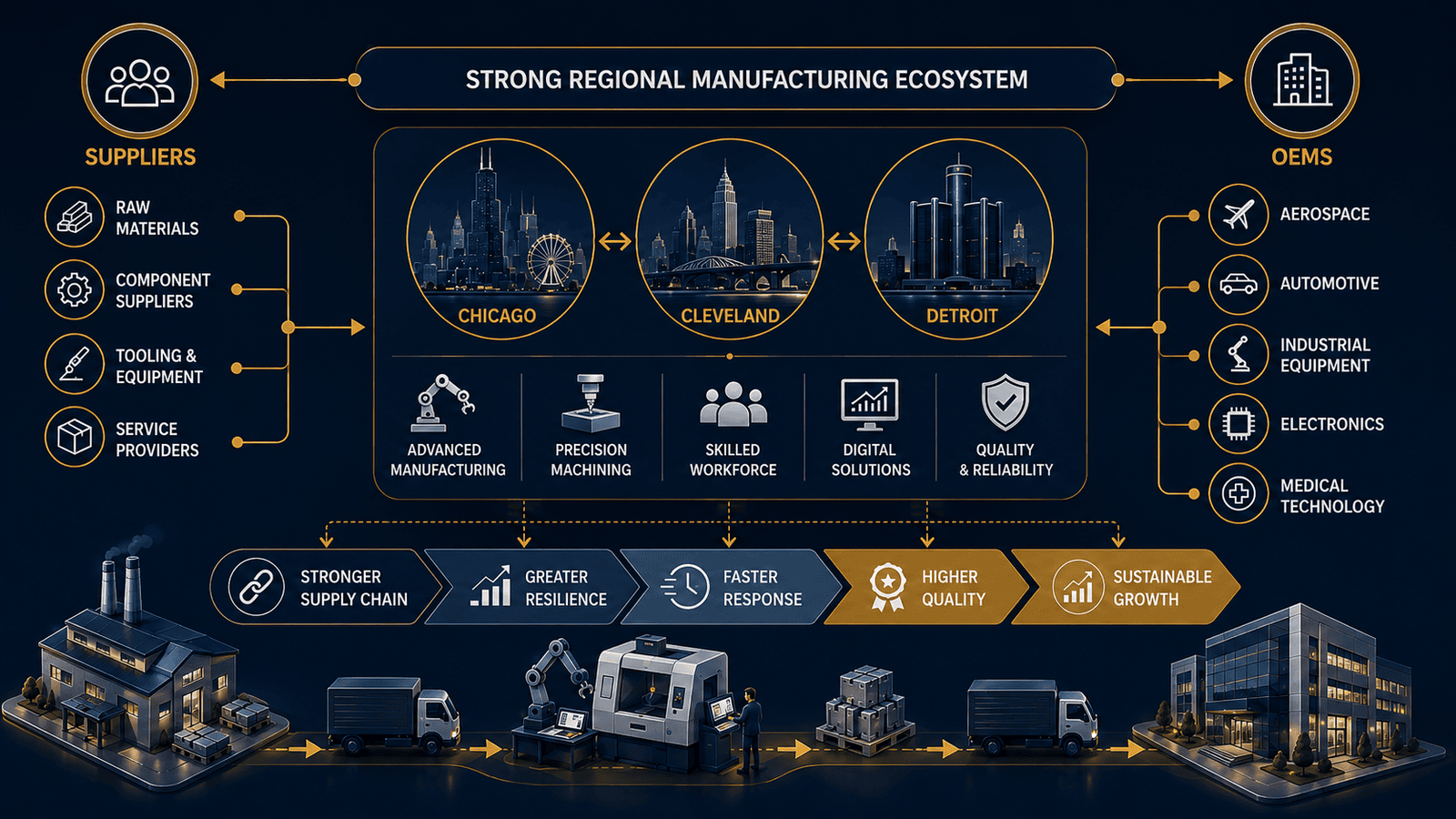
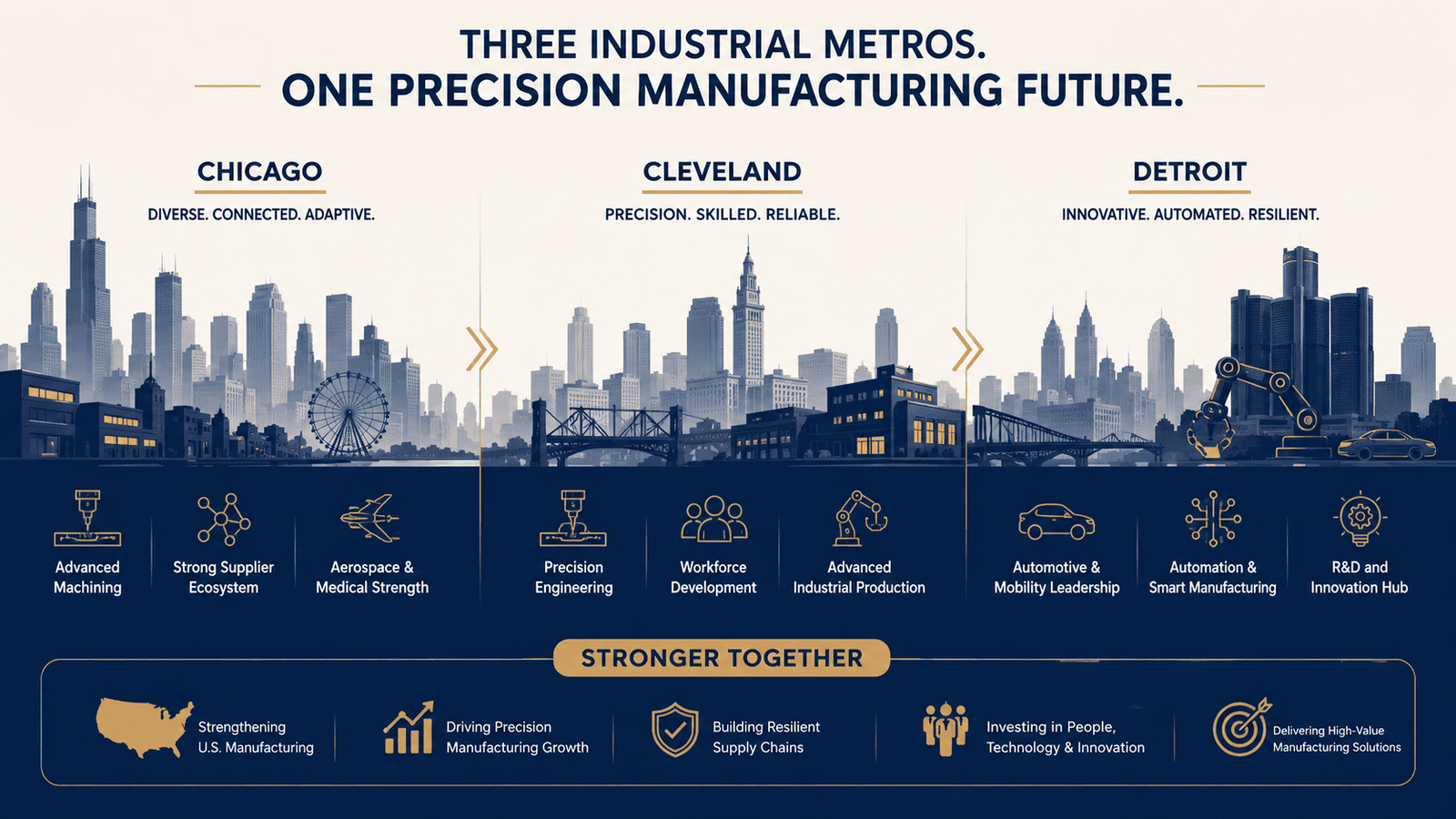
Among the regions leading this transformation are Chicago, Cleveland, and Detroit. While each metro has a distinct industrial heritage and serves different end markets, all three are modernizing their manufacturing ecosystems through investments in precision engineering, advanced production technologies, and workforce development. Their evolution highlights how established manufacturing centers are adapting to support the next generation of high-value, technology-enabled manufacturing in the United States.
Why Precision Manufacturing Growth Is Defining Modern Industrial Success
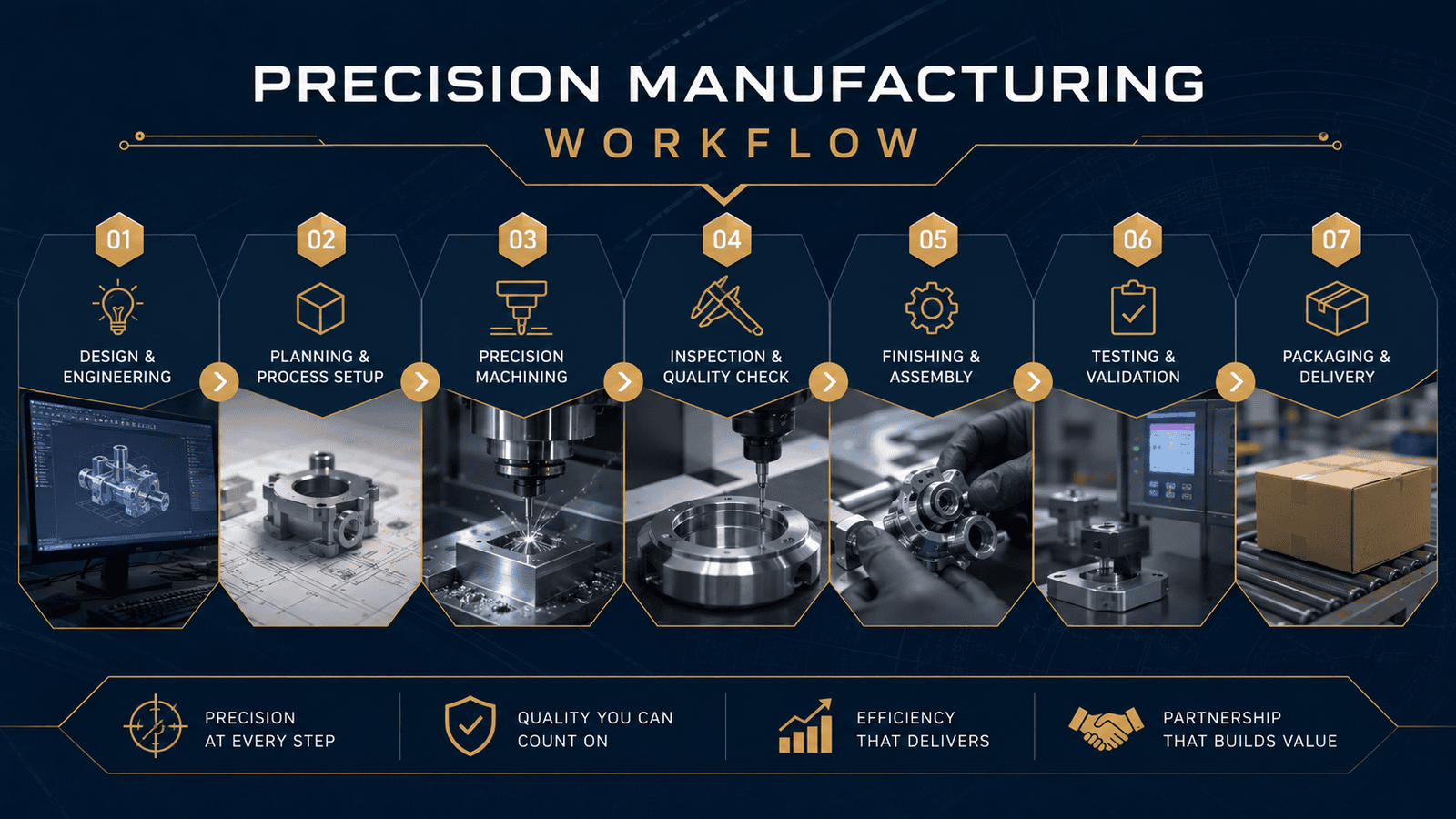
Manufacturing competitiveness is no longer determined simply by production capacity. Companies increasingly differentiate themselves through their ability to manufacture complex parts with exceptional accuracy, shorter lead times, and consistent quality. This requires more than modern equipment—it demands connected manufacturing systems, skilled engineering teams, and continuous process improvement.
Across the United States, manufacturers are investing in automation, digital inspection, advanced analytics, and intelligent machining to remain competitive. These investments improve operational efficiency while enabling suppliers to meet increasingly demanding customer requirements. As OEMs seek more resilient domestic supply chains, regions capable of supporting high-precision manufacturing are attracting greater investment and creating stronger industrial ecosystems. 0
Chicago Manufacturing Continues to Build on Its Industrial Diversity
Chicago has long been one of the country's most diversified manufacturing economies, serving industries ranging from aerospace and medical devices to industrial equipment, transportation, and fabricated metals. That diversity has helped the region remain resilient through changing economic cycles, but its next phase of growth is being driven by the adoption of advanced manufacturing technologies rather than traditional production methods.
Manufacturers throughout the region are modernizing their operations to improve productivity, reduce waste, and produce increasingly complex components. These investments are allowing Chicago manufacturers to compete in industries where precision, repeatability, and manufacturing agility are becoming essential competitive advantages.
Advanced CNC Machining and Automation Are Transforming Productivity
Many manufacturers across Chicago are investing in advanced CNC machining capabilities that extend well beyond conventional machining centers. Five-axis machining has become increasingly common for producing complex geometries, while automated pallet systems and lights-out machining allow facilities to maximize machine utilization outside traditional operating hours.
Manufacturers are also integrating in-process metrology, closed-loop machining, and CAM software enhanced with AI-driven toolpath optimization. Together, these technologies reduce setup times, improve machining consistency, and minimize material waste. According to industry reports, manufacturers implementing automation and digital machining workflows have achieved 20–40% higher spindle utilization, while also reducing scrap rates and improving overall production efficiency. These improvements are especially valuable in aerospace and medical manufacturing, where precision requirements are extremely demanding and production volumes often fluctuate.
Digital Manufacturing Is Connecting the Entire Production Process
Chicago manufacturers are also embracing the concept of the digital thread, where information flows seamlessly from product design through production and quality inspection. Instead of treating engineering, machining, and inspection as separate functions, manufacturers are creating connected workflows that improve visibility and accelerate continuous improvement.
Digital twins are increasingly used to simulate machining processes before production begins, helping engineers identify potential issues early. Automated coordinate measuring machines (CMMs), AI-powered vision inspection systems, and Industrial IoT sensors continuously collect production data that feeds back into manufacturing operations. This connected approach allows manufacturers to shift from reacting to production issues after they occur toward predicting and preventing them before they impact quality or delivery performance.
Cleveland Manufacturing Is Moving Toward Higher-Value Precision Engineering
Cleveland has long been recognized for its expertise in metalworking and industrial manufacturing. Today, however, the region is evolving into a center for high-specification manufacturing that supports aerospace, energy, medical technology, and advanced industrial equipment. Rather than competing on production volume alone, manufacturers are focusing on engineering complexity, process capability, and material expertise.
This transition reflects broader industry demand for components that require exceptional accuracy, specialized materials, and sophisticated manufacturing processes.
Advanced Materials and Tight-Tolerance Manufacturing Drive Growth
Manufacturers throughout Cleveland are increasingly producing components that require extremely tight dimensional tolerances, often below ten microns in critical applications. They are also expanding capabilities in machining high-performance materials such as titanium, Inconel, and other superalloys used in aerospace and energy systems.
Many facilities are combining traditional machining with additive manufacturing technologies to create hybrid production workflows capable of manufacturing increasingly complex components. This movement toward precision engineering allows Cleveland manufacturers to compete in industries where process capability and technical expertise provide greater value than production scale alone.
AI and Automation Are Optimizing Manufacturing Performance
Artificial intelligence is becoming a growing part of Cleveland's manufacturing ecosystem. Industry analysts project AI adoption in manufacturing to grow at approximately 46% annually through 2030, and local manufacturers are already applying these technologies to predictive maintenance, adaptive machining, and production analytics.
Rather than relying on fixed machining parameters, adaptive machining systems continuously adjust feeds and speeds based on real-time cutting conditions. Manufacturers are also investing in laser-based additive manufacturing, advanced surface engineering technologies, and simulation-driven process planning to improve efficiency and product quality. At the same time, workforce development remains a priority as companies prepare for a projected shortage of up to 1.9 million manufacturing workers by 2033. Many organizations are responding by combining experienced machinists with automation engineers while expanding training programs in robotics, CNC programming, and manufacturing data systems.
Detroit Manufacturing Is Leading the Transition to Advanced Mobility
Detroit remains synonymous with automotive manufacturing, but its industrial landscape is rapidly expanding beyond conventional vehicle production. The transition toward electric vehicles, battery technologies, and advanced mobility systems is reshaping manufacturing requirements throughout the region and creating significant new opportunities for suppliers capable of supporting next-generation production.
This transformation is driving investments not only in new factories but also in precision machining, digital manufacturing technologies, and advanced quality systems.
Electrification Is Changing Manufacturing Requirements
Electric vehicle production requires manufacturers to produce highly specialized components, including battery housings, thermal management systems, lightweight aluminum structures, composite assemblies, and precision drivetrain components. Since 2010, more than $50 billion has been invested in electric vehicle and battery manufacturing across the Midwest, with Michigan receiving a significant share of that investment.
As suppliers adapt to these changing requirements, they are upgrading machining capabilities, strengthening quality traceability, and improving assembly processes to meet increasingly demanding production standards.
Digital Manufacturing Is Accelerating Industry 4.0 Adoption
Detroit manufacturers continue leading the adoption of industrial robotics, collaborative robots, digital twins, and AI-powered quality inspection systems. Automated vision technologies are improving inspection accuracy, while real-time production analytics help manufacturers optimize throughput and identify quality issues before they affect customers.
Manufacturers are also integrating Manufacturing Execution Systems (MES), Enterprise Resource Planning (ERP) platforms, edge computing, and cyber-physical production systems that enable real-time decision-making across the factory floor. Supported by one of the nation's highest concentrations of industrial robotics, Detroit continues demonstrating how digital manufacturing can improve both operational efficiency and manufacturing resilience.
What These Manufacturing Hubs Mean for Suppliers and OEMs
Conclusion
The resurgence of American manufacturing is being driven by regions that successfully combine industrial experience with modern innovation. Chicago manufacturing, Cleveland manufacturing, and Detroit manufacturing each demonstrate how established industrial centers continue adapting to meet the demands of advanced production.
Through investments in automation, advanced CNC machining, skilled workforce development, and precision engineering, these metros continue fueling precision manufacturing growth while strengthening the nation's manufacturing competitiveness. Their ability to evolve alongside changing technologies and customer expectations ensures they will remain central to the future of U.S. manufacturing.
As precision manufacturing growth continues across America's leading industrial regions, selecting the right manufacturing partners has never been more important. Whether you're expanding your supplier network, sourcing precision components, or evaluating regional manufacturing capabilities, working with experienced suppliers can improve quality, reduce risk, and accelerate production.
Trustbridge helps manufacturers and OEMs connect with vetted, production-ready suppliers that align with their technical requirements, quality expectations, and delivery goals. By strengthening supplier discovery and improving sourcing decisions, Trustbridge supports more resilient manufacturing partnerships in today's rapidly evolving industrial landscape.
Frequently Asked Questions
1. Why are Chicago, Cleveland, and Detroit becoming important centers for precision manufacturing growth?
Chicago, Cleveland, and Detroit are leveraging their long-established industrial ecosystems while investing in advanced CNC machining, automation, digital manufacturing, and skilled workforce development. These regions are becoming competitive in high-value manufacturing by focusing on precision, engineering expertise, and production flexibility rather than traditional mass production alone.
2. How is automation changing manufacturing in Chicago, Cleveland, and Detroit?
Manufacturers across these industrial metros are adopting technologies such as advanced CNC machining, robotics, digital twins, automated inspection systems, and Industrial IoT platforms. These technologies help improve productivity, reduce production errors, increase machine utilization, and enable manufacturers to produce more complex components with consistent quality.
3. What industries are driving precision manufacturing demand in these regions?
Precision manufacturing growth in Chicago, Cleveland, and Detroit is being driven by industries such as aerospace, automotive, electric vehicles, medical devices, industrial equipment, robotics, and energy. These industries require suppliers capable of producing complex parts with tight tolerances, advanced materials, and reliable quality systems.
4. What do these manufacturing hubs mean for OEMs looking for suppliers?
These regions provide OEMs access to experienced supplier networks, advanced manufacturing capabilities, and specialized engineering expertise. By partnering with qualified suppliers in established manufacturing hubs, OEMs can improve supply chain resilience, reduce sourcing risks, and access production partners capable of supporting complex manufacturing programs.