Anodizing, Plating, Passivation: A Finishing Primer for Product Teams
These three words show up on drawings constantly, get confused with each other constantly, and solve three genuinely different problems. Here's what each one actually does, and how to tell which your part needs.
Introduction
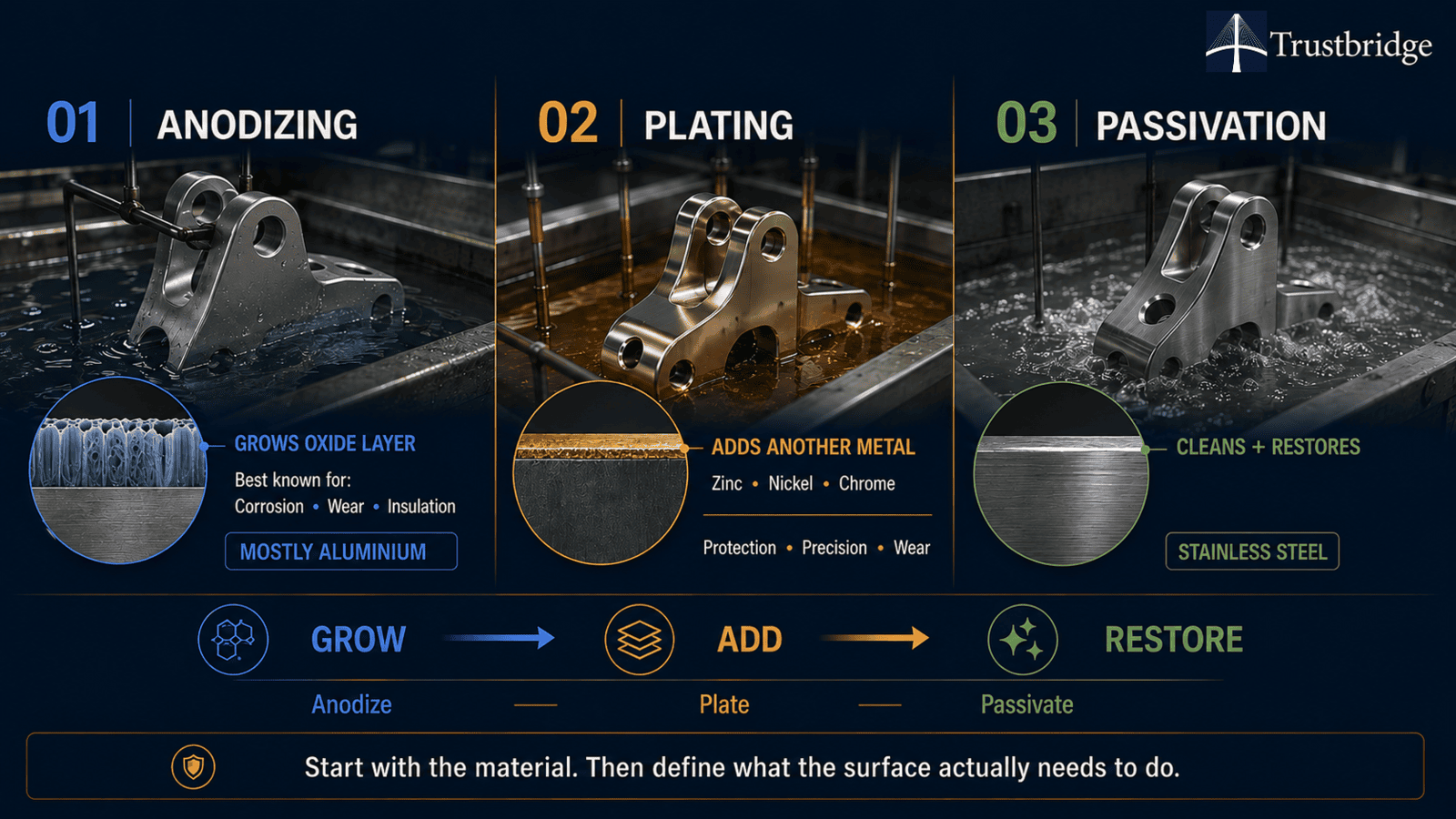
Anodizing, plating, and passivation all fall under the same broad label of "metal finishing," but they aren't interchangeable, and picking the wrong one usually isn't caught until a part comes back the wrong color, the wrong hardness, or with a corrosion problem it was supposed to prevent. The confusion usually starts with what each process actually does to the part, mechanically. Anodizing grows an oxide layer directly out of the base metal most commonly aluminum, though a handful of other metals can be anodized too. Plating goes the opposite direction, depositing a separate metal on top of the surface rather than converting the surface itself. Passivation does neither: it's a chemical cleanup step, almost exclusively for stainless steel, that restores a protective layer the material was already supposed to have rather than adding anything new. None of the three is a general-purpose "make it better" step, and none of them are about surface roughness or texture either that's a separate spec, covered by Ra values, not by any of these three processes. This piece covers what each one actually does, when it's the right call, roughly what it costs, and the one mistake that shows up on drawings more often than any other.
Anodizing: what it does and when it's the right call
Anodizing is an electrochemical process most strongly associated with aluminum, though not exclusive to it: the part becomes the anode in an acid bath, and a controlled electrical current grows an oxide layer directly out of the base metal rather than depositing something separate on top of it. Aluminum remains by far the most common and practical choice nearly every anodizing standard and shop capability is built around it but titanium, magnesium, and other "valve metals" like niobium and tantalum can be anodized too, with titanium in particular producing vivid, permanent colors without any dye, purely by controlling oxide thickness, which is why it shows up on medical and aerospace hardware needing distinct color-coding. Steel and stainless steel, by contrast, don't form a useful oxide layer under anodizing conditions at all. That distinction also matters for tolerances: the oxide layer grows both into and out of the original surface, roughly half in and half out by a commonly cited rule of thumb, so a tightly toleranced anodized feature needs that growth accounted for at the design stage, not discovered after the part comes back oversized.
There are three common types of aluminum anodizing, still the version most designers will actually specify. Type I uses a chromic acid bath and produces the thinnest layer, mostly for corrosion resistance where dimensional change has to stay minimal. Type II, the most common general-purpose version, produces a moderate-thickness layer that's readily dyed into color and gives solid corrosion resistance for everyday parts. Type III, usually called hardcoat, runs at a much lower bath temperature and produces a dramatically thicker, harder layer durable enough to replace hard chrome plating in some wear applications, and electrically insulating too, useful anywhere a part needs to resist abrasion and conduct nothing at all. A complete drawing callout typically specifies the governing standard, the type, and whether the finish is dyed, since leaving any of those out invites a shop to guess.
Plating: what it does and when it's the right call
Plating deposits a layer of a different metal onto a part's surface, either by running an electric current through a bath (electroplating) or through a purely chemical reaction that needs no current at all (electroless plating). Unlike anodizing, plating isn't limited to one base metal, which is exactly why it shows up on so many different parts for so many different reasons. Zinc plating is the cheapest and most common option for protecting steel, working through sacrificial protection: the zinc corrodes before the underlying steel does, so it keeps protecting a part even after a scratch exposes bare metal underneath. Nickel plating offers strong corrosion resistance and a smooth surface, and the electroless version deposits a uniform layer without the pinholes that can show up in electroplated nickel, which is why precision parts often specify it by name. Chrome plating is the one to reach for when hardness and wear resistance are the actual goal hard chrome is standard on cylinders, piston rods, and mold components that need to survive constant friction, while decorative chrome trades most of that wear resistance for a bright, polished look at a much thinner coating.
Choosing among the three usually comes down to naming the actual functional goal rather than defaulting to whichever looks best in a catalog photo: zinc for economical general corrosion protection, nickel for a precise, uniform, corrosion-resistant layer, and chrome for a surface that has to keep working under real mechanical wear.
Passivation: what it does and when it's the right call
Passivation is the odd one out on this list because it doesn't add anything to the part at all. It's a chemical treatment, almost always applied to stainless steel, that removes free iron and other surface contamination left behind by machining, then lets the chromium-rich oxide layer that stainless steel naturally forms re-establish itself cleanly. That's a genuinely different job than anodizing or plating: those two build something new on the surface, while passivation restores a protective layer the material was already supposed to have. The governing standard, ASTM A967, defines several acid treatments and a set of tests salt spray, water immersion, copper sulfate exposure used to confirm a part actually passivated rather than just got dipped in the right chemical.
Passivation matters more than it might seem, because "stainless" doesn't automatically mean fully corrosion-resistant in practice. Free-machining stainless grades, chosen specifically because they machine more easily, contain more sulfur and phosphorus than standard grades, which measurably reduces their natural corrosion resistance exactly the gap passivation is meant to close. Unlike anodizing, passivation leaves electrical conductivity untouched, since it adds no insulating layer relevant for stainless parts that also need to carry current or ground properly. It's also worth knowing what passivation isn't: it doesn't remove heat tint or weld scale the way pickling does, and it isn't electropolishing, which removes a real layer of base metal for a mirror finish. A part that needs a bright, polished look wants electropolishing; a part that just needs its stainless steel to behave like stainless steel wants passivation.
The mistake that shows up again and again on drawings
The single most common finishing error isn't picking the wrong process outright — it's copying a finishing note from one drawing to another without checking whether it still applies. Anodize call-outs, in particular, have a habit of surviving a material change: a note written for an aluminum bracket gets pasted onto a steel version of the same part, and because steel doesn't form a usable anodic oxide layer the way aluminum does, that note is simply meaningless on the new material, not just wrong. The shop either flags it and waits for a correction, or worse, misses it and builds a part with no finish at all.
The same pattern shows up with passivation notes ending up on carbon steel parts, or plating notes carried over without adjusting for the new base metal's different adhesion and corrosion behavior. None of these mistakes require sloppy engineering they're almost always a template or previous drawing reused as a starting point, with the finishing note treated as boilerplate rather than something tied to the material underneath it.
Cost and lead time, roughly compared
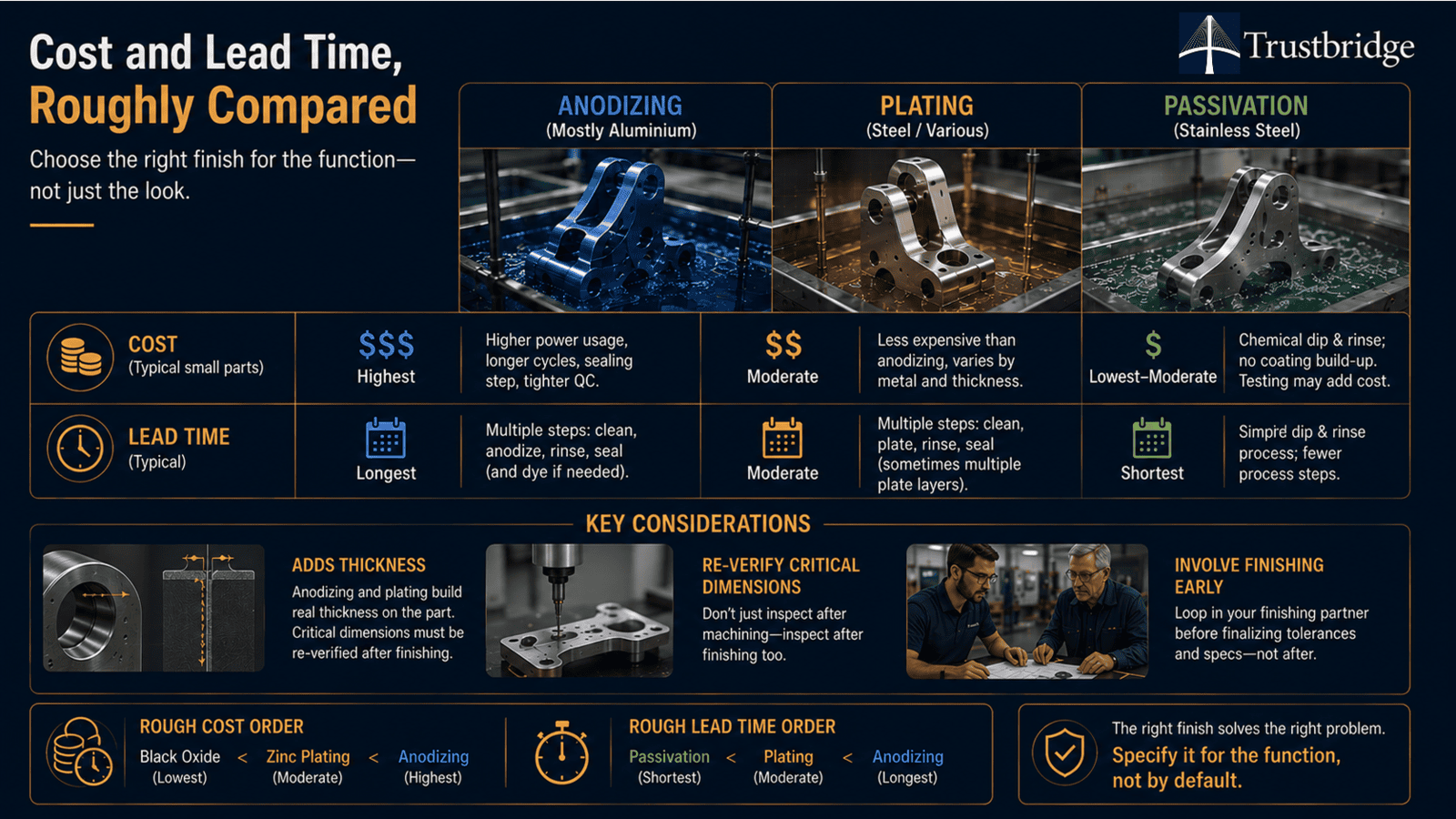
None of these three processes cost the same, and the differences are large enough to matter when specified without a functional reason behind them. On typical small parts, black oxide is the cheapest option, commonly running well under half a dollar per part; zinc plating lands somewhat higher; and anodizing costs noticeably more than either, largely due to the electrical power the process consumes, the longer cycles it requires, and the sealing step and tighter quality control that go with it. Passivation sits in its own category, since it's a chemical dip-and-rinse process rather than a coating build-up, which generally keeps it faster and cheaper than anodizing on a comparable part, though testing requirements under ASTM A967 add their own time if full certification is required.
Lead time follows a similar pattern, for the same reason: anodizing and plating both add process steps cleaning, the bath itself, sealing or rinsing, sometimes a dye step that a passivation dip doesn't need. The dimensional consideration matters too: since anodizing and plating add real thickness to a surface, critical dimensions typically need re-verifying after the finish is applied, not just after machining, one more reason to loop a finishing partner in before tolerances are finalized rather than after.
A quick way to decide
A few questions tend to sort most finishing decisions quickly, before a note gets copied onto the wrong drawing by habit:
What's the base material? Aluminum points toward anodizing; most other metals needing protection point toward plating; stainless steel points toward passivation almost by default.
What's the actual functional goal — corrosion protection, wear resistance, electrical insulation, or just appearance? Naming it usually narrows the choice immediately.
Does the part have a tight tolerance on a surface about to be finished? If so, the coating's added thickness needs to be part of that conversation now, not after parts come back oversized.
Is this finishing note original to this part, or copied from a different drawing with a different base material?
Matching the answer to the material and the function, rather than defaulting to whatever note was already sitting in the template, is most of what separates a correct finishing callout from an expensive do-over.
Conclusion
Anodizing, plating, and passivation get lumped together as "metal finishing" because they happen at the same build stage, but they solve three different problems: anodizing grows a protective oxide layer directly out of the base metal most commonly aluminum, though not only aluminum plating adds a different metal entirely for whatever combination of corrosion resistance, wear resistance, or appearance a part needs, and passivation restores a protective layer stainless steel was supposed to have all along. Getting the choice right is mostly a matter of naming the material and the actual functional goal before a note gets written down then making sure that note never quietly survives a material change, a template reuse, or a copy-paste it was never meant to.
Not sure which finish your next part actually needs?
Send over the drawing and the base material, and get a straight read on whether anodizing, plating, or passivation is the right call — and what it will actually cost in money and lead time before it's locked into a print. A five-minute check is usually enough to catch a finishing note copied from an old drawing and never verified against the material in front of it. Get a finishing recommendation before a copied-over note turns into a part with the wrong finish, on the wrong material, at the wrong cost.
Frequently Asked Questions
1. What is the difference between anodizing, plating, and passivation?
Anodizing creates a controlled oxide layer on the surface of metals such as aluminum, plating deposits a separate metal coating onto a part, and passivation chemically cleans stainless steel so its protective oxide layer can reform. The right process depends on the base material and the part’s functional requirements.
2. Can anodizing, plating, or passivation be used on any metal?
No. The base material determines which finishing process is appropriate. Anodizing is most commonly used for aluminum, plating can be applied to a wide range of metals, and passivation is primarily used for stainless steel. A finishing note should always be checked against the material before it is carried over to a new drawing.
3. What happens when a finishing note is copied to a drawing with a different material?
A copied finishing note can become incorrect or even impossible to apply when the base material changes. For example, an anodizing specification intended for aluminum may not be appropriate for a steel part. This can lead to manufacturing delays, incorrect finishes, rework, added cost, or parts that do not meet their functional requirements.
4. How do I choose the right metal finishing process for a part?
Start with the base material and then identify the actual functional requirement, such as corrosion resistance, wear resistance, electrical insulation, or appearance. Engineers should also consider coating thickness, dimensional tolerances, inspection requirements, cost, and lead time before specifying anodizing, plating, or passivation on a drawing.