
The Design Details That Can Make or Break a Manufacturing Quote
A quote isn't really a price. It's a shop's best guess at how long your part will take to build, translated from a print. Small details in that print change the guess more than most designers expect.
Introduction
Every manufacturing quote is a translation. Somewhere behind the number is an estimator, or increasingly a piece of quoting software, reading a drawing and converting it into machine time, material, setup, and risk. Most of that translation happens invisibly. That's exactly why the same part can come back from two shops at wildly different prices, or why a simple-looking design comes back costing far more than expected. The details doing that work aren't usually the big, obvious ones. They're the smaller choices in material, tolerance, geometry, and finish that quietly decide how much time a shop has to plan for before it ever cuts a chip.
What a manufacturing quote actually reflects
Strip away the paperwork, and almost every machining quote follows the same underlying formula. Material cost, plus machining time multiplied by an hourly rate, plus setup, plus any finishing work. That structure is why the same drawing can produce very different numbers depending on which parts of it a shop reads as expensive. Send the same CAD file to three shops and you can get three numbers that aren't close to each other. Costs that never appear as line items add more on top of that. Fixturing, material waste allowance, and inspection time are usually folded into the unit price rather than itemized, which is part of why a total can feel disconnected from the part in your hand. None of that variance is arbitrary. It's a direct result of how differently two shops interpret the same set of design choices.
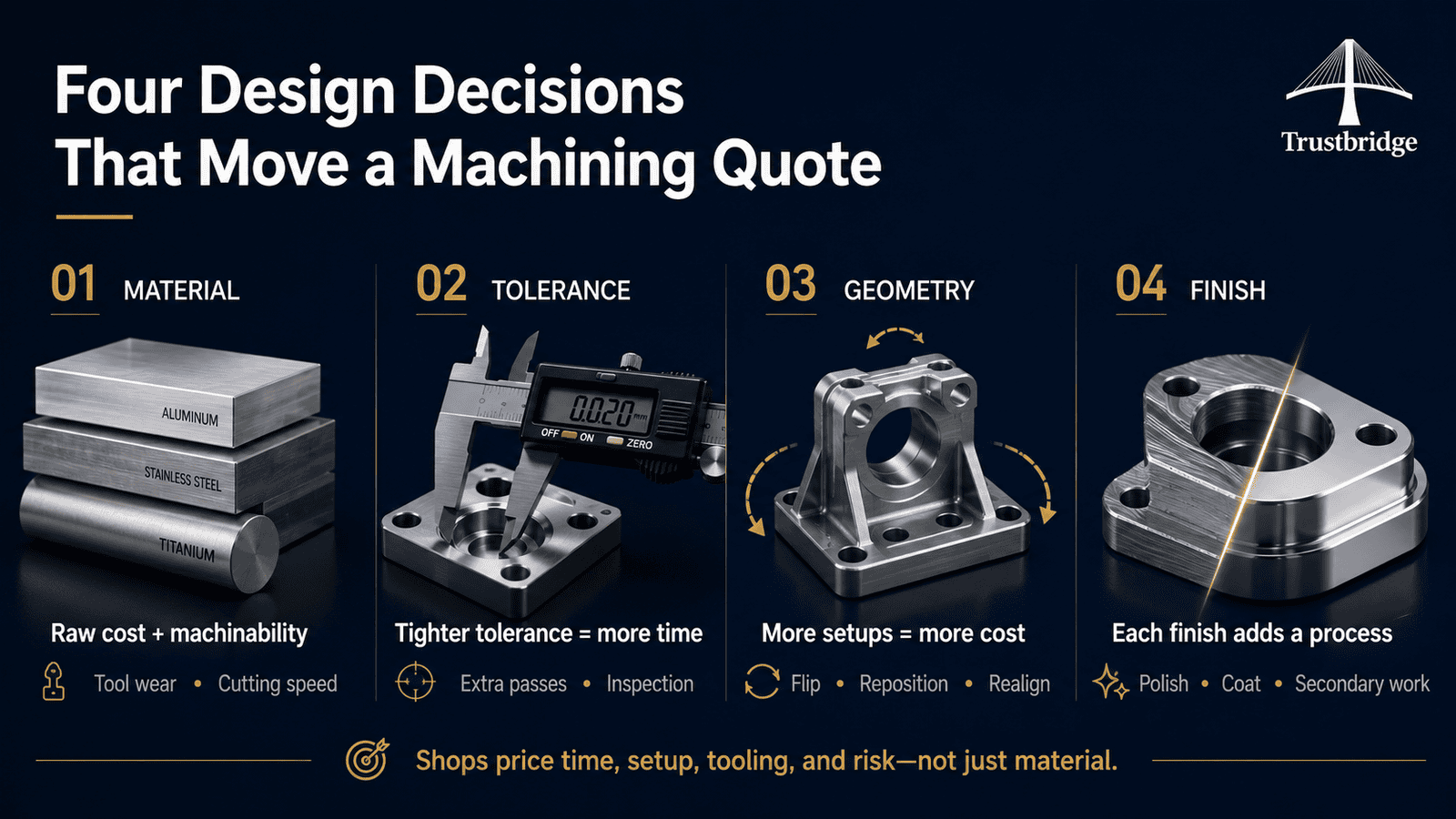
Shop minimums add another layer that's easy to miss. Turning on a machine, calibrating it, and programming a job all cost something, regardless of how simple the part looks. That's why a tiny bracket can sometimes carry a price that seems disconnected from its size. Once that baseline is covered, though, the number starts moving almost entirely in response to four things. Those are the material specified, the tolerances called out, the geometry itself, and whatever finish the part needs afterward. Those four are worth understanding individually, because each one moves the quote for a genuinely different reason.
The four levers that move the number
Material cost isn't just the price per pound of raw stock. Machinability matters just as much, and it doesn't always track with sticker price. Stainless steel doesn't look dramatically more expensive than aluminum on a materials chart, and titanium's premium on paper still understates what it costs to actually cut. But both cut more slowly, wear tools out faster, and demand more careful feeds and speeds. A shop pricing raw material alone will underquote a part in either alloy; a shop pricing machinability will land somewhere much closer to reality.
Tolerance works on its own separate curve. Most shops can hit a standard general tolerance without much fuss, since it's already built into how they run a job by default. Tighten that tolerance, and the job needs slower feeds, extra passes, and dedicated inspection time on top of the cut itself. That's why a tolerance tightened out of habit, rather than function, is one of the most common places a quote quietly inflates.
Geometry drives cost through something less obvious: how many times the part has to be picked up, flipped, and repositioned to reach every feature. Every one of those repositions adds setup time and a small chance of misalignment between features cut in different orientations. A part that can be finished in one clean setup will almost always quote lower than a geometrically similar part that forces three or four.
Finish is the fourth lever, and it behaves like an entirely separate job stacked onto the first one. Anything beyond a standard as-machined surface adds a process step. A tighter Ra callout, a coating, a cosmetic requirement each is something a shop has to schedule, tool for, and often outsource. As-machined aluminum lands around 3.2 µm Ra (125 µin) with no extra work. Asking for 0.8 µm (32 µin) means a finishing pass or a secondary process. None of these four levers is inherently good or bad to specify tightly. The point is simply that each one is read literally, and each one has its own separate cost curve behind it.
The small details that quietly move a quote
The features that blow up a quote are rarely dramatic. They're small geometric choices that look harmless in CAD and turn out to fight the physics of how a cutting tool actually works. Sharp internal corners are the clearest example. Cutting tools are round, so no end mill of any diameter leaves a truly sharp internal corner. A smaller tool only shrinks the radius, and it does that with a slower, more fragile pass. A genuinely sharp corner needs a secondary process like EDM, or a design change that accepts a radius. A common rule of thumb is to draw the internal radius at least 30% larger than the radius of the tool that will cut it, so the cutter is never fully buried in the corner. That sounds like a minor drafting choice. In practice, it can be the difference between a quick pass and an added operation.
Deep, narrow pockets cause a similar problem for a different reason. Past roughly three to four times the tool's diameter, a standard end mill starts to deflect and chatter. Going deeper means a long-reach or tapered tool, or slower feeds to hold accuracy. Beyond about ten times the diameter, you're into specialty tooling territory. A pocket that looks like a simple rectangle on a drawing can still end up needing a specialized long-reach tool. The cycle time stretches too, purely because of its depth-to-width ratio.
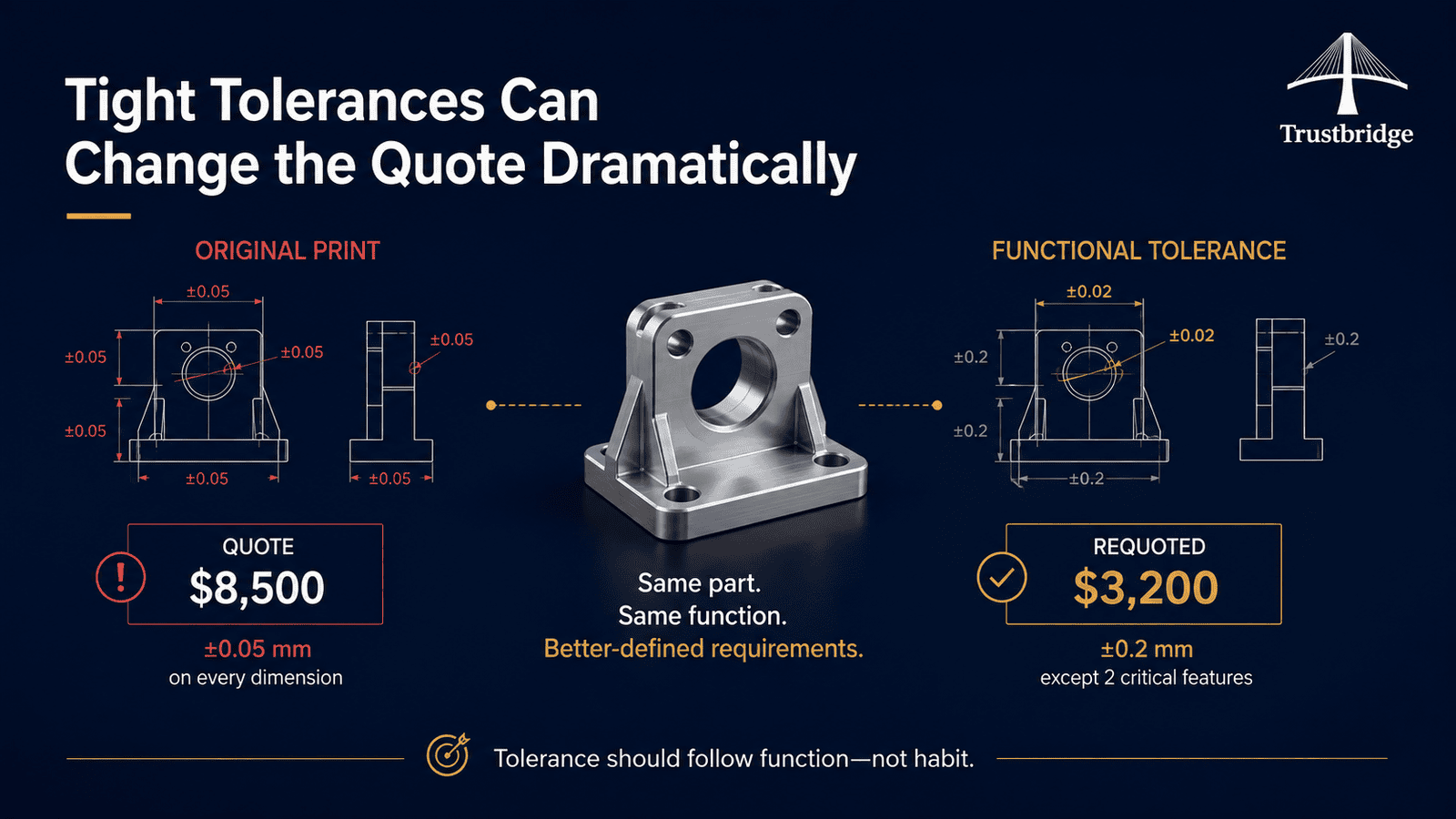
The pattern shows up clearly in a machining shop's own account of a job. A batch of 500 aluminum brackets came in with ±0.05 mm called out on every dimension, an internal part, invisible in the assembly, that only needed to fit. The quote was $8,500. After one conversation with the engineering team, the tolerance was relaxed to ±0.2 mm everywhere except the two dimensions that actually controlled fit. The requote came back at $3,200. Nothing about the part's function changed. What changed was that the print finally said which dimensions mattered.
Why design intent has to translate into production requirements
A drawing only communicates what's actually written on it, and a quoting system, human or automated, has no way to infer what wasn't. That gap is where a lot of quotes quietly go wrong, in one of two directions. The shop might read genuine ambiguity as risk, and price in a safety margin to cover it that inflates the number. Or the shop takes the print at face value and quotes exactly what's drawn. That can produce a part that's technically correct and still not what was actually needed. Both outcomes trace back to the same root cause. The design intent behind a callout never made it onto the page in a form the quote could act on.
This is why accurate quotes tend to come down to completeness more than cleverness. A print that states which dimensions are genuinely critical, which tolerances trace to a real functional requirement, and which finish is actually necessary gives an estimator something firm to price against. A print that leaves that context implicit forces a guess instead. Guesses get priced conservatively, because no shop wants to be the one that quoted too little for a job that turns out to be harder than it looked on paper.
A quick way to check your next print before it goes for quotes
A few questions tend to catch most of the avoidable cost before a print ever reaches a shop:
Does every tight tolerance on this drawing trace to something the part actually needs, or did some of them get copied from a template?
Are there internal corners or deep pockets that a standard tool could reach cleanly, or do any of them force a smaller tool or a secondary operation?
Could this part be finished in fewer setups with a small change to how a feature is oriented or positioned?
Is the reasoning behind any unusual callout written down somewhere a shop can actually see it, or does it only exist in a conversation nobody wrote down?
None of these questions require redesigning the part. They just make sure the quote that comes back is pricing the part that's actually needed, not a more cautious or more literal reading of it.
Conclusion
A manufacturing quote is never really a judgment on a design. It's a shop's best attempt to translate a drawing into time, material, and risk, using only what the drawing actually says. Material, tolerance, geometry, and finish are the four places that translation happens. Small, easy-to-miss choices inside each one routinely move the number more than the big decisions do. Catching them before a print goes out doesn't take a redesign. It takes a few minutes spent asking whether each detail is earning its place on the page, and whether a shop reading that page cold would arrive at the same understanding the designer already has in their head.
Not sure why your last quote came back higher than expected?
Send over the drawing. Get a straight read on which specific details are driving the number, and which ones could come out without touching what the part actually needs to do. Get a quote review before the next print goes out with the same quiet cost sitting inside it.
Frequently Asked Questions
1. What factors affect the cost of a CNC machining quote?
The main factors that affect a CNC machining quote are material, tolerances, part geometry, and finishing requirements. Machinability, setup time, tooling, inspection, and secondary processes can also increase the final cost, which is why two shops may quote very different prices for the same part.
2. How do tight tolerances increase CNC machining costs?
Tight tolerances often require slower machining, additional passes, more frequent inspection, tighter process control, and greater risk of scrap or rework. If a tolerance is tighter than the part's functional requirements demand, it can increase the CNC machining cost without providing any meaningful improvement in performance.
3. How does part geometry affect CNC machining quotes?
Part geometry affects machining cost through tool accessibility, setup requirements, internal corners, pocket depth, and the number of times a part must be repositioned. Features such as deep narrow pockets, sharp internal corners, and difficult-to-reach surfaces can require smaller or specialized tooling, additional setups, or secondary operations.
4. How can designers reduce CNC machining costs before requesting a quote?
Designers can reduce CNC machining costs by specifying only functionally necessary tolerances, using machinable internal radii, avoiding unnecessarily deep or narrow pockets, reducing the number of setups, and selecting finishes that the application actually requires. Reviewing these details before requesting a quote helps shops price the part more accurately and can prevent unnecessary manufacturing costs.