
Why a Shop's Quote History Is Really a Map of Its Business Strategy
Most shop owners can describe their strategy in a sentence. Their quote history often tells a different story. Every RFQ that arrives, every job you choose to quote and every one you win or turn down adds up to a map of where your business is really going.
The strategy in your head vs. the strategy in your quote log
Ask a machine shop owner about strategy and you'll usually get a clear answer. "We're a medical shop." "We focus on complex aerospace parts." "We want more production work and fewer one-offs."
Then look at the shop's quotes from the past year. Often, a large share of the RFQs came from industries the owner barely mentioned. Most of the estimating hours went to jobs that don't fit the stated focus. And the work the shop actually won leans somewhere else entirely. That gap isn't a sign of bad management. It's what happens when a busy shop responds to whatever comes in the door. Day by day, each quoting decision makes sense on its own. But together, those decisions set the shop's real direction, whether anyone planned it or not.
This is why a shop's quote history is so valuable. It's an honest, detailed record of the strategy the shop is actually following. Read it carefully, and it shows where you're strong, where you're drifting and what to change.
What a quote history actually contains
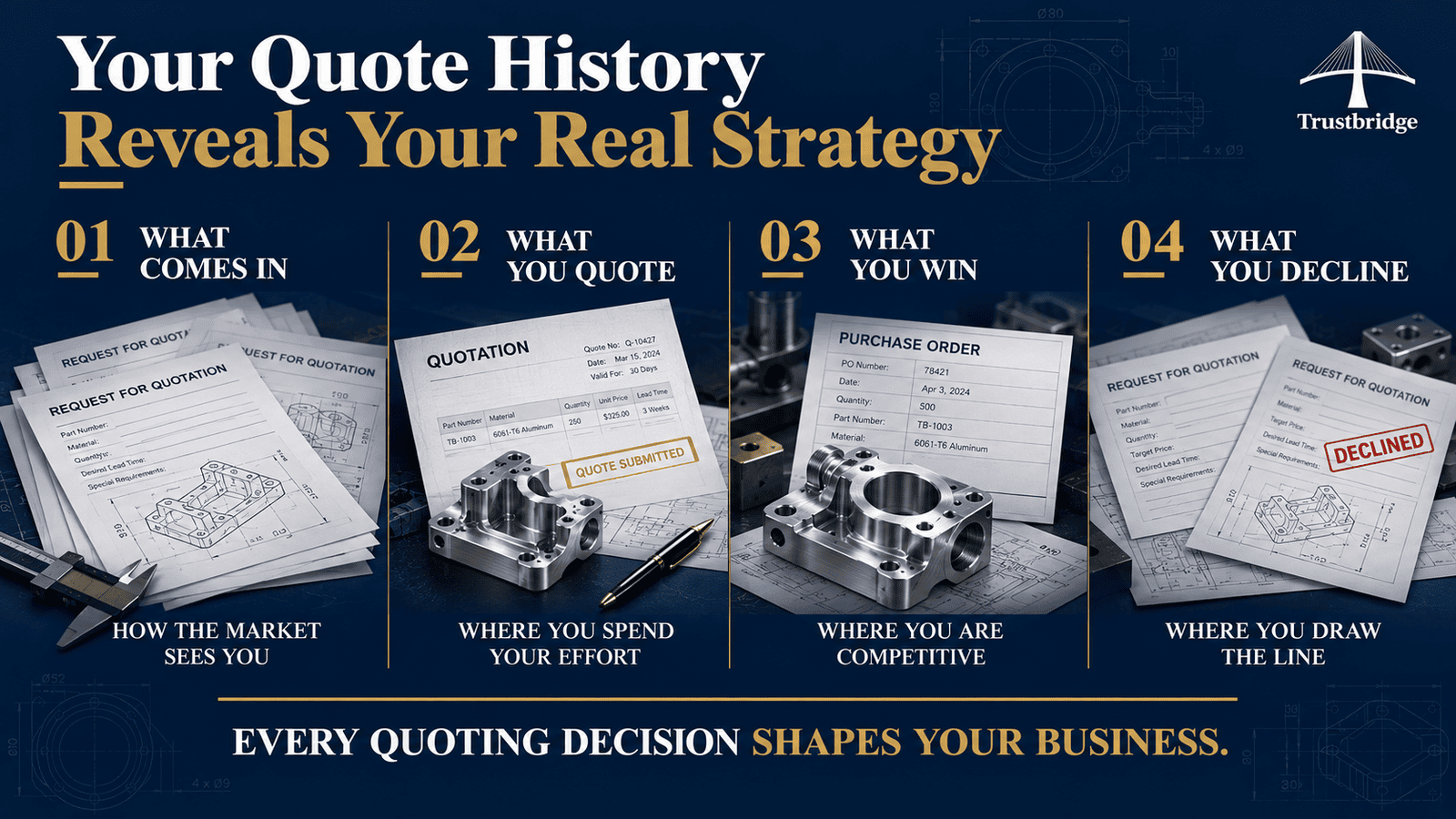
A quote history isn't just a list of prices. It holds four layers of information, and each one tells you something different about your business.
What comes in.
The RFQs that arrive show how the market sees you. They reflect your reputation, your website, your referrals and the industries that know your name. If most RFQs don't match the work you want, the market has a different picture of your shop than you do.
What you choose to quote.
Every decision to quote or pass is a small strategic choice. Over a year, those choices show what your shop actually prioritizes, which is not always what it says it prioritizes.
What you win.
The jobs you win are the market's verdict. They show where your price, speed and capability come together in a way buyers value. Your win pattern is often the clearest picture of your real competitive advantage.
What you turn down.
The work you decline marks your boundaries: the processes, materials, sizes and volumes you've decided aren't for you. Those boundaries can be a sign of healthy focus, or a list of opportunities you've been quietly leaving on the table.
Reading the map: four questions your quote history answers
Who is your shop really built for?
Sort your won jobs by industry and customer. If 60 percent of your revenue comes from two medical device companies, you are a medical shop, whatever your website says. That's not good or bad on its own, but it should shape where you invest, how you market and how much risk you're carrying.
Where does your effort go?
Compare the estimating hours spent on each type of work with the revenue that type actually brings in. Many shops find they spend a large share of their quoting time on work they rarely win. One quoting-software company recommends tracking win rates by customer, part family and margin level for exactly this reason.
Where are you most competitive?
Look for the part types, materials, quantities and lead times where your win rate is highest. That's where the market agrees with you about your strengths, and where growth is likely to be cheapest.
Which way are you drifting?
Compare this year's quote history with last year's. Are RFQs shifting toward new industries? Are average order sizes growing or shrinking? Is your win rate rising with some customers and falling with others? Trends like these often show a strategic shift long before it shows up in revenue.
When your stated strategy and your quote history disagree
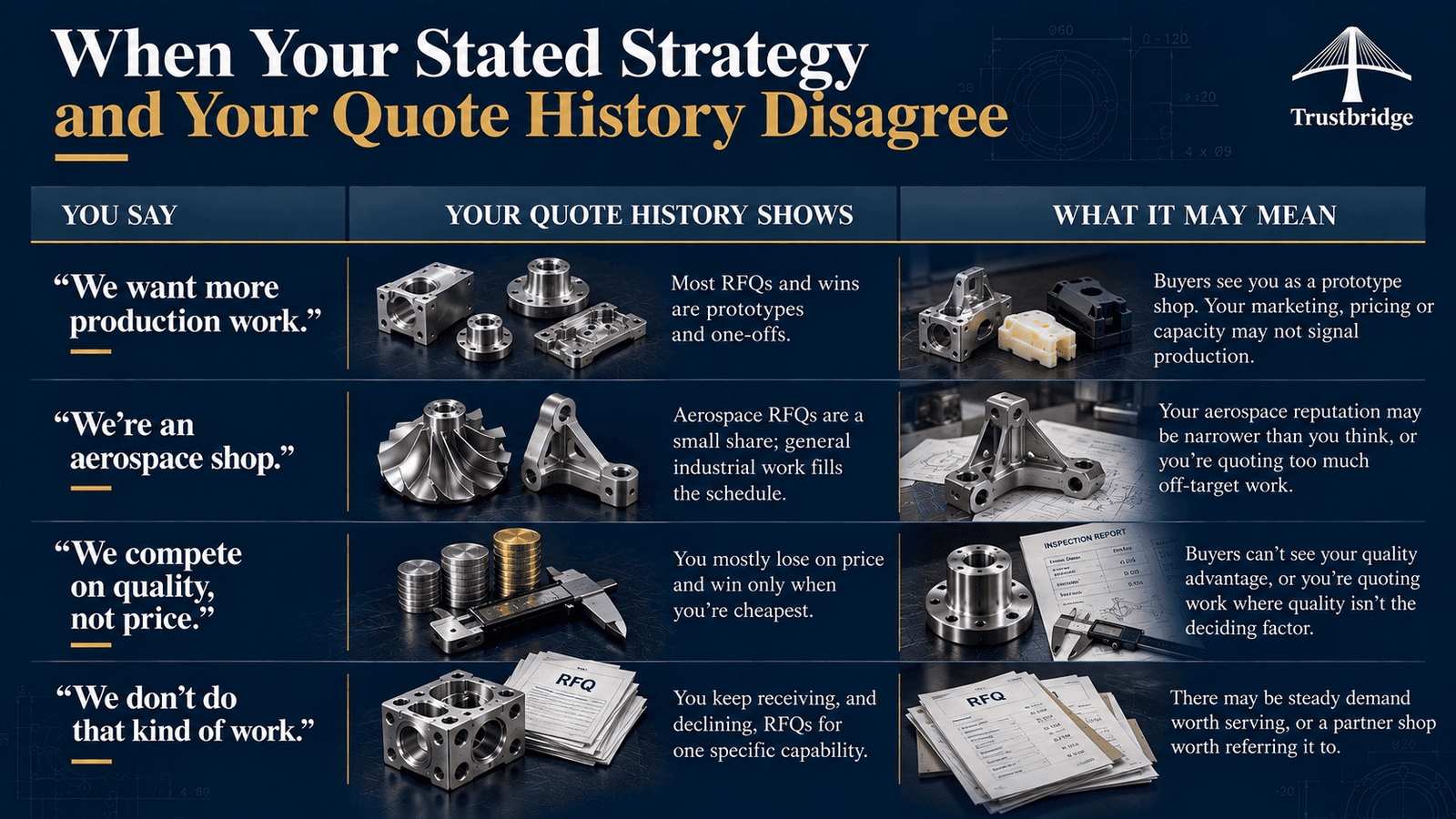
The most useful moments come when the map and the plan don't match. Here are a few common mismatches, and what they usually mean.
You say | Your quote history shows | What it may mean |
"We want more production work" | Most RFQs and wins are prototypes and one-offs | Buyers see you as a prototype shop. Your marketing, pricing or capacity may not signal production. |
"We're an aerospace shop" | Aerospace RFQs are a small share; general industrial work fills the schedule | Your aerospace reputation may be narrower than you think, or you're quoting too much off-target work. |
"We compete on quality, not price" | You mostly lose on price and win only when you're cheapest | Buyers can't see your quality advantage, or you're quoting work where quality isn't the deciding factor. |
"We don't do that kind of work" | You keep receiving, and declining, RFQs for one specific capability | There may be steady demand worth serving, or a partner shop worth referring it to. |
None of these mismatches means the stated strategy is wrong. Sometimes the plan is right and the shop just needs to act on it more deliberately. Other times, the quote history reveals a better opportunity than the one in the plan.
The point is to notice the gap. A shop that never compares its plans with its quote history can drift for years without realizing it.
A quarterly strategy review built on quote history
You don't need a consultant or new software to read your map. A simple review once a quarter, with the owner, the lead estimator and the operations manager in the room, is enough.
Step 1: Pull the last 12 months of quotes.
Use your ERP, quoting tool or a shared spreadsheet. At a minimum, you need the customer, industry, part type, quantity, quoted value and outcome for each quote.
Step 2: Sort it four ways.
Group the quotes by industry, customer, part type and size of order. For each group, note how many RFQs came in, how many you quoted, how many you won and how much revenue resulted.
Step 3: Compare it with your plan.
Write down your stated strategy in one or two sentences, then put it next to what the data shows. Where do they match? Where do they disagree?
Step 4: Choose one or two actions.
Don't try to fix everything at once. Pick the most important gap and decide what to change before the next review: stop quoting a certain customer, rewrite your website around a stronger niche, follow up on a growing industry or test a new capability.
A year of quarterly reviews turns your quote history from a forgotten archive into a steering tool. And because it uses data your shop already creates every day, it costs almost nothing to run.
Using the map to steer the business
Once you can read your quote history, it becomes a practical tool for big decisions, not just a record of past work.
Marketing.
If the RFQs coming in don't match the work you want, change the signals you send. Rewrite your website, capability sheet and introductions around your strongest niche, and track whether the mix of incoming RFQs shifts over the next few quarters.
Customer mix.
Use win rates and revenue by customer to decide where to spend sales time. Grow the accounts where you win often and earn good margins. Limit the time you spend quoting customers who rarely award work.
Investment.
Before buying a new machine, check whether your quote history supports it. Steady RFQs you've had to decline for lack of a capability, or work you keep losing on lead time, are far better evidence for an investment than a sales pitch or a hunch.
Saying no with confidence.
When your map shows clearly what your shop is built for, turning down poor-fit work gets easier. You're no longer guessing. You're following a strategy the data supports, and protecting the time and capacity your best work needs.
Your strategy is already written down
Every shop already has a detailed record of its real strategy. It's sitting in the quoting system, the inbox and the job files, built one decision at a time.
Most shops never read it. They plan from memory, gut feel and the loudest recent customer. The shops that grow with purpose do something different: they look at what the market is sending them, what they're choosing to chase and what they're actually winning, and they adjust.
Start with one quarterly review. Put your stated strategy next to your quote history and see where they agree. Whatever you find, you'll know more about where your shop is headed than you did before, and you'll be in a much better position to steer it.
Trustbridge is building a network of great manufacturers, and we help them solve problems like the ones described here. If you run a shop and this sounds familiar, fill out our interest form and we'll be in touch.
Frequently asked questions
What other KPIs should a machine shop track alongside quote data?
The most useful companions are on-time delivery, scrap or rejection rate, machine utilization and margin by job. Together with quote data, they show not just what work you win, but whether that work is profitable and running well once it reaches the floor.
What if my shop has never tracked its quotes?
Start now and work backward where you can. Most shops can rebuild a rough history from sent emails, quoting software or accounting records for won jobs. Even three to six months of consistent records is enough to start seeing patterns.
How is a quote history different from a sales pipeline?
A sales pipeline looks forward. It tracks open opportunities and what might close soon. A quote history looks back across everything you've quoted, won and lost, so it's better for spotting long-term patterns and judging whether your strategy is working.
How do I get my team to record quote outcomes consistently?
Keep it simple and make it part of an existing routine. Use a few required fields, assign one person to close out each quote and review the data together regularly. People record data more carefully when they see it being used to make real decisions.
Do I need quoting software to analyze my quote history?
No. A well-kept spreadsheet works for many smaller shops. Quoting or ERP software becomes more useful as volume grows, because it captures data automatically and makes sorting by customer, part type or margin much faster.