
Phoenix, Austin, Nashville: The Sunbelt's Emerging Precision Manufacturing Corridor
Phoenix, Austin, and Nashville are attracting billions of dollars in advanced manufacturing investment, making them some of the fastest-growing industrial hubs in the United States. Backed by federal funding, state incentives, and private capital, these regions are expanding semiconductor, aerospace, automotive, battery, and healthcare manufacturing while creating opportunities for suppliers, engineering firms, and precision manufacturers to support America's reshoring efforts.
Introduction
The Sunbelt has become one of the fastest-growing regions for advanced manufacturing in the United States. Arizona, Texas, and Tennessee are attracting major investments in semiconductor fabrication, aerospace, electric vehicles, battery production, and healthcare technologies through a combination of federal funding, state incentives, and private capital.
Unlike earlier manufacturing expansions that focused mainly on reducing costs, today's growth is centered on building resilient domestic supply chains and expanding advanced manufacturing capabilities. As new production facilities open, they create demand for a wide network of suppliers, including CNC machining, fabrication, tooling, automation, quality inspection, logistics, and engineering services.
For manufacturers and suppliers, understanding why Phoenix, Austin, and Nashville are growing is just as important as knowing where the investments are taking place. Companies that recognize these regional strengths can better position themselves to support OEMs, enter new supply chains, and capitalize on long-term manufacturing opportunities.
Why the Sunbelt Is Becoming America's Fastest-Growing Manufacturing Corridor
The rapid expansion of Sunbelt manufacturing is the result of several factors working together. Federal investment programs, state incentive policies, corporate capital spending, and the broader movement toward reshoring have created conditions that encourage manufacturers to build new production capacity within the United States.
The CHIPS and Science Act has been one of the largest catalysts for semiconductor manufacturing, providing approximately $53 billion to strengthen domestic chip production. At the same time, individual states have introduced their own programs to attract manufacturers through tax incentives, workforce development, and infrastructure improvements.
While these policies provide the foundation, private investment has accelerated the pace of growth. Global manufacturers are committing hundreds of billions of dollars to expand production, bringing entire supplier ecosystems with them. Rather than simply opening factories, they are creating regional manufacturing clusters that support long-term industrial development.
Although Phoenix, Austin, and Nashville all benefit from these broader trends, each city has developed a distinct manufacturing specialization that is shaping its future growth.
Phoenix: America's Expanding Semiconductor and Aerospace Manufacturing Hub
Phoenix has become one of the strongest examples of Arizona manufacturing growth. The region has positioned itself as a national leader in semiconductor fabrication while continuing to strengthen its aerospace manufacturing capabilities. Instead of pursuing broad industrial diversification, Phoenix has focused on industries that depend on precision engineering, advanced manufacturing technologies, and highly specialized supply chains.
This strategy has attracted some of the largest manufacturing investments in U.S. history while creating sustained opportunities for aerospace suppliers, precision machining companies, automation providers, and advanced component manufacturers.
Semiconductor Manufacturing Is Driving Long-Term Industrial Growth
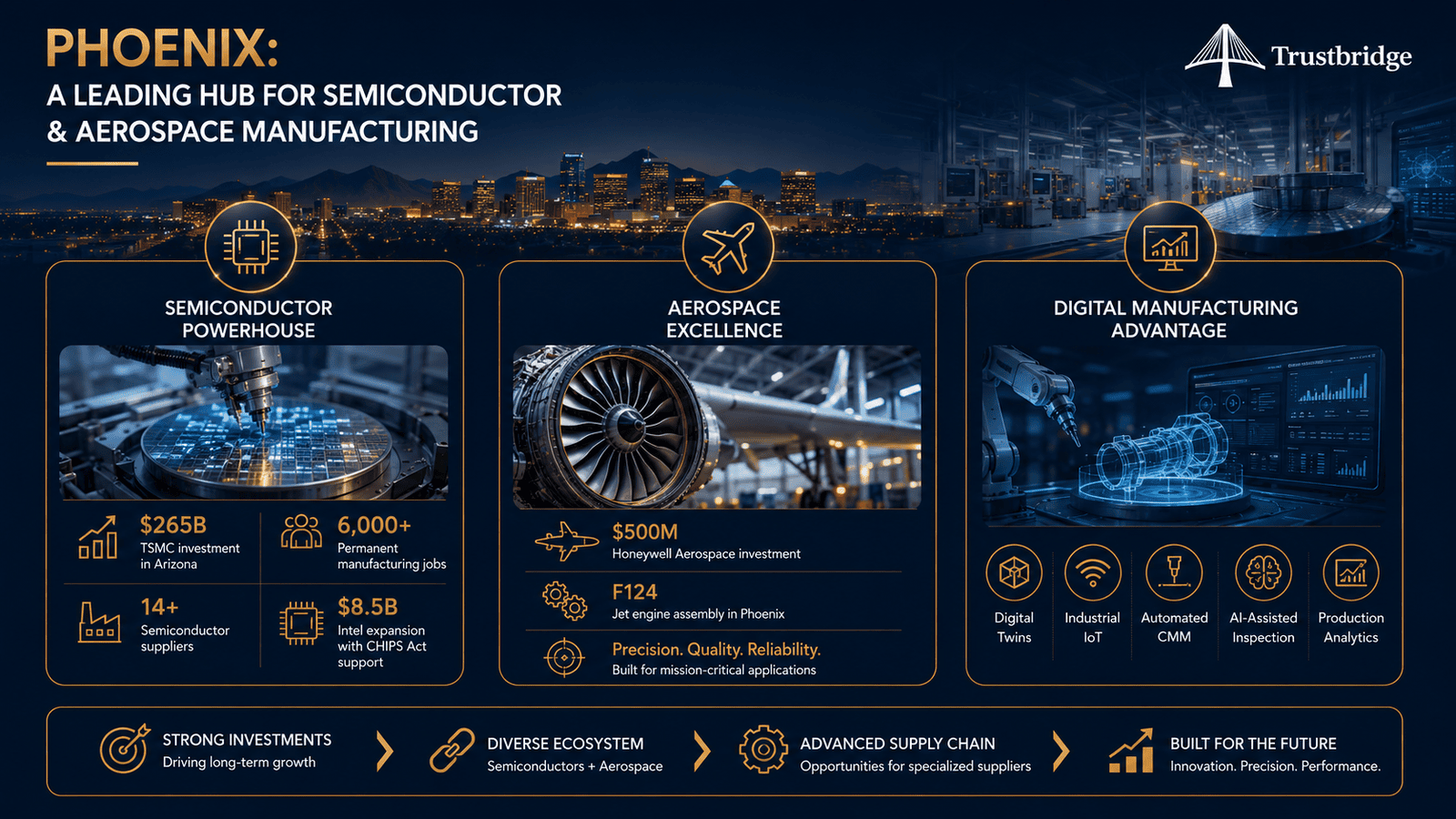
The single largest investment shaping Phoenix is TSMC's Arizona expansion. In 2026, the company increased its total U.S. commitment to $265 billion, making it one of the largest manufacturing investments ever announced in the United States. Supported by approximately $6.6 billion in CHIPS Act funding, TSMC's Arizona campus is expected to include multiple fabrication facilities capable of producing some of the world's most advanced semiconductor technologies.
The scale of the project extends well beyond chip production. Industry estimates suggest the expansion will support approximately 6,000 permanent manufacturing jobs, create more than 20,000 construction jobs, and has already attracted over 14 semiconductor suppliers to Arizona. As production ramps up, demand continues growing for suppliers specializing in precision machining, tooling, cleanroom systems, industrial automation, metrology, and advanced manufacturing equipment.
Intel is also expanding its Chandler campus through Fab 52 and Fab 62, supported by approximately $8.5 billion in CHIPS Act funding alongside additional federal financing. Together, Intel, TSMC, and NXP Semiconductors are creating one of the largest semiconductor manufacturing clusters in North America, strengthening Arizona's long-term position within the domestic semiconductor supply chain.
Aerospace Manufacturing Continues to Diversify the Region
Semiconductors may dominate recent headlines, but aerospace remains another major contributor to Arizona manufacturing. Honeywell Aerospace continues expanding its manufacturing presence in Phoenix, including a $500 million investment to strengthen defense manufacturing capacity. The company has also announced plans to assemble F124 jet engines locally for a next-generation U.S. Navy trainer aircraft program.
These investments create opportunities for suppliers capable of manufacturing high-precision machined components, complex assemblies, aerospace-grade materials, and mission-critical systems. Aerospace production requires rigorous quality standards, comprehensive documentation, and tight machining tolerances, making experienced precision manufacturers valuable long-term partners.
The combination of semiconductor fabrication and aerospace production provides Phoenix with a balanced advanced manufacturing ecosystem that continues attracting suppliers across multiple industries.
Digital Manufacturing Is Improving Productivity
Manufacturing growth in Phoenix is also being supported by significant investment in digital production technologies. Semiconductor and aerospace manufacturers are increasingly connecting CAD/CAM systems, CNC machining, automated inspection, and production analytics into integrated digital workflows.
Digital twins, industrial IoT sensors, automated coordinate measuring machines (CMMs), and AI-assisted inspection systems are becoming more common throughout the region. These technologies help manufacturers improve quality, reduce variation, and increase production efficiency while supporting the extremely tight tolerances required in semiconductor and aerospace manufacturing.
For suppliers, this means future competitiveness will increasingly depend on investments in automation, digital quality management, and advanced manufacturing technologies rather than production capacity alone.
Austin: Building an Integrated Advanced Manufacturing Ecosystem
Austin has developed into one of the most diversified examples of Texas manufacturing. While semiconductor fabrication remains the foundation of regional growth, the city has successfully expanded into electric vehicles, advanced electronics, robotics, industrial equipment, and automation. Instead of relying on one industry, Austin benefits from a manufacturing ecosystem where design, engineering, equipment production, and final assembly operate within the same regional supply chain.
This concentration of advanced industries creates significant opportunities for suppliers supporting semiconductor production, industrial automation, precision machining, tooling, fabrication, and advanced manufacturing services.
Semiconductors and Advanced Technology Continue to Expand
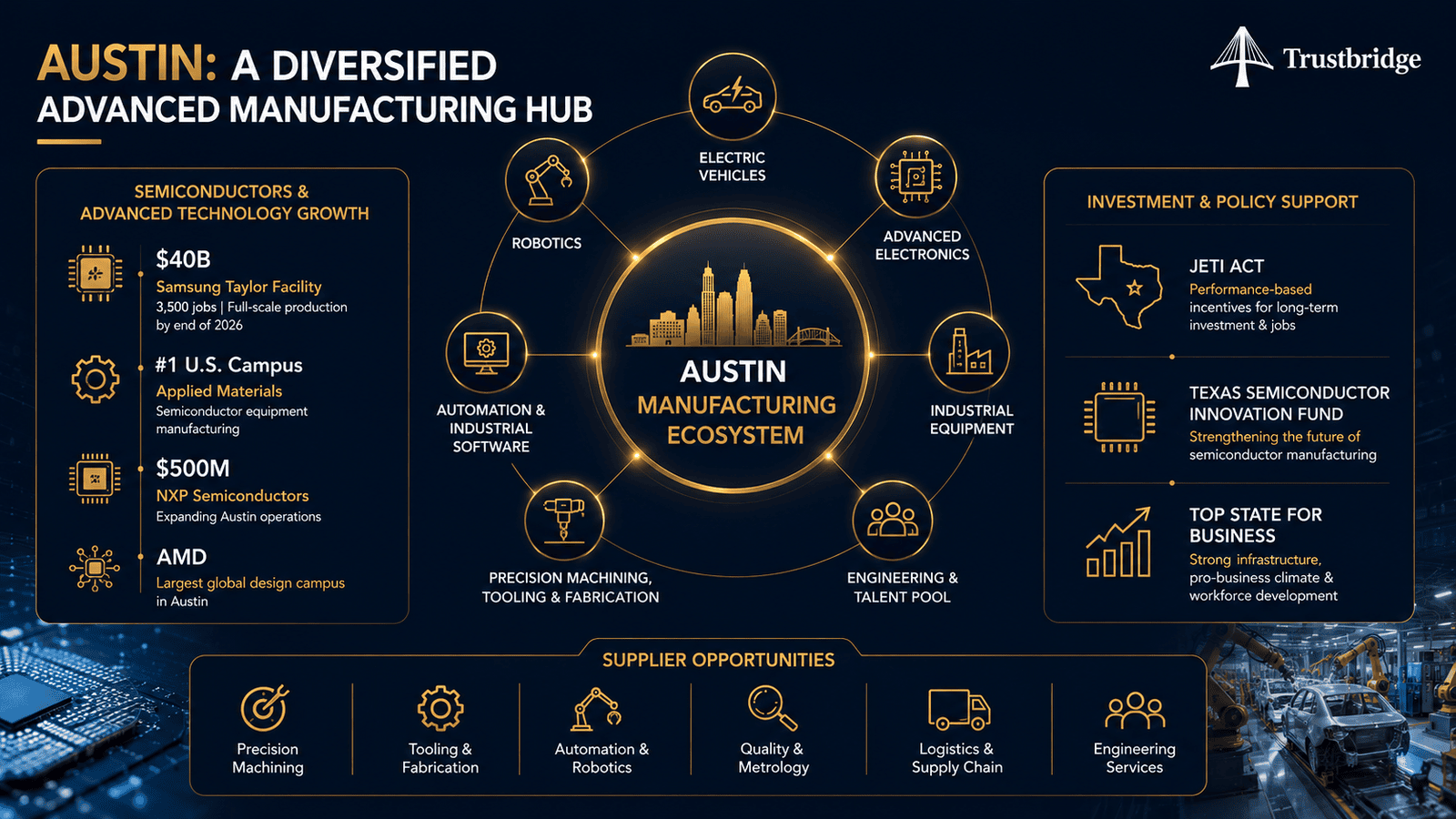
Semiconductors remain the backbone of Austin's manufacturing growth. Samsung's Taylor facility, originally announced as a $17 billion project, has expanded into approximately $40 billion in cumulative Texas investment, supported by both CHIPS Act funding and the Texas Semiconductor Innovation Fund. The facility is expected to begin full-scale production by the end of 2026 while creating roughly 3,500 permanent jobs.
The surrounding ecosystem continues to strengthen as well. Applied Materials operates its largest U.S. manufacturing and logistics campus in Austin, producing semiconductor manufacturing equipment used by companies including Texas Instruments. Meanwhile, NXP Semiconductors continues expanding its Austin operations through a $500 million investment, while AMD's largest global design campus remains located in the city. Together, these companies create a complete semiconductor value chain that spans chip design, manufacturing equipment, fabrication, testing, and engineering talent.
Texas Continues Investing in Future Manufacturing Growth
Austin's manufacturing base extends well beyond semiconductors. Tesla's Gigafactory Texas continues expanding through more than 5.2 million square feet of additional development, including facilities dedicated to robotics and advanced manufacturing technologies. The region's concentration of technology companies also supports increasing investment in automation, AI-driven manufacturing, and industrial software.
Texas has reinforced this growth through the Jobs, Energy, Technology and Innovation (JETI) Act, which replaced the former Chapter 313 incentive program with a performance-based approach tied to job creation and long-term investment. Combined with the Texas Semiconductor Innovation Fund and the state's consistently high rankings for business climate and infrastructure, these policies continue attracting manufacturers looking to establish or expand advanced production operations. As a result, Austin has evolved into one of the nation's most complete manufacturing ecosystems, supporting everything from semiconductor fabrication to robotics, electric vehicles, and next-generation industrial technologies.
Nashville: Expanding Beyond Automotive Into Advanced Manufacturing
While Phoenix has become synonymous with semiconductors and Austin continues to build a diverse advanced manufacturing ecosystem, Nashville manufacturing is evolving through a different strategy. The region has long been anchored by automotive production, but recent investments show a broader shift toward battery manufacturing, medical technologies, advanced materials, and industrial innovation.
Rather than relying on a single industry, Tennessee is diversifying its manufacturing base while leveraging decades of experience in vehicle production. This balanced approach is helping the state remain competitive as manufacturing priorities shift toward electrification, healthcare technologies, and precision engineering.
Automotive and Battery Manufacturing Continue to Drive Investment
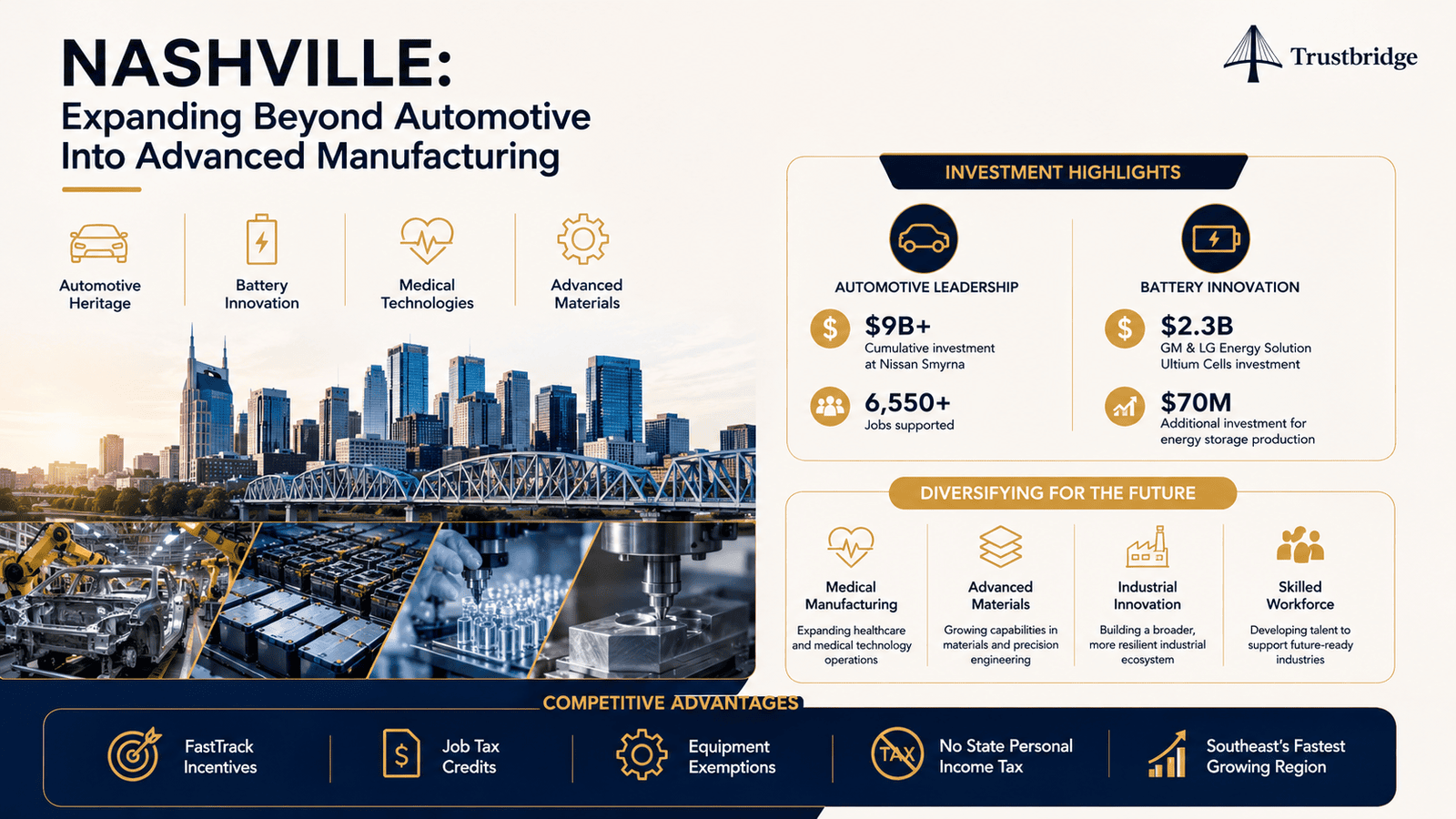
Automotive manufacturing remains the foundation of Tennessee's industrial economy. Nissan's Smyrna facility represents more than $9 billion in cumulative investment and approximately 6,550 jobs, while the company has helped support more than $16 billion in statewide EV investment since 2017.
Battery manufacturing is also evolving. GM and LG Energy Solution's Ultium Cells facility in Spring Hill, originally built through a $2.3 billion investment, shifted part of its production toward lithium-iron-phosphate batteries for grid-scale energy storage after EV demand slowed in 2026. The transition, supported by an additional $70 million investment, demonstrates how manufacturers are adapting production to changing market conditions instead of reducing long-term investment.
Medical Manufacturing and Business Incentives Strengthen Growth
Healthcare is becoming another important growth driver. Companies such as Nissha Medical Technologies are expanding engineering and medical manufacturing operations in the region, adding greater diversity to Tennessee's industrial base.
The state continues to attract manufacturers through its FastTrack incentive program, job tax credits, and exemptions on manufacturing equipment, while its lack of state personal income tax remains attractive for new investment. Although workforce availability remains a challenge, Nashville's combination of automotive expertise, expanding medical manufacturing, and continued industrial investment is positioning it as one of the fastest-growing manufacturing regions in the Southeast.
Yes, that's a much cleaner structure. Instead of having a long concluding analysis followed by another conclusion, split it like this:
What This Growth Means for Manufacturers and Suppliers
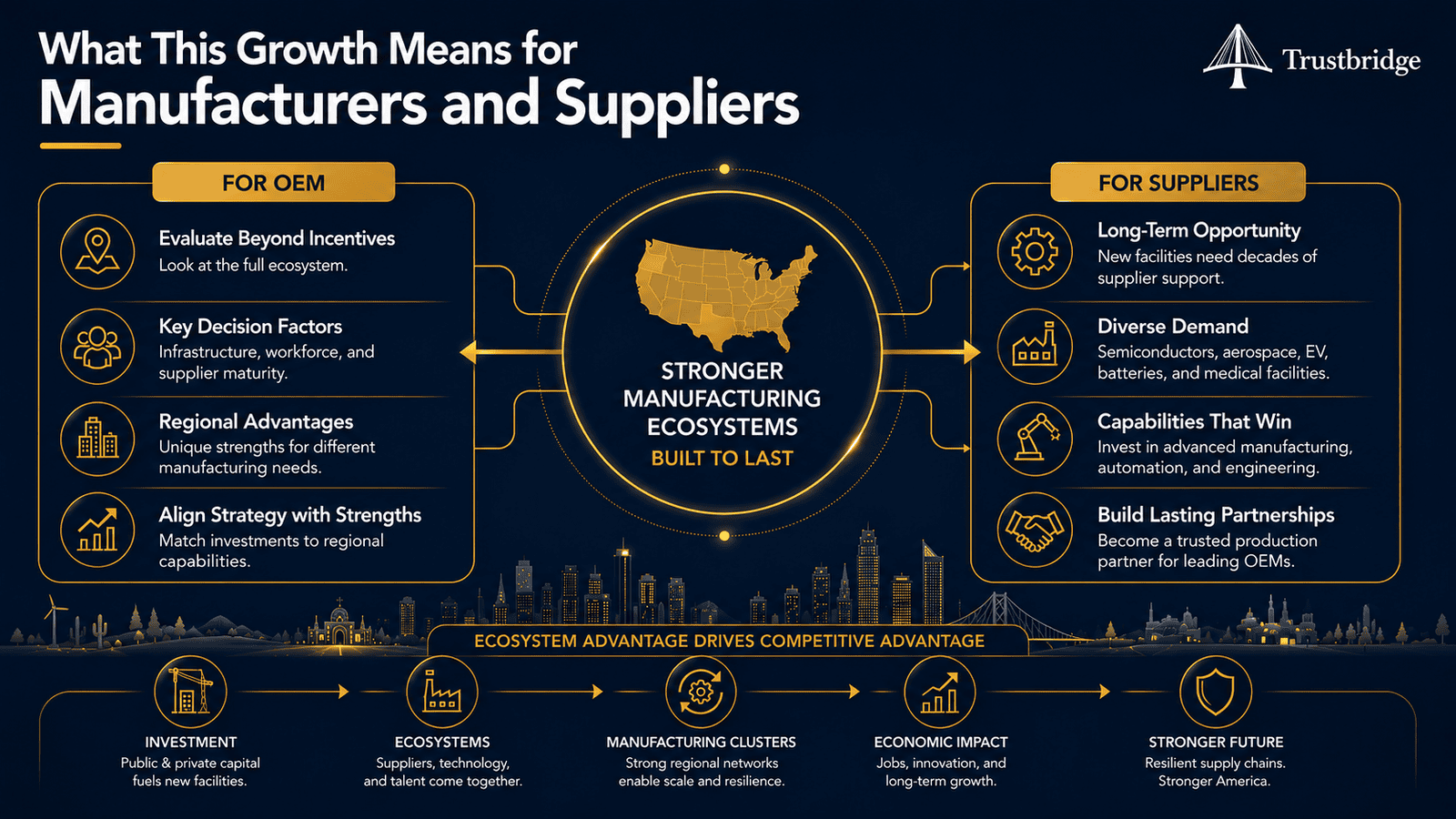
The rapid expansion of Sunbelt manufacturing represents more than a regional success story. It reflects a broader shift in how companies are approaching manufacturing investment, reshoring, and supply chain development across the United States. Instead of selecting locations based primarily on operating costs, manufacturers are increasingly building production ecosystems where advanced technology, supportive public policy, skilled workforces, and established supplier networks work together.
For manufacturers, this means evaluating locations beyond incentive packages alone. Infrastructure, workforce availability, supplier maturity, and long-term production scalability have become equally important decision factors. Arizona, Texas, and Tennessee each offer distinct advantages, but the most successful investments will be those that align business strategy with the strengths of each regional ecosystem.
For suppliers, the opportunity extends well beyond the construction of new facilities. Semiconductor fabs, aerospace plants, EV factories, battery facilities, and medical manufacturing campuses require decades of support from companies providing precision machining, tooling, fabrication, automation, metrology, logistics, and engineering services. As these manufacturing clusters continue to mature, suppliers that invest in advanced manufacturing capabilities, digital quality systems, automation, and engineering expertise will be better positioned to become long-term production partners for leading OEMs.
Ultimately, the continued rise of Arizona manufacturing, Texas manufacturing, and Tennessee manufacturing demonstrates that competitive advantage is increasingly being built through regional manufacturing ecosystems rather than individual factories. Companies that establish relationships within these growing supplier networks today will be better prepared to capitalize on future manufacturing investment and ongoing reshoring initiatives.
Conclusion
Phoenix, Austin, and Nashville each illustrate a different path toward advanced manufacturing growth, but together they represent one of the most significant shifts in American industry in decades. Phoenix has established itself as a global semiconductor and aerospace hub, Austin has built one of the country's most integrated advanced manufacturing ecosystems, and Nashville continues to diversify beyond automotive into batteries, healthcare technologies, and advanced industrial production.
Although each market has its own strengths, they all highlight the same long-term trend: future manufacturing competitiveness will depend on resilient supply chains, advanced engineering capabilities, strong supplier relationships, and the ability to adapt as technologies and markets evolve.
For manufacturers planning expansion and suppliers looking for new business opportunities, these Sunbelt cities offer more than short-term investment announcements—they provide a clear picture of where the next generation of American manufacturing is taking shape. Organizations that position themselves within these growing industrial ecosystems today will be better equipped to support tomorrow's production demands and participate in the next phase of U.S. manufacturing growth.
The manufacturing investments transforming Phoenix, Austin, and Nashville represent far more than new factories—they are creating long-term opportunities for suppliers across machining, fabrication, tooling, automation, quality inspection, and engineering services. As reshoring accelerates and precision manufacturing growth continues, manufacturers need trusted partners that can deliver quality, scalability, and technical expertise.
Trustbridge helps OEMs, manufacturers, and suppliers build stronger connections across emerging industrial markets through a global network of qualified manufacturing partners and engineering expertise. Whether you're looking to expand into Arizona manufacturing, Texas manufacturing, or Tennessee manufacturing, or strengthen relationships with aerospace suppliers, medical manufacturers, and precision engineering partners, Trustbridge can help you identify the right manufacturing partners to support long-term growth.
Frequently Asked Questions
1. Why are Phoenix, Austin, and Nashville becoming major manufacturing hubs in the United States?
Phoenix, Austin, and Nashville are attracting significant manufacturing investment because of a combination of federal funding, state incentive programs, skilled workforces, and growing supplier ecosystems. Industries such as semiconductors, aerospace, electric vehicles, batteries, and medical manufacturing are driving long-term growth across these Sunbelt cities.
2. What opportunities do these manufacturing hubs create for suppliers?
The expansion of semiconductor fabs, aerospace facilities, EV plants, battery factories, and medical manufacturing campuses creates long-term demand for suppliers offering CNC machining, fabrication, tooling, automation, metrology, logistics, quality inspection, and engineering services. Companies that invest in advanced manufacturing capabilities are well positioned to become long-term partners within these growing supply chains.
3. How is reshoring influencing manufacturing growth in Phoenix, Austin, and Nashville?
Reshoring is encouraging manufacturers to expand production within the United States to strengthen supply chain resilience and reduce dependence on overseas manufacturing. Supported by initiatives such as the CHIPS and Science Act and state-level incentive programs, Phoenix, Austin, and Nashville have emerged as key destinations for advanced manufacturing investment.
4. What should manufacturers consider before expanding into emerging manufacturing regions?
Beyond financial incentives, manufacturers should evaluate infrastructure, workforce availability, supplier networks, logistics, engineering talent, and long-term scalability. Choosing a location that aligns with production requirements and supply chain strategy helps improve operational resilience and supports sustainable manufacturing growth.