
The False Economy of "Send It to Three Shops and Compare"
Getting three manufacturing quotes can help you compare prices, but it does not necessarily identify the best manufacturing partner. Differences in quality, lead times, technical expertise, inspection standards, communication, and production capability often determine the true cost and success of a project, yet these factors rarely appear in a simple quote comparison. Evaluating suppliers beyond price helps manufacturers reduce sourcing risk, improve long-term performance, and make more informed purchasing decisions.
Introduction
"Send it to three shops and compare" is close to universal advice in manufacturing sourcing, and it's easy to see why. It's fast, it feels objective, and it produces a number everyone can agree on: whichever quote comes back lowest. For a huge share of purchasing decisions especially anything above a certain dollar threshold collecting quotes from suppliers this way isn't just a habit, it's policy, sometimes written down and sometimes just assumed.
The trouble is that a three-quote comparison is built to answer one question well: which of these three prices is lowest. It answers almost every other question about a manufacturing partnership badly, if it answers them at all and, as the next section gets into, it doesn't even answer its own question as cleanly as it looks. Fit, reliability, and the much larger pool of shops that were never invited to bid all get quietly left out of the spreadsheet. That's the false economy: the process looks rigorous because it produces a clean quotation comparison, while actually optimizing for the one variable that's easiest to see and cheapest to defend in a meeting not the one that determines whether the part ships on time, to spec, and without a follow-up phone call nobody wanted to make.
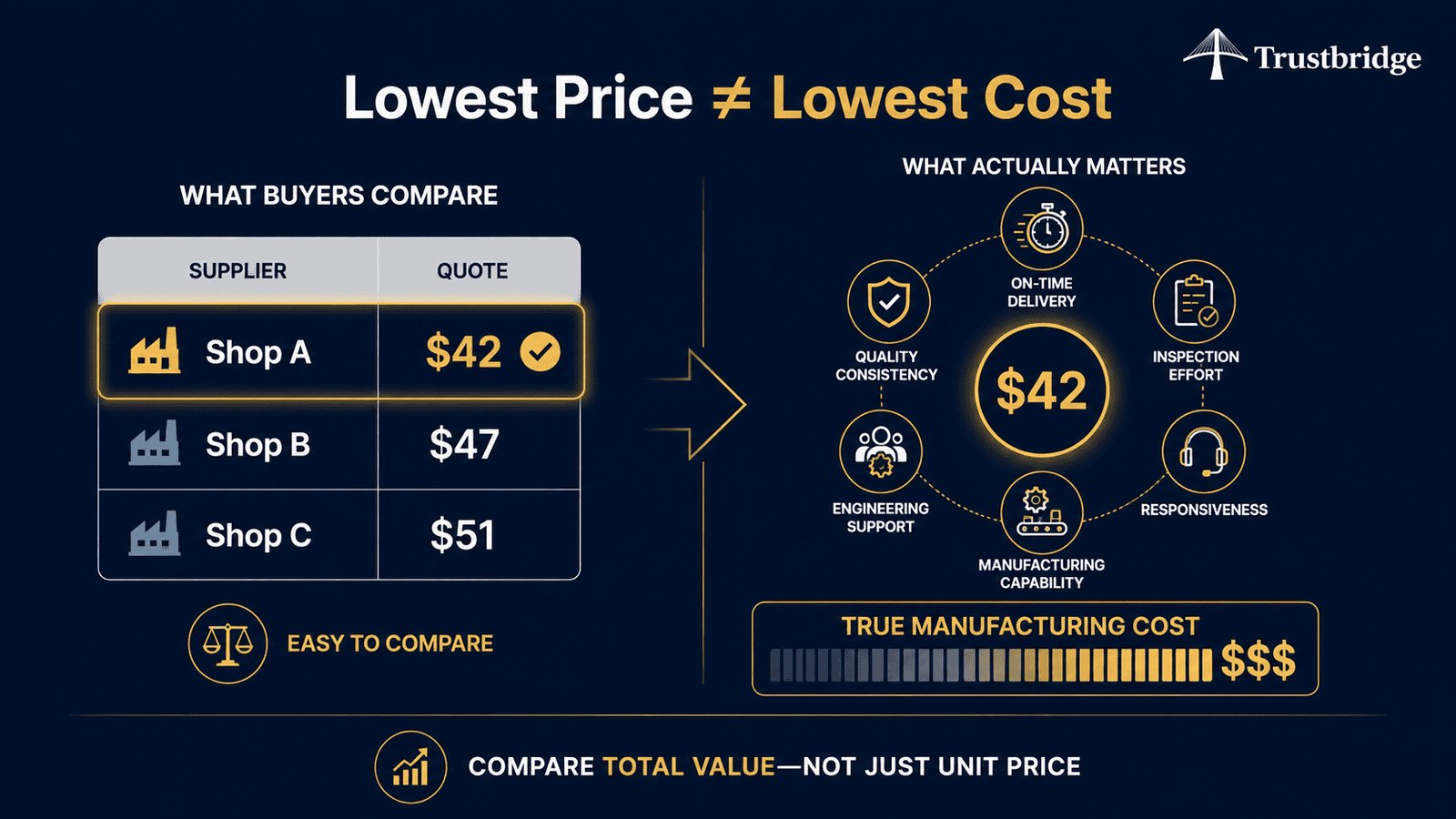
A quotation comparison optimizes for price, not fit or reliability
Picture a straightforward bracket quoted by three shops: $42, $47, and $51 a piece. On paper, the choice looks obvious and if anyone on the team asks why they didn't go with the $47 or $51 supplier, "we compared three quotes and picked the lowest" is a complete and satisfying answer. That's precisely the appeal of the three-quote reflex: it produces a decision that's easy to defend, because unit price is the one variable that fits cleanly into a side-by-side table.
That comparison also assumes the three numbers describe the same job, which is far from guaranteed. Procurement writers sometimes describe this as comparing apples to invisible assumptions: one shop's number might include secondary finishing, packaging, and a full inspection report, while another quietly assumes the buyer will handle finishing separately, or simply excludes an operation the print technically calls for. Sourcing guides written specifically for custom fabrication make the same point in more concrete terms three suppliers can quote the identical drawing and land on three different prices mostly because they priced three different sets of assumptions about deburring, cosmetic finish, and inspection scope, not because one shop is meaningfully more efficient than the others. Treated at face value, a $42 quote and a $47 quote aren't necessarily a $5 gap in efficiency; they can just as easily be a $5 gap in what's quietly included. The three-quote reflex treats the number at the top of each quote as directly comparable. It's rarely guaranteed to be.
Nearly everything that actually determines the total cost of the part doesn't fit into that table. On-time delivery history, tolerance capability, quality consistency, responsiveness when a print needs a revision, financial stability none of it shows up on a quotation comparison, because none of it reduces to a single number three vendors will hand over voluntarily. The costs it hides are real: engineering hours spent resolving tolerance disputes after the fact, production delays from a shop that quoted confidently but delivered late, and the inspection or corrective-action time a quality team spends managing a supplier who looked fine on paper. In one total-cost-of-ownership case study published by procurement consultancy Center Group, the cheapest quoted supplier turned out to be 23 to 31% more expensive once delivery reliability and follow-up costs were rolled into the full calculation.
There's also a subtler problem with picking the lowest of three numbers: it can select for the wrong reason. A shop that comes in noticeably below the other two isn't always the most efficient one sometimes it's the one that most underestimated the job, missed a tolerance callout, or is quoting low because its shop floor happens to be empty that month. Economists describe a closely related pattern in competitive bidding as the "winner's curse," where the winning bid is disproportionately likely to come from whoever most misjudged the value of what they were bidding on. A three-quote RFQ is a small, informal version of the same auction dynamic, and it's just as capable of rewarding a misestimate as it is of rewarding genuine efficiency.
What the reflex quietly costs you
None of this shows up as a line item, which is exactly why it's easy to miss. But the three-quote habit carries two costs that compound quietly, deal after deal, long before anyone connects them back to the sourcing process itself.
The goodwill you're spending without noticing
Preparing a quote isn't free. An estimator has to read the print, check tolerances and GD&T callouts, and price the job before a customer ever sees a number — real time, on every RFQ, whether or not that shop ends up winning the work. Shops that run any kind of formal quoting process track this closely: win rate overall, and increasingly, win rate broken out by customer. CNC Cookbook's survey of machine-shop quoting practices cites an industry benchmark of around 70% for top-performing shops' quote-to-order rate, against roughly 51% for an average shop — meaning the average shop is already losing close to half the jobs it prices, before a habitual three-way split makes things worse.
A buyer who reliably sends the same job to the same three shops, and reliably awards it to whichever one is cheapest, is — from two of those three shops' perspective — a customer whose win rate never improves no matter how sharp the pricing. Shops notice. Some quietly deprioritize that account's RFQs in favor of customers more likely to convert, a pattern common enough that research cited by quoting-automation platform Threekit puts the share of inbound quote requests that get a delayed or non-existent response somewhere around 30 to 40%. Others respond by padding the quote to compensate for a low probability of actually winning the job, which defeats the purpose of asking for a competitive price in the first place. Either way, the relationship erodes long before anyone says so out loud.
The shops you never think to ask
The second cost is what never enters the comparison at all. Procurement research consistently finds that buyers default to familiar, already-known suppliers largely because a full discovery process feels disproportionate to any single job — and that this default persists even when better alternatives genuinely exist. The three shops on a buyer's shortlist are usually the three shops that were already on the shortlist last time, not necessarily the three best fits for this specific part, material, or tolerance.
The buyer-side market-structure whitespace
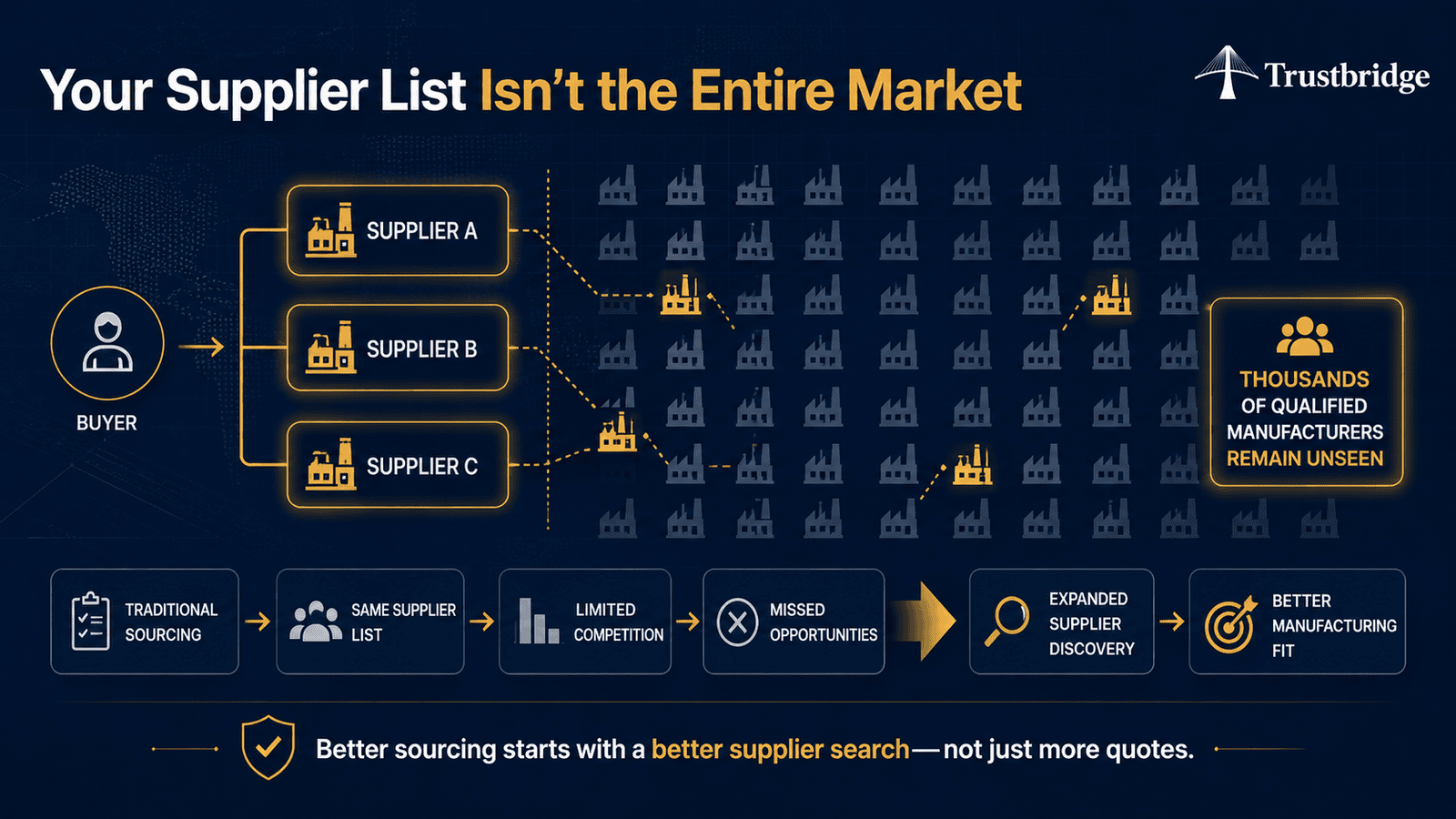
This is worth stating plainly: a fragmented market doesn't help a buyer who never sees most of it. In the U.S. alone, IBISWorld puts the machine shop industry at well over 16,000 businesses, with no single company dominating it the fifty largest firms combined still represent only about a tenth of total industry revenue. On paper, that should mean abundant choice for anyone sourcing a machined, cast, or molded part.
In practice, most buyers' real market is whatever three to five shops are already in their inbox or their head. Everyone else including shops that might be a materially better fit on tolerance, material experience, or lead time sits in what's effectively whitespace: capable, biddable, and invisible to the RFQ. Research on supplier discovery is blunt about the downstream effect: limiting the pool of vendors considered in a sourcing event reduces the number of participants, which in turn tends to produce higher prices and weaker negotiating leverage for the buyer precisely the opposite of what a competitive quotation comparison is supposed to deliver.
This whitespace has nothing to do with whether a part is hard to make and everything to do with which manufacturing partnerships a buyer happens to already know about. A trusted manufacturing partner with visibility across a much wider vendor base can often surface two or three genuinely better-fit shops in less time than it takes to chase down a fourth quote manually but only if "who else could realistically bid on this" gets treated as a live question, not a formality to skip past on the way to a decision that's effectively already been made.
What a better comparison actually looks like
None of this is an argument against comparing quotes competition is still the fastest, fairest way to find a reasonable price. It's an argument for comparing the right things, and for treating supplier discovery as an ongoing part of sourcing rather than a step that ended the day someone first built a vendor list. A few adjustments worth making before the next RFQ goes out:
Score quotes on more than price. Even a simple weighting for on-time delivery history, quality track record, and responsiveness turns a quotation comparison from a single column into an actual decision.
Ask why a quote is unusually low, not just whether it's low. A price that stands out from the other two is a signal worth a follow-up question, not a bid to simply accept.
Periodically test the shortlist itself. If the same three shops have won every job for the last two years, that's not proof they're the best available fit for custom manufacturing work it may just be proof no one has looked lately.
Weigh the relationship cost of a quote you don't intend to award. Chronic non-conversion is exactly what pushes good shops to quietly deprioritize an account, narrowing the field further the next time it matters.
Conclusion
"Send it to three shops and compare" survives because it's fast, defensible, and easy to explain in a meeting. But speed and defensibility aren't the same as rigor. A process built entirely around price visibility will keep finding the cheapest of three quotes and keep missing the better-fit, more reliable, or simply better-priced manufacturing partnerships that were never asked to bid at all. The fix isn't more quotes for their own sake it's a wider, more deliberate view of who gets asked, and a comparison that scores more than the number at the bottom of the page.
Before the next part goes to the usual three shops
Send over the drawing and whoever's already on your shortlist, and we'll tell you plainly whether there's a better-fit, vetted manufacturing partner you're not seeing yet — no pressure to drop anyone already on the list. Just a wider field before you commit to it.
Frequently Asked Questions
1. Is getting three manufacturing quotes enough to choose the right supplier?
No. Comparing three manufacturing quotes helps identify price differences, but it rarely reveals differences in quality, production capability, lead times, inspection standards, or supplier reliability. Evaluating these factors alongside price leads to better sourcing decisions and reduces long-term manufacturing risk.
2. Why can the lowest manufacturing quote end up costing more?
The lowest quote may exclude services such as finishing, inspection, packaging, or secondary operations that other suppliers include. It may also come from underestimated machining time or unrealistic production assumptions. When delays, rework, quality issues, and additional engineering effort are considered, the lowest initial quote can become the most expensive option.
3. What should buyers compare besides price when evaluating manufacturing quotes?
In addition to price, buyers should compare manufacturing capability, quality performance, lead time reliability, communication, inspection processes, technical expertise, and experience with similar parts. Looking beyond the quotation helps identify suppliers that are better suited for long-term manufacturing partnerships.
4. How can buyers improve their manufacturing supplier selection process?
Buyers can improve sourcing decisions by expanding their supplier pool instead of relying on the same shortlist, evaluating suppliers using total cost of ownership rather than unit price alone, and scoring quotes based on quality, delivery performance, technical capability, and responsiveness. This approach reduces sourcing risk and increases the likelihood of finding the best manufacturing partner rather than simply the lowest-priced one.