How Injection Molders Can Identify the Programs That Best Fit Their Capabilities
In injection molding, a poor-fit program is expensive long before the first part is shot. Mold size, press capacity, resin, geometry, tooling, volume and quality requirements all decide whether a program belongs in your shop. Here's how to evaluate them before tooling begins.
Why fit matters so much in molding
In many manufacturing processes, a poorly matched job costs some extra hours and a thinner margin. In injection molding, the stakes are higher. Before a single good part comes off the press, there's a mold to design and build, a press to commit and a process to develop. Those investments are hard to undo. When a program fits, that upfront work pays off over thousands or millions of cycles. When it doesn't, the problems show up in the most expensive places: a mold that won't fit the press, a resin the shop isn't set up to dry, a cycle time that wrecks the quoted price or quality requirements the shop can't document.
That's why good molders evaluate fit carefully before they commit. They look past the part drawing and ask whether the whole program, from tool to press to resin to volume to quality system, matches what their shop is built to do.
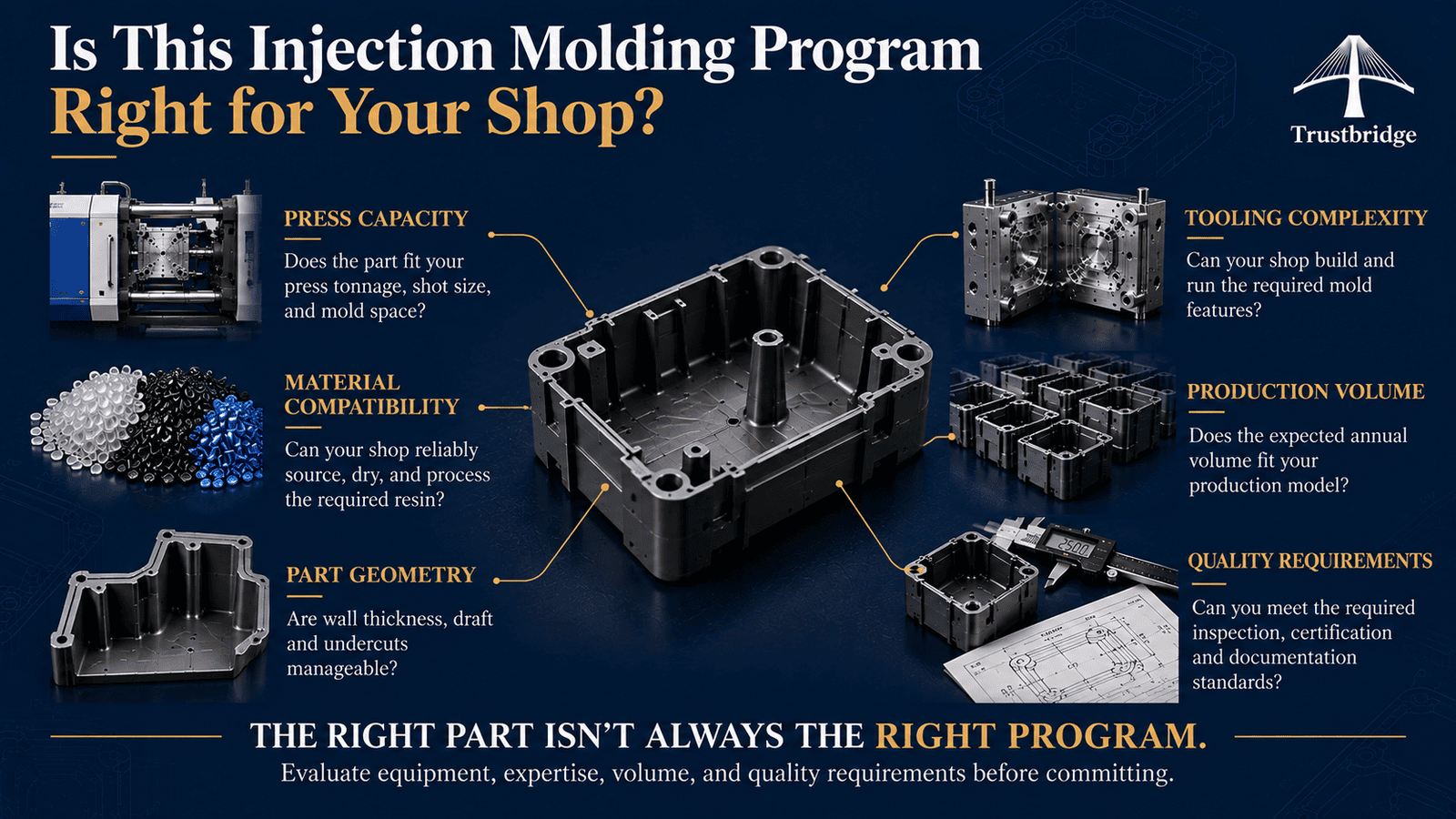
This article walks through the six areas that matter most, from press capacity and mold size to quality requirements, and how evaluating them early helps molders avoid costly tooling changes and production problems.
1. Press capacity and mold size
The first question is physical: will the mold fit a press you have, and can that press run it properly? That depends on more than nameplate tonnage.
Clamp tonnage.
The press must hold the mold closed against injection pressure. Required clamp force is usually estimated from the projected area of the parts and runner, multiplied by a tonnage factor. Plastics Technology notes that typical factors range from 2 to 10 tons per square inch, with 3 tons per square inch a common starting point, adjusted for material flow and gating.
Mold dimensions.
Even with enough tonnage, the mold has to physically fit: between the tie bars, on the platens and within the press’s minimum and maximum mold height and opening stroke. A program that needs a large multi-cavity tool may simply not fit the presses that have the right tonnage.
Shot size.
The press’s injection unit needs enough capacity to fill all cavities and the runner in each shot, without running at the extreme top or bottom of its range, where process consistency suffers.
Bigger isn’t automatically better.
Running a small mold in a press that’s far too large wastes press time and can cause problems. The same column describes a mold needing about 100 tons that an inexperienced molder ran at a 400-ton maximum, which can damage the mold and the machine. Good fit means the right-sized press, not just a big enough one.
2. Material requirements
The resin a program calls for can decide fit on its own. Every material brings its own processing needs, and not every shop is equipped or experienced to handle them all.
Drying.
Many engineering resins absorb moisture and must be dried carefully before molding to avoid defects such as splay, bubbles and brittleness. Some need specific drying equipment, temperatures and times, so a shop has to have enough dryer capacity to keep up with the press.
Temperature control.
Some materials process at high melt or mold temperatures that require hot-oil or high-temperature controllers. A shop without that equipment may not be able to run them consistently.
Fillers and wear.
Glass-filled and mineral-filled materials wear screws, barrels and molds faster, which affects maintenance schedules, tool steel choices and long-term cost.
Process experience.
Experience matters as much as equipment. A shop that molds commodity polypropylene every day may not have the process knowledge to run a high-performance resin consistently, and a shop that specializes in demanding engineering materials may not be cost-competitive on simple commodity parts.
Supply.
Specialty or customer-specified resins may come with long lead times, minimum order quantities or approved-source requirements. A program fits best when the shop can buy, store, dry and process its material reliably, without special exceptions.
3. Part geometry
The shape of the part tells a molder a great deal about how hard the program will be to run, before anyone builds a tool.
Wall thickness.
Parts with consistent wall thickness fill, pack and cool evenly. Thick sections, or sudden changes from thick to thin, tend to cause sink marks, voids, warp and long cycle times. Parts designed with uniform walls are far easier to mold well.
Draft and ejection.
Without enough draft angle on vertical walls, parts stick in the mold and get damaged during ejection. Textured surfaces typically need more draft than smooth ones. A part with little or no draft is a warning sign worth raising early.
Undercuts and complex features.
Snap fits, side holes, threads and other undercuts often require slides, lifters or unscrewing mechanisms in the tool, which add cost, maintenance and risk. Some can be redesigned away. Others are essential, and the molder needs to be comfortable building and running that kind of tool.
Size, cosmetics and tolerances.
Very large, very small, highly cosmetic or very tight-tolerance parts each demand particular skills. A molder who regularly produces cosmetic consumer parts may approach a program differently from one focused on structural industrial components. The best fit is a part whose geometry sits in the middle of what the shop molds well every day.
4. Tooling complexity
The mold is usually the biggest single investment in a molding program, and its complexity shapes everything that follows: cost, lead time, maintenance and how reliably the program runs.
Cavitation.
A single-cavity tool is simpler to build and validate. Multi-cavity and family molds raise output per cycle, but they also need balanced filling and more precise tooling, and they put more demands on the press and the process.
Mechanisms.
Slides, lifters, collapsible cores and unscrewing systems all add moving parts that must be designed, built, timed and maintained. A molder with experience running complex action tools is a better fit for these programs than one used to simple open-and-shut molds.
Runner systems.
Hot runner systems reduce waste and can shorten cycles, but they add cost and require specialized maintenance and temperature control. Cold runners are simpler but create scrap that has to be reground or discarded.
Who builds and owns the tool.
Some molders build tools in-house, others work with trusted toolmakers and some programs arrive with an existing customer-owned mold. A transferred mold can be a good fit, but it should be inspected first: an older or poorly maintained tool can bring problems the new molder inherits.
5. Production volume
Volume determines whether a program fits a molder's presses, people and business model. The same part can be a perfect fit at one volume and a poor one at another.
Annual volume and press hours.
Estimate how many press hours the program will need each year at the expected cycle time. A program that would fill a press for a few days a year behaves very differently from one that ties up a press around the clock. Both can be good business, but they suit different shops.
Run size and changeovers.
Frequent short runs mean more mold changes, setups and purging, which favors shops set up for quick changeovers. Long, stable runs favor shops built for high-volume, highly automated production.
Tool life.
Expected lifetime volume also drives the choice of mold material. Lower-volume or bridge programs are often suited to less expensive tooling, while long production programs usually justify hardened steel tools designed to run for many years. A mismatch between tool and volume can mean replacing a mold far sooner than planned.
Demand stability.
A volume forecast is only an estimate. Programs with uncertain or highly seasonal demand carry more risk, especially if the molder must dedicate a press or invest in automation. Understanding how firm the forecast is helps a molder decide how much to commit.
6. Quality requirements
Two programs can have identical parts and very different quality demands. Those demands often decide fit more than the part itself.
Certifications.
Medical device programs commonly require an ISO 13485 quality system, automotive programs often expect IATF 16949 and aerospace work typically calls for AS9100. If a program requires a certification the shop doesn't hold, it isn't a fit, however capable the presses are.
Validation and documentation.
Regulated programs often require formal process validation, detailed first article inspection, material traceability and ongoing statistical process control. Automotive customers may expect a full production part approval package. These steps take time, people and systems, and they need to be built into the quote.
Environment.
Some medical and electronics programs require cleanroom molding or controlled environments. Cosmetic programs may need careful handling, packaging and inspection to avoid scratches and contamination.
Inspection capability.
Tight tolerances and critical dimensions require the right measurement equipment and trained inspectors. A molder should be confident it can measure what the drawing specifies, at the frequency the customer expects, before it commits.
Example in numbers: Why the same molding program can be a good fit for one shop and a poor fit for another
A customer needs 150,000 polycarbonate electronic enclosures annually. Each part weighs 70 g, has a nominal wall thickness of 2.5 mm, includes a side hole requiring a slide in the mold, and must meet specified cosmetic and dimensional requirements.
The proposed tooling is a two-cavity mold with a 20 g cold runner and a projected area of 18 in² per part.
Two injection molding shops receive the same RFQ.
1. Press capacity and mold size
The total projected area is (2 × 18) + 4 = 40 in², including the runner. Assuming a preliminary clamp factor of 4 tons/in², the mold requires approximately 160 tons, or 184 tons with a 15% allowance.
Shop A has a 250-ton press, while Shop B has a 220-ton press. Both have sufficient mold space and an injection unit capable of handling the 160 g total shot. Both shops pass the initial equipment check, subject to detailed process verification.
2. Material requirements
Polycarbonate requires controlled drying. At an estimated 40-second cycle, the program consumes 160 × (3,600 ÷ 40) = 14.4 kg of resin per hour. Assuming four hours of drying, approximately 58 kg must be held under suitable drying conditions.
Shop A has an appropriately sized 80 kg drying system and regularly processes polycarbonate. Shop B primarily molds polypropylene and has a 35 kg drying hopper. Shop B would need to verify or upgrade its drying capability before accepting the program.
3. Part geometry
The enclosure has 2.5 mm walls but includes a 5 mm thick boss and a side hole. The thick boss presents a potential sink-mark and cooling concern, while the side hole requires additional tooling complexity.
Shop A regularly produces similar electronic housings and suggests coring the boss to reduce excess material. Shop B has limited experience with comparable part geometries.
4. Tooling complexity
The two-cavity mold requires two side-action features, one for each cavity, along with appropriate cooling and ejection systems.
Shop A already runs several molds with side actions and has established maintenance procedures. Shop B predominantly operates simple straight-pull molds and would need additional tooling support.
5. Production volume
Based on similar previous programs, Shop A estimates a 40-second cycle time and a 2% rejection rate. Shop B estimates a 55-second cycle time and a 5% rejection rate.
To deliver 150,000 acceptable parts annually:
- Shop A: 150,000 ÷ (2 × 0.98) × 40 ÷ 3,600 ≈ 850 press hours
- Shop B: 150,000 ÷ (2 × 0.95) × 55 ÷ 3,600 ≈ 1,206 press hours
Shop B would require approximately 356 additional press hours annually. At an illustrative machine-hour cost of $85, that represents approximately $30,300 in additional annual machine time, assuming comparable cost rates.
6. Quality requirements
The customer requires ISO 9001 certification, consistent cosmetic quality and demonstrated Cpk ≥ 1.33 for specified critical dimensions during process qualification.
Both shops are ISO 9001 certified. However, Shop A has experience with cosmetic polycarbonate parts and established statistical process control procedures. Shop B would need to develop and demonstrate an appropriate inspection and process-control plan.
The decision
Both shops have injection molding machines capable of accommodating the proposed tool. But Shop A has a stronger overall fit because the material, geometry, tooling, expected production volume and quality requirements closely resemble programs it already runs successfully.
Shop B could potentially take the work after addressing its capability gaps, but those additional investments and uncertainties must be reflected in its quote.
This is why evaluating an injection molding RFQ should go beyond checking machine tonnage. The strongest fit is often the shop that has already demonstrated it can manufacture similar parts efficiently, consistently and profitably.
A program fit checklist for molders
Bringing the factors together, here's a quick checklist a molder can run through when a new program arrives, before tooling design or a detailed quote begins.
Factor | Questions to ask | Red flag |
Press capacity | Do we have a press with the right tonnage, shot size and mold space? | Only fits our largest or smallest press, or none |
Material | Can we dry, process and source this resin reliably? | Unfamiliar resin or special equipment we don't have |
Geometry | Are walls uniform, draft adequate and undercuts manageable? | Thick sections, no draft, many undercuts |
Tooling | Is the mold complexity within what we build and run well? | Complex actions or hot runners we rarely run |
Volume | Does the annual volume and run size suit our presses and model? | Far above or below our normal range |
Quality | Do we hold the required certifications and inspection capability? | Missing certification, cleanroom or validation capability |
A program doesn't need a perfect score to be worth pursuing. But two or three red flags are a strong signal to slow down, ask more questions or suggest design changes before committing to a tool.
Why evaluating early prevents costly tooling changes
In molding, the cost of changing course rises sharply over time. Moving a gate, adding draft or reducing a thick section is quick and inexpensive while the part is still a 3D model. The same change after the steel is cut can mean welding, re-machining or even rebuilding the mold, along with weeks of delay. Early evaluation catches these issues while they're still cheap. A molder who reviews the part design, resin choice, volume forecast and quality requirements before tooling begins can flag a missing draft angle, suggest a material that processes more consistently or recommend a tool design better suited to the real volume.
It also prevents the most expensive mistake of all: committing to a program the shop isn't equipped to run well. Discovering after the first trial shots that the mold needs a larger press, or that the resin needs drying equipment the shop doesn't have, hurts both the molder and the customer.
This is where design and manufacturing need to meet. When design requirements are matched against real manufacturing capabilities early, both sides avoid surprises. The customer gets a part that molds well, and the molder gets a program it can run profitably for years.
Fit is decided before the first shot
The best molding programs are rarely accidents. They come from a match between what the customer needs and what the molder does well: the right press, the right resin experience, a tool the shop can build and run, a volume that suits its operation and quality requirements it's equipped to meet.
Molders who evaluate those factors before tooling begins avoid most of the costly surprises that sink programs later. They quote with more confidence, start production faster and build longer, steadier relationships with customers whose parts genuinely fit. At Trustbridge, we believe that kind of early alignment between design requirements and real manufacturing capabilities is what makes manufacturing work better for everyone involved.
Trustbridge is building a network of great manufacturers, including injection molders who know exactly what they do best. If you run a molding operation and this sounds familiar, and we'll be in touch.
Frequently asked questions
What is a family mold?
A family mold produces two or more different parts in the same shot, often parts that belong to one assembly. It can save tooling cost, but because the cavities differ in size and shape, balancing the fill and maintaining consistent quality across all parts can be more difficult than with a mold that makes identical parts.
What's the difference between aluminum and steel injection molds?
Aluminum molds are generally faster and cheaper to machine, which makes them popular for prototypes, bridge tooling and lower-volume programs. Hardened steel molds cost more and take longer to build, but they last much longer and suit high-volume, long-running production and abrasive materials.
What is scientific molding?
Scientific molding is a data-driven approach to developing and controlling the molding process. Instead of adjusting settings by trial and error, the molder uses measured process data, such as pressures, temperatures and fill times, to establish a robust process window and keep production consistent.
What should a molder ask for in an RFQ package?
At minimum: a 3D model and drawing, resin specification, annual and per-order volumes, cosmetic and tolerance requirements, quality and certification needs, and whether the customer will own the tool. A complete package lets a molder judge fit quickly and quote accurately.
How long does it take to build an injection mold?
It varies widely with size, complexity, cavitation and mold material. Simple prototype tools can be built quickly, while large, multi-cavity production molds with complex actions take considerably longer. Molders should confirm tool build lead time with their toolmaker before committing to a launch date.