
Design Decisions That Quietly Narrow Your Supplier Options
Most sourcing challenges begin long before procurement sends out an RFQ. Decisions made during product design such as specifying tighter tolerances, uncommon materials, mandatory certifications, or specific manufacturing processes—can significantly reduce the number of suppliers capable of producing a part. Understanding how design choices influence the available supplier market helps engineering teams preserve sourcing flexibility, strengthen manufacturing collaboration, and avoid unintentionally limiting their options before supplier selection even begins.
Introduction
For many product teams, sourcing begins after the CAD model is complete, the bill of materials is finalized, and engineering drawings have been released. At that stage, it feels like the difficult work is behind them. The expectation is that procurement will simply identify qualified manufacturers, collect competitive quotations, and move the project into production.
In reality, the supplier search has already been influenced by dozens of engineering decisions made during design. Every tolerance, material specification, certification requirement, and manufacturing note quietly shapes which manufacturers can realistically bid on the project. Long before procurement evaluates suppliers, he design itself has already determined which machining vendors, contract manufacturers, and OEM manufacturers are even capable of competing for the work. Long before procurement evaluates suppliers, engineering decisions have already shaped future manufacturing partnerships.
This is why selecting a design partner is not only a sourcing decision but also an engineering one. Product development teams that understand how design affects supplier availability maintain greater flexibility throughout the sourcing process, while those that overlook these decisions often discover too late that they have unintentionally narrowed their manufacturing options.
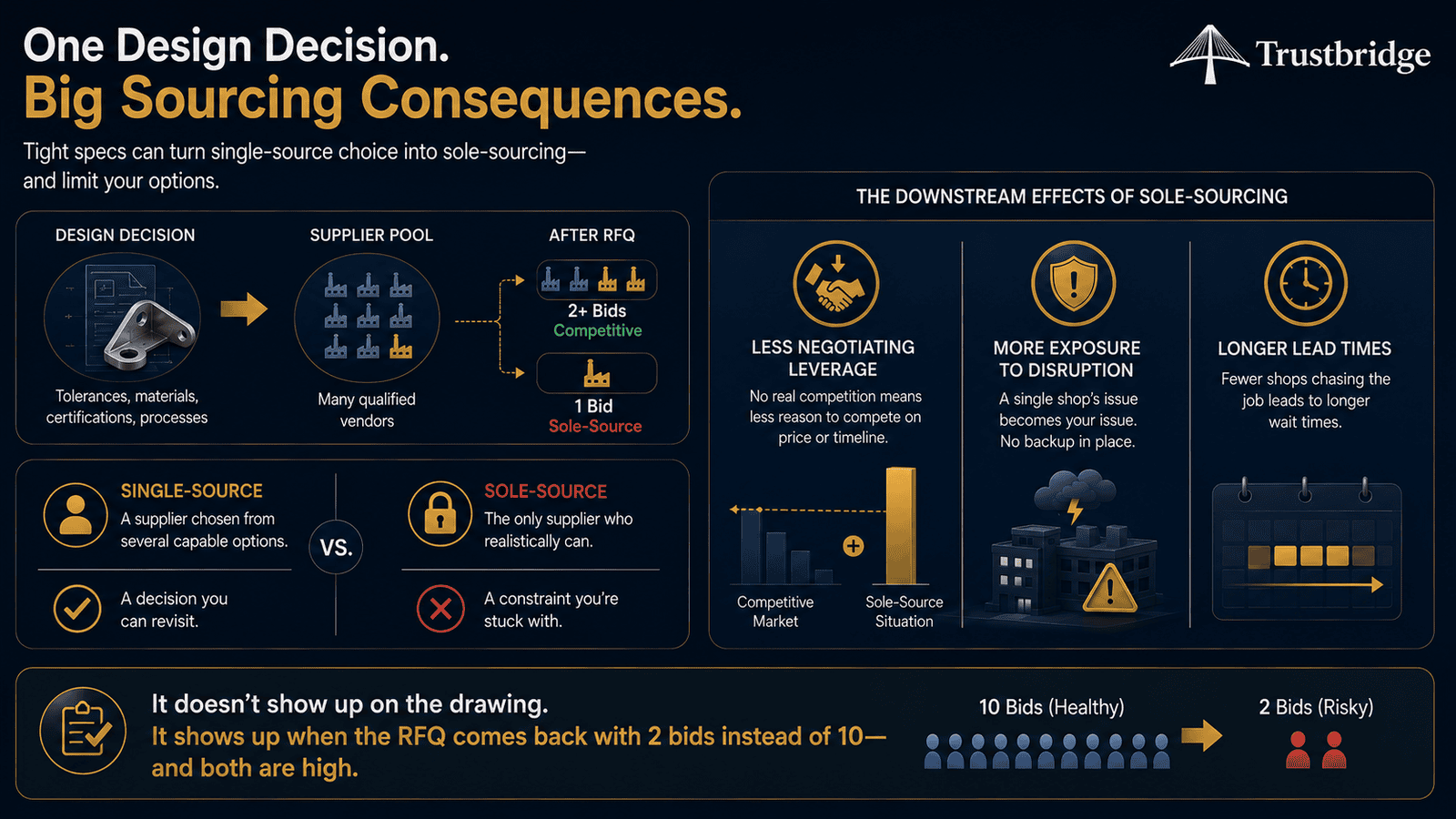
Every Design Decision Shapes Your Supplier Market
Every engineering drawing serves two purposes. It defines how a product should be manufactured, but it also determines which manufacturers are capable of producing it. Designers often view specifications purely from a technical perspective, while procurement teams experience the commercial consequences later during supplier selection.
A seemingly small design decision can significantly change the number of qualified manufacturers available for a project. Tightening one tolerance, selecting a specialized alloy, or specifying a particular manufacturing process may eliminate hundreds of potential suppliers before the RFQ is ever distributed. These choices may all be technically valid, but they also influence competition, pricing, lead times, and sourcing flexibility.
Understanding this relationship helps engineering teams make more informed decisions during product development, especially when preparing products that will eventually move into larger production programs.
A Drawing Is More Than a Technical Specification
Imagine two engineers designing nearly identical aluminum brackets.
The first specifies a common aluminum alloy with standard tolerances that most qualified machine shops can achieve using conventional equipment. The second tightens several dimensions "for safety," specifies a specialty alloy, and carries over a certification requirement from a previous aerospace project.
Both brackets may function exactly the same inside the final product. However, they now exist in two completely different supplier markets.
The first drawing can be manufactured by a broad range of machining vendors and custom manufacturing companies. The second immediately narrows the field to a much smaller group of specialized suppliers, reducing competitive bidding before procurement even begins. The second immediately limits sourcing to manufacturers with specialized material expertise, advanced inspection capabilities, and the required certifications.
Neither engineer intentionally made a sourcing decision, yet both drawings created dramatically different bidding environments.
This illustrates an important reality: every drawing acts as a filter. Before procurement evaluates suppliers, the engineering specification has already decided which companies can participate.
Why Supplier Choice Is Often Decided Before Procurement Starts
Many sourcing limitations originate from perfectly reasonable engineering habits.
Designers frequently reuse specifications from previous projects, inherit tolerance requirements from legacy drawings, or apply conservative design margins simply because tighter specifications feel safer than looser ones. Certification requirements are often copied into new projects without questioning whether they remain necessary.
Individually, these decisions appear harmless. Collectively, they can reduce the available supplier base without improving product performance.
The manufacturing industry offers thousands of capable suppliers, but very few possess the exact combination of machining capability, certifications, material expertise, and inspection systems required by an overly restrictive drawing. As a result, engineering teams may unintentionally create supplier lock-in before procurement has had any opportunity to evaluate alternative manufacturing options.
Design Specifications Can Dramatically Reduce Manufacturing Options
Not every design decision has the same impact on supplier selection. Some specifications influence manufacturing cost, while others determine whether certain manufacturers can participate at all.
Three decisions consistently have the greatest effect on supplier availability: tolerances, material specifications, and manufacturing process requirements. Together, they define the practical size of the supplier network available for any given project.
Recognizing these constraints early allows engineering teams to balance product performance with sourcing flexibility rather than discovering limitations after supplier outreach has already begun.
How Tight Tolerances Shrink the Bidder Pool
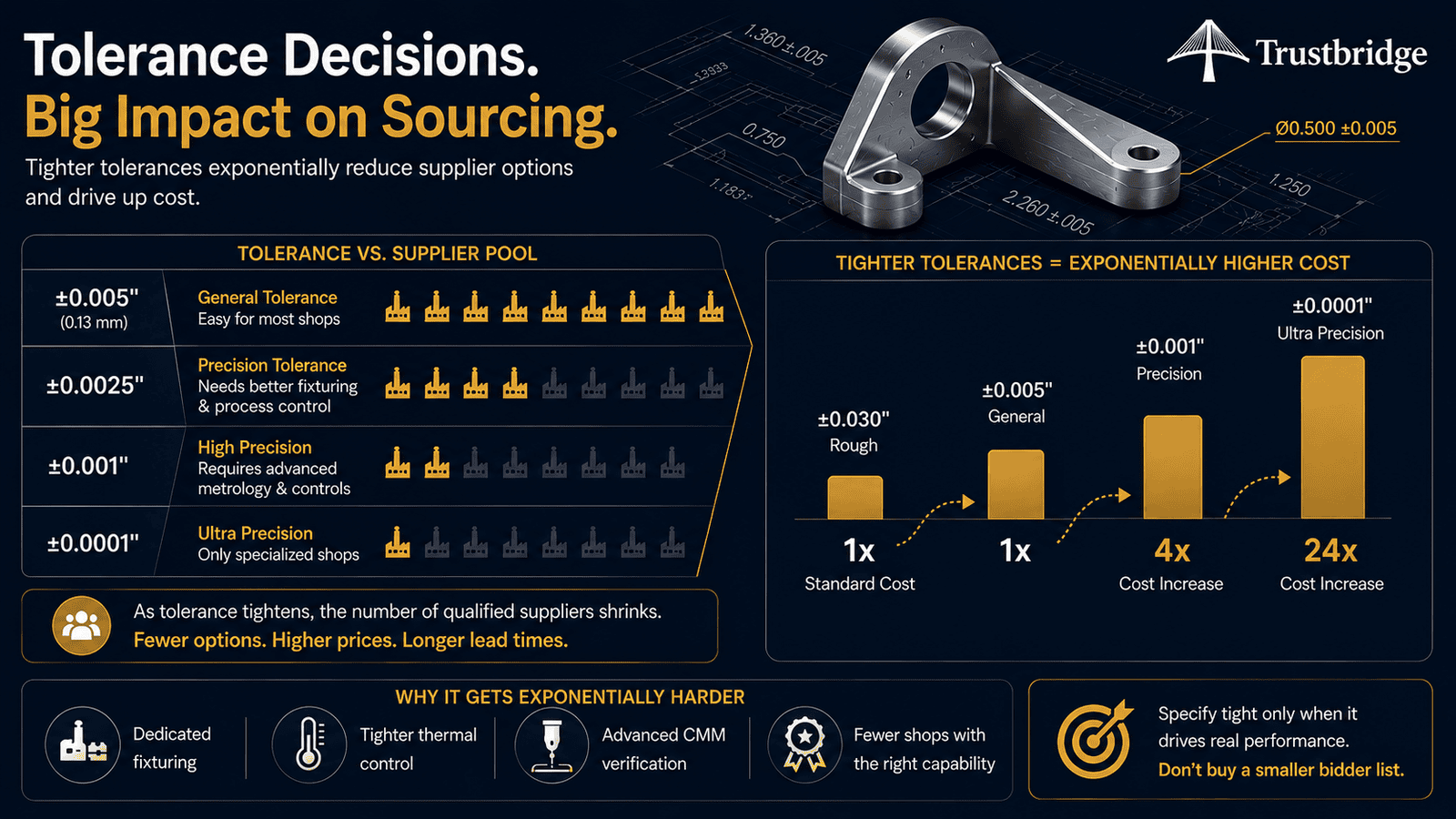
Tolerance selection is one of the clearest examples of how engineering decisions affect sourcing.
Many machine shops routinely produce components with standard tolerances using existing equipment and quality systems. As tolerances become increasingly demanding, however, manufacturers require more sophisticated inspection equipment, better environmental controls, specialized fixturing, and highly experienced machinists.
These investments significantly reduce the number of manufacturers capable of delivering consistent results.
The commercial impact extends beyond machining cost alone. A smaller pool of qualified suppliers means fewer competitive quotations, less pricing leverage, and longer lead times. In some cases, engineering teams discover that only a handful of suppliers can confidently manufacture the part as specified.
None of this suggests that precision should be avoided. Critical functional features often require extremely tight tolerances. The important question is whether every tolerance contributes directly to product performance or whether some specifications were inherited without being challenged during design review.
Material and Certification Requirements Can Create Supplier Gatekeepers
Material selection influences supplier availability just as quickly as tolerance selection.
Specifying common engineering materials typically allows many manufacturers to compete. Selecting specialty alloys, exotic metals, or industry-specific certifications immediately reduces the number of qualified suppliers capable of supporting the project.
The same applies to certification requirements. Standards may be essential for regulated industries such as aerospace or medical devices, but unnecessary certification requirements can exclude capable manufacturers that would otherwise produce high-quality components.
Engineering teams should therefore evaluate whether every specification directly supports functional, regulatory, or customer requirements rather than relying on inherited documentation from previous programs.
Doing so preserves flexibility within the broader supplier network while ensuring the product still meets its intended performance objectives.
Process Requirements Can Unintentionally Lock Out Alternative Manufacturing Routes
Material and tolerance choices are only part of the sourcing equation. Another common design habit that narrows supplier options is specifying a manufacturing process before determining whether it is actually necessary. While some parts genuinely require a specific production method, many drawings prescribe how a part should be made rather than defining the performance it needs to achieve.
This can prevent experienced manufacturers from proposing alternative processes that offer similar performance with lower cost, shorter lead times, or greater production scalability. Maintaining flexibility during design encourages better manufacturing collaboration and allows suppliers to contribute valuable engineering insight before production begins.
Avoid Specifying the Process When the Performance Is What Really Matters
A drawing note that specifies "5-axis CNC machining only" or another fixed manufacturing method immediately removes every supplier that could potentially achieve the same functional outcome using a different process.
For example, a machined aluminum enclosure may eventually prove better suited for die casting, urethane casting, or another manufacturing method once production volumes increase. Likewise, a component designed for machining may be simplified through casting without affecting its structural or functional performance.
This does not mean designers should avoid specifying manufacturing methods when they are critical. Instead, engineering teams should ask whether the process itself is essential or whether the requirement is actually related to strength, accuracy, surface finish, or another measurable performance characteristic.
Keeping specifications focused on functional outcomes rather than predetermined processes gives manufacturers more opportunities to recommend efficient production solutions during product development.
The Hidden Cost of Narrow Supplier Options Goes Beyond Price
When only a small number of manufacturers are capable of producing a part, the consequences extend well beyond higher quotations. A limited supplier pool affects schedule flexibility, production resilience, engineering collaboration, and long-term sourcing strategy.
Procurement teams often experience these challenges first, but their root cause frequently originates during design. Recognizing these downstream effects helps engineering teams understand why supplier flexibility is a strategic advantage rather than simply a purchasing concern.
Fewer Qualified Suppliers Mean Less Competition
Healthy competition gives buyers more than lower prices. It provides multiple engineering perspectives, greater scheduling flexibility, backup manufacturing options, and stronger negotiating leverage throughout the sourcing process.
When specifications become unnecessarily restrictive, fewer manufacturers are willing or able to submit quotations. Reduced competition often results in longer lead times because the remaining suppliers already have full production schedules or specialized workloads.
A broader supplier base creates more opportunities to compare technical recommendations, evaluate production approaches, and select the manufacturer best suited for the project rather than simply choosing from a very limited list.
Sole-Source Risk Often Begins During Design
One of the biggest sourcing risks is unintentionally creating a sole-source situation.
This occurs when only one manufacturer realistically possesses the combination of equipment, certifications, material expertise, and production capability required by the design. If that supplier experiences capacity constraints, quality issues, or scheduling delays, engineering teams have few practical alternatives.
Unlike intentional sole sourcing, which is usually a strategic business decision, accidental supplier lock-in often happens without anyone recognizing it until quotations begin arriving.
Design teams that consider supplier flexibility early reduce this risk while making future sourcing decisions significantly easier.
Design With Supplier Flexibility in Mind
Designing for manufacturability is often discussed in terms of machining efficiency or production cost. Equally important is designing for supplier flexibility. The goal is not to compromise engineering intent but to ensure that unnecessary specifications do not reduce the available manufacturing ecosystem.
By reviewing drawings from both engineering and sourcing perspectives before release, teams can identify opportunities to preserve competition while maintaining product performance.
Challenge Every Specification Before Finalizing the Drawing
Before releasing a drawing, engineering teams should evaluate whether each specification directly supports a functional, regulatory, or customer requirement.
Questions worth asking include:
- Does this tolerance improve product performance?
- Is this material necessary for the application?
- Is this certification required for the intended industry?
- Does this manufacturing process have to be specified, or is there room for supplier recommendations?
Simple design reviews focused on these questions often reveal opportunities to simplify sourcing without affecting product quality.
Strong Engineering Partners Add Value Before Production Begins
The best engineering partner is not simply the manufacturer that offers the lowest quotation. Strong manufacturing partners contribute practical production knowledge while designs are still evolving.
They review drawings for sourcing constraints, recommend manufacturable alternatives, identify unnecessary specifications, and suggest process improvements that preserve both engineering intent and supplier flexibility.
These conversations are most valuable during the early stages of product development, when changes are relatively inexpensive and multiple manufacturing paths remain available.
Working collaboratively with experienced manufacturers helps engineering teams make informed decisions before the RFQ process begins rather than reacting to sourcing limitations after designs are already finalized.
Conclusion
Finding the right manufacturing partner is not only a procurement challenge—it is also the result of countless engineering decisions made during product design.
Every tolerance, material specification, certification requirement, and manufacturing process callout influences which suppliers can realistically compete for the work. While these decisions may appear purely technical, they also determine sourcing flexibility, supplier competition, production resilience, and long-term manufacturing options.
The strongest product teams recognize that design and sourcing are closely connected. By evaluating specifications through both engineering and commercial perspectives, they preserve access to a broader manufacturing ecosystem, encourage better supplier collaboration, and reduce the likelihood of unintended supplier lock-in.
Ultimately, good design is not just about creating a product that performs well. It is also about creating one that can be manufactured competitively, reliably, and by the right partners.
The best sourcing outcomes begin long before procurement sends an RFQ. They begin during design, when engineering teams still have the flexibility to balance product performance with manufacturing practicality.
At Trustbridge, we help product teams connect with experienced manufacturing partners who provide practical DFM feedback, identify sourcing constraints early, and recommend manufacturing approaches that support both engineering objectives and long-term production success. Through our global design partner manufacturing network, we help companies strengthen manufacturing collaboration, evaluate supplier capabilities more effectively, and make informed decisions before designs are released for production.
If you're preparing your next product for manufacturing, start by reviewing your design through the eyes of the suppliers who will build it. The earlier these conversations happen, the more sourcing options—and competitive advantages—you'll preserve.
Frequently Asked Questions
1. How do design decisions affect supplier selection in manufacturing?
Every design decision—such as tolerances, material selection, certifications, and manufacturing process requirements—determines which suppliers are capable of producing a part. Restrictive specifications reduce the available supplier pool, limiting competition, increasing costs, and reducing sourcing flexibility before procurement even begins.
2. Why can tight tolerances and specialized materials reduce manufacturing options?
Ultra-tight tolerances often require advanced machining capabilities, specialized inspection equipment, and experienced operators, while uncommon materials and industry-specific certifications eliminate suppliers that lack those capabilities. Unless these specifications are functionally necessary, they can unnecessarily narrow the supplier network and increase production costs.
3. Should engineers specify a manufacturing process or focus on product performance?
Whenever possible, engineers should specify the required functional performance rather than prescribing a specific manufacturing process. This gives qualified manufacturers the flexibility to recommend alternative production methods that can reduce cost, improve lead times, and increase scalability without compromising product quality.
4. How can engineering teams preserve supplier flexibility during product development?
Engineering teams can preserve supplier flexibility by reviewing every specification before releasing a drawing, challenging unnecessary tolerances, materials, certifications, and process requirements, and collaborating early with experienced design and manufacturing partners. This approach supports stronger manufacturing collaboration, expands sourcing options, and reduces the risk of unintended supplier lock-in.