The Battle for American Manufacturing: What Do Buyers Actually Check Before Trusting a New Manufacturing Supplier?
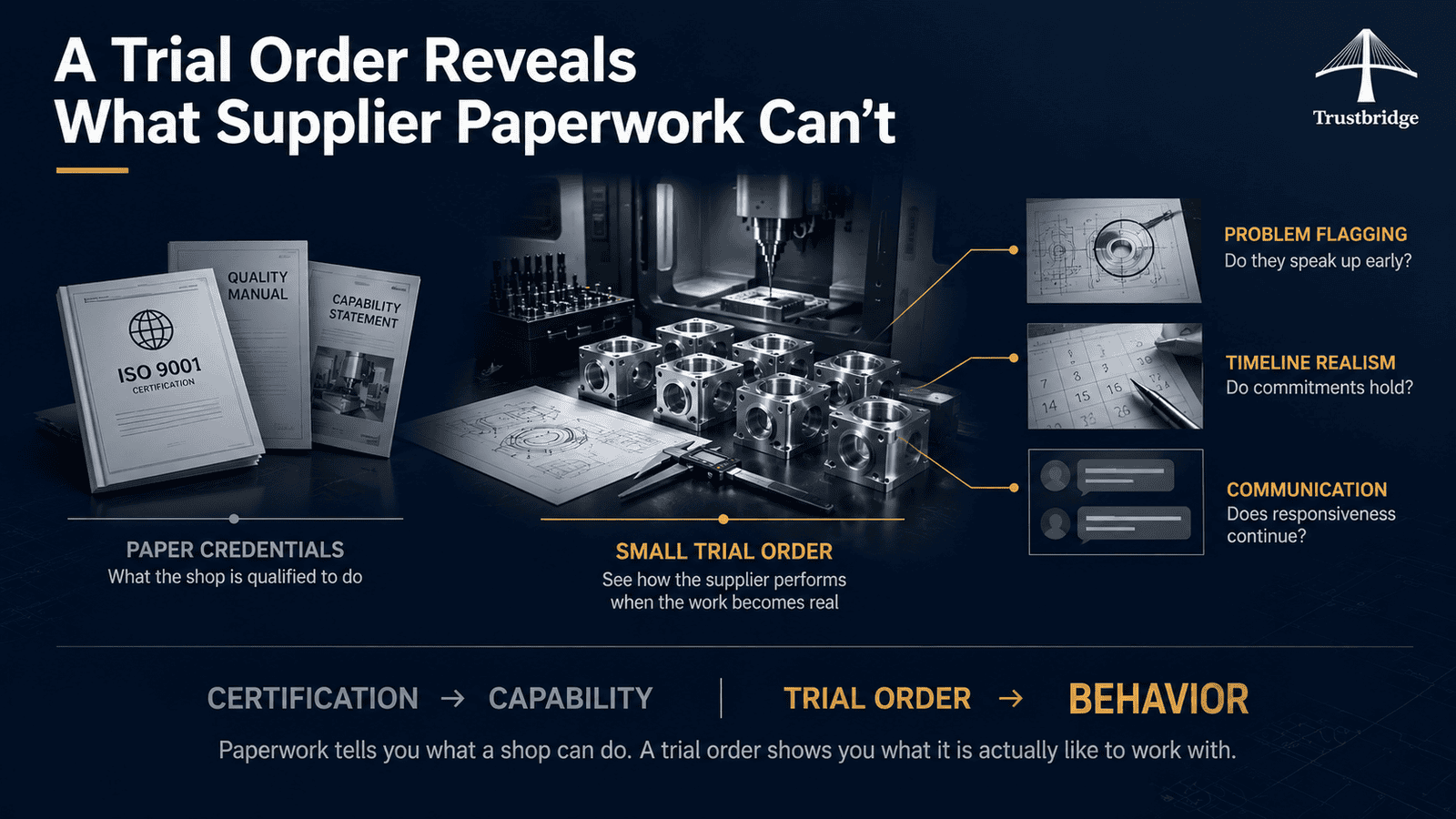
A certification tells you what a shop is allowed to do. It doesn't tell you how that shop behaves the first time nothing is guaranteed yet. That's a different question, and it's the one most buyers actually answer through a small trial order, not a checklist.
Introduction
A new supplier has no track record yet, which means the usual ways of checking a shop's certifications, references, and a quality manual only go so far. Those things confirm a shop is allowed to do the work. They don't confirm how it will actually behave the first time something is genuinely uncertain: a first order, a first deadline, a first problem that needs to get flagged before it becomes a bigger one.
Most experienced buyers answer that question a specific way, and it isn't by asking harder interview questions. It's by placing a small trial order before committing to anything larger, and watching closely how the shop handles it. That single decision to start small, then watch does more real diagnostic work than most of what happens before it.
The Trial Order Is the Real Diagnostic, Not the Paperwork
A trial order works as a test precisely because it's small enough that getting it wrong doesn't sink a business relationship, which means a shop's true instincts show up more honestly than they would on a large, high-pressure first commitment. Does the shop ask sharp questions about the print, or just accept it at face value? Does a realistic timeline come back, or an optimistic one that later slips? These are hard to fake convincingly across an entire trial run, in a way a single sales conversation isn't.
The signal gets sharper once it's read against something this series has already established: small orders are genuinely less profitable for a shop. Setup time doesn't shrink because the order is small it just gets spread across fewer parts, which means a trial order is, by the shop's own economics, one of the least attractive jobs on the floor that week. A shop that still gives it real attention is revealing something about how it operates generally, not just how it handles easy, profitable work. A shop that treats it as filler for a slow week, taken on because there happened to be open capacity rather than genuine interest in the relationship, is revealing something too, usually before either side has said so directly.
A Good Sample Doesn't Guarantee a Good Production Run
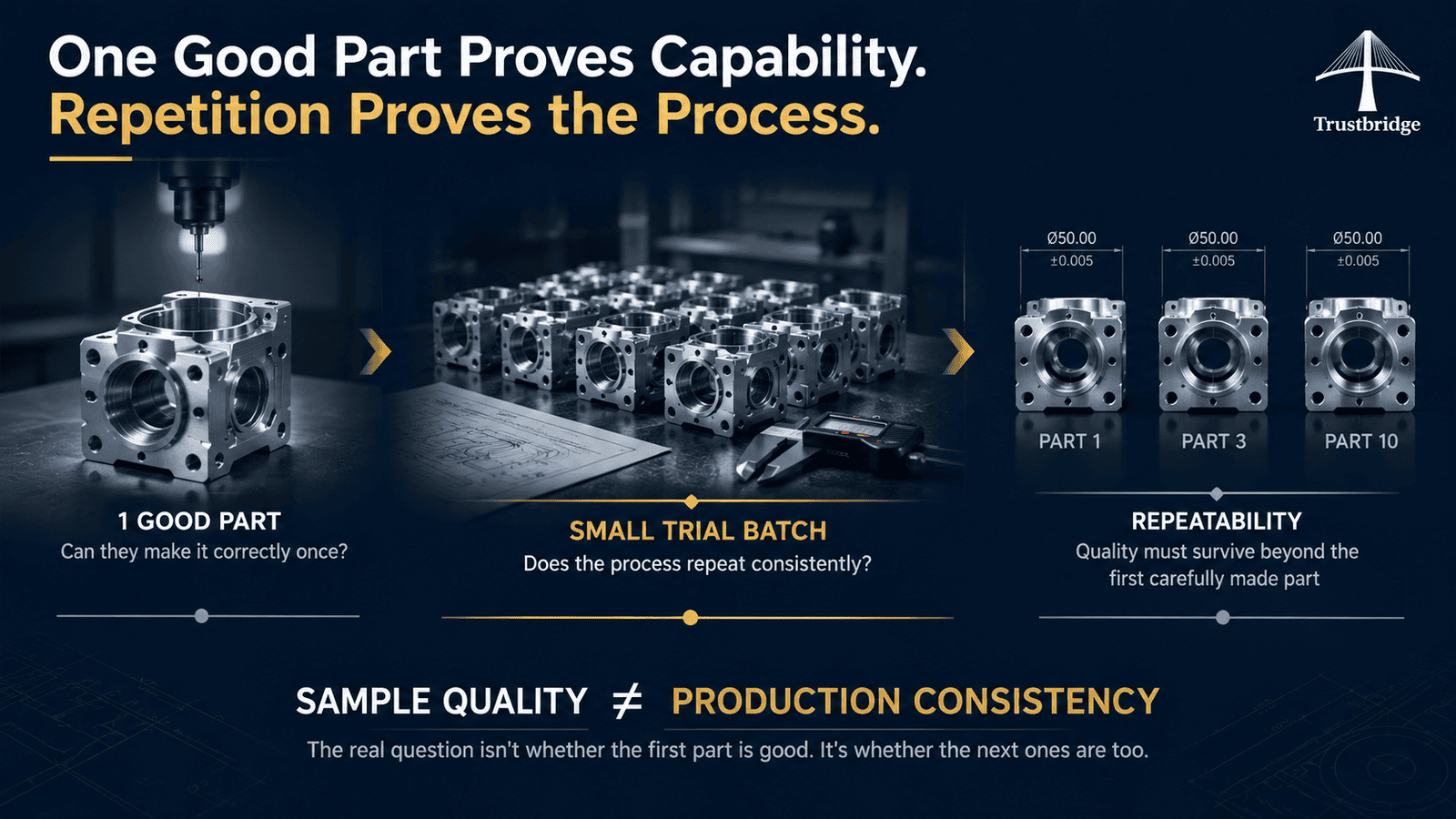
There's a specific trap worth naming inside this process. A single well-made sample confirms a shop can produce one good part under close attention. It doesn't confirm the same quality holds up once the job moves from careful, hands-on production to a full batch running at normal speed. That gap has a name in sourcing circles quality fade, and it's common enough that experienced buyers treat a good sample as a necessary first check, not a finished one.
The fix isn't distrusting a good sample. It's not treating it as the finish line. A trial order sized between a single sample and a full production run does something a sample alone can't. Enough parts to see the process repeat itself a handful of times, not just once, tests whether the second, third, and tenth part hold the same dimensions and finish as the first one did under careful attention.
What to Actually Watch During That First Small Order
The specific things worth paying attention to during a trial order are more concrete than "does it go well." Three signals matter more than the rest:
- Does the shop flag a problem proactively, before it becomes visible in the finished part — or does it wait to be asked?
- Does a quote or timeline shift once the shop realizes real volume might follow, in a way that reads as pricing for the relationship rather than the job in front of them?
- Is communication during the small order about as responsive as it was during the original quote, or does attention visibly drop once the stakes feel lower?
None of these show up on a certificate, and none of them require a formal audit to check. They show up in a handful of ordinary interactions around one modest order, which is exactly why so much real signal fits inside something this small. A shop's paperwork tells a buyer what it's capable of. A trial order tells a buyer what it's actually like to work with, which is the harder and more useful question when there's no history yet to fall back on.
Conclusion
Trusting a new manufacturing supplier was never really about collecting enough documents to feel confident. It's about creating one small, low-stakes situation where a shop's real habits have room to show themselves before anything significant is riding on them. The shops worth building a real manufacturing partnership with are usually the ones that treat that small first order like it matters. Not because it's profitable on its own, but because how they treat it is the most honest preview of everything that comes after it.
What that first order is really testing is whether a shop's behavior earns it a reputation for trusted manufacturing on its own terms, rather than one built on a certificate or a polished sales conversation. That distinction tends to hold up a lot longer than either one does.
Start Small With a Shop That's Actually Vetted
Trustbridge surfaces verified capability and track record before a buyer ever places a first order, which shortens how much a trial run has to prove on its own. It doesn't replace watching how a new shop actually behaves. Nothing does. But it means that first small order goes to a machining vendor, job shop, or contract manufacturer that's already cleared a real bar, not just a convincing sales conversation. Comparing quotes from suppliers is a lot more useful once every name on the list has already passed that check.
Frequently Asked Questions
1. How do you evaluate a new manufacturing supplier with no track record?
When a supplier has no established track record, buyers can evaluate its capabilities, certifications, communication, and production processes, then validate those signals through a small trial order. The trial reveals how the supplier handles real deadlines, questions, quality issues, and communication before a larger production commitment is made.
2. What should buyers look for in a manufacturing supplier's first trial order?
Buyers should pay attention to whether the supplier asks useful questions, meets realistic timelines, flags problems proactively, and maintains consistent communication throughout the order. These behaviors often provide a better indication of what the supplier will be like to work with than certifications or a sales conversation alone.
3. Why isn't a successful sample enough to qualify a new manufacturing supplier?
A single successful sample shows that a supplier can produce one acceptable part, but it does not prove that the same quality will continue across a production run. A larger trial order can reveal whether dimensions, finish, communication, and process consistency hold up across multiple parts and normal production conditions.
4. What certifications should buyers check when evaluating a new manufacturing supplier?
Buyers should review certifications relevant to the supplier's industry, processes, and quality requirements, but certifications should be treated as one part of supplier qualification rather than proof of future performance. A small trial order provides an additional real-world test of quality, responsiveness, reliability, and production consistency.