
A Short History of Who Intermediates Custom Manufacturing Across Fiscal and Venture Paradigms
Manufacturing has always needed someone to sit between the buyer and shop, reducing the cost of finding and trusting a stranger. Who has filled that role, and how they were funded to do it, has changed twice and the story of one real company shows both changes happening in the same company.
Introduction
A custom manufacturing transaction has never been a simple handshake between a buyer and a shop. Someone in the middle has always done the work of connecting the two publishing a directory, taking a commission, running a marketplace, because finding an unfamiliar shop and trusting it with real money is expensive to do alone. That middle role isn't new. What's changed, more than once, is who occupies it and how they're paid to stay there.
This isn't an abstract question. One real company's history traces both major shifts directly: a business that spent over a century funding itself through ordinary commercial revenue, later acquired by a venture-backed platform built on a completely different financial logic. Following that one story is a faster way to understand the shift than any general theory of it.
The Fiscal Paradigm: Businesses That Had to Earn Their Keep
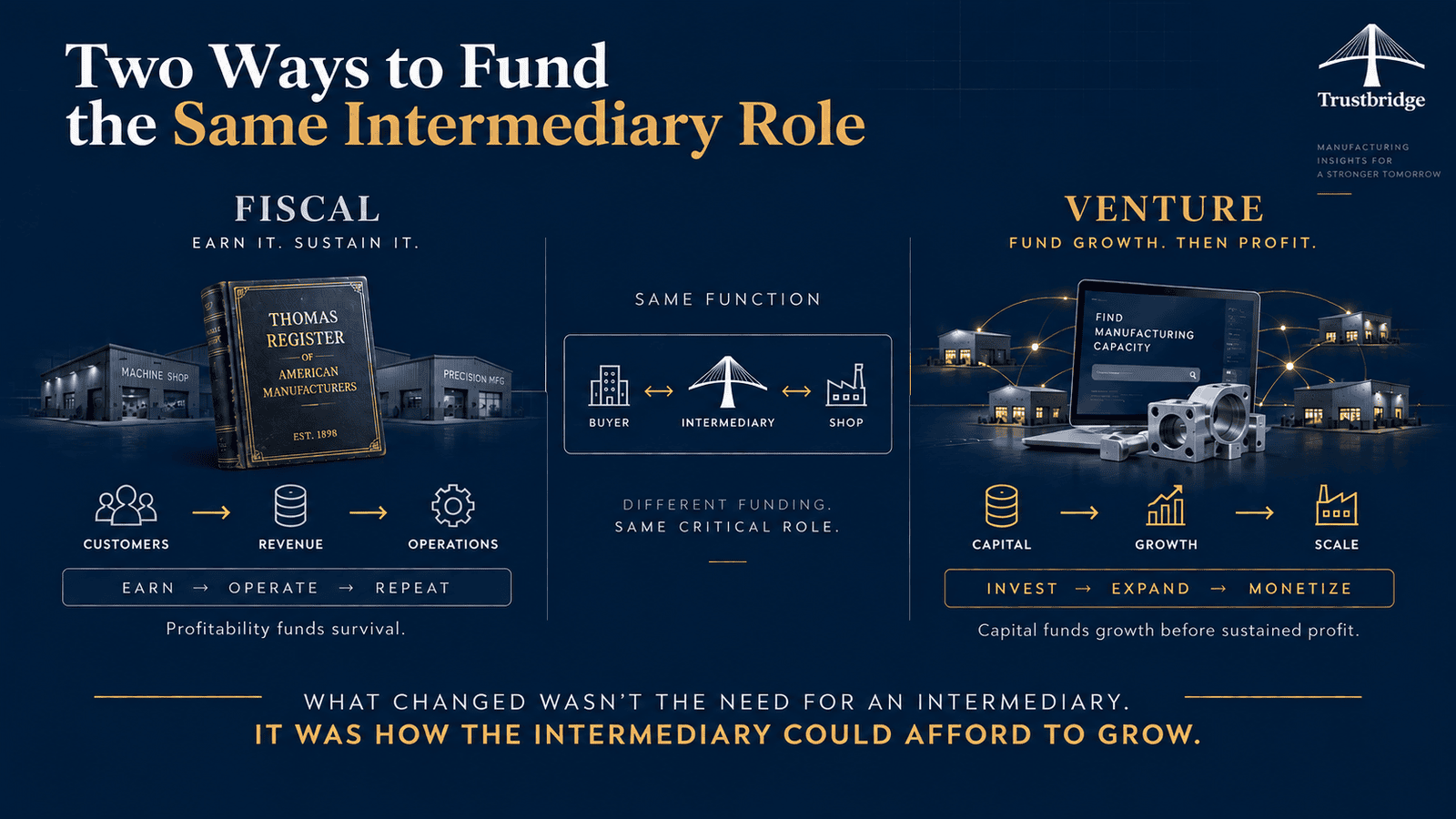
For most of the 20th century, the intermediary between a manufacturing buyer and a shop was funded the ordinary way: commissions on deals closed, subscription and advertising fees, or space sold in a printed directory. Thomas Register of American Manufacturers is the clearest example still standing. First published in 1898, it grew into a multi-volume industrial directory known as "the bible of industry." It funded itself by selling advertising space to the manufacturers listed inside it. That space was sold, notably, through independent sales representatives the same intermediary model the directory itself was built to support.
That funding model came with a built-in discipline. A directory business selling ad space has to generate enough revenue from that ad space to cover its own costs, every year, or it doesn't survive to publish the next edition. Thomas Register did exactly that for over a century, moving from print to a CD-ROM regional edition in the 1970s, then fully online as Thomasnet.com by the mid-2000s, without ever needing outside investment to keep operating. Profitability wasn't a milestone this business was working toward. It was the condition it had to meet continuously just to keep existing.
The Venture Paradigm: Funding Growth Before Funding Profit
Digital manufacturing marketplaces introduced a genuinely different financial logic starting in the 2010s. Xometry, founded in 2013, raised somewhere between $150 million and $200 million in venture capital before going public in 2021. That capital let it operate at a loss for years while it built out its marketplace, its supplier network, and its quoting technology. That's not a footnote. It's the entire point of venture funding: buy years of growth and market share now, and work out sustained profitability later, on a timeline investors are willing to accept.
The evidence that this actually happened, not just in theory, is in the numbers. By 2025, Xometry was generating $687 million in annual revenue and was still posting a net loss for the year. A fiscally-funded intermediary, dependent on its own ordinary revenue to survive, could never sustain that combination for more than a year or two before running out of money. A venture-funded one can sustain it for over a decade, because the capital covering the gap didn't come from the business's own operations in the first place.
When the Two Paradigms Collided
These two stories aren't just parallel examples. They intersect directly. In December 2021, Xometry acquired Thomas Register and its online successor, Thomasnet.com. This was the fiscal-paradigm directory business, still running on its original commercial logic more than a century after it started, absorbed into the venture-paradigm marketplace that had just gone public six months earlier.
That's not a coincidence worth glossing over. It's close to the cleanest real illustration available of the entire shift this piece is describing: the older model didn't get out-argued or proven obsolete in principle. It got acquired by the newer model, once that newer model had the capital and the market position to do it. One paradigm didn't refute the other. It bought it.
What Actually Changed, and What Didn't
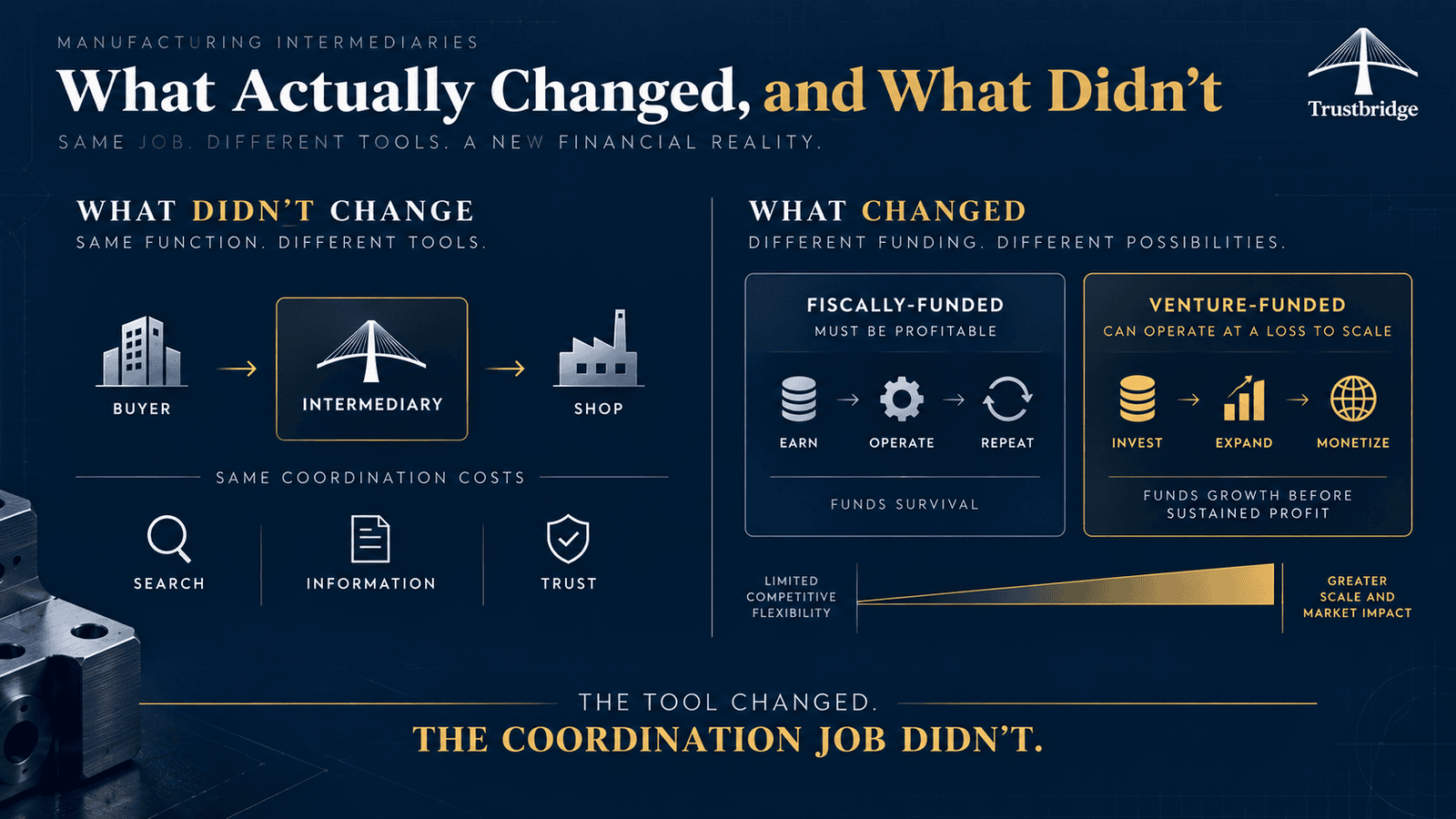
The underlying function these intermediaries perform hasn't moved at all. It's the same coordination cost this series has already traced back to basic transaction cost economics: search costs, information costs, the expense of finding and trusting an unfamiliar counterparty. Thomas Register reduced that cost with a printed directory. Xometry reduces the same cost with an algorithm and a verified supplier network. Different tools, same underlying job.
What changed is who can afford to do that job at a loss while building toward scale, and what that capital advantage does to competitive dynamics once it exists. A venture-funded platform can undercut, outspend, and out-market a fiscally-funded competitor for years in a way that was never possible when every intermediary had to be profitable on its own terms. That's a real advantage. It also creates real pressure of its own. A venture-backed platform eventually has to justify the capital it raised with a genuine path to margin, which is exactly the tension this series examined directly in the piece on who actually captures margin in custom manufacturing.
Conclusion
Manufacturing has needed an intermediary for as long as buyers and shops have been strangers to each other, and that hasn't changed with either paradigm. What changed is the financial logic funding the role from a business that had to earn its keep every year, to one that could spend years losing money in service of a bigger position later.
Thomas Register and Xometry aren't just two companies that happen to share a history. They're the same story, told twice, about who gets to occupy the middle of a transaction and on whose terms. The next version of that story hasn't been written yet, and there's no obvious reason it has to be funded the same way either of the first two were.
Built for the Next Paradigm, Not Just This One
Whatever comes after the venture paradigm will still have to answer the same basic question these companies answered differently. Who reduces the cost of connecting a buyer to a shop they've never worked with, and what do they take in exchange for doing it? Trustbridge is built around answering that question without asking a machining vendor, job shop, or contract manufacturer to give up ownership of their own reputation to get it. That's a design choice, not an accident of timing, and it's worth judging on its own terms rather than assuming every platform funded this way ends up in the same place.
Frequently Asked Questions
1. What is a manufacturing intermediary?
A manufacturing intermediary connects buyers with manufacturers or job shops and reduces the time, cost, and risk involved in finding and evaluating unfamiliar suppliers. Historically, intermediaries included industrial directories and sales representatives; digital platforms later expanded the model through online marketplaces, supplier networks, and automated quoting.
2. How did manufacturing directories like Thomas Register make money?
Thomas Register primarily generated revenue by selling advertising space to manufacturers listed in its industrial directory. This commercial model required the business to generate enough recurring revenue to fund its operations, creating a fundamentally different financial structure from venture-backed manufacturing platforms.
3. How is a venture-backed manufacturing marketplace different from a traditional manufacturing directory?
A traditional directory generally had to fund its operations through recurring commercial revenue, while a venture-backed marketplace can use outside capital to invest heavily in technology, supplier networks, customer acquisition, and market expansion before reaching sustained profitability. This difference can significantly change how quickly an intermediary can scale and compete.
4. Why has the intermediary role remained important in custom manufacturing?
The underlying problem has remained largely the same: buyers need an efficient way to find, evaluate, and work with unfamiliar manufacturing suppliers. The tools have changed from printed directories to digital marketplaces and automated systems, but the intermediary continues to reduce search, information, and coordination costs in custom manufacturing.