What Is First Article Inspection and When Does Your Product Team Actually Need It?
A product may perform exactly as expected during prototype testing and still encounter manufacturing problems once production begins. Small variations in dimensions, materials, machining processes, or assembly methods can quickly lead to quality issues, engineering changes, production delays, and higher manufacturing costs. This is why first article inspection product development plays such an important role before full-scale production starts.
Rather than checking parts only after production is underway, first article inspection verifies that the first component produced using the intended manufacturing process fully meets engineering drawings, material specifications, and quality requirements. It provides confidence that both the product and the manufacturing process are ready for repeatable production. By validating manufacturing early, engineering teams can strengthen manufacturing quality control, improve collaboration with suppliers, and move from prototype to production with fewer surprises.
Introduction
A prototype that performs well in testing is an important milestone, but it does not automatically mean the product is ready for production. The transition from prototype to manufacturing introduces new variables such as production tooling, machining strategies, inspection methods, supplier capabilities, and process consistency. Even when the CAD model remains unchanged, these variables can influence whether every manufactured part meets the original engineering intent.
This is why first article inspection product development plays a critical role in modern product development. Rather than relying solely on prototype validation, engineering teams use first article inspection to confirm that the first part produced using the intended production process fully complies with engineering drawings, material specifications, dimensional requirements, and quality standards. It provides confidence that both the design and the manufacturing process are ready for repeatable production.
Whether launching a new product, introducing a new supplier, or implementing an engineering change, FAI inspection helps identify manufacturing issues before they become large-scale production problems. By validating the production process early, organizations strengthen manufacturing quality control, improve communication between engineering and manufacturing teams, and reduce the risk of costly redesigns, scrap, and production delays.
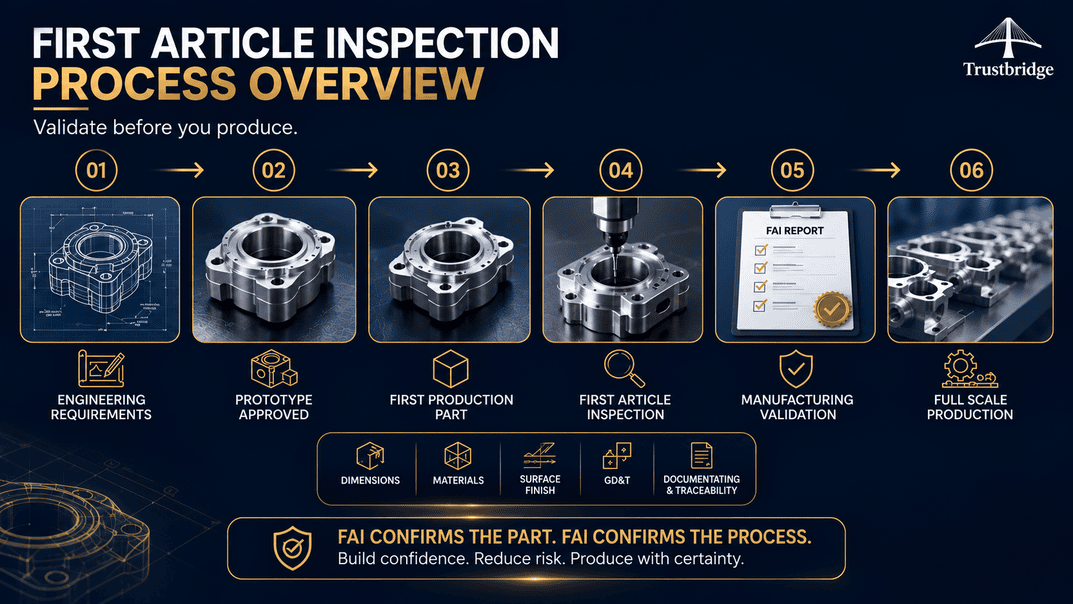
Why First Article Inspection Matters Before Production Begins
Many engineering teams assume that once a prototype has passed functional testing, the product is ready for manufacturing. In reality, prototype success only proves that the design works—it does not confirm that the same design can be manufactured consistently, economically, and repeatedly using production equipment and processes.
Production introduces variables that are often absent during prototype development. Different CNC machines, production tooling, operators, fixtures, inspection methods, and manufacturing environments can all influence the final part. Even small variations in machining or assembly can affect dimensional accuracy, surface finish, or product performance. Without validating these variables before production begins, minor issues can quickly multiply across an entire production batch.
This is where first article inspection product development becomes an essential manufacturing milestone. Instead of discovering quality problems after hundreds of parts have been produced, engineering teams validate the first production component and confirm that the manufacturing process is capable of meeting every design requirement before production moves forward.
What Is First Article Inspection?
First article inspection (FAI) is a structured verification process performed on the first part manufactured using the intended production process. The objective is not simply to inspect a single component but to verify that the complete manufacturing process consistently produces parts that meet engineering specifications.
Unlike routine quality inspections that examine selected dimensions during production, FAI evaluates every requirement defined on the engineering drawing. Critical dimensions, geometric tolerances, materials, coatings, surface finishes, heat treatments, and special manufacturing processes are all verified against documented inspection results.
The inspection also confirms that manufacturing documentation, tooling, machining methods, and quality procedures are correctly aligned before larger production quantities are approved. In this way, FAI validates both the product and the production process rather than the part alone.
What Does an FAI Inspection Verify?
A comprehensive FAI inspection examines every characteristic that influences product quality and manufacturing consistency.
Inspectors verify dimensional measurements, geometric tolerances (GD&T), raw material certifications, surface finish requirements, coatings, threads, assembly features, and critical functional dimensions. Manufacturing documentation such as machining records, inspection reports, material traceability, and process certifications are also reviewed to ensure complete compliance with engineering requirements.
This documentation becomes an important quality reference throughout future production. Once the first article has been approved, manufacturers can use it as the baseline for ongoing manufacturing quality control, helping maintain consistency across future production batches while reducing uncertainty during inspections.
When Should Product Teams Perform First Article Inspection?
Many engineers associate first article inspection only with aerospace programs or highly regulated industries. While industries such as aerospace commonly require formal FAI documentation through standards like AS9102, the underlying principle applies to almost any product moving toward production.
The right time to perform FAI is whenever manufacturing conditions change in ways that could affect product quality. Waiting until problems appear during production often results in unnecessary scrap, engineering revisions, delayed deliveries, and increased manufacturing costs. Performing FAI at key milestones allows engineering teams to validate manufacturing before those risks become expensive.
During the Transition from Prototype to Production
One of the most important times to perform production validation is when moving from prototype manufacturing into production.
Prototype parts are often produced using different tooling, fixtures, machining strategies, or production methods than those planned for commercial manufacturing. Even when the CAD model remains unchanged, production equipment may behave differently than prototype equipment, introducing subtle dimensional variation or process-related quality issues.
By conducting first article inspection during this transition, engineering teams confirm that production-ready machining processes, inspection procedures, and manufacturing documentation all produce components that match the original design intent. This significantly reduces the risk of discovering manufacturing problems after production has already started.
After Engineering, Process, or Supplier Changes
FAI should also be repeated whenever significant engineering or manufacturing changes occur.
Design revisions that modify dimensions, tolerances, materials, or assembly features can directly influence manufacturing outcomes. Likewise, updates to CNC programs, cutting tools, fixtures, machining parameters, inspection methods, or production equipment may introduce unexpected variation into the manufacturing process.
Supplier changes deserve particular attention as well. Even when a new supplier follows identical drawings, differences in equipment, tooling strategies, inspection techniques, or process controls can influence product quality. Performing a new engineering inspection after these changes ensures that manufacturing continues meeting the same design requirements before production resumes.
For High-Risk Products and Regulated Industries
Certain products require more rigorous production validation because failures can have significant safety, regulatory, or financial consequences.
Industries such as aerospace, medical devices, automotive, industrial machinery, and precision electronics frequently rely on structured FAI processes to verify manufacturing readiness before production approval. In aerospace manufacturing, AS9102 establishes standardized requirements for documenting every engineering characteristic and maintaining complete manufacturing traceability.
Even organizations that are not formally required to comply with AS9102 often adopt similar inspection practices because they improve consistency, strengthen supplier communication, and reduce manufacturing risk. As products become more complex and tolerances become tighter, structured CNC quality assurance through First Article Inspection becomes increasingly valuable regardless of industry.
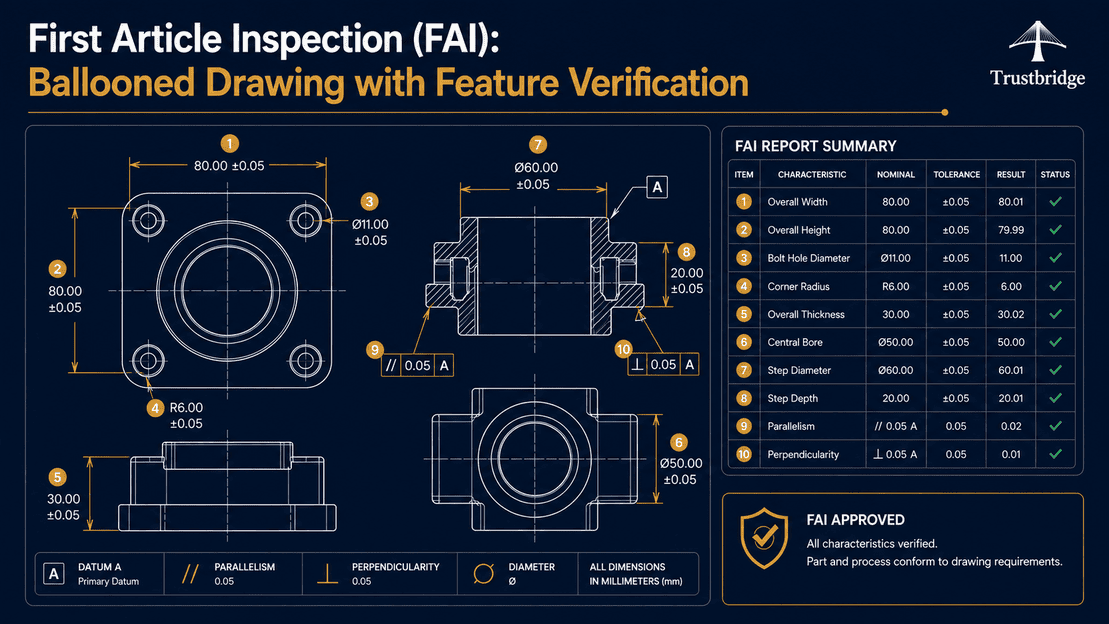
How First Article Inspection Improves Product Development and Manufacturing Quality
Many organizations think of First Article Inspection as a quality-control activity that happens after manufacturing is complete. In reality, it is one of the most valuable engineering validation tools available during product development. A well-executed FAI helps confirm that the product design, manufacturing process, inspection plan, and production documentation all work together before larger production volumes begin.
Rather than simply identifying defects, FAI allows engineering teams to understand why issues occur and resolve them while changes are still relatively inexpensive. This proactive approach improves collaboration between design, manufacturing, and quality teams while reducing the likelihood of costly redesigns later in the product lifecycle.
For companies moving from prototype builds into repeat production, first article inspection product development provides confidence that manufacturing is capable of consistently delivering the intended design without introducing unnecessary variability.
Prevent Manufacturing Problems Before They Scale
Manufacturing problems are far easier to correct when only one part has been produced than when hundreds of components have already reached production or assembly.
First Article Inspection helps identify issues such as incorrect machining dimensions, tolerance stack-up, fixture alignment errors, material substitutions, or process deviations before they become widespread production problems. Corrective actions can then be implemented while production is still in its earliest stages.
This early production validation reduces scrap, minimizes rework, shortens engineering review cycles, and protects project schedules. Instead of reacting to quality issues after production begins, engineering teams can make informed decisions using documented inspection data before manufacturing scales.
Strengthen Collaboration Between Engineering and Manufacturing
One of the greatest benefits of FAI is the communication it creates across departments.
Design engineers gain insight into how manufacturing processes affect the product, while manufacturing engineers and machinists can identify opportunities to improve tooling, machining strategies, fixture design, or inspection methods. Quality teams contribute measurement data that helps verify whether engineering intent has been achieved consistently.
These discussions often uncover opportunities to simplify production without affecting product performance. A revised tolerance, improved datum structure, or minor geometry adjustment may significantly improve manufacturability while maintaining the original functional requirements.
This collaborative review process strengthens manufacturing quality control by ensuring that design intent and manufacturing capability remain aligned throughout product development.
Build a Strong Foundation for Repeatable Production
Successful production depends on repeatability rather than producing a single acceptable part.
FAI establishes a documented manufacturing baseline that future production can consistently follow. Approved inspection reports, validated machining processes, verified tooling, and confirmed quality procedures become reference points for future production runs.
This consistency improves supplier confidence, simplifies quality audits, reduces production variability, and strengthens long-term CNC quality assurance. As production volumes increase, manufacturers spend less time troubleshooting avoidable problems and more time maintaining stable manufacturing performance.
Best Practices for Successful First Article Inspection
A successful First Article Inspection begins long before the first component reaches the inspection department. Engineering preparation, manufacturing planning, documentation quality, and communication all influence the effectiveness of the inspection process.
Organizations that integrate FAI into their overall product development strategy gain far greater value than those treating it simply as a customer requirement. The objective should be continuous improvement rather than documentation alone.
By planning inspection alongside engineering and manufacturing activities, product teams can reduce uncertainty while creating a smoother transition into production.
Prepare Complete Engineering Documentation
Every successful FAI starts with accurate engineering information.
Engineering drawings should clearly define dimensions, tolerances, GD&T requirements, materials, surface finishes, coatings, and any critical product characteristics. Bills of materials, process specifications, and inspection requirements should also be complete before manufacturing begins.
Incomplete or ambiguous documentation often creates inconsistent interpretation between engineering, manufacturing, and inspection teams. Clear documentation reduces questions during production while making inspection faster, more accurate, and easier to repeat across future production batches.
Make First Article Inspection a Cross-Functional Review
Although quality inspectors perform many of the measurements during FAI, the inspection itself should involve the entire product development team. Design engineers verify that functional requirements have been achieved. Manufacturing engineers evaluate machining performance and production capability. Quality teams confirm compliance with specifications, while suppliers provide insight into process stability and manufacturing constraints.
Reviewing inspection results together creates valuable opportunities to improve product quality before production expands. Cross-functional collaboration also reduces communication gaps that often delay engineering changes later in the project.
Use Inspection Results to Improve Future Production
The value of First Article Inspection extends well beyond approving the first production component.
Inspection findings should be used to improve engineering drawings, optimize machining strategies, refine fixture designs, clarify inspection procedures, and strengthen supplier communication. Lessons learned during FAI often reduce setup time, improve process capability, and simplify future manufacturing activities.
Treating FAI as a continuous improvement tool rather than a one-time inspection allows organizations to build stronger manufacturing processes with every new product introduction.
Conclusion
A successful prototype demonstrates that a product can function as intended, but successful production requires much more than functional testing alone. Manufacturing processes must consistently produce parts that meet engineering specifications, quality requirements, and customer expectations every time production begins.
This is why first article inspection product development remains one of the most valuable validation activities within modern manufacturing. By verifying dimensions, materials, machining processes, documentation, and inspection results before production scales, engineering teams reduce risk while building confidence in their manufacturing process.
Whether introducing a new product, changing suppliers, updating machining programs, or implementing engineering revisions, first article inspection provides the structured engineering inspection needed to support reliable production validation and stronger manufacturing quality control.
Ultimately, successful production begins with verified manufacturing—not assumptions. Engineering teams that invest in comprehensive FAI build products that transition from prototype to production with greater consistency, fewer surprises, and improved long-term manufacturing performance.
Moving from prototype to production requires more than a successful design—it requires confidence that every manufacturing process, supplier, and quality system can consistently deliver the product exactly as intended.
Trustbridge helps engineering teams strengthen first article inspection, improve production validation, and connect with experienced global manufacturing partners who understand Design for Manufacturability (DFM), engineering inspection, supplier qualification, and CNC quality assurance. By validating manufacturing readiness early, product teams can reduce development risk, improve collaboration, and accelerate production without compromising quality.
Whether you're preparing your first production run, qualifying a new supplier, or refining an existing manufacturing process, Trustbridge helps bridge the gap between engineering design and production-ready manufacturing—so your products reach the market with confidence, consistency, and fewer costly surprises.
Frequently Asked Questions
1. What is First Article Inspection (FAI) and why is it important?
First Article Inspection (FAI) is a comprehensive verification process performed on the first part produced using the intended production process. It confirms that the component meets all engineering drawings, material specifications, GD&T requirements, and quality standards before full-scale manufacturing begins. FAI helps identify manufacturing issues early, reducing scrap, rework, production delays, and quality risks.
2. When should a product team perform a First Article Inspection?
Product teams should perform First Article Inspection when transitioning from prototype to production, after engineering design changes, process or tooling updates, supplier changes, or whenever manufacturing conditions could affect product quality. Conducting FAI at these milestones ensures the manufacturing process is capable of producing consistent, production-ready parts.
3. What does a First Article Inspection verify?
A First Article Inspection verifies all critical product characteristics, including dimensions, GD&T requirements, materials, surface finishes, coatings, heat treatments, assembly features, and manufacturing documentation. It also confirms that machining processes, tooling, inspection methods, and quality procedures are properly aligned to support repeatable production.
4. How does First Article Inspection improve manufacturing quality and product development?
First Article Inspection helps engineering teams detect manufacturing issues before production scales, strengthens collaboration between design, manufacturing, and quality teams, and establishes a validated production baseline. By confirming both product and process readiness early, FAI improves manufacturing quality control, reduces production risk, and supports a smoother transition from prototype to full-scale production.