3-Axis vs. 5-Axis CNC Machining: A Designer's Guide to Choosing the Right Process
Choosing between 3-axis and 5-axis CNC machining shapes more than how a part gets cut. It shapes cost, lead time, tolerance, and finish. In custom manufacturing, geometry drives nearly every one of those outcomes, which makes this a decision worth understanding while a design is still flexible, not after quotes come back higher than expected. Here's what actually separates 3-axis from 5-axis machining, where 3+2 fits in, and how to use that understanding when you're comparing precision CNC machining service quotes for your next part.
The Core Difference Between 3-Axis and 5-Axis CNC Machining
The distinction comes down to one thing: how many directions the cutting tool or the part itself can move at the same time.
3-axis machining moves the tool along three linear directions: X, Y, and Z. 5-axis machining adds two rotational axes on top of those, so the tool or the part can tilt and rotate mid-cut, not just slide back and forth.
That single difference in freedom of movement cascades into everything else: how many setups a part needs, how tight its tolerances can stay, what geometry is even possible, and eventually what the part costs to produce. Every section that follows traces back to this one distinction.
How 3-Axis CNC Machining Works
In 3-axis machining, the part sits stationary in a vise or fixture while the cutting tool moves along X, Y, and Z to remove material. It's the workhorse behind most CNC milling services: reliable, well understood, and usually the fastest, most economical route to flat faces, pockets, slots, drilled holes, and simple contours.
The limitation shows up when a part needs features on more than one face. Since the tool only approaches from directly above, machining a side face or an angled feature means stopping the job, unclamping the part, flipping or re-fixturing it, and re-establishing its datum, the reference point everything else is measured from, before continuing. Each manual setup is another opportunity for misalignment, and that risk compounds when a part needs three or four separate operations to finish.
For designers, the practical read is this: parts that are mostly prismatic, with features that can be grouped onto one or two faces, are a natural fit for 3-axis and often the most cost-effective option when the geometry allows it.
What 5-Axis Machining Adds
5-axis machining keeps the same X, Y, Z linear movement and adds two rotational axes with some combination of A, B, and C, depending on whether the machine tilts the table, the spindle head, or both. That extra freedom lets the tool reach a part from nearly any angle without the part ever leaving its fixture.
In practice, that means:
Fewer setups. Features spread across multiple faces, undercuts, and compound angles can often be machined in one operation instead of three or four.
Better accuracy. The part holds a single datum from start to finish, so there's no accumulated error from repeated flipping and re-clamping.
Access to more complex geometry. Organic, sculpted, and freeform surfaces, such as impeller blades, medical implants, and aerospace brackets, become machinable in ways that would be impractical, or impossible, on a 3-axis setup.
5-Axis vs. 3+2 Machining: What's the Real Difference?
Not all "5-axis" quotes describe the same process, and this is where a lot of designers get tripped up comparing quotations from different suppliers. 3+2 machining (also called positional or indexed 5-axis) uses the two rotational axes to tilt the part into a fixed position, locks it there, and then cuts using only X, Y, and Z movement, the same as 3-axis, just from a new angle. It's a hybrid: you get the setup-reduction benefit of a 5-axis machine, but the tool never actually rotates mid-cut. True, or simultaneous, 5-axis machining keeps all five axes moving together throughout the cut, continuously reorienting the tool to hold an ideal cutting angle against curved and contoured surfaces.
In practice: 3+2 suits parts with features on multiple flat or simple faces, where the goal is just reaching more sides without extra setups. Simultaneous 5-axis is what continuously curved, organic, or undercut geometry requires, since the tool's angle relative to the surface must keep changing as it moves. It also demands more sophisticated CAM programming and a more experienced machinist to run well, which feeds directly into cost and lead time, and it's worth asking any machining vendor which version of "5-axis" they mean before you compare quotes.
Cost: Which Process Is Actually Cheaper?
There's no universal answer, and that's exactly why it's worth comparing quotes rather than assuming. A few things shift the math:
Machine and programming cost. 5-axis machines cost more to buy and operate, and simultaneous 5-axis programming takes longer and demands more specialized CAM expertise than 3-axis programming.
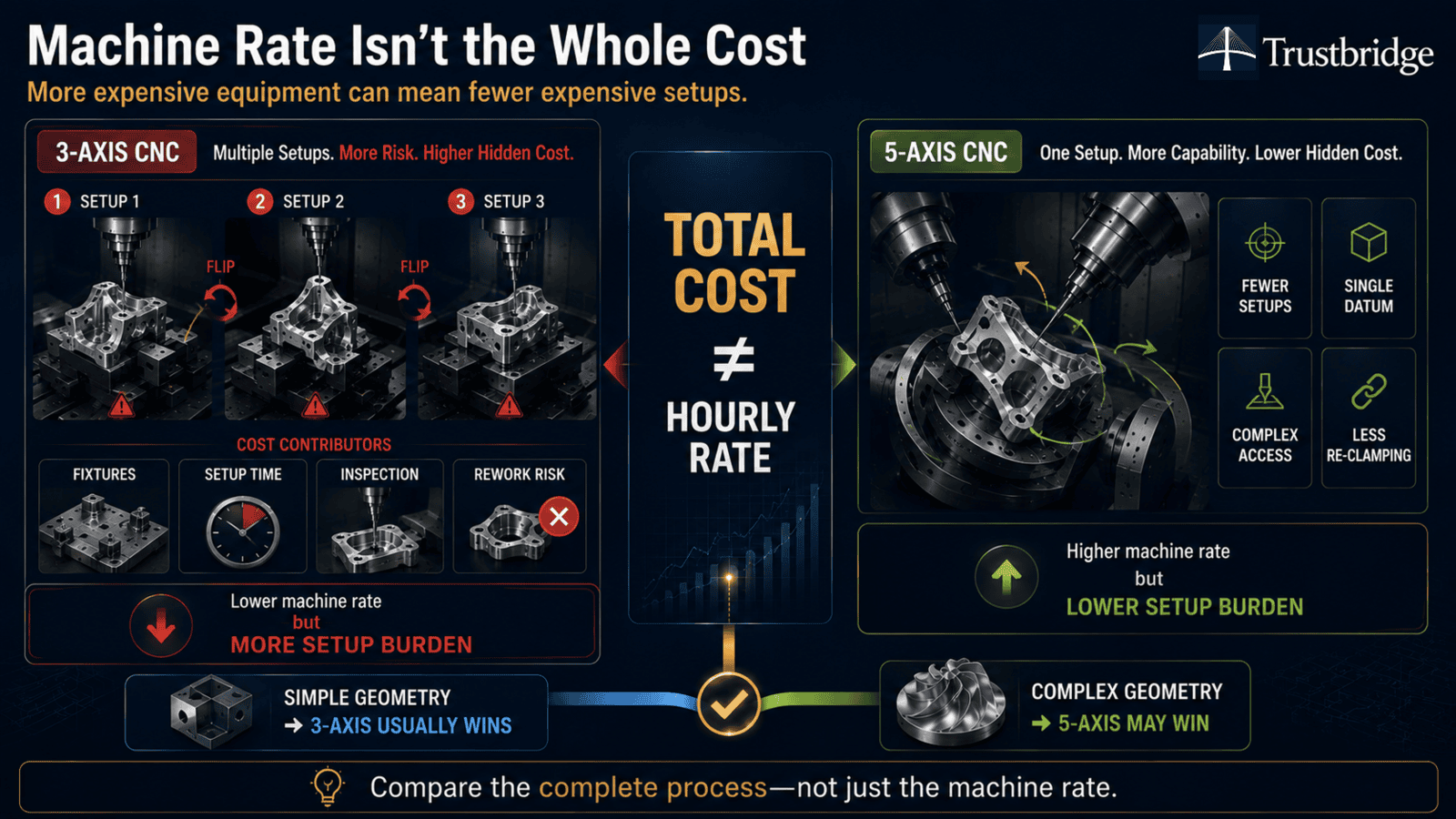
Setup and fixturing time. A complex part on a 3-axis machine might need custom fixtures for three or four separate setups. 5-axis can eliminate most of that, which sometimes offsets its higher machine rate.
Cycle time. Simple parts run faster and cheaper on 3-axis, full stop. Complex parts can end up taking longer overall on 3-axis once multiple setups, in-process inspection, and rework risk are added.
Scrap and rework risk. Every manual re-fixturing on 3-axis introduces a chance of misalignment, a real cost on tight-tolerance parts.
The only reliable way to know which is cheaper for a specific part is a proper quotation comparison: get quotes from more than one machining supplier or contract manufacturer, for both processes where geometry allows it, and let the numbers make the call instead of a rule of thumb.
Practical Selection Criteria for Designers
A few questions worth running through before committing a design to one process or the other:
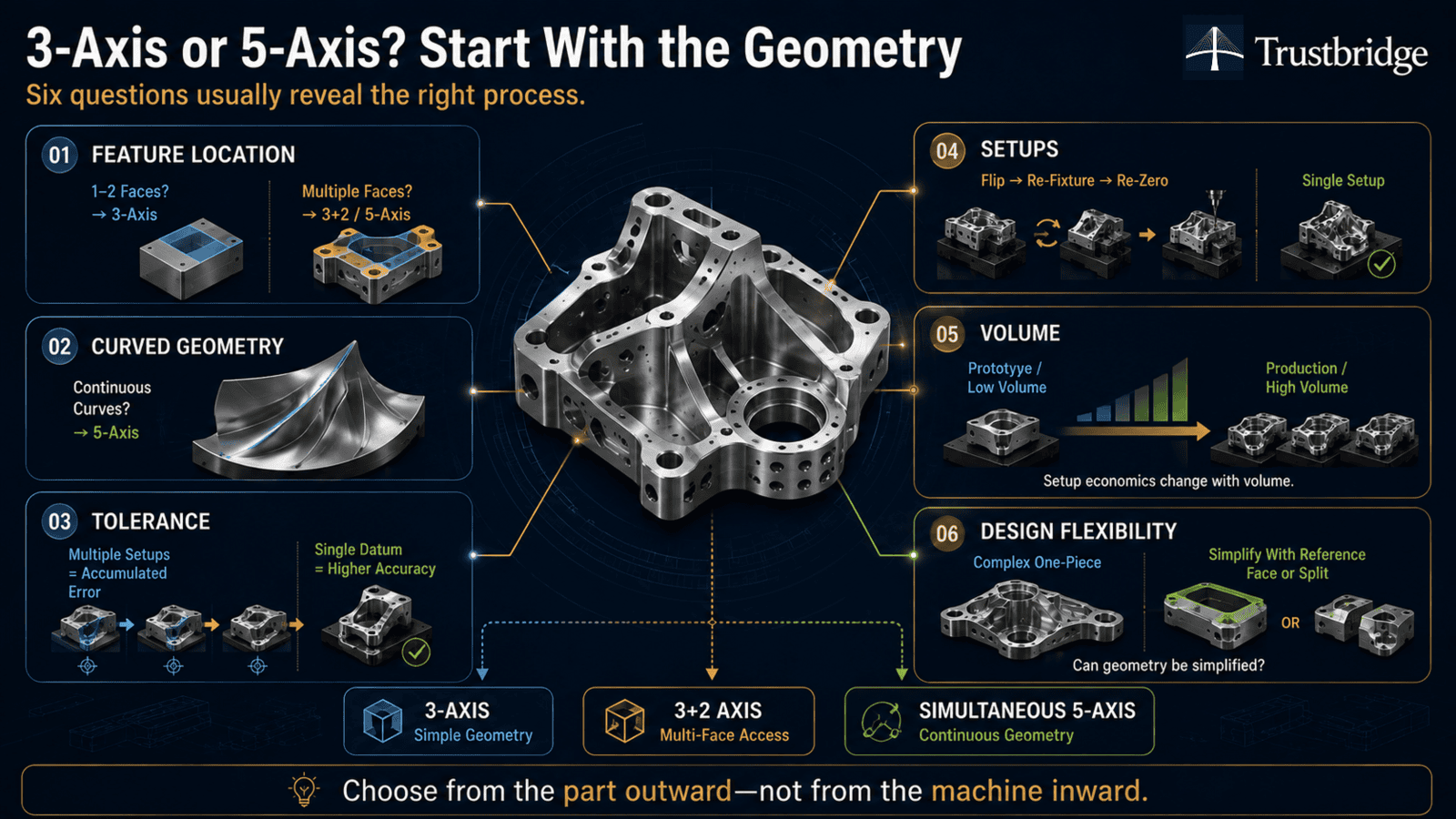
Where do the features sit? Everything groupable onto one or two faces points to 3-axis. Features scattered across multiple faces or angles point toward 3+2 or full 5-axis.
Is there continuously curved or organic geometry? Sculpted surfaces, undercuts, and compound curves generally need simultaneous 5-axis to machine cleanly.
How tight are the tolerances? Tolerances that can't absorb the error introduced by flipping and re-fixturing favor 5-axis and its uninterrupted datum.
What is the volume? For a one-off prototype, the cheaper setup sometimes wins even if it takes a little longer. For a production run, setup time amortizes, and 5-axis can become the more economical choice at scale.
Can the design flex? Adding a flat reference face, or splitting a part into two simpler components, sometimes keeps a design on 3-axis entirely. It's worth raising with your machining vendor before the CAD is locked.
What does your supplier actually run? Not every job shop has simultaneous 5-axis equipment on its floor. When comparing quotes, confirm exactly what capability is behind the number.
Surface Finish: Why Axis Count Affects Quality
Axis count doesn't just decide what's possible to cut. It shows up directly in how the finished surface looks and feels.
On curved surfaces, 3-axis machining typically uses a fixed tool orientation during a given setup, which can leave visible stepover marks or scalloping, especially on steep walls where the tool cannot maintain an ideal cutting angle. Getting a smoother result usually means slower toolpaths, finer stepovers, or manual polishing afterward, all of which add cost and lead time.
5-axis machining, and simultaneous 5-axis in particular, can hold the tool at a consistent, optimal angle across a curved surface for the whole cut. That tends to produce a more even finish straight off the machine, with less hand-finishing needed. Fewer setups also mean fewer witness lines, the faint mismatch marks left where separate operations don't quite line up.
None of this makes 3-axis a poor finisher. On flat and prismatic features, it holds up perfectly well. But if a part has continuously curved surfaces and finish is a real spec, it's worth calling that out explicitly in an RFQ, so suppliers quote the process and finishing steps that will actually hit it.
Choosing the Right Process and the Right Partner
3-axis and 5-axis aren't competing standards; they're two tools suited to different geometry, tolerance, and finish requirements. The right call depends on where a part's features sit, how curved its surfaces are, how tight its tolerances are, and how many units are on order.
The fastest way to find out is to put the CAD in front of more than one manufacturing partner and compare quotes side by side on price, lead time, and the process actually being proposed. Upload your file and get quotes from trusted, vetted CNC machining suppliers, and turn that comparison into a manufacturing partnership you can rely on for the next part, and the one after that.
Frequently Asked Questions
1. What is the difference between 3-axis and 5-axis CNC machining?
3-axis CNC machining moves the cutting tool along the X, Y, and Z axes, while 5-axis machining adds two rotational axes that allow the tool or workpiece to approach features from different angles. This gives 5-axis machining greater flexibility for complex geometries, reduces the need for multiple setups, and can improve accuracy on parts with features across multiple faces.
2. Is 3-axis or 5-axis CNC machining cheaper?
3-axis CNC machining is usually more economical for simple parts with features that can be machined from one or two directions. However, 5-axis machining can be more cost-effective for complex parts because it reduces setups, re-fixturing, machining time, and the risk of alignment errors. The better option depends on the part's geometry, tolerances, volume, and required finish.
3. When should you use 5-axis CNC machining instead of 3-axis?
5-axis CNC machining is generally better suited for parts with complex curves, compound angles, undercuts, features across multiple faces, or tight tolerances that are difficult to maintain through repeated setups. For simpler prismatic parts with accessible features, 3-axis machining is often the more practical and economical choice.
4. What is the difference between 3+2 and simultaneous 5-axis machining?
3+2 machining uses the two additional rotary axes to position the workpiece or tool at a fixed angle before cutting with three linear axes. Simultaneous 5-axis machining continuously moves all five axes during the cut, allowing the tool orientation to change along complex curved surfaces. 3+2 is often suitable for multi-sided features, while simultaneous 5-axis is better for complex organic surfaces and continuous contours.