
Why Manufacturing Suppliers Should Track the Work They Lose, Not Just the Work They Win
Most manufacturing suppliers track the jobs they win in detail and forget the ones they lose. But lost quotes hold some of the most useful information a shop can get: where its pricing is off, which customers are worth quoting and what kind of work really fits.
Introduction
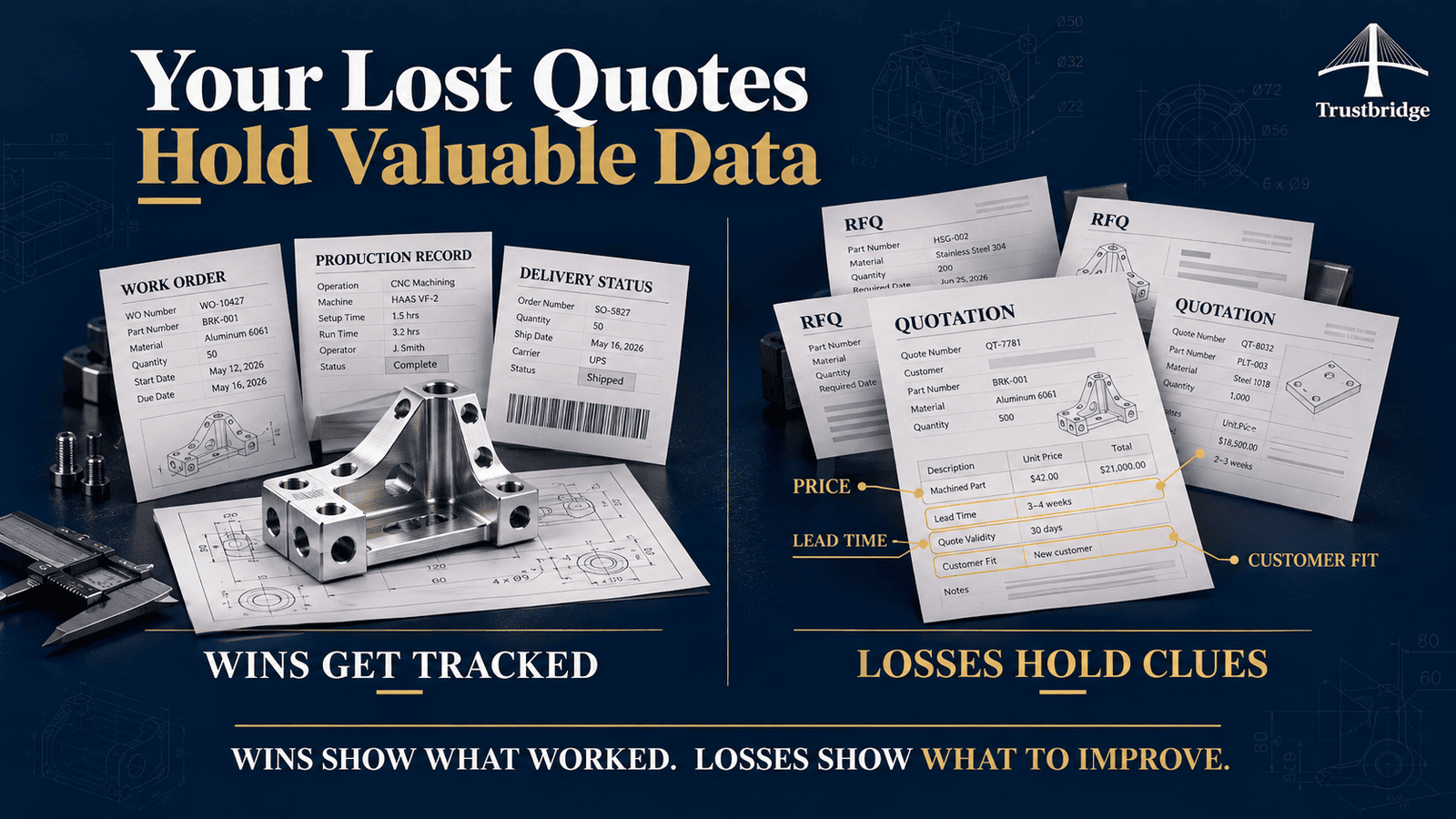
When a shop wins a job, it creates a work order, schedules machine time, orders material and tracks the job through to shipping. Every detail ends up in the system. When a shop loses a quote, the email usually just sits in an inbox, and nobody looks at it again. That's understandable.
Lost work feels like wasted effort, and there's always the next RFQ to get to. But it means most shops are making decisions about pricing, customers and capacity using only half the picture.
The quotes you lose tell you things the quotes you win can't. They show where your prices are out of line, which customers rarely buy, which part types you keep losing to other shops and where slow responses are costing you work. This article explains why lost work is worth tracking, what to record, what common loss patterns mean and how to get started without buying new software.
Why lost work is the more useful data
For most shops, lost quotes far outnumber won ones. On one long-running machinist forum, owners describe win rates from 5 to 10 percent with new prospects to around 50 percent with established customers. That means most of a shop's quoting effort ends in a loss, and most of its quoting data sits in those losses. That effort isn't free. One industry estimate puts the estimating labor on most quotes at one to four hours.
Multiply that across dozens of lost quotes a month, and a shop is spending a large share of its estimating time on work it never sees, without learning anything from it.
More quoting doesn't automatically mean more work, either. One owner on the same forum described how his strike rate fell from about 50 percent to about 25 percent when he went from quoting one job a day to eight. Without tracking losses, it's hard to see that kind of pattern until it has already cost months of effort.
Wins tell you what worked once. Losses, tracked over time, tell you why things don't work, and that's what you need to improve pricing, choose better customers and focus on the right work.
What to record on every lost quote
You don't need a complicated system. A handful of fields, recorded consistently on every quote, is enough to start seeing patterns. One quoting-software company recommends logging every quote as won, lost or expired, so you can see win rates by customer, part family and margin level.
Field | Why it matters |
Customer and contact | Shows which customers actually buy, and which mostly collect quotes |
Part type, material and process | Reveals which kinds of work you win, and which you consistently lose |
Quantity | Shows whether you're competitive at prototype, low or high volume |
Quoted price and margin | Lets you compare lost quotes with won ones at similar margins |
Lead time quoted | Shows whether delivery dates, not price, are costing you work |
Response time | How long it took to send the quote after the RFQ arrived |
Outcome | Won, lost, expired with no answer, or declined by you |
Reason, if known | Price, lead time, capability, relationship, project cancelled or unknown |
The reason field is often blank at first, and that's fine. Even without a reason, the other fields will show patterns. Over time, asking buyers for feedback will fill in more of the picture.
The key is consistency. A field recorded on every quote is far more useful than a detailed note on a few. Make it part of the routine for whoever closes out each quote.
Common reasons shops lose work, and what each one tells you
Once you start tracking, the losses tend to cluster around a few causes. Each one points to a different fix.
You lose on price for one kind of part.
If you're consistently beaten on high-volume work but competitive on prototypes, the market may be telling you that other shops are built for that volume. That's a signal to focus on the work where your costs are competitive, not to cut prices across the board.
You lose on lead time.
If buyers choose a faster shop, your capacity planning or quoting habits may be the problem, not your price. Quoting realistic lead times and responding faster can win back work without any price change.
You lose because the quote arrived late.
Speed matters. One quoting-software company reports that quotes sent within 24 hours win about twice as often as quotes sent after 48 hours. If many of your lost quotes went out days after the RFQ, faster turnaround may be the cheapest improvement available.
You lose with certain customers no matter what.
Some buyers send RFQs to many shops and rarely award work to anyone new. If a customer almost never buys from you, quoting them less, or not at all, frees up estimating time for customers who do.
You lose and never hear why.
An expired quote with no answer often means the project was cancelled, the buyer went with an existing supplier, or your quote was used only as a price check. If you see many of these from the same source, it's worth asking whether that source is worth quoting.
Track the work you turn down, too
Lost quotes aren't the only work worth recording. The RFQs you decline to quote, sometimes called no-quotes, are just as revealing.
Every no-quote is a small decision about what your shop is and isn't. Maybe the part needed a process you don't run, a material you rarely cut, a size beyond your machines or a volume outside your sweet spot. Recorded over time, those decisions form a clear picture of where demand exists that you're not serving.
That picture can guide real choices. If you turn down a steady stream of jobs that need one extra capability, it may be worth investing in it. If you keep declining work in one industry, you might partner with a shop that serves it well, and refer those jobs there.
No-quotes also show whether your shop is attracting the right RFQs in the first place. If most of what arrives is a poor fit, the problem may be how you describe your capabilities, not how you quote.

Turning lost-work data into better decisions
Data only helps if it changes what you do. Here are the decisions lost-work tracking can improve most.
Pricing.
Compare the margins on won and lost quotes for similar parts. If you lose almost every job above a certain margin, your pricing may be out of line for that work. If you win almost everything, you may be leaving money on the table.
Which customers to quote.
Calculate your win rate for each customer. One owner on the machinist forum set a simple rule: if he wins less than 25 percent of what he quotes for a customer, he stops quoting for them. Your threshold may differ, but having one at all is the point.
Where to focus.
Look at which part types, materials and quantities you win most often. That's your real sweet spot, and it's where marketing, sales effort and new equipment will pay off fastest.
How you quote.
If lost quotes cluster around slow response times or missing information, fix the process: set a turnaround target, ask buyers clarifying questions earlier, or use standard templates for common part types.
How to start without new software
You don't need an ERP upgrade to begin. A shared spreadsheet with the fields above works fine for most shops. If your ERP or quoting tool already records quotes, add a status and a reason field and make sure they get filled in.
Set a simple rule: every quote gets an outcome within 30 days. If you haven't heard back by then, follow up once, then mark it lost or expired. That one habit turns a pile of old emails into usable data.
Ask for feedback when you lose. A short, friendly note, such as "Thanks for the opportunity. Could you share what made the difference on this one, price, lead time or something else?", often gets an honest answer. Buyers who explain why you lost are also telling you how to win next time.
Review the data once a month. Spend 30 minutes looking at your win rate by customer, part type and response time. Within a quarter, most shops can see clear patterns, and within a year the data becomes one of the most valuable tools in the business.
Your losses are telling you something
Every lost quote costs estimating time. Tracking it is how you get something back for that time. Instead of disappearing into an inbox, each loss becomes a small piece of evidence about your pricing, your customers and the work that truly fits your shop.
The shops that improve fastest aren't the ones that never lose. They're the ones that learn from every loss: they quote less of the wrong work, price the right work with more confidence and spend their estimating hours where they're most likely to pay off.
Start this month. Record the outcome of every quote, ask a few buyers why you lost, and look at the patterns. You may find that the work you lose has more to teach you than the work you win.
TrustBridge is building a network of great manufacturers, and we help them solve problems like the ones described here. If you run a shop and this sounds familiar, [fill out our interest form] and we'll be in touch.
Frequently asked questions
How do you calculate a quote hit rate?
Divide the number of quotes won by the total number of quotes that reached an outcome, then multiply by 100. It's also worth calculating the rate by dollar value, total value won divided by total value quoted, because winning many small jobs and losing every large one can hide a real problem.
What is a good quote win rate for a machine shop?
There's no single benchmark, because win rates depend heavily on how many new prospects, repeat customers and broadcast RFQs a shop quotes. The most useful comparison is your own rate over time, broken down by customer type, so you can see whether changes you make are working.
Should I lower my prices if my win rate is low?
Not automatically. A low win rate can come from slow responses, poor-fit RFQs, long lead times or customers who rarely award work, none of which a lower price fixes. Check the reasons first, and only adjust pricing where the data shows price is the real issue.
How do I follow up on a quote without being pushy?
Send one short, helpful follow-up a few days after quoting. Confirm the buyer received the quote, offer to answer questions or adjust quantities, and mention any lead time you can hold. One well-timed check-in is usually welcome; repeated chasing usually isn't.
Who in the shop should own win/loss tracking?
Usually the estimator or sales lead, since they send the quotes and hear from buyers. But the results should be shared with the owner and operations team, because they affect pricing, staffing and equipment decisions across the whole shop.