
Why Machine Shops Need to Define Their Ideal Customer Before Selling
Most machine shops try to sell to anyone who needs parts. It feels safe, but it spreads sales effort thin and fills the schedule with work that doesn't fit. Defining your ideal customer first makes every sales call, website update and quoting decision sharper.
We'll make anything for anyone
Ask many machine shop owners who their customers are, and the answer is some version of "anyone who needs parts." It's an understandable answer. When you've worked hard to build capacity, turning away any potential customer feels like leaving money on the table. But "anyone" isn't a target. When a shop tries to appeal to everyone, its website says nothing specific, its sales outreach goes to whoever is easiest to reach and its estimators quote whatever lands in the inbox. Effort gets spread so thin that none of it lands with real force.
The shops that grow steadily usually work the other way around. Before they sell, they decide exactly who they're best suited to serve: which industries, which kinds of parts and which kinds of buyers. Then they point their marketing, sales and quoting at those customers.
That decision is called defining an ideal customer profile. It sounds like a big-company marketing exercise, but for a machine shop it's one of the most practical things an owner can do, and it doesn't require a consultant or new software.
What an ideal customer profile means for a machine shop
An ideal customer profile, often shortened to ICP, is a short description of the type of company your shop serves best. It's not a single customer. It's the pattern shared by the customers who are a great fit: the ones whose work runs smoothly, pays fairly and keeps coming back.
For a machine shop, a good ICP describes both the work and the buyer. It covers what kinds of parts the customer needs, such as materials, tolerances, sizes and volumes, and what kind of company is buying them: the industry, size, location and how they like to work with suppliers.
Here's an example of what one might look like:
US aerospace and defense hardware companies with 20 to 500 employees, needing tight-tolerance aluminum and titanium parts in quantities of 10 to 500, with repeat programs, who value fast communication and complete inspection documentation.
Notice how specific that is. It doesn't mean the shop refuses every other customer. It means the shop knows exactly where to focus first, and can recognize a great-fit opportunity the moment it appears.
Why selling without one wastes time and margin
Sales effort goes to the wrong people.
Without a clear target, outreach tends to go to whoever is easiest to find, not whoever is most likely to buy. Calls, emails and trade show conversations get spread across companies that may never need what you do best.
Your message gets vague.
If you're speaking to everyone, you can't speak directly to anyone. "Precision CNC machining for all industries" sounds like hundreds of other shops. A buyer scanning websites has no reason to stop on yours.
You win the wrong work.
When you take whatever comes in, some of it will be poor-fit jobs: wrong volumes, unfamiliar materials, difficult customers or thin margins. Those jobs still consume machine time, setup hours and attention, often more than the good ones.
Estimating time gets stretched.
Every RFQ from a poorly matched customer costs quoting hours, and most of those quotes are unlikely to win. A clear ICP helps your team see quickly which RFQs deserve full attention and which deserve a fast, polite no.
The building blocks of a shop's ideal customer profile
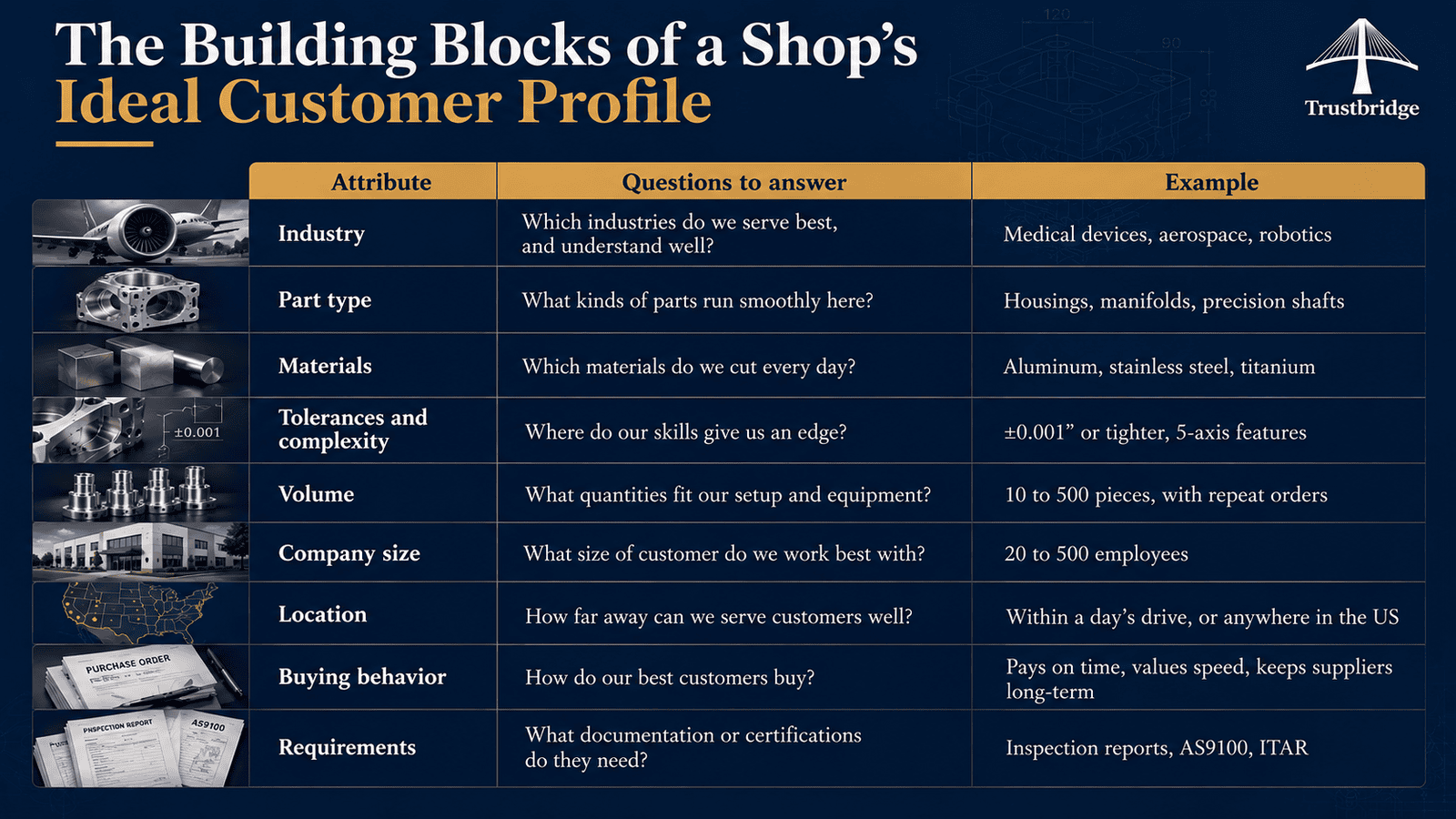
A useful ICP combines two kinds of information: what the customer needs made, and what kind of company is buying it. Here are the attributes most shops should consider.
Attribute | Questions to answer | Example |
Industry | Which industries do we serve best, and understand well? | Medical devices, aerospace, robotics |
Part type | What kinds of parts run smoothly here? | Housings, manifolds, precision shafts |
Materials | Which materials do we cut every day? | Aluminum, stainless steel, titanium |
Tolerances and complexity | Where do our skills give us an edge? | ±0.001" or tighter, 5-axis features |
Volume | What quantities fit our setup and equipment? | 10 to 500 pieces, with repeat orders |
Company size | What size of customer do we work best with? | 20 to 500 employees |
Location | How far away can we serve customers well? | Within a day's drive, or anywhere in the US |
Buying behavior | How do our best customers buy? | Pays on time, values speed, keeps suppliers long-term |
Requirements | What documentation or certifications do they need? | Inspection reports, AS9100, ITAR |
You don't need every attribute to be perfect. Most shops find that three or four of them, usually industry, part type, volume and buying behavior, do most of the work in separating great customers from poor fits.
Buying behavior is the one shops most often forget. Two companies can need identical parts, but one pays on time, plans ahead and stays loyal, while the other sends broadcast RFQs to dozens of shops and switches suppliers over pennies. Only one of them belongs in your ICP.
How to define yours, step by step
Step 1: List your best customers.
Pick the five to ten customers you'd most like to clone. Judge them on more than revenue: look at margin, how smoothly their jobs run, how they pay, how often they reorder and how easy they are to work with.
Step 2: Find what they have in common.
Go through the attributes in the table above for each customer. Look for patterns. Maybe most are in two industries, order similar volumes or value the same things, like fast turnaround or detailed inspection reports.
Step 3: List your worst-fit customers, too.
Do the same exercise for the customers or jobs that caused the most trouble. What made them a poor fit? This often reveals boundaries just as clearly as your best customers reveal targets.
Step 4: Write it in two or three sentences.
Combine the patterns into a short description, like the example earlier in this article. If you can't explain it simply, it's probably still too broad.
Step 5: Check it against your data.
Compare your draft ICP with your recent quotes and orders. Do the companies that match it actually win more often and earn better margins? If not, adjust. The goal is a profile based on evidence, not just on the customers you wish you had.
Putting the profile to work
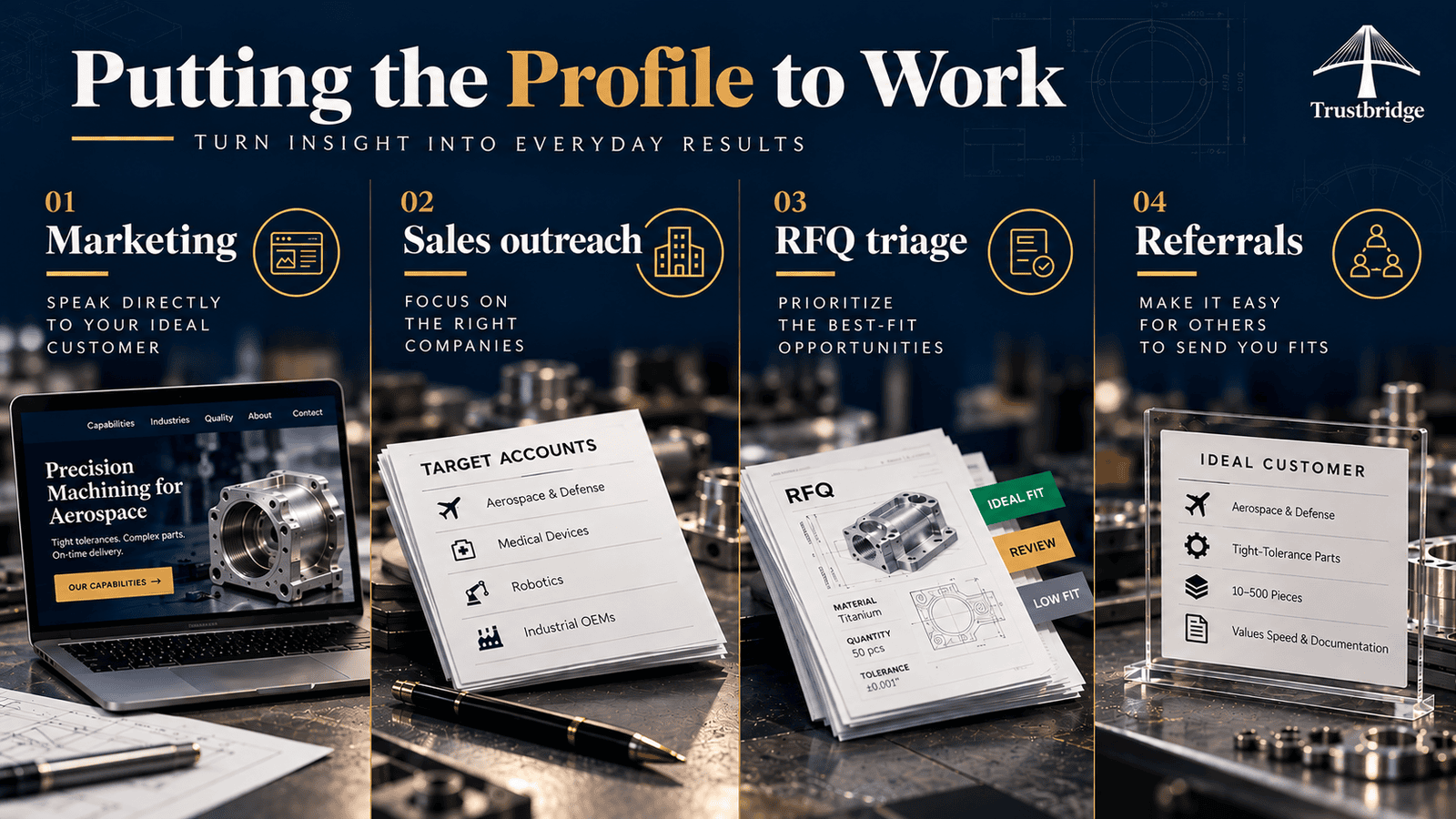
An ICP only matters if it changes what the shop does every day. Here's where it pays off.
Marketing.
Rewrite your website and capability sheet so they speak directly to your ideal customer. Use their industry's language, show examples of the parts they buy and highlight what they care about most. A buyer who matches your ICP should feel like the page was written for them.
Sales outreach.
Build your prospect list from companies that match the profile, not just whoever you can find contact details for. Ten conversations with well-matched companies will usually do more than a hundred cold emails to random ones.
RFQ triage.
Use the ICP as a quick filter when RFQs arrive. Jobs from customers who match it get priority and your best estimating effort. Jobs far outside it get a closer look before anyone spends hours quoting them.
Referrals.
Tell customers, partner shops and independent reps exactly who your ideal customer is. "Send us medical device companies that need tight-tolerance titanium parts" is far easier to act on than "let us know if you hear of anyone who needs machining."
Common mistakes when defining an ideal customer
Making it too broad.
"Manufacturing companies in the US" isn't an ICP. If your profile could describe half the companies in the country, it won't help you choose where to focus. Narrow it until it feels slightly uncomfortable.
Basing it on wishes instead of evidence.
Many shops write an ICP around the customers they'd love to have, such as big-name aerospace primes, rather than the customers they actually serve well. Aspiration is fine, but start from what's working today and grow from there.
Ignoring how customers buy.
Industry and part type matter, but so do payment habits, loyalty and communication style. A perfect technical fit that pays late and shops every order to ten suppliers isn't ideal.
Writing it once and forgetting it.
Markets shift, customers change and your shop's capabilities grow. An ICP should be revisited as you add equipment, certifications or people, and as you learn which customers really drive your best work.
Know who you're for before you sell
Selling to everyone feels safe, but it rarely builds a strong shop. It spreads your effort across customers who don't value what you do best, and fills your schedule with work that doesn't fit. Defining your ideal customer flips that. It gives your marketing a clear voice, your sales outreach a target and your estimators a fast way to spot the RFQs worth their time. And it helps the right buyers recognize you as the right shop.
You can draft your first ICP in an afternoon. List your best customers, find what they share and write it down. Then put it to work, and refine it as you learn.
Trustbridge is building a network of great manufacturers, and we help them solve problems like the ones described here. If you run a shop and this sounds familiar, fill out our interest form and we'll be in touch.
Frequently asked questions
How many ideal customer profiles should a machine shop have?
Most small and mid-size shops do best with one to three. One primary profile keeps the focus sharp, and a second or third can cover a distinct but valuable group, such as prototype startups alongside established production customers. More than that usually means the profiles aren't specific enough.
What if my biggest customer doesn't match my ideal customer profile?
That's common, and it isn't a reason to drop them. Keep serving them well, but be careful about letting one account shape your whole strategy. Use the ICP to guide where new growth comes from, so the business becomes less dependent on any single customer over time.
Is an ideal customer profile the same as a buyer persona?
No. An ICP describes the type of company you want to work with. A buyer persona describes the individual people inside that company, such as the design engineer, buyer or operations manager, and what each one cares about. Most shops should define the ICP first, then think about the people they'll be talking to.
Should I turn away customers who don't fit my ideal profile?
Not automatically. Work outside your ICP can still be worth taking when it fits your capacity and margins. The ICP's job is to decide where you spend proactive sales and marketing effort, and to help you say no with confidence when a job clearly isn't right.
Does an ideal customer profile help if my shop has no sales team?
Yes, arguably even more. When the owner or an estimator also handles sales, time is the scarcest resource. A clear ICP makes sure the few hours available for marketing and outreach go toward the customers most likely to become long-term accounts.