
Why Manufacturing Marketplaces Often Turn Good Suppliers Into Commodity Bidders
Manufacturing marketplaces make it easy for buyers to compare quotes. For skilled suppliers, that convenience often comes at a cost: their expertise gets reduced to a single number next to everyone else's. Here's why it happens, and how good shops protect their margins and their customer relationships.
A skilled shop, reduced to a price
You spent years building your shop. You invested in the right machines, trained your people, earned your certifications and learned how to hold tolerances other shops struggle with. Your best customers know you'll deliver on time and call them before a problem becomes a crisis.
Then you log into an online manufacturing marketplace. A part appears with a drawing, a quantity and a deadline. You enter a price. So do a dozen other shops. And in that moment, everything that makes your shop different disappears behind a number.
That's the quiet problem with many manufacturing marketplaces. They are built to make buying fast and simple, which is genuinely useful for buyers. But the same design that makes quotes easy to compare also makes suppliers easy to swap. Over time, good shops start to look like interchangeable bidders.
This article explains how that happens, what it costs suppliers, where marketplace work still makes sense and what shops can do to compete on value instead of price alone.
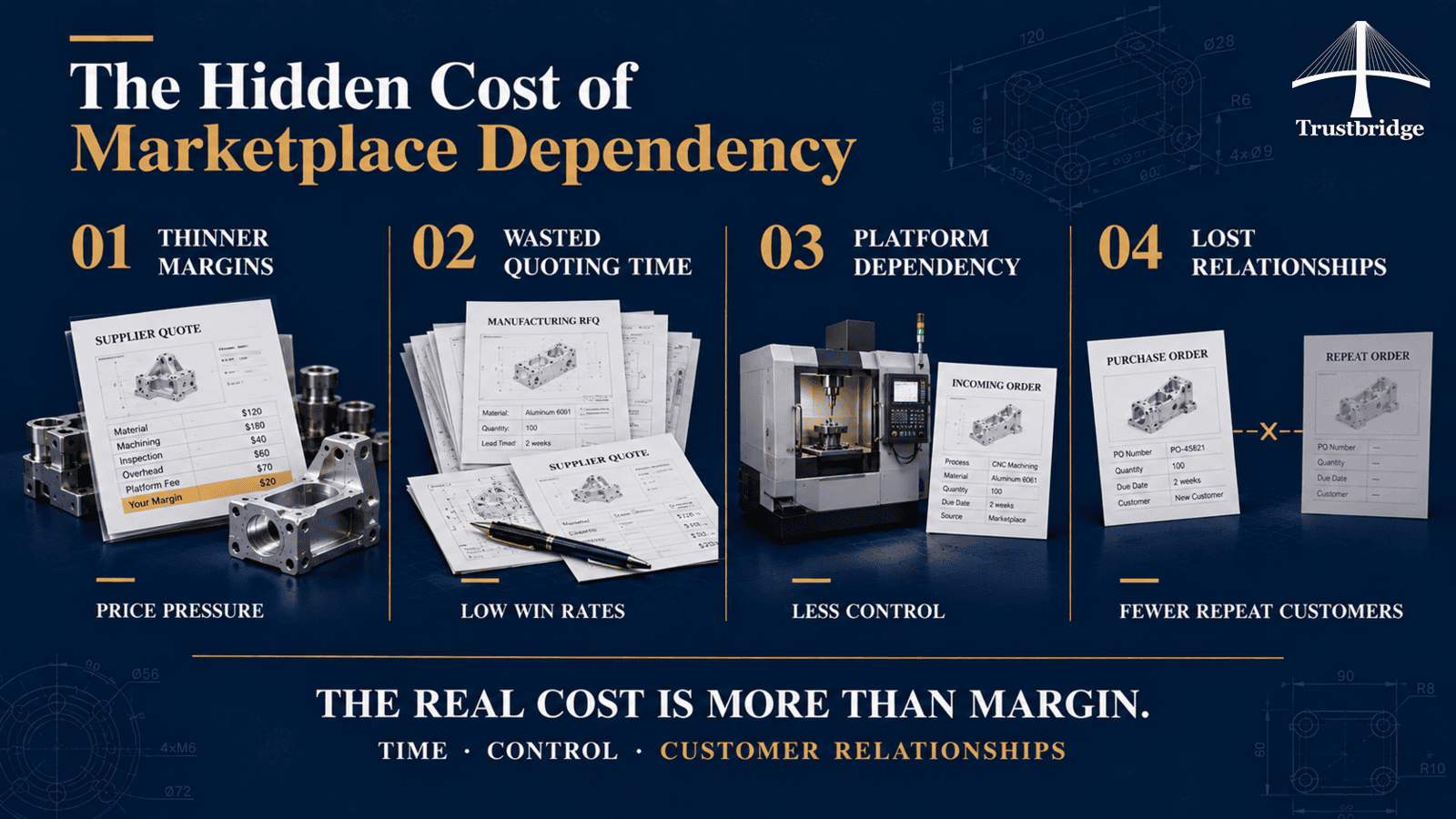
How manufacturing marketplaces work, and why buyers like them
Most online manufacturing marketplaces follow a similar model. A buyer uploads a CAD file, chooses a process, material and quantity, and gets a price, sometimes instantly and sometimes after shops in the network submit bids. The platform then routes the job to a supplier, handles payment and usually manages communication with the buyer.
For buyers, the appeal is obvious. They can get quotes quickly without building a supplier list, avoid dozens of phone calls and emails, and compare prices side by side. For a busy engineer who needs a few prototype parts next week, that convenience is real.
Marketplaces also solve a genuine problem in manufacturing: finding a capable shop is hard. Many good suppliers are nearly invisible online, and many buyers don't know where to look. A platform that connects the two fills that gap.
The trouble isn't that marketplaces exist. It's what their structure tends to reward. When the main thing a buyer sees is a list of prices, price becomes the main way suppliers compete, and that has consequences for the shops doing the work.
How good suppliers become commodity bidders
Commoditization doesn't happen all at once. It builds through a few small features of how marketplace work flows, each of which nudges suppliers toward competing on price alone.
Everything is reduced to a price.
On many platforms, the buyer's main point of comparison is cost and lead time. Your quality record, your engineering judgment and your track record with similar parts are hard to see, or not visible at all. When the only visible difference between shops is price, the buyer naturally picks on price.
Many shops see the same job.
When a job is visible to a large pool of suppliers, someone will usually bid low, whether because they have idle capacity, misread the drawing or simply need the work. That low bid resets expectations for everyone, and over time the going rate for a part type drifts downward.
The relationship belongs to the platform.
In many marketplace models, the supplier rarely talks to the end customer. You can't ask about the next project, suggest a design change that saves money or earn the kind of trust that turns one order into ten. Each job stays a transaction, and the next one may go to someone else.
There's no room to show expertise.
Some of the most valuable things a good shop does happen before the quote: questioning a tolerance, suggesting a better material, flagging a design risk. When the process is built for fast, standardized quoting, that kind of input often has nowhere to go, and the shop that adds it gets no credit for it.
Where marketplace work does make sense
None of this means marketplaces are always a bad choice. For many shops, they play a useful role when used deliberately.
Marketplace work can fill idle capacity. A machine sitting empty earns nothing, so a modest-margin job that covers costs and keeps people busy can be better than no job at all. It can also help a new shop build volume, cash flow and experience while it develops direct customers.
Platforms can expose a shop to new part types, materials and industries it might not otherwise see. Some shops use that exposure to learn which kinds of work they're best at, then go after more of it directly.
The key is intent. Marketplace work works best as a supplement you choose, with clear limits, not as the foundation your business depends on. Shops that stay in control decide in advance how much of their capacity they'll give to platforms, and what margin they'll accept.
How to stay out of the commodity trap
The answer isn't to bid lower or quote faster on every platform. It's to build a business where buyers choose you for reasons other than price. Here's where to start.
Specialize, and say so clearly.
A shop that does "all kinds of CNC work" competes with everyone. A shop known for tight-tolerance titanium medical parts, or fast-turn aluminum prototypes for robotics, competes with far fewer. Buyers find specialists more easily, trust them faster and are more willing to pay for expertise.
Own your customer relationships.
Put more effort into the customers who already work with you directly. Ask what else they buy, what's coming next quarter and which suppliers are letting them down. Existing customers who know your quality are the least price-sensitive buyers you have.
Build referrals on purpose.
In one survey of custom part buyers, 63 percent said they find new vendors through referrals, nearly as many as use internet search. Tell customers, partner shops and independent reps exactly what work you want, and refer bad-fit jobs to shops that can do them well. A referred buyer arrives already trusting you.
Show your value before the quote.
Make your capabilities, certifications and track record easy to see on your own website. Offer design feedback when you quote directly. Buyers who see your judgment before they see your price are less likely to compare you on price alone.
Track every channel's real profitability.
Compare marketplace jobs with direct jobs on margin, payment terms, rework, communication time and repeat potential. Many shops discover that work that looks similar on the schedule looks very different on the bottom line, and that clarity makes it easier to decide how much platform work to take.
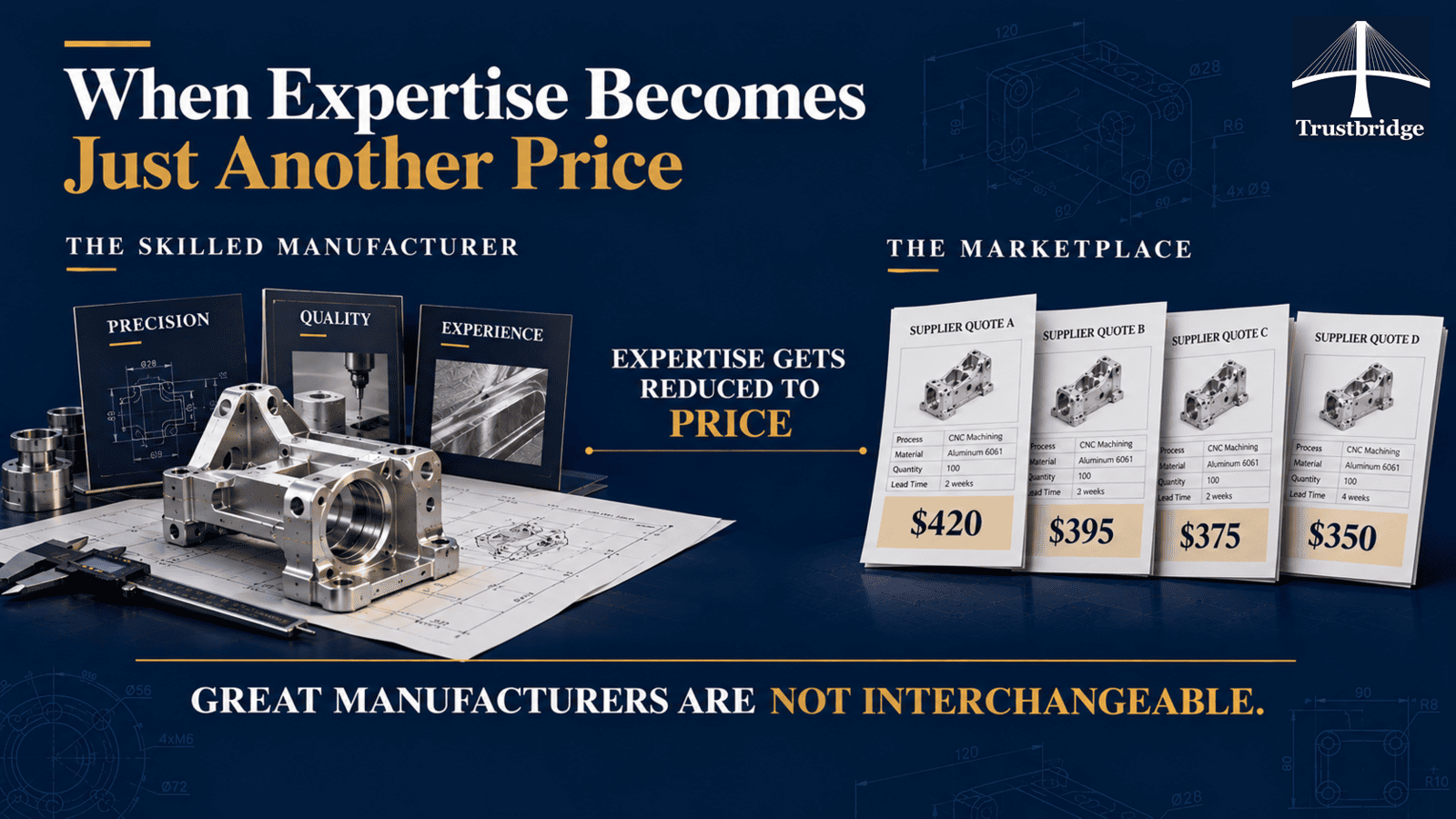
Compete on what makes you different
Manufacturing marketplaces are good at one thing: making quotes easy to compare. For buyers who need speed and simplicity, that's valuable. For skilled suppliers, it often means competing on the one dimension where their skills matter least.
The shops that grow over the long term don't win by being the cheapest bid on a crowded platform. They win by being known for something specific, owning their customer relationships and earning referrals from people who understand exactly what they do well.
Use marketplace work if it helps, but use it on your terms. Your expertise is worth more than a number in a list, and the right buyers are willing to pay for it when they can see it.
Trustbridge is building a network of great manufacturers, and we help them solve problems like the ones described here. If you run a shop and this sounds familiar, [fill out our interest form] and we'll be in touch.
Frequently asked questions
What does commoditization mean in manufacturing?
Commoditization happens when buyers see a product or service as interchangeable, so they choose mainly on price. For a machine shop, it means being treated as one of many identical options, even when its quality, speed or expertise is better.
How do manufacturing marketplaces make money from suppliers?
Models vary. Some platforms set the buyer's price and pay the supplier a lower amount, keeping the difference. Others charge fees or commissions on each order. Read a platform's supplier terms carefully so you know your real margin on every job.
What should I check before joining a manufacturing marketplace?
Look at how prices are set, how and when you get paid, who owns communication with the buyer, how quality disputes are handled and whether you can work with a buyer directly later. These terms decide whether the platform helps your business or just keeps machines busy.
How do I explain to a buyer why my quote is higher?
Point to what the buyer gets for the difference: on-time delivery, inspection documentation, relevant certifications, experience with similar parts or design suggestions that reduce risk. Buyers accept a higher price more readily when they can see the value behind it.
Can independent manufacturers' reps help shops avoid price-only competition?
Yes. A good rep knows which buyers need a shop's specific strengths and introduces the shop as the right fit, not just another quote. Because reps build long-term relationships on both sides, the work they bring is often less price-driven than open bidding.