How Do You Get More CNC Machining Work Without Relying on Aggregators
Aggregator platforms can fill gaps in your schedule, but they rarely build a business. Here are practical ways machine shops get more CNC machining work: growing existing accounts, building referrals, winning subcontract jobs and making your specialty easy to find, all without giving up the customer relationship.
Why shops want more than platform work
Every machine shop owner knows the feeling. A few machines are sitting idle, the schedule has gaps next month, and the quickest way to fill them seems to be logging into an online manufacturing platform and taking whatever jobs are posted.
Those platforms can be useful. They bring a steady flow of RFQs, handle some of the paperwork and can keep spindles turning during slow weeks. But many shops that lean on them heavily end up feeling stuck: busy, yet not building anything that lasts.
The reason is simple. When work comes through an intermediary, the relationship usually belongs to the intermediary, not to you. You make the part, but you don't own the customer, you have limited say over price and the next job may go to someone else.
The good news is that the most reliable ways to get more CNC machining work have nothing to do with platforms. They come from relationships, reputation and being easy to find for the work you do best. This guide covers how to build each one.
The trade-off of relying on aggregator work
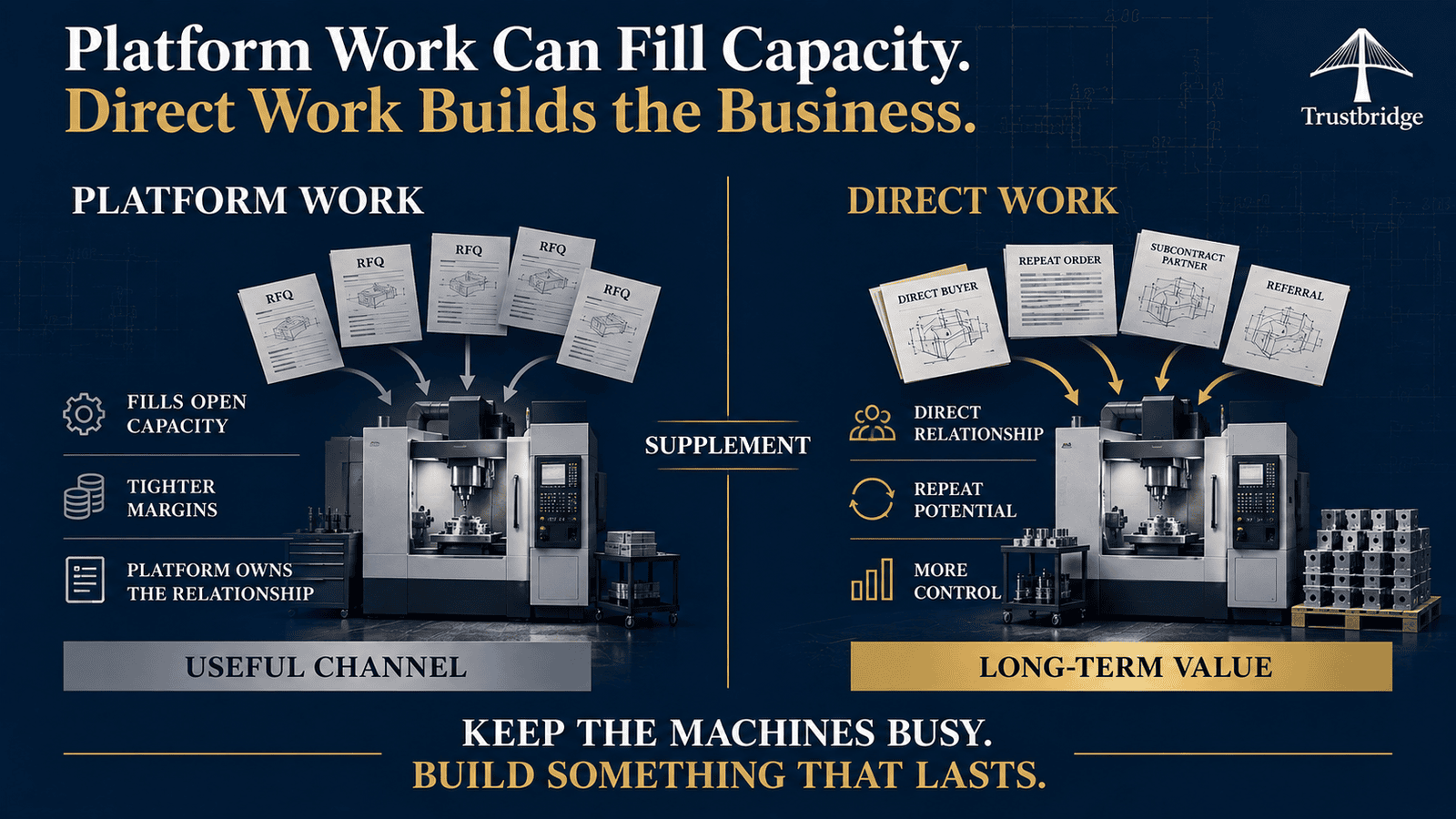
Aggregators sit between the buyer and the shop. The buyer uploads a part, the platform sets or negotiates a price, and the work is offered to shops in its network. For the buyer, it's convenient. For the shop, it comes with trade-offs worth understanding before you depend on it.
The first is margin. Because the platform takes its share and buyers often choose these services for price, the work can come in at rates tighter than you'd charge your own customers. That's fine for filling gaps, but hard to build a business on.
The second is the relationship. Often you never talk directly with the end customer. You can't learn what they're working on next, suggest a better design or earn their trust for the next project. Each job is a transaction rather than the start of an account.
The third is control. Your volume depends on someone else's pricing, rules and priorities, which can change without warning. A shop that gets most of its work from one channel it doesn't control carries real risk. The goal isn't to never take platform work. It's to make sure it's a supplement, not the foundation.
1. Grow your existing accounts first
The cheapest new work usually comes from customers you already have. Depending on the study and the industry, acquiring a new customer is five to 25 times more expensive than keeping an existing one. Your current customers already trust you, know your quality and have your contact details.
Many of them also send work elsewhere without you knowing. They may not realize you can handle a second process, a larger part size or a tighter tolerance. One quoting-software company suggests regularly reminding your customer list what you can do and what you specialize in, because customers often don't know your full range of capabilities.
The simplest step is to ask. Call your best customers and ask what they're buying that you aren't making, which suppliers are frustrating them and what projects are coming up next quarter. Those conversations often reveal work you could win without competing against anyone new.
Repeat business also comes from making reorders effortless. Keep programs, fixtures and inspection data ready for repeat parts, respond fast when the same part comes back, and hold your lead times. When reordering from you is the easiest option, customers stop shopping the job around.
2. Build a referral engine
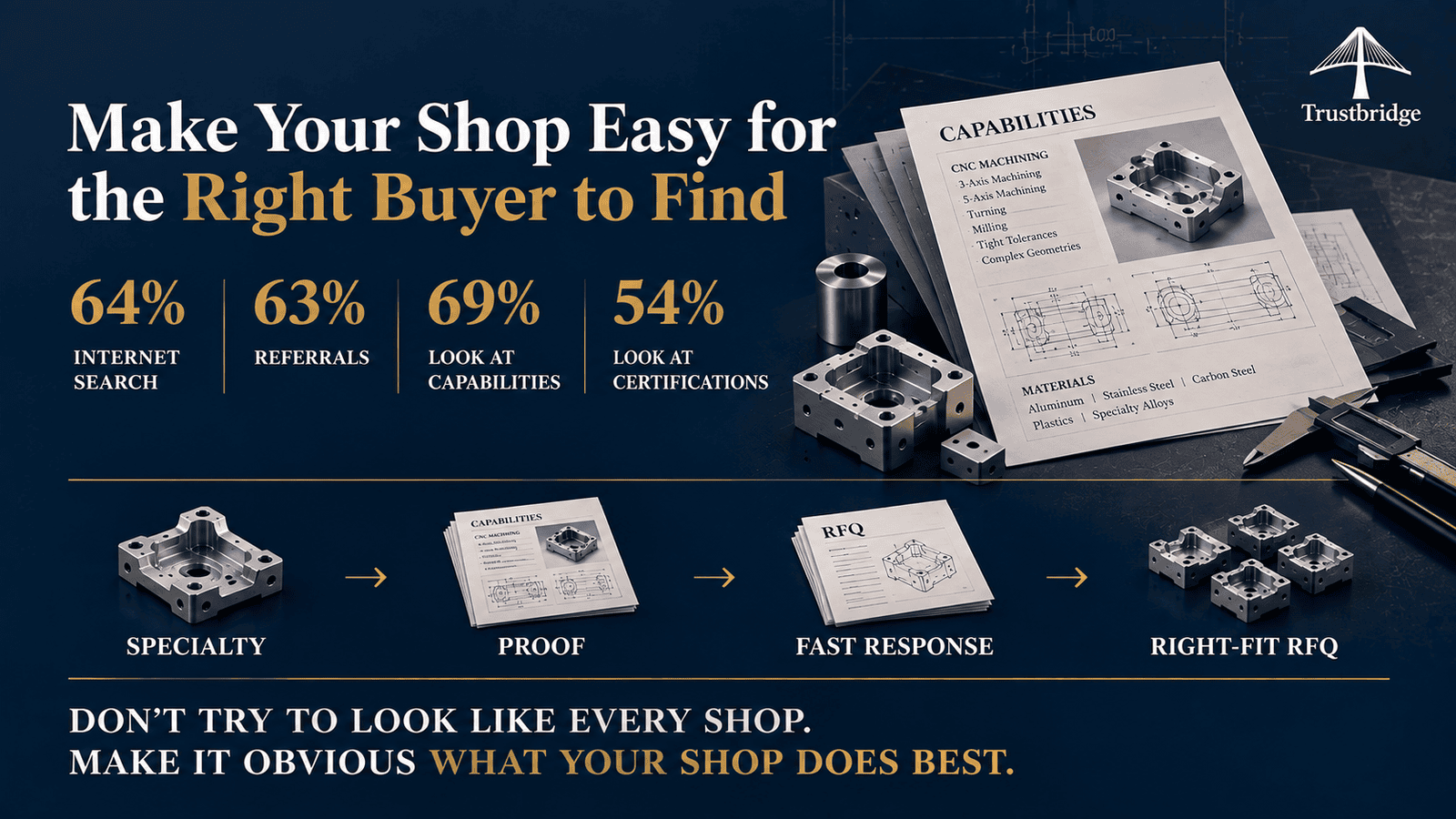
Referrals are one of the most powerful sources of new work in manufacturing. In one survey of custom part buyers, referrals were the second most common way buyers find new vendors, used by 63 percent of respondents, just behind internet search at 64%. The same survey found buyers' reliance on referrals had jumped in recent years, as they looked for vetted, reliable suppliers.
Referrals come from three main places. The first is satisfied customers, especially engineers and buyers who move between companies and bring their trusted suppliers with them. The second is other shops, which send work they can't or don't want to do to shops they trust. The third is independent manufacturers' reps, who make their living matching buyers with the right shops.
Most shops get referrals by accident. You can get far more on purpose. Thank customers and partners when they send you work, tell them exactly what kind of jobs you want more of, and stay in touch with engineers when they change jobs. A referral is far more likely when people know what to refer.
Referrals also work both ways. When you send a bad-fit RFQ to a shop that's better suited to it, you help the buyer and build goodwill with that shop. Over time, the shops you refer to are often the ones that refer back to you.
3. Win subcontract machining work
Some of the best CNC work comes from other manufacturers, not end customers. Larger job shops, contract manufacturers and OEMs with in-house machining regularly run out of capacity, lack a specific capability or need a backup supplier for critical parts. When that happens, they look for subcontractors they can trust.
To get subcontract machining work, start by identifying the companies most likely to need you. Look for larger shops in your region with complementary equipment, contract manufacturers that assemble products using machined parts, and OEMs that keep some machining in-house but outsource overflow. Then reach out with a clear message about what you can take off their plate.
Be specific. A general "we do CNC machining" email is easy to ignore. A note that says you specialize in five-axis aluminum parts up to a certain size, hold a particular certification and can turn prototypes in a week gives a busy shop owner a reason to keep your name on file.
Once you get the first subcontract job, treat it like an audition. Deliver on time, communicate clearly and protect their customer relationship. Shops that send subcontract work worry about being undercut, so being a trustworthy partner, one that never goes around them to their customer, is what turns one overflow job into a steady relationship.
4. CNC machine shop marketing: make your specialty easy to find
In the same buyer survey, internet search was the top way buyers find new vendors, used by 64 percent of respondents. If your shop is hard to find online, or your website doesn't explain what you do well, you are invisible to a large share of potential customers.
The same survey found that buyers look first at a shop's capabilities (69 percent) and quality certifications (54 percent) to judge whether it can complete their project. So your website should answer those questions immediately: the processes you run, the materials you cut, part size ranges, typical tolerances, volumes, certifications and the industries you serve.
Specialization makes marketing easier. "Full-service CNC machining" describes thousands of shops. "Tight-tolerance titanium components for medical devices" or "fast-turn aluminum prototypes for robotics startups" tells the right buyer they've found the right place, and it helps you show up in more specific searches with less competition.
Back it up with proof. Photos of real parts, short case studies, a downloadable capability sheet and a clear way to submit drawings all make it easier for a buyer to take the next step. Good CNC machine shop marketing isn't about looking big; it's about making the right buyer confident you're the right fit.
5. Machine shop sales strategies that attract high-quality leads
Marketing helps buyers find you. Sales means going out and finding them. For most shops, the best approach is narrow and targeted: pick a few industries and customer types where you're strongest, and focus your outreach there instead of chasing everyone.
Start with a short list of target accounts. Look for companies in your best-fit industries, within a practical shipping distance, that buy parts like the ones you make well. Then reach the engineers and buyers directly with a specific message: the kinds of parts you make for companies like theirs, and why you'd be a good backup or primary source.
Trade shows and industry events still matter. Regional manufacturing events, industry-specific conferences and supplier days let buyers meet you face to face, and trade publications ranked third in the buyer survey as a way to find new vendors. Go with a clear goal, such as ten conversations with engineers in your target industry, rather than just handing out cards.
Independent manufacturers' reps are another option. A good rep already has relationships with buyers in your target market and works on commission, so you pay only when work comes in. The key is choosing reps whose customers match your specialty, and giving them clear information about the jobs you want.
6. Respond fast, and say no well
Getting more RFQs only helps if you win them, and speed is one of the biggest factors. In the same buyer survey, 47 percent of respondents said speed of response directly affects their decision to work with a shop, and another part-buyer survey found 67 percent of buyers expect a quote in less than 24 hours.
That doesn't mean quoting everything. It means deciding quickly which RFQs fit your shop and responding to those first. A fast, accurate quote on a good-fit job does more for your business than a slow quote on ten jobs you were never likely to win.
For RFQs that don't fit, say no quickly and politely. Silence frustrates buyers and makes them less likely to send the next job. A fast decline, with a short explanation and a suggestion of a better-suited shop if you know one, leaves a far better impression.
Buyers are open to new suppliers: 94 percent in the survey had tried at least one new vendor in the previous 12 months. Shops that respond quickly, deliver on time and handle declines professionally are the ones that turn a first RFQ into a long-term customer.
Are manufacturing aggregators worth it for shops?
The honest answer is: sometimes, in the right role. Platform work can fill open capacity, help a new shop build volume and expose you to part types you might not see otherwise. For some shops, it's a sensible way to keep machines busy between larger jobs.
Problems start when platform work becomes the main source of revenue. Margins can be thinner, you often don't own the customer relationship, and your volume depends on rules and pricing you don't control. A slow month on the platform becomes a slow month for your whole shop.
A useful way to decide is to track it. Compare the margin, payment terms, rework and repeat potential of platform jobs against your direct customers. Many shops find that the work looks similar on the schedule but very different on the bottom line.
The healthiest approach is balance. Use platforms, if you use them, as one channel among several, and put most of your effort into the channels that build long-term value: existing accounts, referrals, subcontract partners and buyers who find you directly because of what you do best.
Frequently asked questions
How do machine shops find new customers?
Most new customers come from a handful of channels: internet search, referrals from customers and other shops, trade publications and events, and direct outreach to companies in a shop's best-fit industries. Shops that grow steadily usually combine two or three of these rather than relying on one.
How do I find CNC machining jobs for my shop?
Start close to home. Ask existing customers what else they buy, contact larger shops and contract manufacturers that may need overflow help, and make sure your website clearly lists your capabilities so buyers searching for your type of work can find you.
How do small machine shops get clients?
Small shops win by being specific and responsive. Focusing on a niche, such as a material, part type or industry, makes you easier to find and recommend, and fast, reliable communication is an advantage larger competitors often can't match.
What is the best way to market a CNC machine shop?
A clear, capability-focused website is the foundation, because it supports every other channel. Add photos of real parts, a downloadable capability sheet and a simple way to submit drawings, then point referrals, trade show contacts and outreach back to it.
How do I find subcontract CNC work?
Identify regional job shops, contract manufacturers and OEMs that run their own machining and may need overflow capacity or a capability they lack. Reach out with a specific description of what you can take on, and once you win a job, protect their customer relationship to earn repeat work.
How do I get repeat business in a machine shop?
Make reordering easy and reliable. Keep programs and fixtures ready for repeat parts, hold your quoted lead times, communicate early about any issues and check in with customers about upcoming projects, so they come back to you before they shop the job around.