
Cast Urethane Quote Requests: What Shops Wish Customers Knew, and How to Get Better RFQs
A cast urethane quote depends on a few things a general manufacturing RFQ never asks about. Get those specific to the process right, and the quote that comes back is one you can actually plan a program around.
Introduction
Cast urethane sits in an unusual spot in manufacturing. There's no metal tooling, a mold that wears out after a few dozen parts, and a material property hardness that has to be specified as an actual number rather than a general description. A general manufacturing RFQ built around files, material grade, and tolerance covers a lot of ground. It doesn't ask about any of that. That's exactly why a cast urethane quote built on a generic RFQ template usually comes back with a shop guessing at the parts that matter most.
This isn't a rehash of general RFQ advice with "urethane" swapped in. The three things below Shore hardness, master pattern quality, and mold life against real quantity are specific to how an urethane casting service actually operates. Getting them right is most of what separates a quote a shop can stand behind from one built on assumptions.
Shore Hardness Is the One Spec That Can't Be Approximated
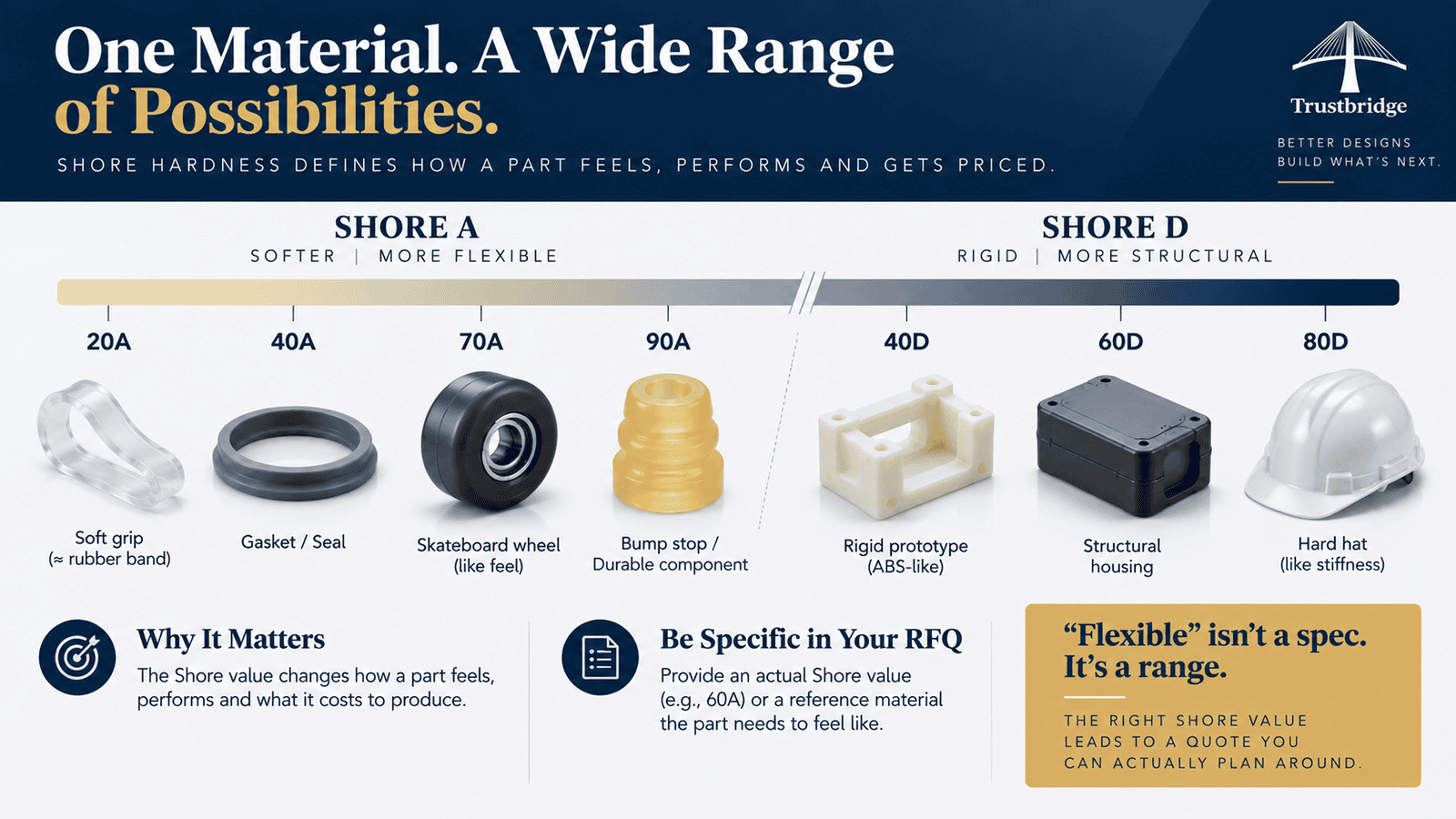
Cast urethane resins span an enormous range of stiffness, measured on the Shore durometer scale, and where a resin lands on that scale changes both how a part feels and what it costs to produce. Shore A covers the softer end, from around 20A, about as soft as a rubber band, up through 90A, closer to a skateboard wheel. Shore D covers the rigid end, from around 40D up past 80D, in the neighborhood of a hard hat. "Flexible" could mean anything from a soft grip material to a firm gasket, and a shop asked to quote "flexible urethane" without a number is quoting a different material than whatever the buyer actually had in mind.
This matters more in urethane casting than in most other processes. The resin itself is the main lever for matching a prototype's feel to production intent, simulating everything from soft-touch TPU to rigid ABS-like housings with the same casting process. Naming an actual Shore value, or naming a reference material the part needs to feel like, removes the single biggest guess a foundry has to make before it can quote accurately at all.
The Master Pattern Decides Everything Downstream
Every cast urethane part starts from a master pattern, usually 3D printed or CNC machined, sometimes an existing physical part being reverse-engineered when no CAD file exists at all. Whatever surface finish, dimensional accuracy, and detail that master carries gets replicated directly into the silicone mold, and from there into every part the mold produces. A soft edge or a surface flaw on the master doesn't get corrected in the casting step. It gets copied.
That makes the master pattern conversation worth having explicitly in an RFQ, not assumed. Is the buyer supplying a finished, inspection-ready master, or does the shop need to produce one first from a CAD file? If there's no CAD file and the part is being reverse-engineered from a physical sample, that's its own step with its own accuracy limits. It's better flagged upfront than discovered once the first cast part comes back looking like a faithful copy of a flaw nobody meant to keep.
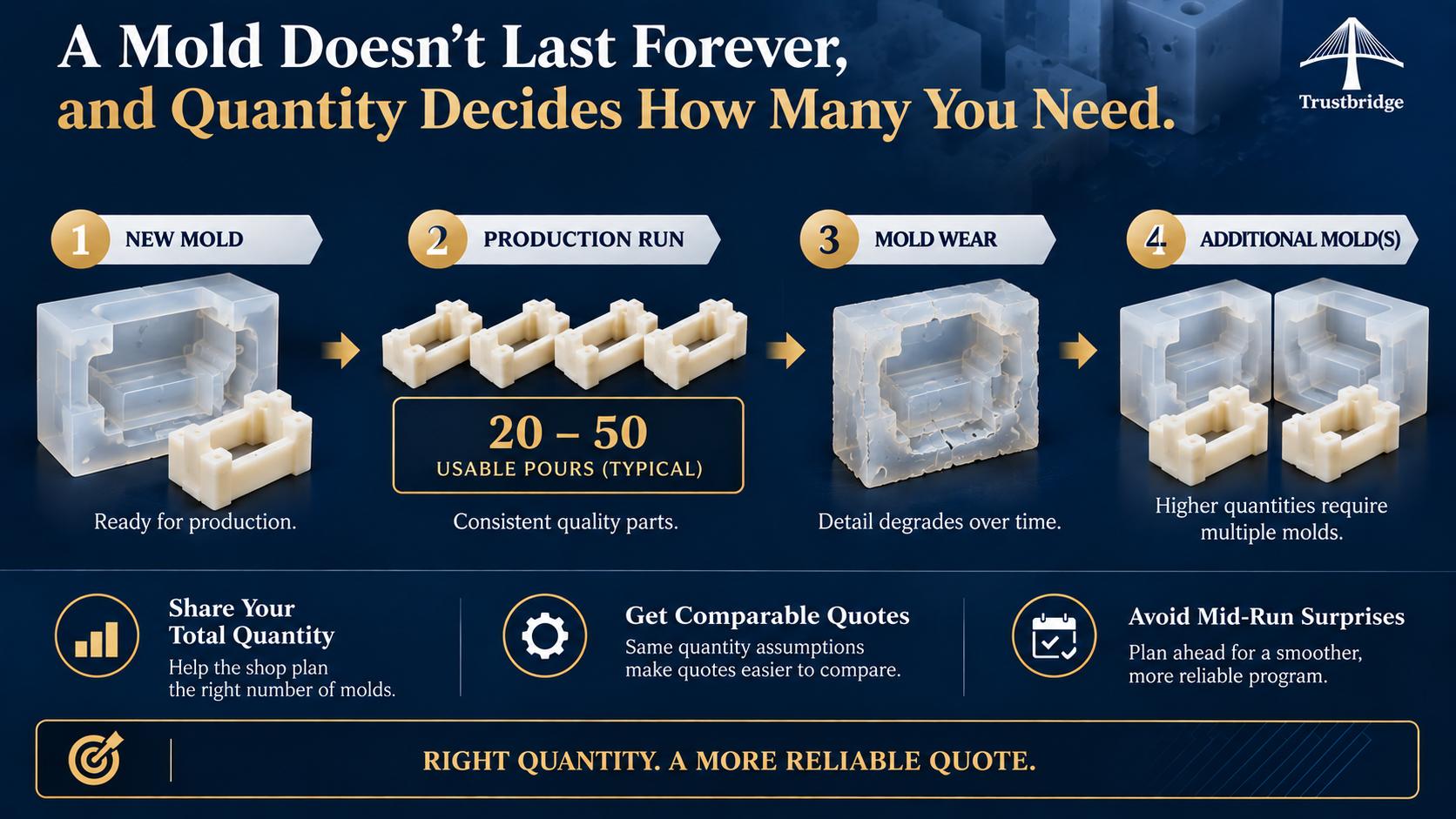
A Mold Doesn't Last Forever, and Quantity Decides How Many You Need
A silicone mold used in cast urethane isn't a permanent tool. Repeated exposure to the heat and chemistry of curing resin gradually tears, shrinks, or degrades mold detail, and most shops get somewhere around 20 to 50 usable pours out of a single mold before quality starts to slip. That number moves with part geometry, resin choice, and mold silicone grade, but it's never unlimited, which means total part quantity isn't just a pricing input. It directly determines how many molds a program actually needs.
An RFQ that states "50 units for now, more later" is asking a shop to price one mold's worth of parts while quietly hoping the relationship extends further without a second mold ever coming up. A number closer to the real expected total, even a rough one, lets a shop price and plan for exactly how many molds a program needs. It also makes quotes from suppliers genuinely comparable to each other, since two shops quoting against different assumed quantities aren't really pricing the same program at all. Skip that step, and the more common outcome is discovering mid-run that the original mold is worn out with no replacement built into anyone's plan.
Conclusion
None of this replaces the basics that apply to any manufacturing quote: a clear file, a real quantity, a stated deadline. What it adds is specific to how cast urethane actually behaves as a process. A Shore value that removes the guesswork on material feel. A master pattern conversation that happens before casting starts, not after a flaw shows up in every part. A quantity that accounts for how many molds the real total will actually require. Get those three right, and a cast urethane quote stops being an estimate built on assumptions and starts being a number a program can actually be planned around.
Get Quotes From Shops That Actually Run Cast Urethane
Not every job shop or contract manufacturer that lists cast urethane services on a website runs it as a core capability, and the gap between the two shows up fastest in exactly the details this piece has covered. Trustbridge matches urethane casting requests to shops with real, verified experience in the process. That includes judgment calls a generalist shop is more likely to get wrong like whether a given part is actually better suited to cast silicone vs urethane resin as the finished material. The quote that comes back reflects an actual understanding of Shore hardness, mold life, and master pattern quality, not a generic estimate from a shop treating it as an occasional side job.
Frequently Asked Questions
1. What information should be included in a cast urethane RFQ?
A cast urethane RFQ should include the required Shore hardness, part files and tolerances, surface finish requirements, master pattern expectations, total expected quantity, and target timeline. Providing these details upfront helps suppliers quote the actual casting process instead of making assumptions about material, tooling, or production requirements.
2. Why is Shore hardness important when requesting a cast urethane quote?
Shore hardness determines how soft, flexible, or rigid the finished urethane part will be. Because cast urethane materials cover a wide range of hardness levels, specifying an exact Shore A or Shore D value—or a reference material with the required feel—helps suppliers select the appropriate resin and provide a more accurate quote.
3. How does master pattern quality affect cast urethane parts?
The master pattern determines the surface finish, dimensions, and details transferred to the silicone mold and ultimately to the cast urethane parts. If the master pattern contains surface defects or dimensional inaccuracies, those characteristics can be reproduced in every casting. An RFQ should therefore clarify whether the customer is supplying the master pattern or expects the supplier to create one.
4. How many parts can a silicone mold produce for urethane casting?
A silicone mold typically produces a limited number of usable castings before its detail or dimensional performance begins to decline. The actual mold life depends on factors such as part geometry, resin, and silicone grade. Because of this, expected total quantity should be stated clearly in the RFQ so the supplier can determine whether multiple molds will be required.