
The RFQ We Lost and Why Losing It Was More Valuable Than Winning It
The Quote That Was Supposed to Win
Penelope had already planned where the work would go.
Her shop does sheet metal fabrication: laser cutting, press brakes, welding, powder coat through a partner down the road. Twenty-two people, two shifts on a good month. The request was for 1,200 steel electrical enclosures a year, released in batches of 100. It was steady, repeatable work, and exactly the kind of job a shop her size wants on the schedule.
She sharpened her pencil harder than she ever had. She trimmed her margin, shaved setup time in her estimate, and assumed her best-case scrap rate. The quote went out at a number she was almost uncomfortable with.
Two weeks later, the email came. Thank you for your quote. We have decided to go with another supplier.
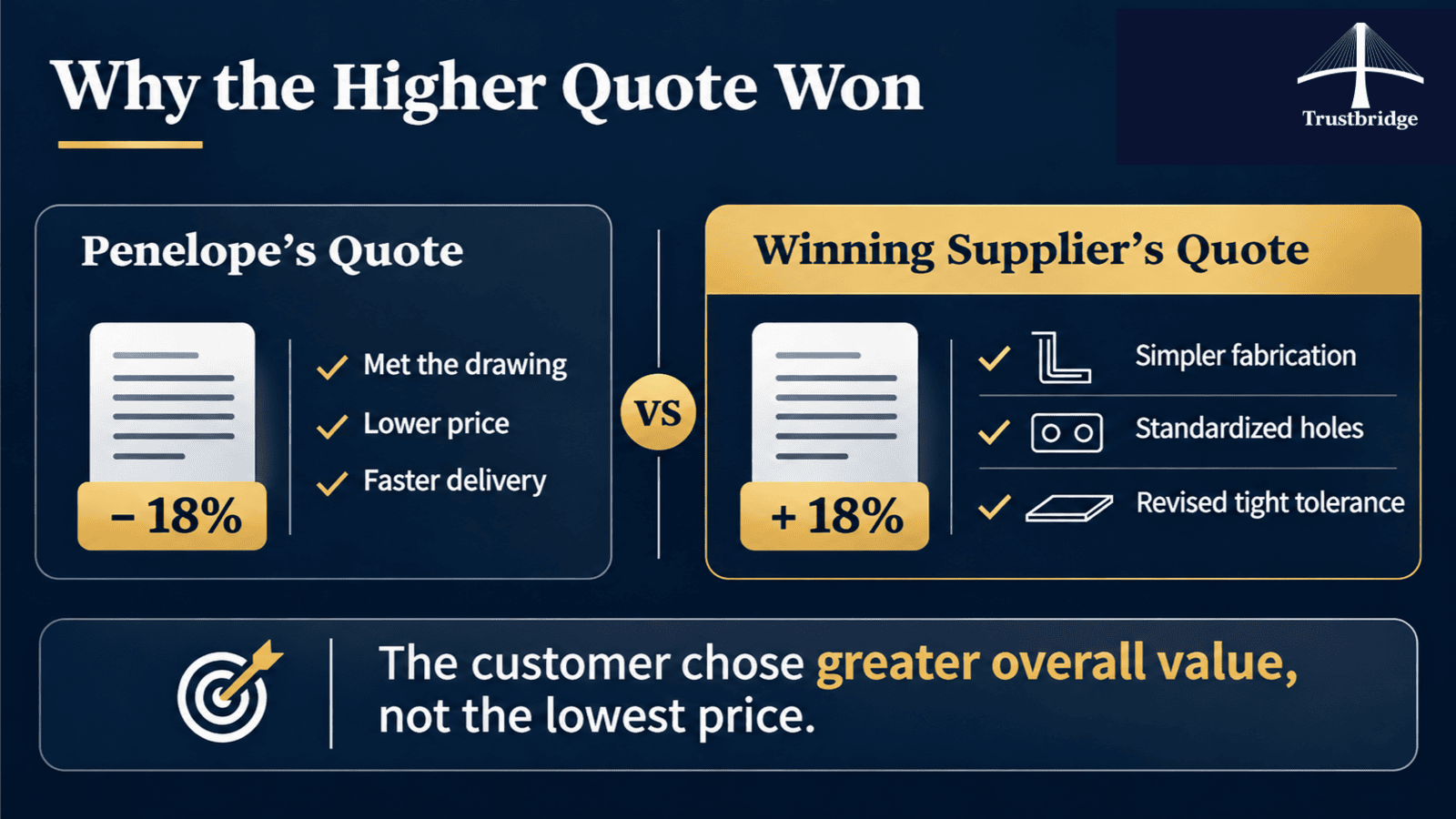
She found out later that the shop that won had quoted 18% higher than she had.
The Stories We Tell Ourselves
The first explanation came fast. They must have a relationship with that other shop. The second followed close behind. The buyer didn't understand what they were comparing.
Penelope's estimator had a third theory: the other shop was probably overseas, or had some volume deal on steel nobody local could match. Her production lead thought the customer had simply never intended to switch and was using her quote to squeeze their incumbent.
All of these were possible. None of them required anyone in the building to change anything. That is what makes them comfortable, and it is why most lost quotes end right here, filed away with a shrug.
Penelope almost let this one go the same way. What stopped her was the 18%. Losing on price she understood. Losing to a higher price meant the customer was buying something she hadn't offered.
The Phone Call
So she did something she had never done. She called the buyer and asked, plainly, why she lost.
The buyer was surprised to be asked, and then surprisingly candid. Price had not been the deciding factor. The winning shop had sent back their quote with a one-page markup of the drawing.
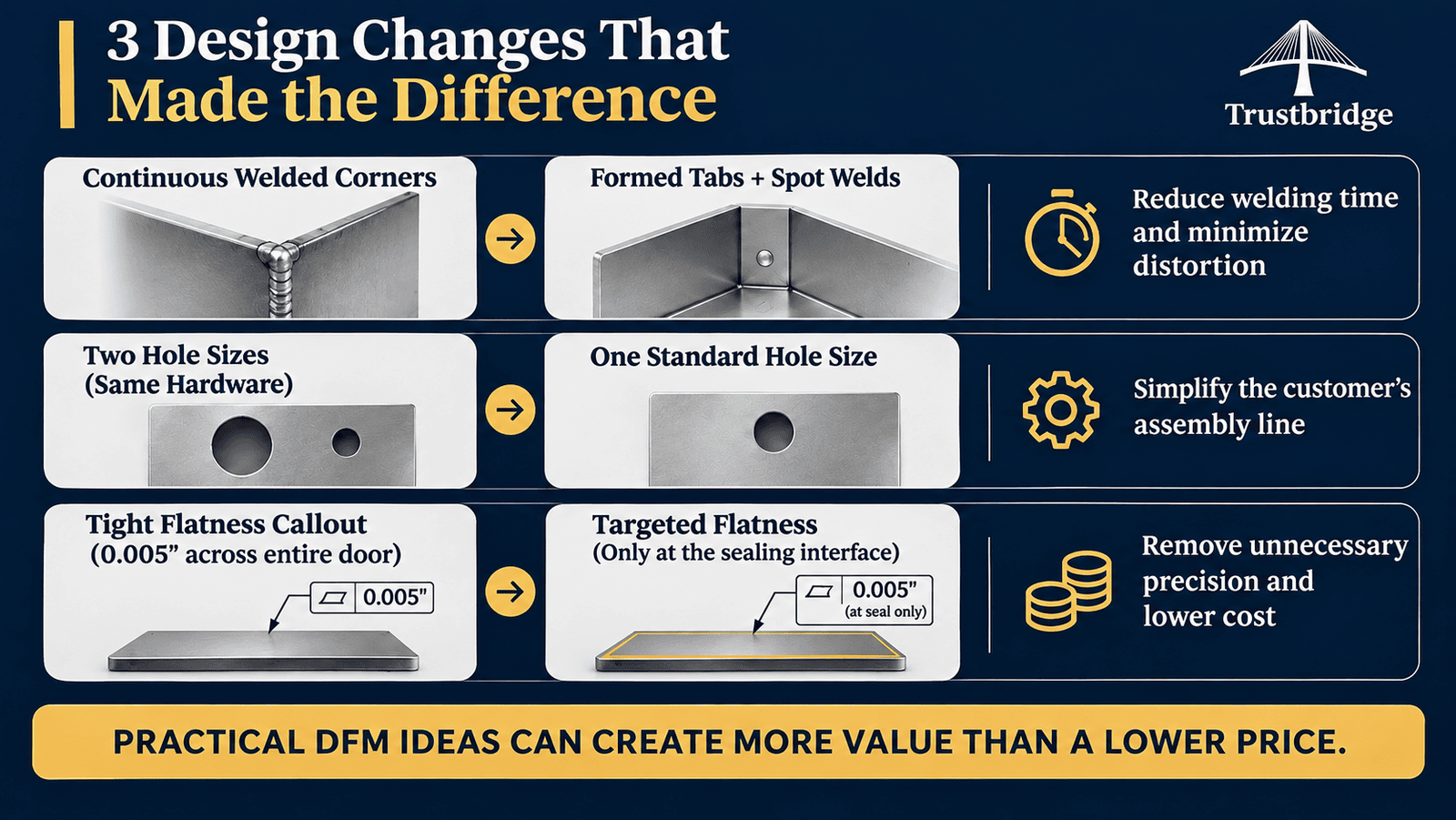
They had suggested redesigning the enclosure corners using formed tabs and strategically placed spot welds instead of continuous welded seams, provided the revised design could meet the enclosure's structural and sealing requirements. The change could reduce welding time, and minimize thermal distortion. They had also flagged that two different hole sizes for the same hardware could be made one size, which would simplify the customer's own assembly line. They had questioned whether the 0.005-inch flatness requirement across the entire enclosure door was necessary, or whether that level of precision was only needed around the sealing interface.
"Your price was lower on the drawing we sent," the buyer said. "But their suggestions will save us more than the difference, on the part and on our own line, for as long as we build this product. And honestly, it felt like they'd thought about our product. Your quote felt like you'd thought about your machines."
Penelope thanked her, hung up, and sat very still for a while.
What the Loss Was Really Telling Her
The hard part was that her team had seen every one of those things.
Her lead welder had grumbled about the corner welds while they were estimating. Her brake operator had noticed the mismatched hole sizes. Her estimator had padded the door specifically because of that flatness callout. They knew. They just never told the customer, because nobody thought that was their job. The job, as they understood it, was to take the drawing as given and put the lowest defensible number on it.
That realization pulled on a few other threads:
Pricing. She had been competing on price in a race she couldn't win and didn't need to run. Cutting her margin bought her nothing, because price wasn't the question the customer was asking.
Positioning. Her shop's real strength was twenty years of knowing how sheet metal behaves. None of that showed up on a quote. On paper, she looked like every other shop with a laser and a press brake.
The right work. When she looked back over the year, her best jobs, the ones that stayed, paid on time and grew, had one thing in common. The customer had brought her in early, while the design could still change. Her worst jobs were drawings thrown over the wall, priced against five other shops.
She hadn't lost because she was too expensive. She'd lost because she had been selling the least valuable thing her shop knew how to do.
What Penelope Does Now
The next Monday, she changed two habits.
First, every quote now goes out with a short manufacturability note. Sometimes it's one line. Sometimes it's a marked-up drawing. If her team sees a way to make the part cheaper, stronger or easier to build, the customer hears about it, even when it lowers the shop's own price.
Second, she treats every lost quote as information worth a phone call. After each loss, she tries to answer a few questions:
Did we lose on price, or on something we didn't offer? If a higher bid won, the customer was buying something else.
Did we show what we know? A quote that only contains a number says the shop only has a number to offer.
Was this our kind of work? Some losses are a gift. They're jobs the shop was never set up to do well.
When did we see the design? If the answer is "after it was frozen," the shop was competing for the least valuable part of the project.
What would we do differently next time? One concrete change per loss is enough.
Not every buyer answers. The ones who do have taught her more than any job she has won.
Eight months later, she quoted the same customer on a new product, this time while the design was still in CAD. She won it, at her full margin.
Why We Tell This Story
Penelope is a composite, but the lesson she learned is one we see play out again and again.
Trustbridge is a product design studio, and design for manufacturability is at the heart of our work. From where we sit, the most valuable thing a shop knows is rarely its price. It's the welded corner that should be a bend, the tolerance that's costing more than it's worth, the hole that could match its neighbor. That knowledge is worth the most while a design can still change, and it is usually wasted when it arrives after the drawing is frozen.
That's why we bring manufacturers into our projects at a specific point: when the design is far enough along to be real, but early enough that feedback from the people who will run the parts can still shape it. Shops that think like Penelope does now are exactly who we want at that table.
We work with a group of manufacturing partners who share that view, and we're building practical tools for the shops we work with, aimed at the everyday decisions that never make it onto a drawing.
If you run a shop and you'd rather be known for what you know than for how low you'll go, tell us about your shop.
And if you're designing a product headed for production, talk to us while the design can still change. That's when the people who build it can help most.