
What Separates a Machine Shop That Grows from One That Just Stays Busy
Preamble
Many machine shops stay busy year after year yet struggle to achieve meaningful growth. Full production schedules do not automatically translate into higher profitability, stronger customer relationships, or long-term business expansion. The difference between a shop that grows and one that simply remains occupied often comes down to strategy rather than workload.
Successful manufacturers focus on building a sustainable manufacturing growth strategy that balances operational excellence, customer acquisition, profitability, and capacity management. By understanding the factors that drive machine shop profitability and manufacturing sales growth, suppliers can move beyond short-term production demands and create a foundation for long-term success.
Introduction
For many machine shop owners, a full production schedule feels like a sign of success. Machines are running, employees are busy, and customer orders continue to arrive. However, being busy and being profitable are not always the same thing.
Many manufacturers discover that despite working at full capacity, they struggle to improve margins, attract better customers, or expand their operations. This often creates a cycle where the shop remains occupied but fails to achieve meaningful business growth.
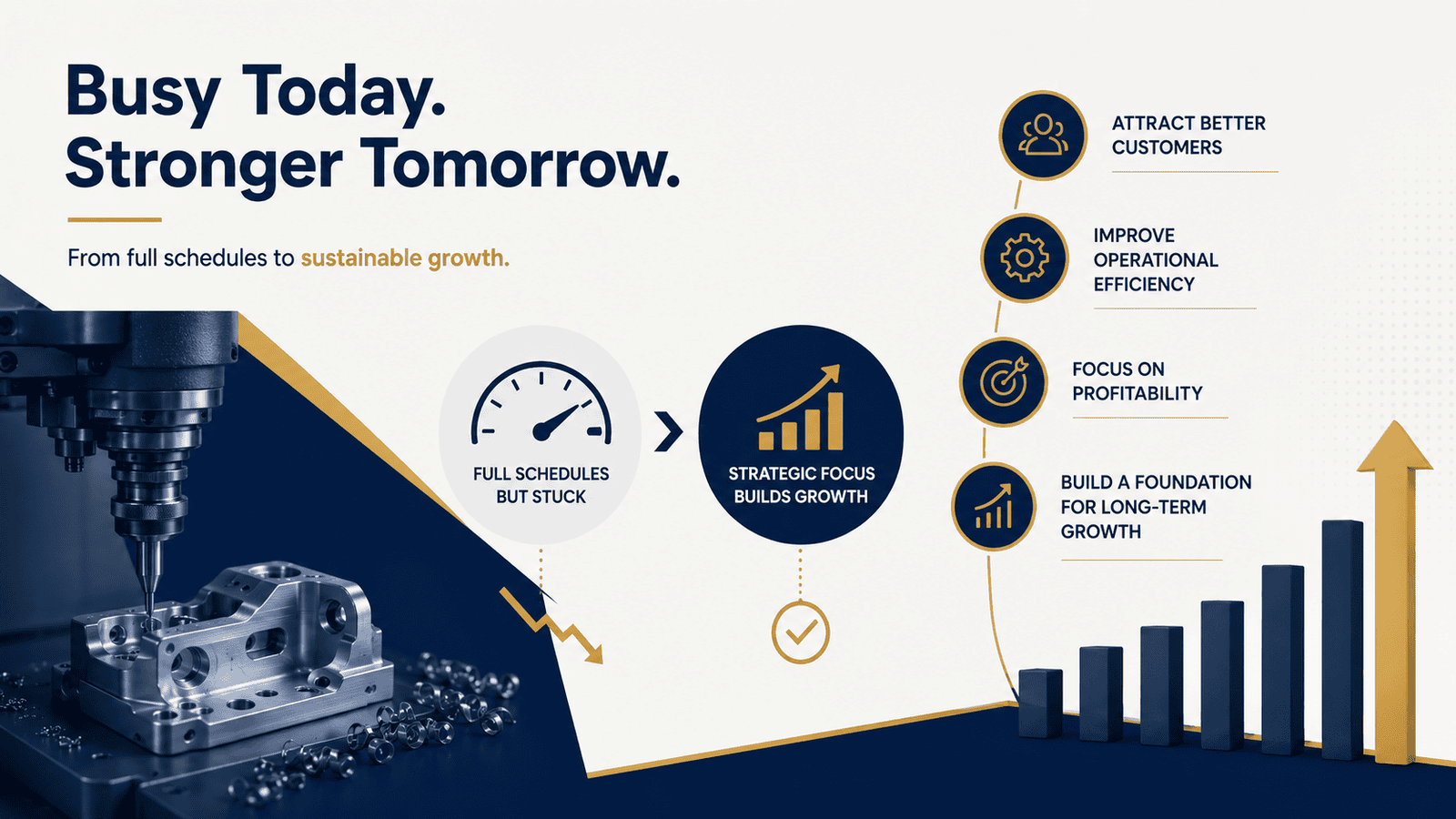
In many cases, the problem is not a shortage of work but a shortage of strategic focus on profitability, customer mix, and operational efficiency.
Understanding how to grow a manufacturing business requires looking beyond day-to-day production activity. Sustainable growth comes from developing a clear strategy that improves profitability, strengthens customer relationships, increases operational efficiency, and positions the company for future opportunities.
The machine shops that consistently grow are not necessarily the largest or the busiest. They are the ones that make deliberate decisions about where they invest their resources, how they manage capacity, and how they create value for customers.
Growth Requires More Than Keeping Machines Running
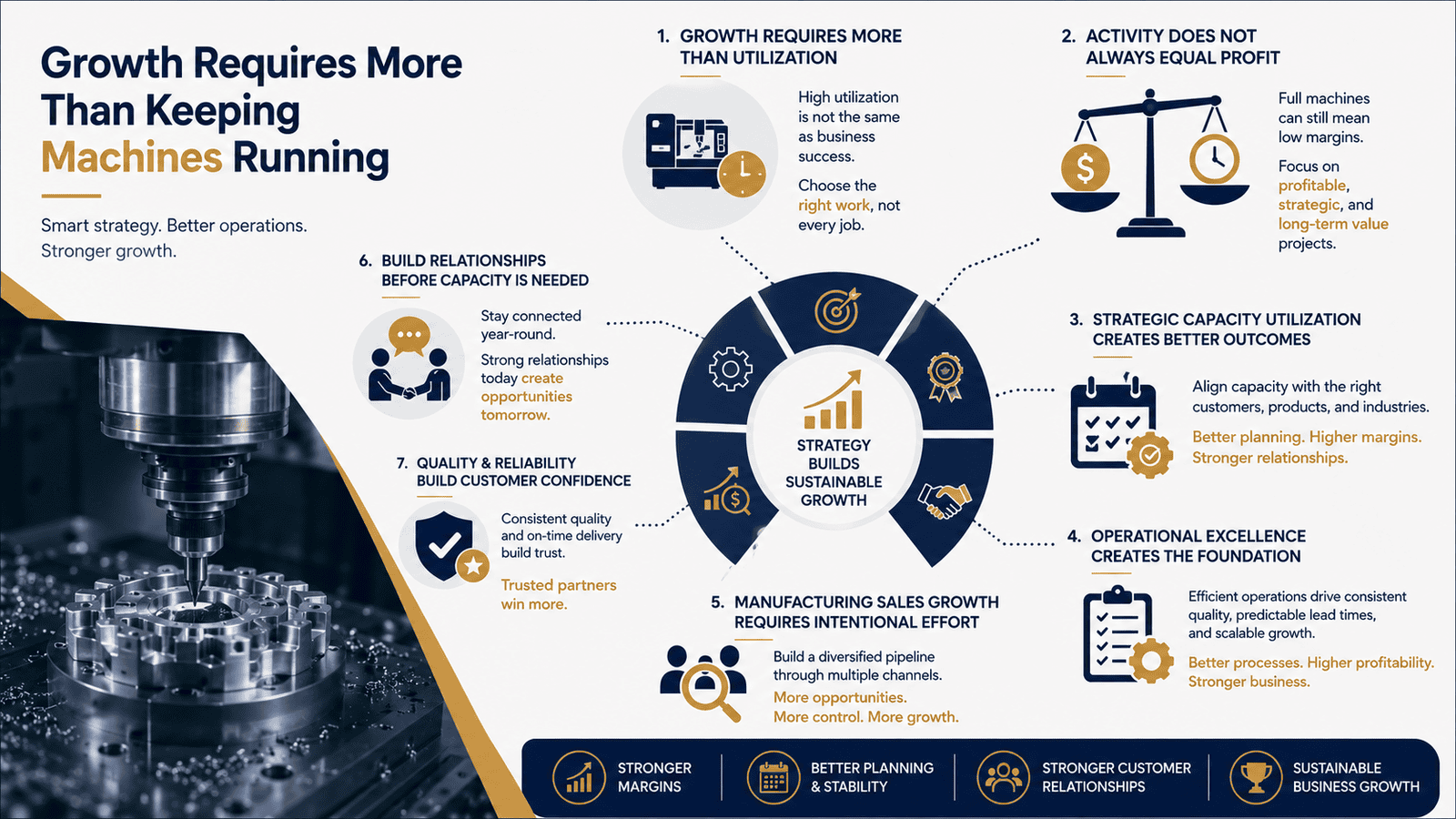
Many manufacturers equate high machine utilization with business success. While keeping equipment productive is important, growth requires more than simply filling available machine hours.
A shop that accepts every available job may generate revenue, but it can also create scheduling conflicts, operational inefficiencies, and pricing challenges that limit long-term profitability. The most successful manufacturers understand that sustainable growth comes from choosing the right work rather than accepting every opportunity that comes through the door.
- Activity Does Not Always Equal Profitability
A machine shop can operate at near-full capacity while generating modest profits. Low-margin jobs, excessive setup requirements, frequent schedule changes, and inefficient workflows can consume valuable resources without creating meaningful financial returns.
Growing companies focus not only on workload volume but also on the quality of the work they accept. They evaluate projects based on profitability, strategic fit, and long-term customer value rather than simply keeping machines occupied. This allows valuable machining capacity to be reserved for customers and projects that generate stronger margins and repeat business instead of constantly chasing short-term revenue.
- Strategic Capacity Utilization Creates Better Outcomes
Effective capacity utilization means using available resources in a way that supports both current operations and future growth. Rather than filling every machine hour with any available work, successful manufacturers allocate capacity toward customers, products, and industries that align with their long-term objectives.
For example, a precision CNC shop may choose to prioritize repeat aerospace or medical machining programs with stable demand instead of accepting multiple low-margin one-off jobs that require frequent setup changes. Although both options keep machines running, the first creates greater scheduling stability, higher profitability, and stronger long-term customer relationships.
This strategic approach creates stronger margins, improves production planning, and supports sustainable business performance.
Operational Excellence Creates the Foundation for Growth
One of the most important factors separating growing machine shops from stagnant ones is operational excellence. Efficient operations allow manufacturers to deliver consistent quality, maintain predictable lead times, and scale production without creating unnecessary complexity.
Operational improvements often have a greater impact on profitability than simply increasing sales volume. When production processes become repeatable and measurable, manufacturers spend less time solving recurring problems and more time focusing on strategic growth opportunities.
- Process Consistency Reduces Hidden Costs
Inconsistent processes create waste throughout manufacturing operations. Delays, rework, scheduling disruptions, quality issues, and communication breakdowns all reduce profitability.
Machine shops that document processes, standardize workflows, and continuously improve operations create a more stable environment that supports sustainable growth. When production becomes predictable, management teams can focus more attention on strategic initiatives rather than constantly reacting to operational problems.
Standardized setup procedures, documented inspection plans, and consistent tooling practices also reduce variation between shifts, helping improve delivery performance and customer satisfaction.
- Quality and Reliability Build Customer Confidence
Reliable quality is one of the strongest competitive advantages a machine shop can develop. Customers expect parts to meet tolerance requirements, arrive on time, and perform consistently across every production run.
For example, if a supplier consistently delivers precision-machined components within specified tolerances and maintains on-time deliveries across multiple blanket orders, procurement teams are far more likely to award additional programs without reopening supplier qualification. Consistent inspection results, reliable process controls, and predictable lead times demonstrate operational maturity that buyers value.
As machine shops improve operational excellence, they strengthen their reputation and become trusted manufacturing partners rather than suppliers selected primarily on price.
Manufacturing Sales Growth Requires Intentional Business Development
Many machine shops rely heavily on existing customers and referrals. While these relationships are valuable, they may not provide enough opportunities to support long-term expansion.
Sustainable manufacturing sales growth requires a structured approach to business development. Building a diversified pipeline allows manufacturers to pursue higher-value opportunities while reducing dependence on any single customer or industry segment.
- Diversifying Customer Acquisition Channels
Growing manufacturers actively pursue new opportunities through multiple channels. They invest in digital marketing, industry networking, trade shows, referral programs, strategic partnerships, and targeted outreach efforts.
This diversified approach reduces dependency on any single source of business. A consistent pipeline of qualified opportunities also allows manufacturers to be more selective about the projects they pursue, improving profitability and long-term customer alignment.
- Building Relationships Before Capacity Is Needed
Many suppliers begin prospecting only when production schedules slow down. Unfortunately, manufacturing sales cycles often take months to produce results.
Successful machine shops build relationships continuously, even during busy periods. By maintaining regular contact with engineering teams, procurement professionals, and existing customers, they create future opportunities that support sustainable growth and reduce revenue fluctuations.
Strong Customer Selection Drives Machine Shop Profitability
Not all customers contribute equally to business growth. Some customers create stable revenue streams and collaborative partnerships, while others generate constant pricing pressure and operational challenges.
Growing manufacturers understand that selecting the right customers is just as important as winning new business. Choosing projects that match technical capabilities and production strengths often leads to better operational performance and stronger long-term profitability.
- Identifying Ideal Customer Profiles
The most successful machine shops clearly define the types of customers they serve best. This may include specific industries, production volumes, material requirements, quality expectations, or technical capabilities.
For instance, a shop specializing in tight-tolerance multi-axis machining may achieve better results by focusing on aerospace or medical OEMs rather than competing for high-volume commodity components where pricing becomes the primary decision factor. This alignment improves quoting efficiency, production planning, and customer satisfaction.
Some projects may generate immediate revenue but offer little long-term value.
Growing companies evaluate opportunities based on repeat business potential, profitability, strategic fit, engineering collaboration, and relationship strength. This approach creates a healthier customer portfolio that supports sustainable business development and more predictable future workloads.
Growth Depends on Scaling Systems, Not Just Sales
Winning additional business is only one part of growth. Manufacturers must also ensure their operations can support increased demand without sacrificing quality or profitability.
Without scalable systems, growth can quickly create operational stress. As customer expectations increase, manufacturers need stronger planning, quality, and communication processes that allow the business to expand without losing operational control.
- Building Processes That Support Expansion
As customer volume increases, informal processes often become bottlenecks. Successful manufacturers invest in scheduling systems, quality management procedures, production planning tools, and performance metrics that support larger operations. These systems create structure and allow organizations to grow without losing control of day-to-day activities.
- Investing in People and Leadership
Growth requires more than equipment investment. Strong leadership, employee development, and workforce planning play critical roles in long-term success. Shops that invest in training and organizational development are better positioned to manage increasing complexity as the business expands
Continuous Improvement Supports Long-Term Manufacturing Growth Strategy
Growth is rarely the result of a single initiative. Instead, it comes from a consistent commitment to improvement across every area of the business.
Manufacturers that continuously evaluate performance and adapt to changing market conditions often outperform competitors over time. Continuous improvement enables organizations to identify operational inefficiencies early and respond before they become barriers to growth.
- Measuring What Matters
Successful machine shops track key performance indicators that influence profitability and growth. Metrics related to delivery performance, quality, machine utilization, customer retention, quoting success rates, and production efficiency provide valuable insights for decisionmaking. These measurements help leadership teams identify opportunities for improvement before problems become significant obstacles.
- Adapting to Market Changes
Customer expectations, technologies, and industry requirements continue to evolve.
For example, a machine shop may invest in five-axis machining capabilities, automation, or digital inspection technologies after seeing increased demand for complex components and shorter lead times. Others may expand into new industries such as medical devices or renewable energy when demand shifts away from traditional sectors.
By adapting capabilities, equipment, and target markets, manufacturers remain competitive while reducing dependence on a single source of business.
This adaptability strengthens long-term resilience and supports sustainable growth.
Conclusion
The difference between a machine shop that grows and one that simply stays busy is not determined by workload alone.
Busy shops often focus on keeping machines running and filling available capacity. Growing shops take a broader view by prioritizing profitability, operational excellence, customer quality, business development, and strategic capacity utilization.
They make deliberate decisions about which customers to serve, which capabilities to invest in, and how to improve operational performance over time. Rather than measuring success solely by machine utilization, they evaluate whether every decision contributes to stronger margins, repeat business, and long-term competitiveness.
For manufacturers seeking to understand how to grow a manufacturing business, the objective is not simply to remain busy. It is to build an organization that becomes increasingly profitable, resilient, and valuable as market conditions evolve.
If your machine shop is consistently busy but growth feels difficult to achieve, it may be time to evaluate the systems, strategies, and customer relationships driving your business.
The most successful manufacturers do not rely solely on production volume. They build sustainable manufacturing growth strategies that improve operational excellence, strengthen customer acquisition, increase machine shop profitability, and support long-term expansion.
By taking a strategic approach to manufacturing business development, your organization can move beyond staying busy and build a stronger foundation for lasting growth, higher-value customer relationships, and a more competitive position in the manufacturing market.
Frequently Asked Questions
1. What separates a machine shop that grows from one that simply stays busy?
Growing machine shops focus on more than keeping machines occupied. They prioritize profitability, operational efficiency, strategic customer selection, and long-term business development. Rather than accepting every job, they invest in systems and processes that support sustainable manufacturing growth and stronger financial performance.
2. How can a machine shop improve profitability without increasing production volume?
Improving machine shop profitability often starts with optimizing operations rather than adding more work. Standardizing processes, reducing setup time, eliminating waste, focusing on higher-margin projects, and improving production planning can increase profits while using existing capacity more effectively.
3. Why is customer selection important for long-term manufacturing growth?
Not every customer contributes equally to business success. Manufacturers that focus on customers aligned with their technical capabilities, profitability goals, and long-term growth strategy often achieve more stable workloads, stronger margins, and lasting business relationships than those competing solely on price.
4. What is the best strategy for growing a manufacturing business sustainably?
A successful manufacturing growth strategy combines operational excellence, continuous improvement, diversified customer acquisition, and scalable business systems. By balancing production efficiency with strategic business development, manufacturers can strengthen competitiveness, improve profitability, and achieve long-term, sustainable growth.