
7 Companies Smart Home & Consumer Hardware OEMs Should Know to Scale Production Efficiently
Preamble Summary
For smart home OEMs, scaling production efficiently requires more than selecting a manufacturing partner—it requires understanding the broader ecosystem of companies that enable production at different stages.
From global manufacturing leaders that execute large-scale production to software platforms that support design and supply chain coordination, each category plays a distinct role. At the same time, newer matchmaking-driven approaches are improving how OEMs connect with the right suppliers early in the process.
Understanding how these companies differ—and how they fit together—helps OEMs reduce risk, improve alignment, and move from prototype to production more effectively
Introduction
Scaling production is one of the most challenging phases for smart home OEMs. Moving from prototype to full-scale manufacturing requires coordination across engineering, sourcing, and production teams—often across multiple partners and regions.
As products become more complex, the traditional approach of relying on a single manufacturing partner is no longer sufficient. Instead, OEMs must build ecosystems that combine manufacturing execution, software-enabled coordination, and efficient supplier discovery.
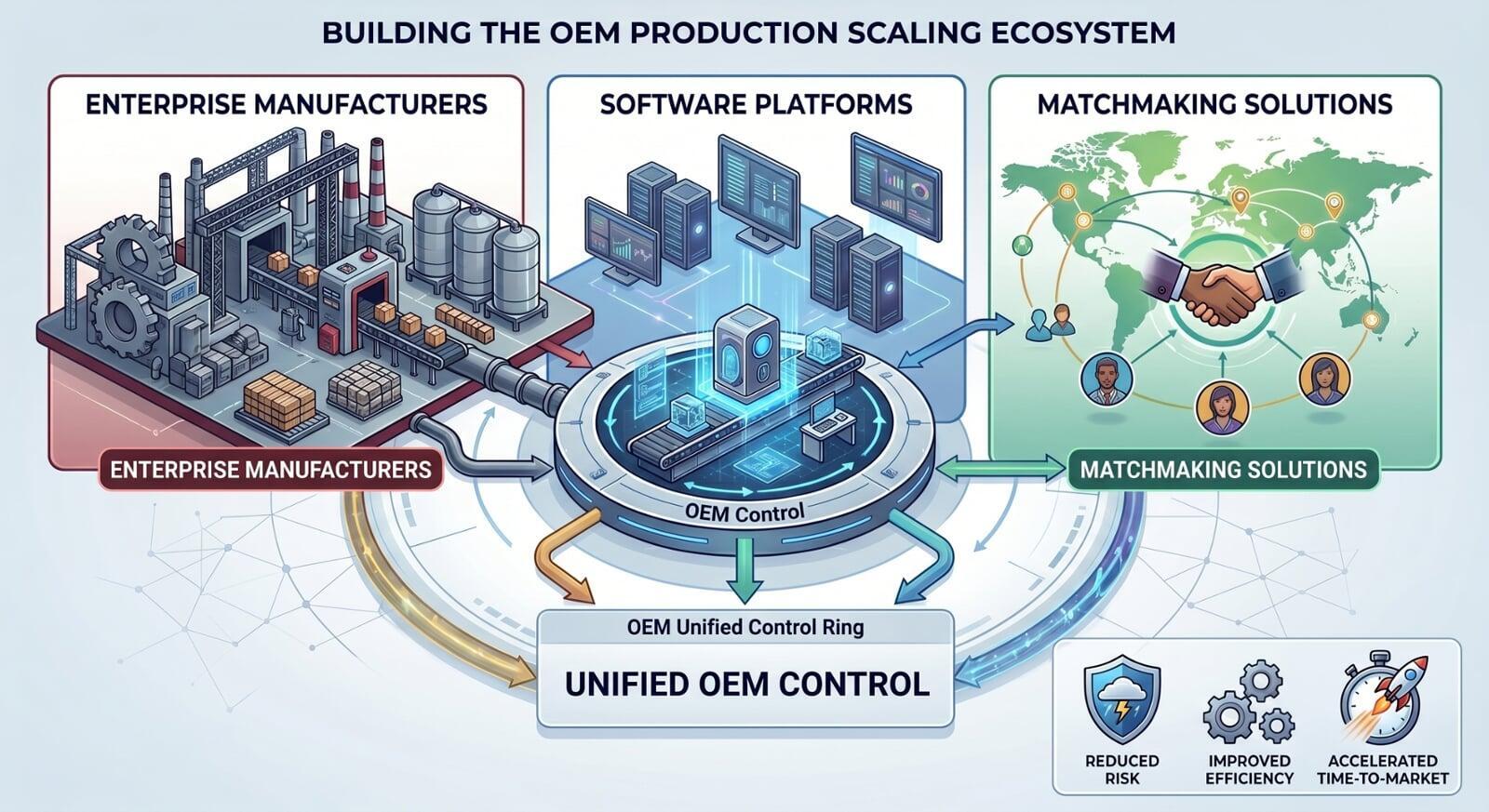
Each of these layers plays a different role. Large manufacturers bring scale and process maturity, software platforms enable visibility and alignment, and newer matchmaking approaches improve how OEMs identify and engage the right suppliers early in the lifecycle.
The key is not choosing between them—but understanding how to use them together effectively.
From global manufacturing leaders that execute large-scale production to software platforms that support design and supply chain coordination, each category plays a distinct role. At the same time, newer matchmaking-driven approaches are improving how OEMs connect with the right suppliers early in the process.
Understanding how these companies differ—and how they fit together—helps OEMs reduce risk, improve alignment, and move from prototype to production more effectively.
Why Efficient Scaling Requires the Right Ecosystem
For OEMs, scaling production is not just about increasing volume—it is about maintaining quality, controlling costs, and ensuring alignment across every stage of development.
This requires strong integration between Design for Manufacturability (DFM) and New Product Introduction (NPI) workflows, particularly during validation stages such as Engineering Validation Test (EVT), Design Validation Test (DVT), and Production Validation Test (PVT).
Breakdowns in this process—whether due to poor supplier fit, misaligned expectations, or lack of visibility—can significantly delay production timelines.
Large manufacturing partners, software platforms, and supplier discovery solutions each address different parts of this challenge. When combined effectively, they enable OEMs to scale production more predictably and with less risk.
Enterprise Manufacturing Leaders
For OEMs preparing to scale production at volume, global manufacturing partners provide the infrastructure and execution capabilities required to support large programs. These organizations are designed to handle complexity, compliance, and multi-region production.
1. Flex Ltd.
Flex is one of the largest global EMS providers, offering end-to-end capabilities across design, engineering, and high-volume production.
Its global footprint allows OEMs to scale production across regions while maintaining consistency in quality and process control. Flex integrates DFM principles and automation into its workflows, helping OEMs transition smoothly from design to manufacturing.
Takeaway: Best suited for OEMs requiring global scale, operational depth, and integrated supply chain execution.
2. Celestica
Celestica specializes in complex electronics manufacturing and hardware platform solutions.
The company works closely with OEMs to solve engineering challenges, optimize production processes, and deliver consistent performance across large-scale programs. Its strength lies in combining manufacturing execution with deep engineering collaboration.
Takeaway: Ideal for OEMs managing complex builds that require strong engineering alignment alongside scale.
3. Plexus Corp.
Plexus focuses on high-reliability manufacturing and engineering services, particularly for products that demand precision and regulatory compliance.
Its capabilities span design, prototyping, and production, making it a strong partner for OEMs developing complex smart hardware systems.
Takeaway: Best suited for high-complexity programs where quality and engineering depth are critical.
Large but Different: Software & Infrastructure Enablers
In addition to manufacturing partners, OEMs rely on software platforms that support product development, engineering workflows, and supply chain coordination. These companies do not manufacture products but play a critical role in enabling efficient scaling.
4. Siemens
Siemens provides industrial software solutions that support product lifecycle management, digital twins, and manufacturing execution systems.
These tools allow OEMs to simulate and optimize production processes before manufacturing begins, reducing risk and improving efficiency.
Takeaway: Enables large-scale process optimization and coordination across complex manufacturing environments.
5. Autodesk
Autodesk offers design and engineering tools that support product development from concept through production.
By integrating manufacturability considerations early, Autodesk helps OEMs ensure that designs are production-ready before entering manufacturing.
Takeaway: Critical for early-stage design collaboration and DFM alignment.
6. PTC
PTC provides product lifecycle management solutions that connect engineering, manufacturing, and service data.
This improves visibility across the product lifecycle, helping OEMs maintain alignment between teams and reduce miscommunication during scaling.
Takeaway: Strengthens coordination and visibility across distributed teams and systems.
A Different Approach to Supplier Discovery
Even with strong manufacturing and software partners, OEMs often face challenges in identifying and engaging the right suppliers—particularly during early-stage development.
Traditional sourcing methods can limit visibility and delay collaboration, while large manufacturing partners are typically optimized for scale rather than early engagement.
7. Trustbridge
Trustbridge represents a different approach focused on supplier matchmaking and early-stage collaboration.
Rather than acting as a broad directory, it connects OEMs with vetted suppliers based on technical fit, production requirements, and alignment with program goals. This enables OEMs to engage suppliers earlier, improve DFM alignment, and reduce delays during NPI stages.
For OEMs, this approach provides greater flexibility and faster decision-making, particularly when building supplier networks for new products.
Takeaway: Enables faster, more targeted supplier discovery and stronger early-stage collaboration.
Building the Right Ecosystem
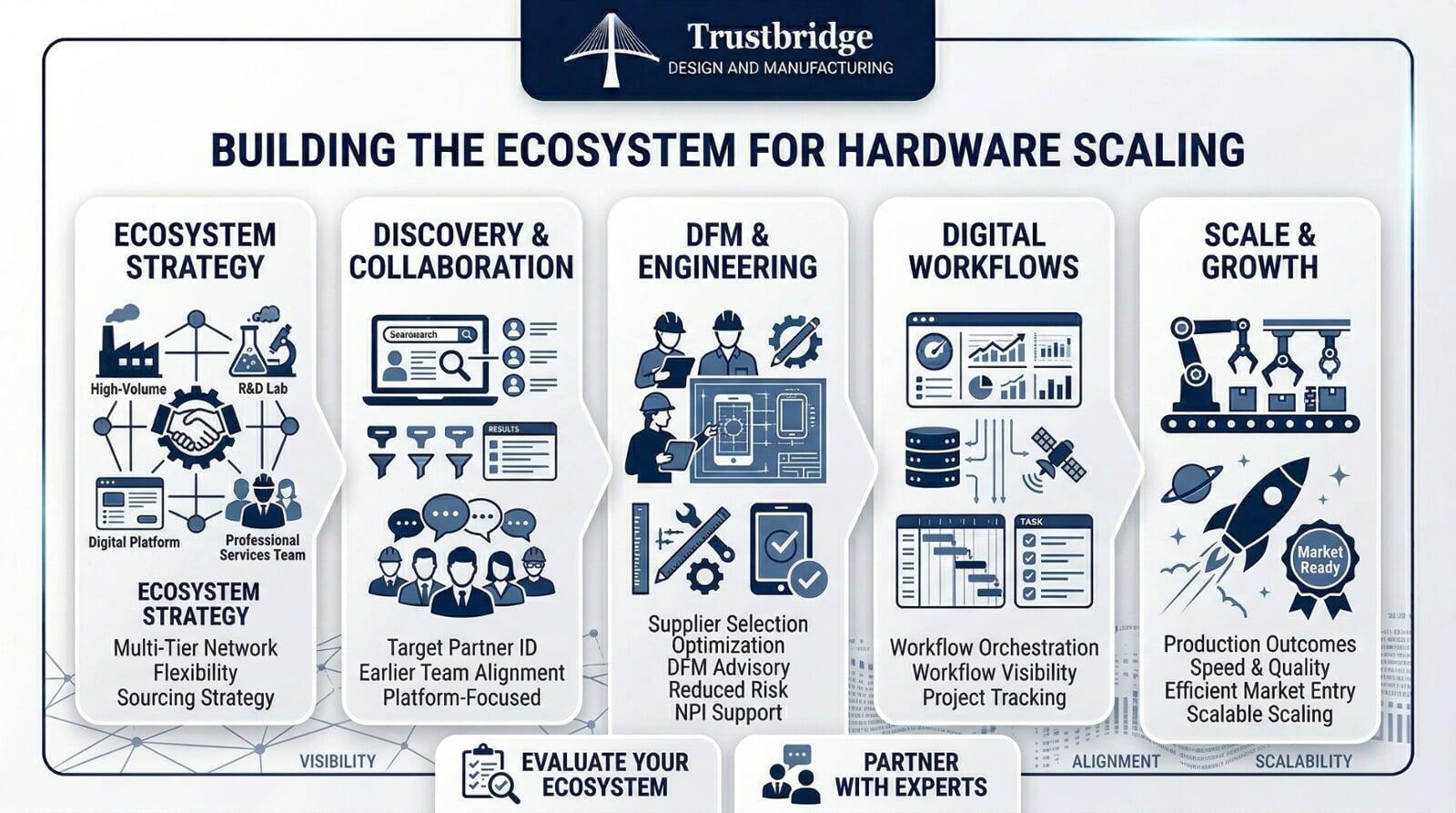
No single company can support every stage of production scaling. Instead, OEMs must build ecosystems that combine multiple types of enablers.
Enterprise manufacturers provide scale and execution, software platforms enable coordination and visibility, and matchmaking solutions improve how suppliers are discovered and engaged.
The most effective OEMs integrate these components into a unified system, ensuring that decisions made during design, sourcing, and production are aligned. This reduces risk, improves efficiency, and accelerates time-to-market.
Conclusion
Scaling smart home production efficiently requires more than selecting the right manufacturer—it requires understanding the ecosystem of companies that enable production at every stage.
Large manufacturing partners, software platforms, and emerging supplier discovery approaches each play a distinct role. By recognizing these differences and using them strategically, OEMs can navigate complexity more effectively and scale with greater confidence.
If you are a smart home OEM preparing to scale production, the first step is evaluating how your current ecosystem supports supplier discovery, DFM alignment, and production coordination.
Improving how you identify and engage the right manufacturing partners early can significantly impact speed, cost, and product quality.
Platforms like Trustbridge are designed to support this process by enabling more targeted supplier discovery and stronger collaboration between OEM and supplier teams.
By building the right ecosystem—and ensuring each partner plays the right role—you can scale production more efficiently and bring products to market faster.
Frequently Asked Questions (FAQs)
1. How do smart home OEMs scale production efficiently?
Smart home OEMs scale production by combining global manufacturing partners, software platforms for coordination, and supplier discovery solutions that enable early collaboration and better alignment during NPI stages.
2. What role do EMS companies play in smart home manufacturing?
Electronics Manufacturing Services (EMS) providers handle large-scale production, supply chain management, and process optimization, enabling OEMs to manufacture products at volume with consistent quality.
3. Why is supplier discovery important for OEMs?
Supplier discovery determines how quickly and effectively OEMs can find the right manufacturing partners. Early engagement improves DFM alignment, reduces delays, and increases the chances of successful production scaling.
4. What is the difference between manufacturing partners and software platforms?
Manufacturing partners execute production, while software platforms enable design collaboration, lifecycle management, and supply chain visibility. Both are essential but serve different roles in the ecosystem.