
When to Stop Optimizing Cycle Time and Focus on Setup Reduction in CNC Machine and Programming
Preamble
Many CNC job shops focus heavily on reducing cycle time while overlooking a larger source of lost productivity: setup time. In high-mix production environments, excessive setup changes often create more operational inefficiency than cutting time itself. Applying setup reduction principles inspired by SMED (Single-Minute Exchange of Dies) allows suppliers to improve throughput, reduce downtime, and strengthen production flexibility.
For companies involved in small batch manufacturing and rapid-turn machining, optimizing cnc machine and programming workflows around setup efficiency can deliver greater long-term profitability than chasing marginal cycle time gains. Shops that improve setup consistency often achieve better spindle utilization, faster turnaround, and more predictable scheduling without purchasing additional machines.
Introduction
Cycle time optimization has long been considered one of the primary goals of CNC machining efficiency. Shops invest heavily in tooling, programming, and machine upgrades to reduce seconds from cutting operations.
However, in many modern job shop environments, setup time—not cutting time—is the true bottleneck limiting productivity.
This is especially true for small batch manufacturing and high-mix production environments where machines spend large portions of the day transitioning between jobs rather than actively cutting material.
Understanding when to stop optimizing cycle time and focus instead on setup reduction is essential for improving overall manufacturing performance.
Many suppliers mistakenly assume faster spindle speeds or more aggressive toolpaths automatically improve profitability. In reality, a machine sitting idle during fixture swaps, offset checks, tooling preparation, or program verification generates no revenue regardless of how fast the cutting cycle becomes afterward.
As customer demand shifts toward smaller production quantities and faster delivery expectations, setup efficiency has become one of the biggest competitive advantages in modern manufacturing operations.
Many CNC job shops focus heavily on reducing cycle time while overlooking a larger source of lost productivity: setup time. In high-mix production environments, excessive setup changes often create more operational inefficiency than cutting time itself. Applying setup reduction principles inspired by SMED (Single-Minute Exchange of Dies) allows suppliers to improve throughput, reduce downtime, and strengthen production flexibility.
For companies involved in small batch manufacturing and rapid-turn machining, optimizing cnc machine and programming workflows around setup efficiency can deliver greater long-term profitability than chasing marginal cycle time gains. Shops that improve setup consistency often achieve better spindle utilization, faster turnaround, and more predictable scheduling without purchasing additional machines.
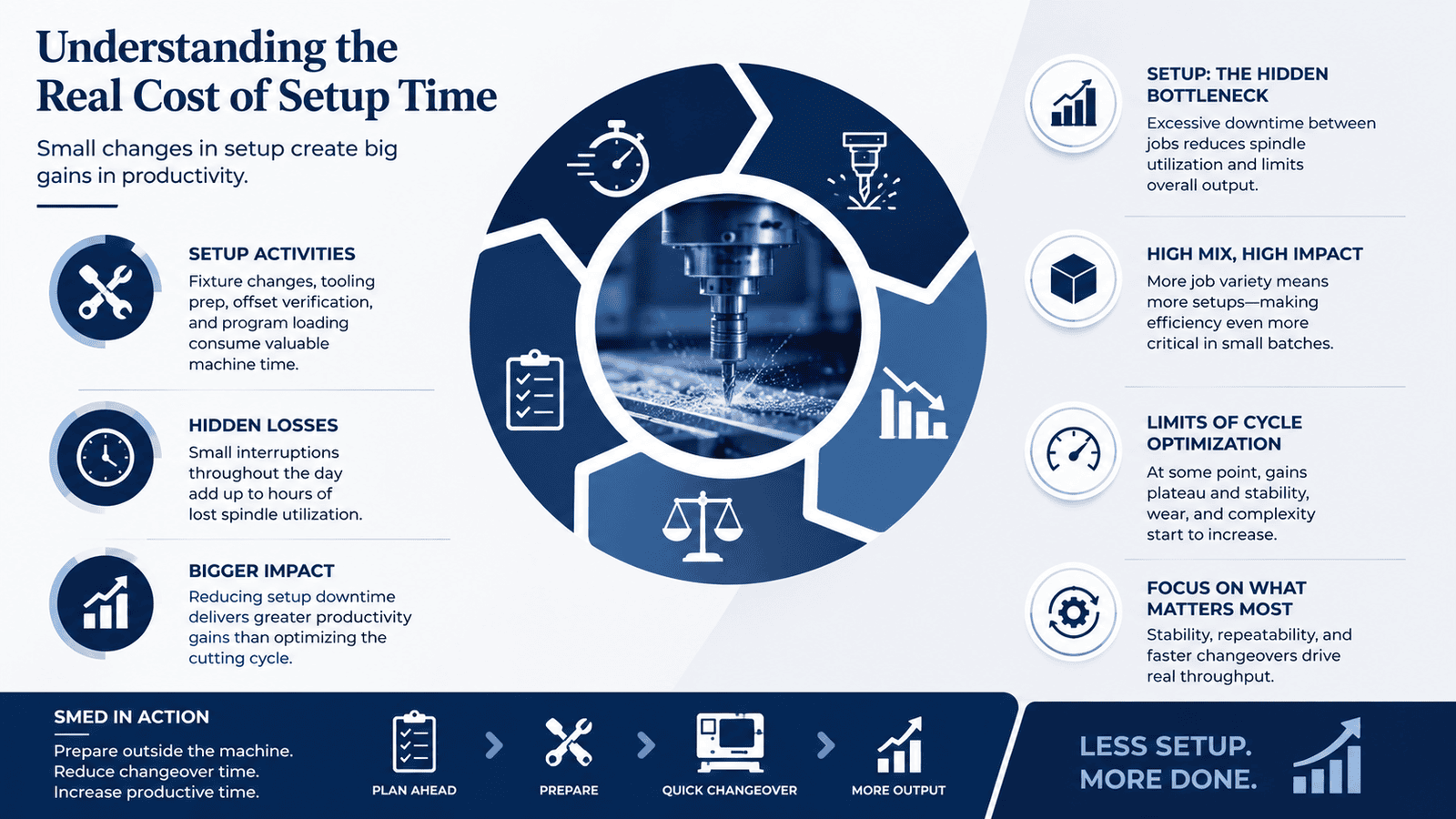
Understanding the Real Cost of Setup Time
Setup activities include fixture changes, tooling preparation, offset verification, and program loading.
These non-cutting activities consume valuable machine availability and reduce overall throughput.
Many shops underestimate setup losses because setup time is often fragmented across multiple small activities throughout the day. Individually these interruptions may seem minor, but collectively they can consume several hours of lost spindle utilization every shift.
For suppliers operating under tight delivery schedules, reducing setup-related downtime can create larger productivity improvements than additional cycle time optimization inside the cut itself.
- Why Setup Time Becomes the Hidden Bottleneck
Even highly optimized machining cycles cannot compensate for excessive downtime between jobs.
Frequent setups significantly reduce spindle utilization.
In many facilities, machines may operate with highly efficient cutting cycles while still achieving poor daily output because operators spend too much time preparing fixtures, locating tooling, verifying offsets, or troubleshooting setup inconsistencies.
As production mix increases, setup frequency rises as well. This means the operational impact of inefficient changeovers becomes even more severe in flexible manufacturing environments.
- The Impact on Small Batch Manufacturing
In small batch manufacturing environments, setup time often represents a larger percentage of total production time than machining itself.
This makes setup efficiency critical for profitability.
For example, a short-run production order with a 12-minute machining cycle may still require several hours of setup preparation before the first acceptable part is produced. In these situations, reducing setup duration often creates far greater operational improvement than reducing a few seconds from the machining cycle.
This is why many high-mix suppliers prioritize setup reduction strategies before pursuing additional cutting optimization.
The Limits of Cycle Time Optimization
Many shops continue pursuing smaller and smaller cycle time improvements while ignoring larger operational inefficiencies elsewhere.
At some point, additional optimization delivers diminishing returns.
Reducing cycle time remains valuable, but there is a practical limit where aggressive optimization begins creating instability, operator dependency, or excessive tooling wear. Beyond that point, overall production efficiency often improves faster through operational simplification and setup consistency instead.
- Marginal Gains vs Operational Bottlenecks
Reducing a cycle by a few seconds provides limited value if setups still consume hours of downtime daily.
Overall throughput matters more than isolated machining speed.
For example, saving 15 seconds per cycle may sound impressive, but if the machine loses two hours each day during setup transitions, the net production improvement becomes relatively small.
Many suppliers eventually discover that improving setup repeatability creates a far larger increase in completed parts per shift than additional cycle optimization ever could.
- Increased Risk from Over Optimization
Aggressive cycle time optimization can introduce unstable cutting conditions, excessive tooling wear, and increased troubleshooting requirements.
Balancing efficiency with process stability is essential.
Highly aggressive feeds and speeds may shorten cycle time temporarily, but they can also increase vibration, accelerate tool failure, and create unpredictable machining behavior.
When operators constantly adjust offsets, replace tools early, or monitor unstable processes manually, the theoretical cycle time improvement often disappears operationally.
Applying SMED Principles to CNC Job Shops
SMED focuses on reducing setup activities and converting internal setup tasks into external preparation activities.
These principles translate effectively into CNC manufacturing environments.
Originally developed for manufacturing changeovers, SMED methodology helps shops minimize machine downtime by preparing as many setup activities as possible before the machine stops cutting.
For CNC suppliers, this approach improves machine utilization while reducing operator stress during rapid job transitions.
- Separating Internal and External Setup Tasks
Tool preparation, fixture staging, and program verification can often occur while machines are still running previous jobs.
This reduces idle machine time significantly.
Instead of waiting for the spindle to stop before preparing the next setup, operators can preload tooling carts, verify programs offline, stage fixtures nearby, and organize inspection equipment in advance.
This separation between internal and external tasks dramatically reduces changeover duration and improves overall production flow.
- Standardizing Setup Procedures
Consistent setup documentation and fixture organization reduce variation between operators and improve repeatability.
Shops that standardize setup workflows experience fewer setup errors, faster operator training, and more predictable machine utilization.
Clear setup sheets, standardized tooling locations, fixture identification systems, and repeatable offset procedures all contribute to smoother production transitions across multiple operators and shifts.
CNC Machine and Programming Strategies for Faster Setups
Programming workflows directly affect setup efficiency.
Poor organization increases downtime and operator dependency.
Even highly capable machines lose productivity when programs are inconsistent, difficult to verify, or heavily dependent on manual adjustment. Structured cnc machine and programming practices improve setup repeatability and reduce unnecessary troubleshooting during job transitions.
- Standardized Program Structures
Consistent cnc machine and programming practices simplify setup verification and reduce troubleshooting time.
Operators can transition between jobs more efficiently.
Standardized program headers, consistent tool numbering, organized offset structures, and predictable code formatting allow operators to validate setups faster and with greater confidence.
Programming of cnc machines becomes significantly easier to manage when every program follows similar operational logic and verification procedures.
- Reducing Manual Offset Adjustments
Reliable probing routines and standardized tooling systems reduce setup complexity and improve consistency.
Programming of cnc machines should prioritize repeatable setup workflows.
Automated probing systems help eliminate repeated manual measurements while improving offset accuracy across multiple jobs.
Reducing operator-dependent adjustment improves setup speed, lowers scrap risk, and creates more stable machining performance during production changeovers.
High-Mix Low-Volume Production Challenges
Setup reduction becomes especially important in high-mix production environments.
Frequent job changes create significant operational disruption if setup workflows are inefficient.
High-mix manufacturing requires shops to balance flexibility, responsiveness, and machine utilization simultaneously. Without organized setup systems, production schedules quickly become unstable as operators struggle to manage constant changeovers.
- Managing Frequent Changeovers
High-mix low-volume suppliers often perform multiple setups daily across varying part geometries and fixture requirements.
Efficient setup strategy directly affects machine utilization.
Every additional setup introduces opportunities for delay, verification errors, or fixture inconsistency. Shops that streamline setup preparation can transition between jobs faster while maintaining stable production quality.
This flexibility becomes especially valuable when handling urgent customer requests or rapidly changing production priorities.
- Improving Scheduling Flexibility
Faster setups allow shops to respond more quickly to customer demand changes and urgent production requirements.
Reduced setup time gives production planners greater flexibility to rearrange schedules without severely impacting throughput.
This responsiveness improves customer service while helping suppliers manage fluctuating workloads more efficiently.
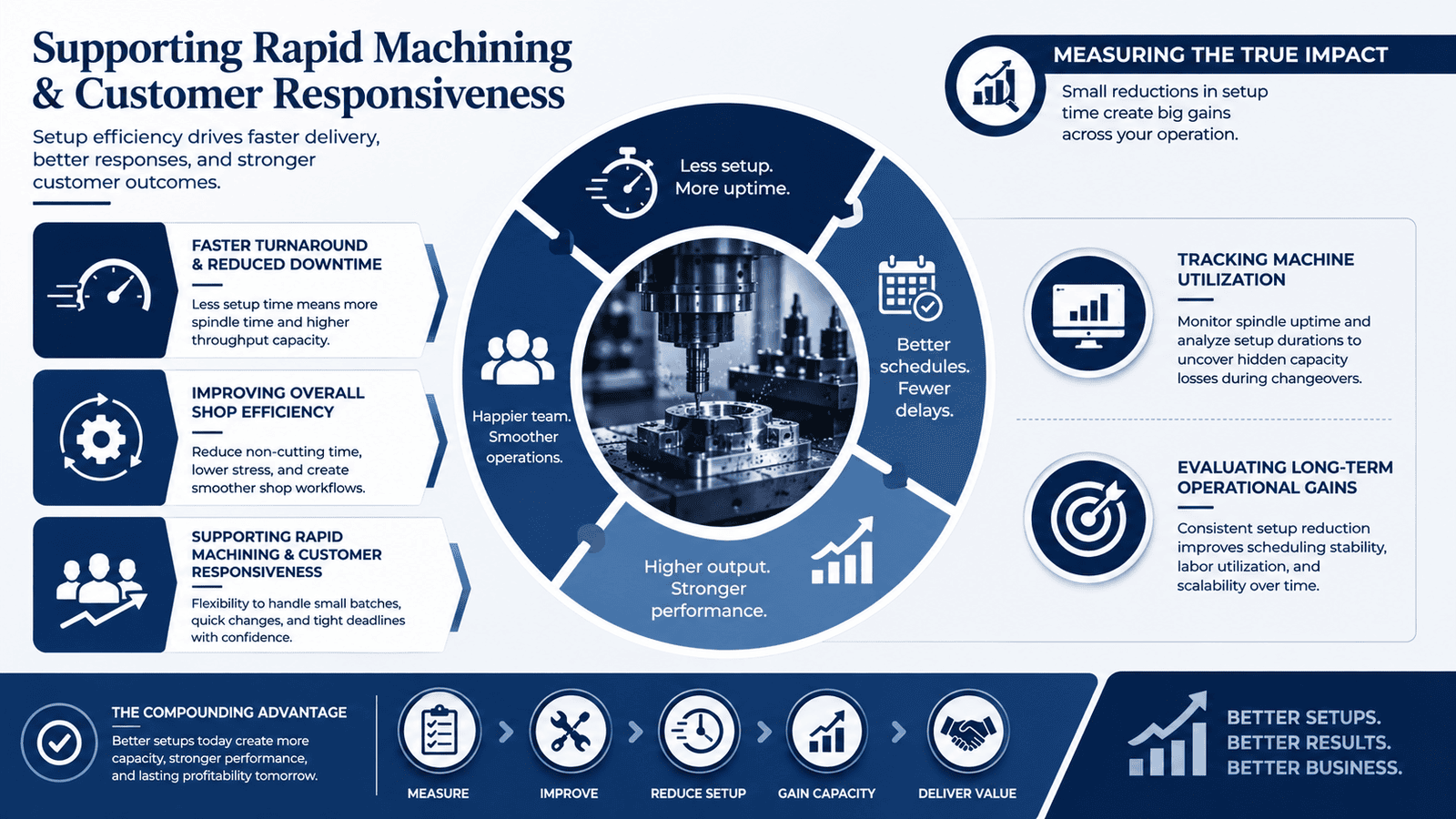
Supporting Rapid Machining and Customer Responsiveness
Setup efficiency directly affects delivery speed and quoting competitiveness.
Rapid-response manufacturing environments depend heavily on flexible operations.
Many customers now expect faster lead times, smaller order quantities, and more frequent engineering changes. Shops that reduce setup delays gain a significant operational advantage in these fast-moving production environments.
- Faster Turnaround and Reduced Downtime
Rapid machining suppliers benefit significantly from reduced setup delays because machine availability improves overall throughput capacity.
When machines spend less time idle between jobs, shops can complete more work without expanding equipment capacity.
This improves delivery performance while reducing scheduling pressure throughout the production floor.
- Improving Overall Shop Efficiency
Reducing non-cutting time allows shops to increase production output without adding additional machines.
Improved setup efficiency also reduces operator stress, minimizes scheduling disruption, and creates smoother workflow coordination across departments.
In many cases, setup reduction provides one of the highest-return operational improvements available to modern CNC manufacturers.
Measuring the True Impact of Setup Reduction
Many shops underestimate the financial impact of setup efficiency improvements.
Small reductions in downtime often create large productivity gains across entire production schedules.
Because setup losses accumulate gradually throughout the day, they are often harder to recognize than obvious machining inefficiencies. Measuring setup performance directly helps shops identify hidden capacity losses more accurately.
- Tracking Machine Utilization
Monitoring spindle uptime helps identify where setup inefficiencies reduce production capacity.
Machine monitoring systems, downtime tracking reports, and setup duration analysis help suppliers understand how much productive capacity is lost during changeovers.
This data often reveals that setup inefficiency affects throughput far more than expected.
- Evaluating Long-Term Operational Gains
Consistent setup reduction improves scheduling stability, labor utilization, and manufacturing scalability over time.
As setup workflows become more repeatable, production becomes easier to predict, quote, and scale.
Long-term operational consistency often creates larger profitability improvements than short-term cycle time optimization alone.
If your machining team is struggling with excessive downtime, frequent setup delays, or inconsistent production flow, your biggest opportunity may not be inside the cutting cycle itself.
Evaluating setup workflows, tooling organization, and programming structure together can reveal major opportunities to improve machine utilization and operational efficiency.
Companies like Vulcury support suppliers with production-focused manufacturing insights, helping teams optimize cnc machine and programming workflows, improve setup consistency, and strengthen long-term production performance.
By focusing on setup reduction strategically, suppliers can improve flexibility, reduce downtime, and achieve more scalable manufacturing operations.
Frequently Asked Questions
1. What are the most common causes of chatter in CNC machining?
Chatter is commonly caused by a combination of spindle instability, weak fixturing, excessive tool stick-out, aggressive CAM toolpaths, and incorrect feeds and speeds. In many cases, the problem is not the CNC tool itself, but instability within the overall CNC machine and programming setup.
2. How does CNC machine and programming strategy affect machining chatter?
Programming decisions directly influence cutting stability. Poor tool engagement, inconsistent chip load, aggressive stepovers, and incorrect RPM selection can create vibration during machining. Optimizing programming of CNC machines through smoother toolpaths, balanced cutter engagement, and proper feed rate control helps reduce chatter and improve surface finish.
3. Why is fixturing stability important in tight-tolerance machining?
Weak or unstable fixturing allows vibration to transfer through the workpiece during cutting. For a tight-tolerance machining supplier, this can lead to dimensional inaccuracies, poor surface finish, and inconsistent machining performance. Rigid workholding and proper support placement are critical for maintaining stability and repeatability.
4. How can advanced machining suppliers reduce chatter and improve process stability?
Advanced machining suppliers reduce chatter by taking a system-level approach that includes spindle condition monitoring, rigid fixturing, optimized CAM programming, vibration analysis, and continuous process improvement. Combining machine maintenance with smarter CNC machine and programming strategies helps improve tool life, reduce scrap, and maintain consistent machining quality.