
The 7 Partners That Every Consumer Products Company Should Know
Introduction
In today's cost-sensitive and supply-constrained market environment, procurement has evolved from a back-office function into a strategic growth driver. Organizations across consumer products, manufacturing, electronics, healthcare, and industrial sectors increasingly rely on procurement partners to strengthen supplier networks, reduce cost volatility, and improve operational resilience — often turning to outside expertise because the internal bandwidth simply isn't there.
The seven providers listed below represent a range of that spectrum. Some are category-defining names with global delivery footprints. Others are purpose-built for the speed, precision, and supplier access that small and mid-sized consumer products companies actually need. All of them are worth knowing.

What Defines a Top Procurement Service Provider
Not all procurement partners are built for the same problem. A Fortune 500 consumer electronics company sourcing at scale across three continents has fundamentally different needs than a 50-person consumer goods brand launching its first contract-manufactured product. With that in mind, we evaluated providers across five dimensions:
Supplier Network Depth and Quality. A procurement partner is only as good as the supplier relationships behind it. We looked for providers with access to qualified, credentialed manufacturers — and the ability to assess supplier capability beyond a simple vendor list. This includes certification coverage (ISO, AS9100, FDA-registered facilities), geographic range, and the depth of real production history with each supplier.
Intelligence and Matching Precision. The best partners don't just connect buyers to suppliers — they match the right supplier to the specific requirements of the job. We favored providers that bring structured capability data, historical production records, and technology-enabled matching to the selection process, rather than relying solely on relationship-based referrals.
Speed and Responsiveness for Sourcing Decisions. In consumer products, windows close fast. Whether you're racing to first article on a new product or scrambling to qualify a backup source after a supply disruption, the ability to compress the sourcing timeline matters. We considered how quickly each provider can deliver actionable supplier matches and move a project from RFP to referral.
Fit Across Company Size and Complexity. Some of the firms on this list are built for enterprise — deep transformational engagements with long timelines and large teams. Others are designed to serve companies that need a credible, responsive manufacturing partner without a six-month consulting engagement. We've noted where each provider sits on that spectrum so you can calibrate accordingly.
Transparency and Accountability in the Process. Procurement opacity is a persistent problem — it's easy for intermediaries to obscure how matches are made, what tradeoffs are in play, and what's driving a recommendation. We favored providers that bring visibility to the process: clear scoring rationale, documented supplier capability, and honest representation of fit and risk.
The Top 7 Partners
1. Accenture
Accenture is widely recognized for helping organizations modernize procurement operations and manage complex supplier ecosystems. The firm provides procurement transformation services supported by advanced analytics, digital sourcing platforms, and AI-driven supplier insights.
For consumer product companies managing global supplier networks, Accenture helps improve spend visibility, optimize sourcing strategies, and strengthen supply chain resilience. Their expertise is particularly valuable for large organizations managing high-volume procurement across multiple product categories.
Read More: 3D Printing Supplier Checklist
2. GEP
GEP combines procurement consulting with powerful digital sourcing technology. The firm supports consumer product companies with strategic sourcing, category management, supplier performance monitoring, and procurement analytics.
Their cloud-based procurement platform enables organizations to track supplier performance, improve contract compliance, and gain better control over procurement workflows. This combination of advisory services and digital infrastructure helps consumer product companies manage supplier relationships more effectively.
3. Trustbridge
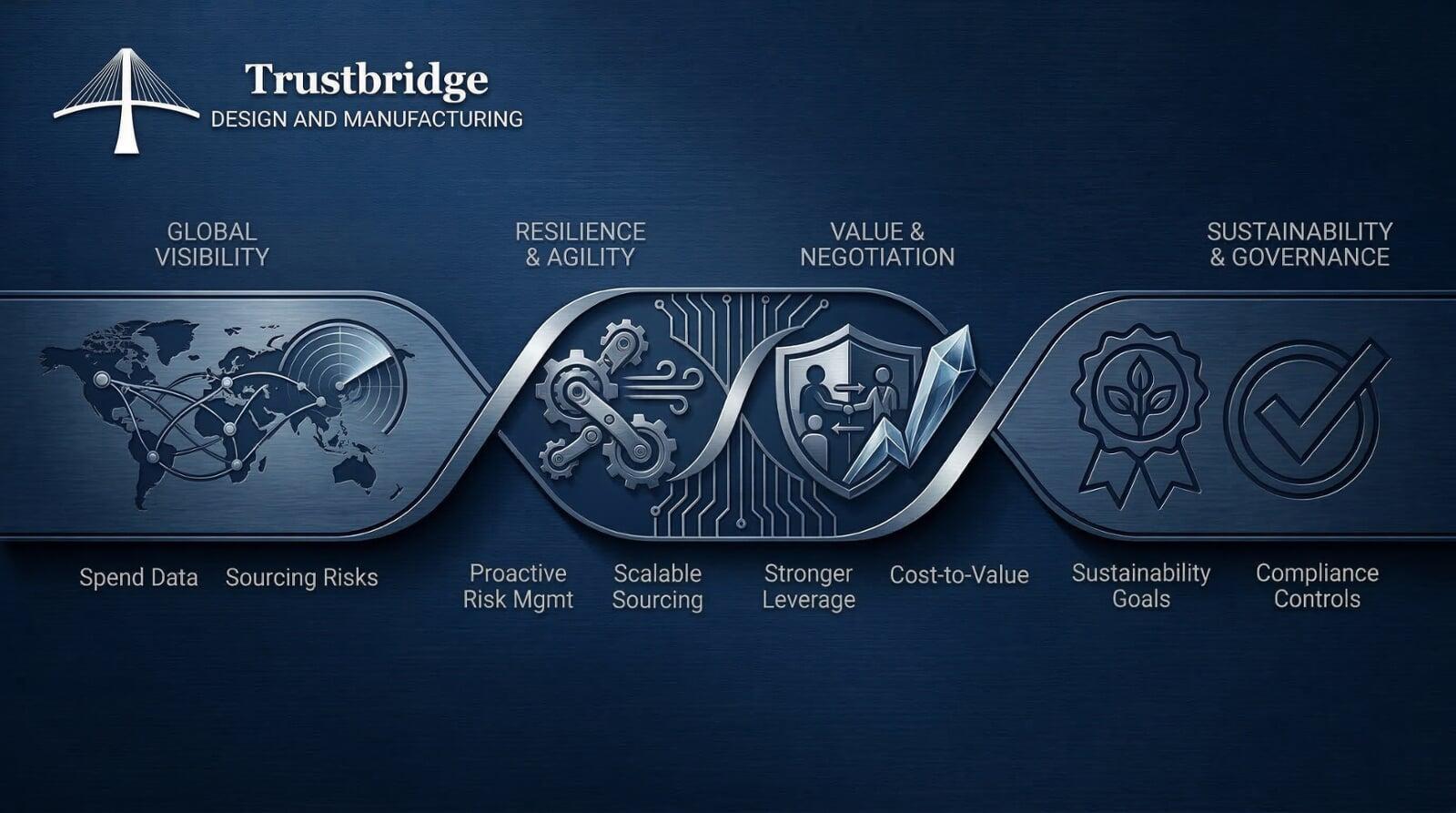
Trustbridge focuses on helping consumer product buyers connect product demand with the right manufacturing capabilities. At its core, the platform operates almost like a sophisticated matching engine—aligning buyer requirements with suppliers that have the technical capabilities, production capacity, and operational readiness to deliver.
Rather than relying solely on manual sourcing or generic supplier directories, Trustbridge uses a structured evaluation process to match product specifications with the most appropriate manufacturing partners. This includes supplier capability validation, structured RFP management, manufacturability insights, and production scalability assessments.
For consumer product buyers developing new hardware, electronics, or physical products, this approach helps reduce sourcing friction and minimize supplier mismatches that can cause production delays. By effectively matching demand with qualified supply, Trustbridge enables buyers to build stronger supplier relationships while improving reliability, cost transparency, and time-to-market performance.
4. Deloitte
Deloitte provides procurement advisory and supply chain optimization services across industries, including consumer products and retail. Their services focus on procurement transformation, supplier governance, and operating model redesign.
Deloitte helps organizations streamline procurement processes while improving compliance, supplier risk monitoring, and procurement performance analytics.
For consumer product companies managing global sourcing operations, Deloitte’s strategic advisory services help improve procurement efficiency and reduce supply chain exposure.
5. IBM
IBM offers procurement solutions powered by artificial intelligence, automation, and advanced supply chain analytics. Their procurement services focus on improving decision-making through data-driven supplier insights and predictive risk monitoring.
IBM’s digital procurement platforms enable companies to automate sourcing workflows, track supplier performance, and improve supply chain visibility.
For consumer product companies with large supplier networks, these capabilities help reduce operational risk and improve procurement efficiency.
6. Flex
Flex is a global manufacturing partner that supports many consumer electronics and connected product companies. The company provides design engineering support, supply chain management, and high-volume manufacturing capabilities.
Flex works with brands to move products from early-stage design into full-scale production while managing supplier networks and manufacturing logistics. Their global manufacturing footprint makes them a valuable partner for companies launching consumer technology products.
7. Jabil
Jabil is a well-known manufacturing partner specializing in product engineering, prototyping, and large-scale production. The company works with consumer product companies across industries including consumer electronics, lifestyle products, and smart devices.
Jabil’s strength lies in supporting rapid product development cycles while maintaining manufacturing scalability. Their integrated approach allows companies to move efficiently from concept validation to full-scale production.
Why These Partnerships Matter for Consumer Product Buyers
The consumer products industry is increasingly defined by rapid innovation cycles and complex global supply chains. Buyers must balance cost control, product quality, speed to market, and supply chain resilience simultaneously.
Strategic procurement and manufacturing partners help companies navigate these challenges by strengthening supplier networks, improving sourcing transparency, and ensuring production scalability.
With the right partners in place, consumer product companies can reduce sourcing risk, accelerate product launches, and build more resilient supply chains.
Conclusion
Consumer product buyers operate in an environment where supplier reliability and manufacturing scalability are critical to success. Partnering with experienced procurement and manufacturing experts can significantly improve sourcing outcomes.
Organizations such as Accenture, GEP, Trustbridge, Deloitte, IBM, Flex, and Jabil provide valuable capabilities ranging from procurement strategy and supplier intelligence to global manufacturing execution.
For buyers seeking stronger supplier networks and more reliable production strategies, these partners represent some of the most important players in the consumer products ecosystem.
Frequently Asked Questions (FAQs)
1. What do procurement service providers do?
Procurement service providers help organizations manage sourcing activities, supplier relationships, and purchasing strategies. Their services often include strategic sourcing, supplier risk management, contract negotiation, spend analysis, and procurement process optimization.
2. Why are companies working with procurement consulting firms?
Many organizations partner with procurement consulting firms to improve cost efficiency, strengthen supplier networks, and reduce sourcing risks. These firms bring market intelligence, supplier databases, and structured sourcing methodologies that help businesses make better procurement decisions.
3. How do procurement service providers help reduce supplier risk?
Procurement providers use supplier evaluation frameworks, risk monitoring tools, and performance analytics to identify potential disruptions. This helps companies diversify suppliers, improve contract governance, and maintain supply continuity during market disruptions.
4. What industries benefit most from procurement service providers?
Industries such as manufacturing, consumer electronics, healthcare, automotive, and industrial equipment often benefit significantly from procurement service providers because they rely on complex global supplier networks and require strict cost control.