
How Can a One-Person Shop Quote Like a Larger Manufacturer?
When you run a machine shop alone, every hour spent quoting is an hour away from the spindle. A repeatable process helps you spot good-fit RFQs, price similar jobs consistently, and respond when you say you will. Software and AI can handle some of the paperwork while you make the calls on fit, cost, and risk.
Introduction
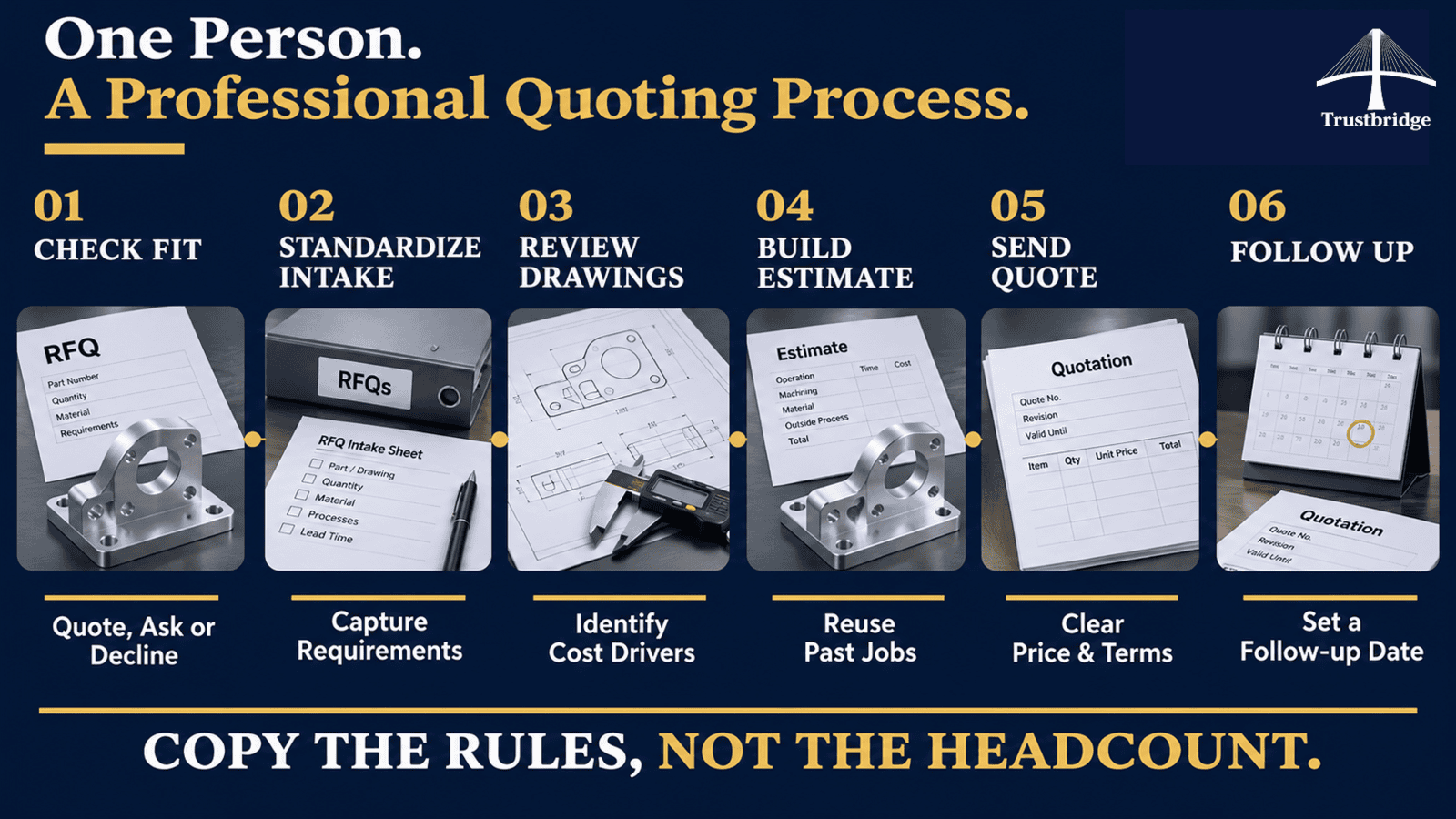
A one-person shop can quote like a much larger manufacturer. It doesn't need an estimating department to do it. It needs the system a good estimating department runs on, sized down to one person, with software and AI taking the clerical work.
If you run a shop alone, you already know the problem. The RFQ lands while a job is running. The print needs studying, the material needs pricing, the plating house needs a call. Every hour spent quoting is an hour not spent making chips, programming, or going home.
Larger shops face the same RFQs. The difference is that quoting is someone's whole job there, and it runs on a process. This article breaks that process into pieces a solo owner can actually copy, and is honest about where AI helps and where your judgment still has to carry the quote.
What "quoting like a larger manufacturer" really means
A larger shop's quoting advantage is mostly process, not headcount. When you look at how well-run shops handle RFQs, the same habits show up again and again:
- One front door. Every RFQ enters the same way, so nothing sits forgotten in a personal inbox.
- A fit filter. Not every RFQ gets quoted. Someone decides early which ones are worth the time.
- A turnaround promise. Customers know roughly when they'll hear back, and the shop keeps that promise.
- Standard costing. Shop rates, material pricing and outside-processing costs come from a sheet, not from memory.
- A quote history. Past quotes are searchable, so a similar part doesn't get estimated from scratch.
- Follow-up and tracking. Someone checks whether the quote landed and records whether it was won.
None of these needs a team. They need decisions you make once and a few tools that hold them. The rest of this article walks through each one.
Step 1: Give RFQs one front door
Start by making every RFQ arrive in one place. Larger shops call this a single point of entry. The Fabricator recommends it so requests don't stall when one person is busy or away. For a solo shop, the risk is the same: an RFQ buried under supplier emails or written on a notepad by the machine.
In practice, that means a dedicated email address (quotes@yourshop.com works), a simple web form, or both. Phone requests get typed into the same place before you hang up.
Then capture the same information from every request. Most quoting delays start with something missing. An intake checklist catches the gaps on day one instead of day three:
- Customer, contact and whether they're new or repeat
- Part number, revision, and both the 3D model and the 2D drawing
- Material and any material certification required
- Quantity, including likely repeat or annual volume
- Critical tolerances, GD&T callouts and surface finish
- Finishing and outside processes (heat treat, plating, anodize, coating)
- Inspection and paperwork (first article, CMM report, certs)
- Required delivery date and quote due date
- Anything missing or unclear, to ask about right away
If something is missing, ask for it the same day. A quick question shows the customer you're working on it, and it's far better than guessing.
Step 2: Decide what to quote before you estimate
The fastest quote is the one you decide not to write. Quoting isn't free: for a solo owner, every estimate comes straight out of machine or programming time.
Advance CNC Machining in Ohio studied its own quoting history and found a striking split, as reported by Modern Machine Shop. Good-fit RFQs (complex parts in at least moderate quantities) converted to orders 40 to 50 percent of the time. Another class of RFQs converted only 4 percent of the time. Once the shop filtered those out before quoting, RFQ processing dropped by 20 percent with no drop in orders.
Your filter will look different, but it can be just as simple. Write down four or five questions and run every RFQ through them in two minutes:
- Can I make this with my machines, my workholding and my skills, without heroics?
- Is the quantity and value worth the setup and programming time?
- Can I hit the delivery date with what's already on my schedule?
- Is this a real buyer who needs the part, or someone shopping for the lowest number?
- Does this customer or kind of work fit where I want the shop to go?
Advance CNC's own screens included a minimum order size, a minimum value per piece, and checking whether the requester actually makes a product that uses the part. Your numbers will be different, but having numbers is the point.
When the answer is no, say so quickly and politely. Paperless Parts CEO Jason Ray warned in Production Machining that silence can get a shop quietly dropped from a buyer's list. A short "this one isn't a fit for us, but please keep us in mind for X" keeps the door open. If you know a shop that suits the job better, pointing the buyer there builds goodwill too.
Step 3: Set a turnaround promise you can keep
Buyers want quotes fast, and they decide fast. In a 2020 survey of 417 U.S. part buyers by Paperless Parts, 67 percent expected a quote within 24 hours and only 6 percent were willing to wait more than three days. Three in four said they decide within a week of receiving a quote. The data is several years old, but nothing since suggests buyers have become more patient.
One job shop's records point the same way. In a study of 1,794 RFQs described in The Fabricator, more than half of the shop's winning bids were awarded within three days of the quote going out. Buyers often have an urgent need, and the order goes to whoever answers while it still matters.
Speed isn't everything, though. Shop owners interviewed by Production Machining split on it: some win by always being first, while others argue that a good-fit job deserves proper due diligence before the due date. What matters most is being predictable. If you quote one job in four hours and the next in four days, the customer learns you're unreliable.
A solo shop can borrow two ideas from larger estimating teams:
- Sort quotes into families. Repeat parts, simple new parts and complex new parts take very different effort. Promise each family its own turnaround, for example same day for repeats, 24 hours for simple parts, and 48 hours for complex work.
- Block a daily quoting window. Pick a fixed time, such as the first hour of the day or the hour after lunch, and quote then. Batching protects machine time and makes your promise realistic.
Once you can keep the promise, tell customers what it is. "Send it by 10 a.m. and you'll hear from us by end of day" is the kind of reliability buyers remember.
Step 4: Make every estimate repeatable
Consistency is what makes a small shop look like a big one. If two similar parts get very different prices, the customer notices, and you lose either margin or trust.
The co-owner of BensonsCNC, a two-person Iowa shop, described the old way in a case study published by AMFG: hunting down material sizes and costs by hand, guessing setup and cycle times, and lightly programming parts in CAM just to check the estimate. That's familiar to most solo owners, and most of it can be standardized without any software at all.
Build a one-page costing sheet and use it for every quote:
- Shop rates. An hourly rate for each machine, and a separate rate for programming and setup. Include overhead, not just wages and electricity.
- Material. Current prices from your usual suppliers for the stock you buy most, updated monthly.
- Setup and cycle assumptions. Typical setup times by part type, and how you estimate cycle time (rules of thumb, CAM simulation, or past jobs).
- Outside processing. Agreed price lists from your heat treat, plating and coating vendors. The Fabricator suggests pre-set pricing for standard services so you aren't waiting on a vendor's quote to send your own.
- Additional manufacturing costs. Account for cutting tools, consumables, fixtures, workholding, material wastage, inspection, packaging, and potential rework.
- Margin and minimums. Define your target profit margin, minimum order charge, and expedite premium. Distinguish between margin and markup to avoid unintentionally underpricing jobs. Then keep a quote library. Save every quote with the part, material, quantity, price, lead time and outcome. The next time a similar part comes in, you start from a real number instead of a blank page.
Where AI helps, and where it doesn't
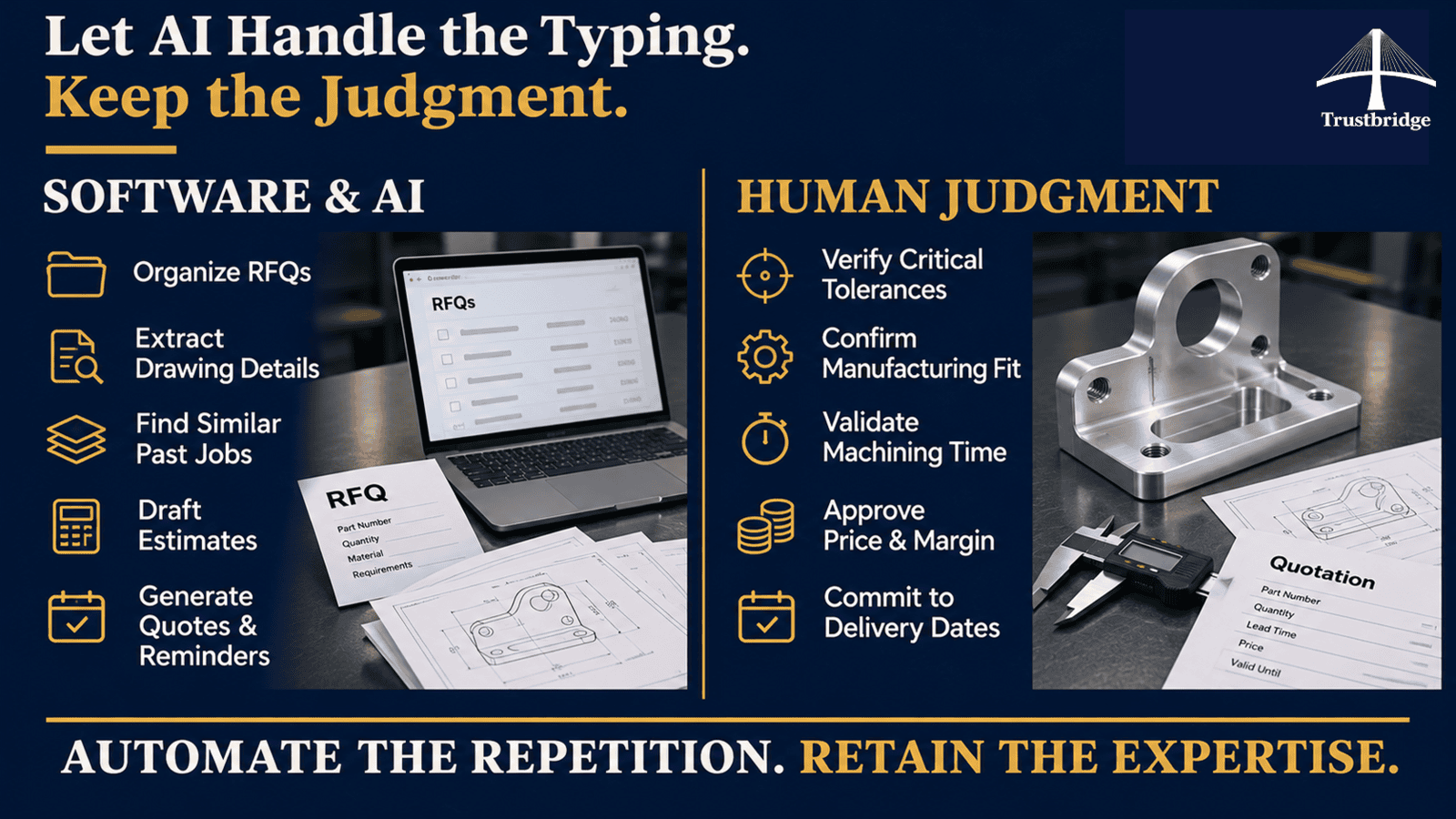
AI is good at the reading, sorting and typing that surround a quote. It is not a replacement for knowing how you'd make the part. Treat it like a fast, tireless assistant whose work you always check.
| Quoting task | What AI or software can do | What still needs you |
|---|---|---|
| Reading the RFQ email | Pull out customer, part numbers, quantities, due dates and attachments into a structured summary | Spotting what the buyer didn't say but probably needs |
| Checking completeness | Compare the package against your intake checklist and draft a question for anything missing | Deciding which gaps actually matter |
| Reading the drawing | Draft a list of dimensions, tolerances, GD&T callouts, finishes and notes | Verifying every critical callout against the print |
| Fit check | Compare requirements with your stated capabilities and filter rules | The final go/no-go call |
| Finding similar work | Search your quote library for comparable parts and prices | Judging whether "similar" is really similar |
| Estimating time and cost | Geometry-based or rules-based estimates in dedicated quoting software | Process planning, setup strategy, risk and the final price |
| Writing the quote | Format a clean, itemized quote with assumptions and lead-time options | Commercial judgment about the customer and the job |
| Follow-up | Remind you when a quote is due for a call | The call itself |
Two limits are worth knowing. First, reading drawings is still hard for AI. Research on automated drawing interpretation notes that general models often struggle with rotated symbols, stylized fonts and dense layouts, and that extraction errors can lead to wrong setups and scrapped parts. Even a model trained specifically on engineering drawings reported a hallucination rate of about 5 percent. That's useful as a first draft and dangerous as a final answer.
Second, estimating software has limits its makers admit. AMFG, which sells quoting software, notes that AI-based estimates rely on historical data and struggle with completely new, complex parts. A Paperless Parts engineer has written that automated estimation of machined parts is hard because every shop makes different choices about how to run a part. Your process knowledge is the part of the quote no tool can supply.
One rule on confidentiality. Customer drawings are often covered by NDAs, and some fall under export-control rules such as ITAR. Before you paste a print into any AI tool, check where that data goes and whether the customer allows it. Only upload customer drawings to tools authorized under the applicable confidentiality agreements and export-control requirements. Removing identifying information does not necessarily make controlled technical data safe to share.
Walkthrough: one RFQ from inbox to sent quote
Here's how the system works on a single request. This is an illustrative example, not a real customer, and the steps matter more than the details.
An email arrives at 7:40 a.m. from an equipment maker you haven't worked with. It asks for 50 pieces of a machined bracket in 6061 aluminum, black anodized, with a STEP file and a PDF drawing attached. The quote is due Friday.
- Intake (5 minutes). The email lands in your quotes inbox. An AI assistant summarizes it into your intake template: customer, part number, revision, material, quantity, finish, due date. It flags that the drawing calls out a 0.0005" bore tolerance and that no inspection requirements are stated.
- Fit check (2 minutes). You run your five questions. The part fits your mill, the quantity is reasonable, and the company makes the equipment the bracket goes into. It passes.
- Clarify (3 minutes). You send one question the same morning: "Do you need a first article or inspection report, and is the bore tolerance before or after anodize?" That second question matters, because coating thickness can change a bore's size.
- Verify the print (10 minutes). At your quoting window, you check the AI's list of callouts against the drawing yourself, line by line. You catch a surface finish note it missed.
- Estimate (15 minutes). You pull a similar bracket from your quote library, adjust for the tighter bore and the extra operation, and fill in your costing sheet. Anodize comes from your vendor's price list, so there's no waiting.
- Build the quote (5 minutes). Your template formats it with itemized costs, your assumptions, and two lead-time options.
- Send and schedule follow-up. The quote goes out the same day, and a reminder is set to call in two days.
The times above are a sketch, not a benchmark. The point is where the time goes: the clerical steps shrink, and your attention goes to the two things only you can do, which are verifying the print and pricing the risk.
Send a quote that looks like it came from a bigger shop
The quote document is often the first thing a new customer judges you on. A clear, complete quote signals that the work will be handled the same way. A strong quote from a one-person shop includes:
- An itemized price by part and quantity break, with setup or NRE shown separately where it applies.
- Lead-time options. Paperless Parts reports that shops offering several lead times with matching prices consistently win more work, for example two weeks at a premium, three weeks standard, four weeks at a discount. It lets buyers trade time for cost without a phone call, and it captures the expedite premium many shops leave on the table.
- Your assumptions and exclusions, such as material certs included, inspection level, packaging, and who pays freight.
- A validity date, so a material price swing doesn't lock you into an old number.
- Clean presentation: your logo, the part number and revision, and a named contact.
Red Horizon Engineering, a two-person fabrication shop in Ohio, told The Tube & Pipe Journal that itemized quotes with a part image let customers see exactly where their cost goes. The owner described being able to compete with much bigger shops without an estimator or sales engineer on staff.
Follow up and learn from every quote
Sending the quote isn't the end of the job. A short call two or three days later ("did this land, any questions?") catches misunderstandings and shows the buyer you want the work. Jason Ray of Paperless Parts argues that lost quotes are more often caused by miscommunication than by
price, and a call is how you find out.
Then record the result. A simple spreadsheet is enough to start:
| Date in | Customer | Part | Qty | Quoted price | Days to quote | Won / lost | Reason |
|---|---|---|---|---|---|---|---|
After a few months, patterns appear. You'll see which customers actually buy, which kinds of parts you win, and how long your quotes really take. Shop owners in Production Machining describe very different win rates by customer type: one reported winning nearly all repeat part numbers but under 10 percent of quotes for new customers. Knowing your own numbers tells you where to spend your limited quoting time, and it feeds your fit filter from Step 2.
Mistakes to avoid when automating your quoting
- Trusting extracted tolerances without checking. One misread callout can turn a profitable job into scrap. AI drafts; you verify every critical dimension.
- Automating a messy process. If RFQs still arrive five different ways and your rates live in your head, software just makes the mess faster. Fix intake and costing first.
- Quoting more instead of quoting better. Faster quoting tempts you to answer everything. Keep your fit filter, or you'll fill your week with quotes you were never going to win.
- Buying software before you know your numbers. Track your quote volume, time per quote and win rate for a month first. Then you'll know whether a tool pays for itself and which features matter.
- Putting customer prints into tools without permission. Check NDAs and export-control requirements before uploading anything.
- Racing to the lowest price. Speed and clarity win work. Underpricing to win wins the jobs you'll regret.
A 30-day roadmap
You don't need to change everything at once. One piece a week is enough to feel the difference within a month.
| Week | Focus | What to do |
|---|---|---|
| 1 | Front door and tracking | Set up a quotes inbox or form, start the intake checklist, and log every RFQ in a spreadsheet |
| 2 | Filter and turnaround | Write your five fit questions, define quote families, and block a daily quoting window |
| 3 | Repeatable estimates | Build your costing sheet, get price lists from outside vendors, and create a quote template with lead-time options |
| 4 | Assistance and review | Trial AI help for intake summaries and drawing checklists (with a confidentiality check), then review a month of data: time per quote, win rate, and what to change |
At the end of the month, you'll know how long your quotes really take and which ones are worth your time. That's the same information a larger shop's estimating manager works from.
Frequently asked questions
How fast should a machine shop respond to an RFQ?
Aim for 24 to 48 hours on most new parts and the same day on repeat work. In a 2020 buyer survey, two-thirds of buyers expected a quote within 24 hours. Being consistently on time matters as much as being fast.
Should a small shop quote every RFQ?
No. Screen each request against a few fit questions first. One shop that filtered out poor-fit RFQs cut its quoting work by 20 percent with no drop in orders.
What's the difference between estimating and quoting?
Estimating works out what a part will cost you to make: material, setup, machine time and outside processing. Quoting turns that estimate into a commercial offer, with margin, lead time, terms and a validity date.
Can AI read engineering drawings?
Partly. AI can draft a list of dimensions, tolerances and notes from a drawing, but research shows it still misreads symbols and dense layouts. Use it as a first pass and verify every critical callout yourself.
The bottom line
A one-person shop will never have an estimating department, and it doesn't need one. One front door, a fit filter, a turnaround promise, a costing sheet, a quote library and a follow-up habit give you most of what a larger shop's process delivers. AI and quoting software then take on the reading, sorting and formatting, so your time goes to the judgment calls that win good work.
At Trustbridge, we work alongside manufacturers and build practical tools that help shops run their business. If quoting is eating your week, we'd like to hear how you handle it today.