
How Cast Urethane Shops Can Get Better RFQs and Win More Work
A quote-ready cast urethane RFQ gives a supplier enough information to choose a material approach, estimate tooling and part costs, identify risk, and commit to a realistic lead time. Shops get better requests when they ask for that information through a process-specific form and a short, fast follow-up instead of expecting every buyer to know the terminology.
Introduction
Many buyers source urethane casting only a few times in their careers. They may have a 3D model and a target quantity but no Shore hardness, surface standard, color requirement, or plan for repeat batches. That does not make the project unqualified. It means the intake process must translate the application into the information a casting supplier needs.
For suppliers, this is an operational problem with a practical fix. A focused intake form, plain-language prompts, and a specific follow-up message reduce clarification cycles and make suitable projects easier to quote.
What a quote-ready cast urethane RFQ should include
The exact requirements vary by part and application, but most cast urethane quote requests should cover the following inputs. A buyer does not need to know every technical answer. The RFQ should make uncertainty visible so the supplier can recommend the next step.
Part definition: Provide a revision-controlled 3D CAD file, a 2D drawing with critical dimensions and tolerances, or an existing physical part as a reference.
Application and performance: Explain how the part will be used, the expected load or impact, service temperature, chemical exposure, outdoor exposure, and the required flexibility or rigidity.
Material and appearance: State the target resin or comparable production material, Shore hardness when known, color, gloss, texture, clarity, and any cosmetic surfaces.
Master and tooling context: Confirm whether a master pattern exists, who owns it, its condition and finish, and whether the supplier should produce a new master and silicone mold.
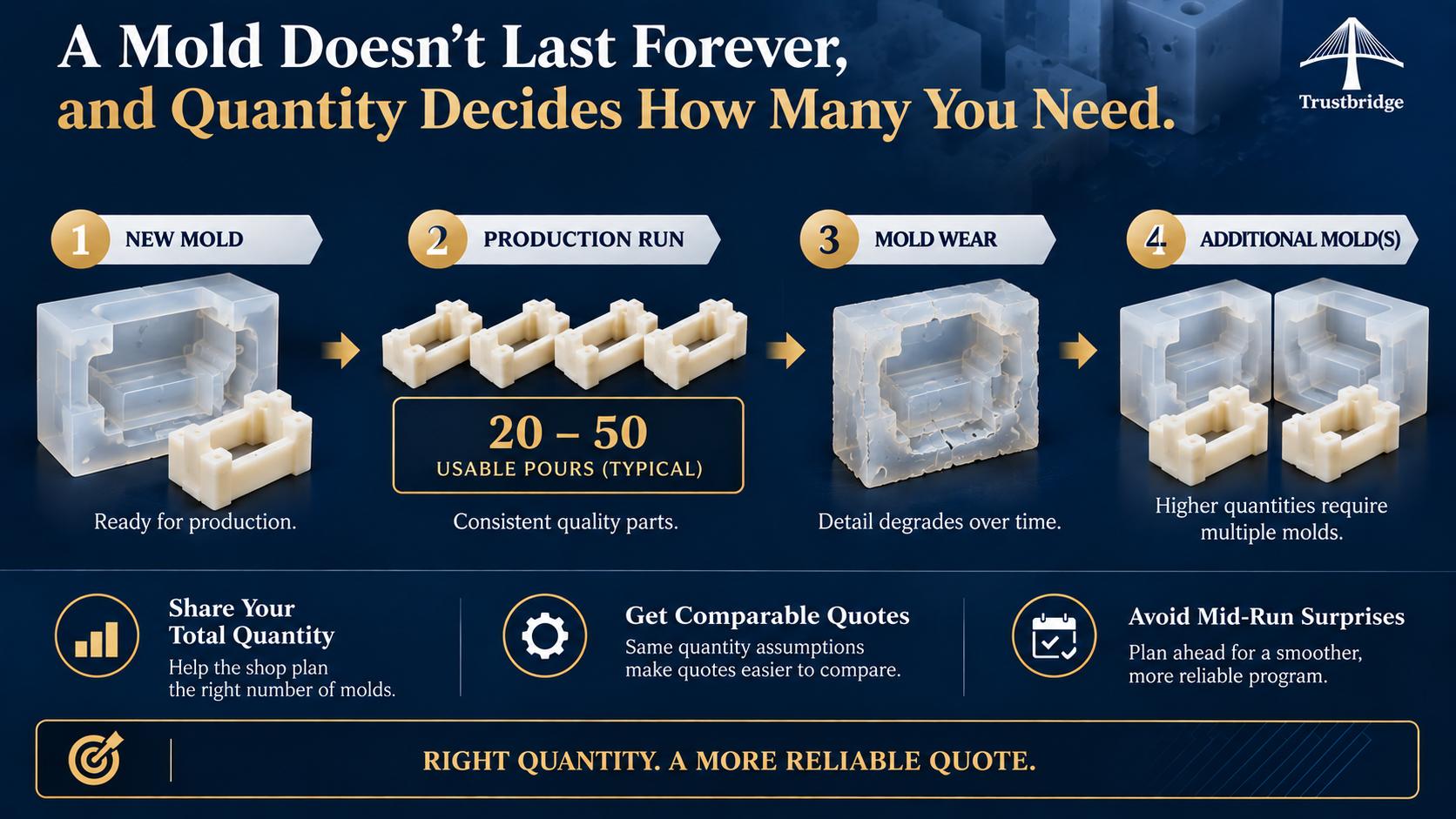
Quantity and program demand: Give the first-order quantity, expected repeat batches, variants, and likely total demand before the design or production process changes.
Quality and delivery: Identify critical-to-function features, inspection or documentation needs, inserts or secondary operations, packaging, delivery location, and required date.
Build the missing questions into the intake form
A generic upload form transfers the work to the buyer. It asks them to guess which details matter and where to put them. A cast urethane intake form should ask the process-specific questions directly and separate required fields from optional details.
Start with the information needed to decide whether the project fits the shop: files or reference part, application, quantity, target properties, delivery date, and location. Then reveal conditional questions. If the buyer has an existing master, ask about ownership and condition. If appearance matters, ask for color, texture, and protected cosmetic surfaces. If inserts are required, ask for the insert file or specification.
Do not make every field mandatory. A buyer who does not know the durometer should be able to say so and describe the intended feel or application. The goal is to identify known requirements, unknowns, and decisions that need supplier input.
Ask for performance in language buyers can answer
Technical labels are useful after both sides understand the requirement. They are less useful as the only way into the conversation. Pair each specification field with a plain-language prompt or an ‘unsure’ option.
Technical requirement | Buyer friendly prompt |
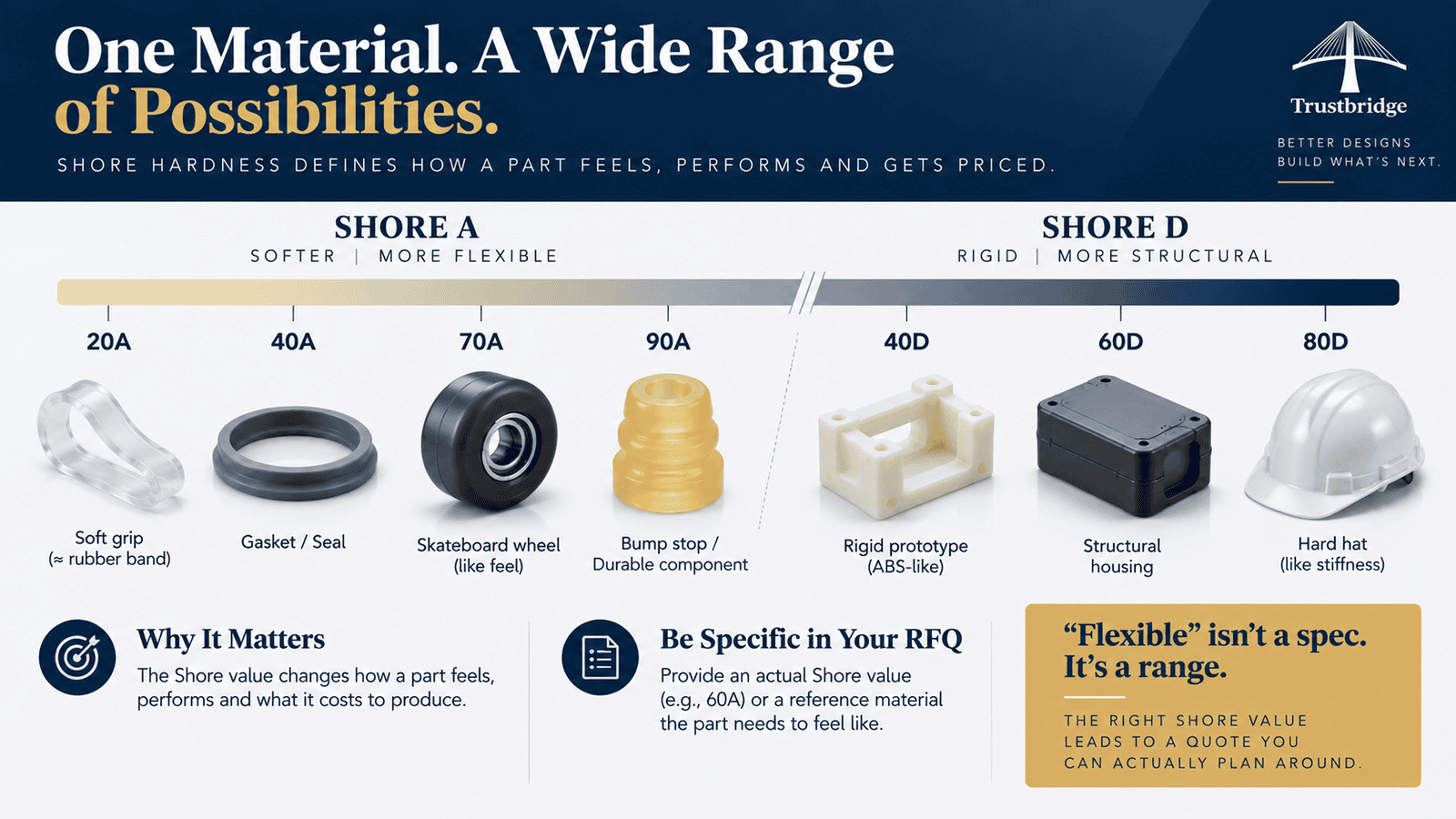
Shore hardness | Should the part bend like soft rubber, resist flex like a tire tread, or feel rigid like a molded plastic housing? |
Master source | Do you have a 3D model, a finished master pattern, or an existing part that needs to be matched? |
Program quantity | How many parts do you need first, and do you expect repeat batches after that? |
Cosmetic standard | Which surfaces will users see, and do you have a color, gloss, or texture reference? |
Service environment | Will the part face heat, sunlight, chemicals, abrasion, repeated impact, or sustained load? |
These prompts do not replace engineering review. They give the supplier enough context to ask the next precise question and avoid treating a buyer’s rough comparison as a final material specification.
Use a short follow-up to close the remaining gaps
An incomplete RFQ does not need a broad request for ‘more information.’ Send a short message that lists only the missing decisions, explains why they affect the quote, and gives the buyer an easy way to answer.
Example follow-up message
Thanks for the files. We can review the project once we confirm three points: the part’s required flexibility or hardness, whether the first order is the full demand or one of several batches, and which surfaces are cosmetic. Approximate answers are fine. If hardness is unknown, describe how the part should feel and what it does in the assembly.
Keep the first follow-up focused. If the answers uncover a material or tooling decision, schedule that discussion separately rather than adding a long questionnaire to the email.
Turn a complete RFQ into a clear supplier quote
Better inputs only help if the quote makes its assumptions visible. A cast urethane quote should state the tooling or master cost, unit or lot price, quantity basis, lead time, shipping treatment, and any material, finish, inspection, or mold-life assumptions that could change the price. Where alternatives are useful, separate them clearly.
For example, a supplier may quote the requested first batch and show how another mold or cavity strategy would affect repeat quantities. The quote should also flag any requirements that remain provisional, such as a color match that depends on an approved sample. This gives the buyer a decision they can understand and reduces disagreement after award.
How Trustbridge helps cast urethane suppliers
Trustbridge connects product teams with vetted manufacturers across urethane and silicone casting and other custom manufacturing processes. Its supplier workflow uses capability profiles and engineering review to route suitable projects to a small group of shops. Project briefs can include CAD files, drawings, material requirements, inspection needs, and delivery context.
Trustbridge’s supplier FAQ says that usually two to four suppliers are invited to quote a project. Suppliers can review the files, raise technical questions, and submit pricing, lead time, shipping, assumptions, and options. That structure helps shops spend less time sorting through poorly matched inquiries and more time evaluating work that fits their capabilities.
Apply to the Trustbridge supplier network
If your shop produces cast urethane or silicone parts, tell Trustbridge about your equipment, materials, certifications, preferred quantities, and technical strengths. The team reviews supplier capabilities before routing suitable opportunities.
Ioin the Trustbridge manufacturing network
Frequently asked questions
What information does a cast urethane supplier need to quote a part
Most suppliers need a 3D model or reference part, quantity, application, target material behavior, finish and color requirements, critical dimensions, quality requirements, delivery location, and required date. Repeat demand and master-pattern information also affect tooling and production planning.
What if the buyer does not know the Shore hardness
Ask how the part should flex, what load it carries, and what environment it will face. A supplier can use that context to discuss candidate materials. The final choice should be confirmed against the application and the selected resin’s technical data.
Why should an RFQ include repeat quantity?
Repeat demand can change the recommended mold strategy, number of molds or cavities, and the way tooling costs are allocated. It also helps the supplier identify when another manufacturing process may deserve comparison.
Should a buyer send a 2D drawing with the 3D model
A 2D drawing is useful when the part has critical dimensions, tolerances, cosmetic zones, inserts, inspection requirements, or notes that are not explicit in the model. File names and revisions should match.
How quickly should a supplier follow up on an incomplete RFQ
Respond as soon as the request has been reviewed. Ask only for the missing information that blocks fit, price, or lead-time decisions, and explain why it matters. Avoid promising a universal response time unless the shop has an operating standard it can meet.